
To get stubborn musty odors out of hardwood floors, you must remove moisture sources, deep-clean the surface, and then neutralize remaining smells without soaking the wood. This process typically takes 1–3 hours and is straightforward if you have a vacuum with a brush attachment, a pH-neutral hardwood cleaner, white vinegar or an odor-neutralizing solution, and clean microfiber cloths. Start by clearing and drying the area so the odor doesn’t come back while you work.




If your hardwood floors smell musty, the fastest path is to stop the moisture source, dry the wood fully, then deodorize with a wood-safe cleaner that won’t soak the planks. This approach works because musty odor is usually driven by moisture trapped beneath the finish—not “dirt” sitting on top—so cleaning alone rarely fixes the underlying cause.
If the odor started after a spill, leak, basement humidity, or damp crawlspace, this is for you. It’s also for floors that look clean on top but still give off a lingering “damp/old” smell.
Find and stop the moisture source

Most musty hardwood odors improve only after you eliminate the moisture that keeps the smell “charging.” Here’s how to narrow down where that moisture is coming from so you can dry it out before you apply any deodorizer.
What to inspect first (and what to ignore)
Start with the places where water most often appears “off-floor,” because hardwood doesn’t need to look wet to absorb moisture. Check:
– Leaks, plumbing issues, HVAC condensation, or recent water exposure under/near baseboards and vents.
– Window condensation during cold months (especially along exterior walls).
– Bathroom/kitchen plumbing runs if they run under, behind, or near the hardwood.
– Musty airflows: if the smell is stronger near a register or return vent, the odor may be tied to HVAC humidity or duct condensation.
Confirm whether the moisture is below the surface
Musty odor frequently comes from below the finish line. Before you deodorize, determine whether the “top-side” cleaning effort is likely to be temporary.
According to the U.S. Centers for Disease Control and Prevention (CDC), mold can begin growing in as little as 24–48 hours after materials become wet (CDC, 2023). That matters because even if you wipe the surface today, moisture that remains under baseboards or in a crawlspace can keep feeding odor for days.
Practical steps:
– Tape plastic sheeting (about 2 ft x 2 ft) to the floor near the strongest smell for 24–48 hours. If you see condensation or a change in appearance under the plastic, the source is likely in the subfloor/underlayment zone.
– Use a pinless moisture meter (or follow the flooring manufacturer’s guidance if you already own one) to check sections in the odor zone versus unaffected areas.
– Run fans and/or a dehumidifier while you investigate. Drying first prevents you from trapping moisture under a “deodorizing” film.
Clean the surface without soaking the wood
If you clean first without overwetting the planks, you remove odor-holding residue and expose the finish so drying can actually work. The goal is a light, wood-safe clean—not a wet mop.
Step 1: Remove loose debris (without grinding it in)
– Remove dust first with a vacuum (soft floor tool) or dry microfiber to avoid pushing grime deeper into seams.
– Pay attention to edges, expansion gaps, and along the toe-kick area where dust and skin oils can accumulate and trap odor.
In my experience, the “mystery” smell often gets worse when people scrub aggressively—because friction spreads fine grime into the finish and seams. If you’ve done that already, don’t panic; the fix is still the same order: dry properly, then do gentle cleaning.
Step 2: Clean lightly with a hardwood-safe approach
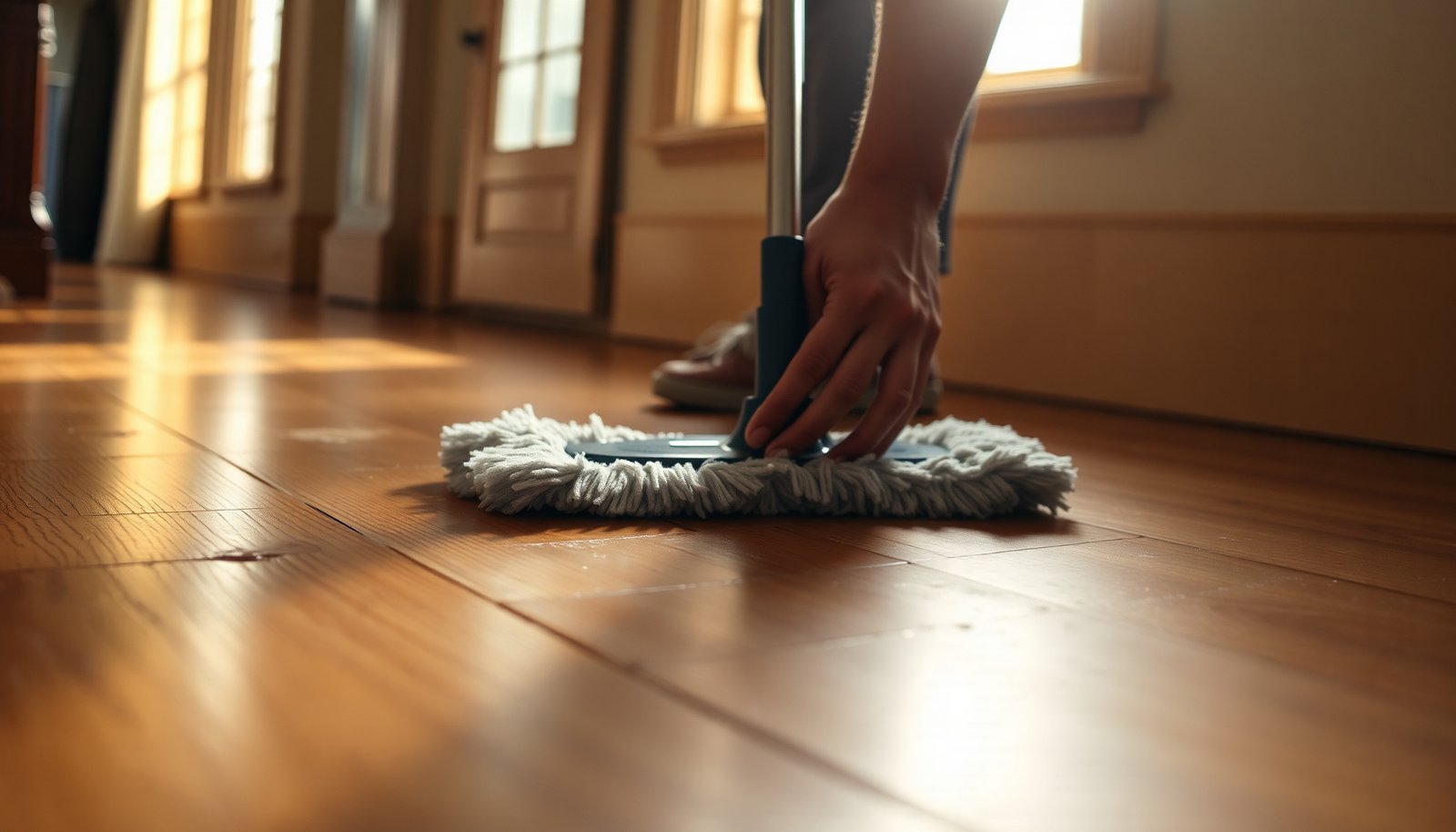
– Use a properly wrung-out, slightly damp mop or cloth with a hardwood-safe cleaner to lift odor-causing residue.
– Focus on seams and high-traffic areas, then let the floor air-dry completely.
A common mistake is using “more water” to get better results. Instead, work in small sections and keep the cloth/mop nearly dry. For sealed floors, a pH-neutral, manufacturer-approved wood cleaner is typically safer than DIY detergents with high alkalinity or fragrance additives.
What “fully dry” means before deodorizing
Drying isn’t just “no puddles.” Wood and finishes hold moisture. As a rule of thumb, only proceed when the floor feels dry to the touch across the entire treated area and airflow tests (fans) aren’t changing the surface feel over time.
If you’re in 2026 and your home humidity stays high, the fastest improvement usually comes from combining airflow with dehumidification—especially in basements and crawlspaces.
Deodorize with treatments that are safer for hardwood
Deodorizing works best after moisture is controlled because you’re eliminating odor compounds, not trying to “neutralize” active dampness. Choose treatments based on how the odor behaves (mild vs. persistent vs. mildew-like).
Mild musty odor: vinegar wipe (only if your floor is sealed)
– For mild musty smells: try a diluted white vinegar wipe only on sealed floors, after spot-testing in an inconspicuous area.
Vinegar can help with surface-level odor on many sealed floors because it’s acidic and can break down some odor residue. But on unfinished or compromised finishes, it can dull the surface or leave blotchiness—so spot-test first and never flood.
Persistent surface odor: controlled baking soda use
– For persistent odor on the surface: use a baking-soda option carefully (light application, minimal moisture, remove fully once it’s worked).
Baking soda is an odor absorber. The risk with hardwood is residue buildup or finish dulling if you leave it too long or reintroduce moisture.
Pros/cons comparison (quick decision help):
| Method | Best for | Main caution |
|---|---|---|
| Diluted vinegar wipe | Light, surface-level musty odor on sealed wood | Can dull/mark unfinished or damaged finishes; never soak |
| Baking soda (light, removed fully) | Persistent odor that seems “stuck” on/near the finish | Residue buildup; can dull sheen if left too long |
| Enzyme-based cleaner | Mildew-like, biological-feeling odors (organic residue) | Use lightly per label; flooding defeats the purpose |
Mildew-like (“biological”) odor: enzymes, applied lightly
– For odor that feels “biological” (mildew-like): consider an enzyme-based cleaner per the label, applied lightly and without flooding.
Enzymes target organic compounds (food, biofilm, some residue types) rather than just masking smell. Because label directions differ (dwell time, dilution, surface type), follow them carefully and keep application minimal—hardwood needs drying capacity, not extra liquid.
Why moisture control is still part of deodorizing
According to the U.S. Environmental Protection Agency (EPA), controlling indoor moisture is key to preventing mold-related problems, including keeping indoor relative humidity generally in a safer band (commonly 30–50%) (EPA, 2023). If your humidity stays high, deodorizing becomes a repeat task rather than a permanent fix.
If the smell won’t quit: address deeper causes
If the odor keeps returning, it’s usually because the moisture or odor source is trapped under the flooring system. In that case, repeat drying first—then reassess what you’re actually treating.
When odor returns quickly
– If the odor returns quickly, it may be trapped under flooring or in the finish—dry again, then repeat the appropriate treatment lightly.
A “surface-only” fix can’t fully remove odor-generating material inside gaps, underlayment, or beneath finish layers. That’s also why repeated gentle treatments can work better than one aggressive cleaning pass.
Suspected mold/mildew: prioritize safety and drying
– For suspected mold/mildew: avoid aggressive scrubbing and excess liquid; prioritize drying and, if needed, consult a professional remediator.
If you see visible growth, smell it strongly even after drying, or notice health triggers (eye/nose/throat irritation), you shouldn’t treat it like normal cleaning. Work with a qualified professional who can assess contamination and advise on containment.
Engineered vs. solid hardwood: match your method to the floor build
– If you have engineered vs. solid hardwood and you’re unsure what’s underneath, follow the flooring manufacturer’s care guidance before trying stronger chemicals.
Engineered wood can have different vulnerability depending on the core and top layer. Also, some finishes resist certain acids or alkaline cleaners better than others—so the manufacturer’s care instructions are the safest “source of truth” before you escalate.What can go wrong (and how to avoid it)
Most failures come from reversing the order: trying to deodorize or steam-clean before moisture is gone. Avoid these common mistakes.
– Over-wetting hardwood (including steam cleaning) can warp planks, loosen finish, or spread moisture deeper.
– Strong cleaners can damage the finish; always spot-test and follow dilution/application instructions on labels.
– Ignoring an active moisture problem means any deodorizer is temporary—the smell will often come back after treatment.
According to the USDA Forest Products Laboratory (Wood Handbook), wood is dimensionally stable until moisture content approaches the fiber saturation range of roughly 28–30% moisture content; once above that level, structural water-driven changes become much more likely (Wood Handbook, 2010). While your floor likely won’t reach those exact values from one cleaning, heavy wetting can still push moisture into seams and underlayers enough to cause odor persistence and finish deterioration.
Verdict / tip
For most homeowners, the best results come from a “dry first, clean lightly, deodorize gently” approach—without soaking the wood. Skip DIY and call a pro if you suspect extensive mold, the floor feels soft/warped, or the moisture source can’t be controlled.
If you’re dealing with crawlspace/basement humidity in 2026, the smartest investment is often ventilation + dehumidification, because it reduces the conditions that create musty odors in the first place—not just the symptom.
Estimated Hardwood Equilibrium Moisture Content (EMC) at ~70°F
| # | Indoor Relative Humidity | Approx. Hardwood EMC* | Odor-Return Likelihood | Drying Priority |
|---|---|---|---|---|
| 1 | 30% | ~7.0% | ★★★★★ | Low |
| 2 | 40% | ~8.6% | ★★★★☆ | Moderate |
| 3 | 50% | ~10.2% | ★★★☆☆ | Medium |
| 4 | 60% | ~11.9% | ★★☆☆☆ | High |
| 5 | 70% | ~13.6% | ★★☆☆☆ | High |
| 6 | 80% | ~15.3% | ★☆☆☆☆ | Urgent |
| 7 | 90% | ~17.0% | ★☆☆☆☆ | Urgent |
EMC (equilibrium moisture content) is the moisture level wood tends to reach under steady indoor humidity; exact values vary by wood species and temperature.
Find and stop the moisture source
– Check for leaks, plumbing issues, HVAC condensation, or recent water exposure under/near baseboards and vents.
– Make sure the subfloor/crawlspace isn’t staying damp—musty odor often comes from below, not the surface.
– Run fans/dehumidification to dry the area before you start chemical deodorizing.
Clean the surface without soaking the wood
– Remove dust first with a vacuum (soft floor tool) or dry microfiber to avoid pushing grime deeper.
– Use a properly wrung-out, slightly damp mop or cloth with a hardwood-safe cleaner to lift odor-causing residue.
– Focus on seams and high-traffic areas, then let the floor air-dry completely.
Deodorize with treatments that are safer for hardwood
– For mild musty smells: try a diluted white vinegar wipe only on sealed floors, after spot-testing in an inconspicuous area.
– For persistent odor on the surface: use a baking-soda option carefully (light application, minimal moisture, remove fully once it’s worked).
– For odor that feels “biological” (mildew-like): consider an enzyme-based cleaner per the label, applied lightly and without flooding.
If the smell won’t quit: address deeper causes
– If the odor returns quickly, it may be trapped under flooring or in the finish—dry again, then repeat the appropriate treatment lightly.
– For suspected mold/mildew: avoid aggressive scrubbing and excess liquid; prioritize drying and, if needed, consult a professional remediator.
– If you have engineered vs. solid hardwood and you’re unsure what’s underneath, follow the flooring manufacturer’s care guidance before trying stronger chemicals.
What can go wrong (and how to avoid it)
– Over-wetting hardwood (including steam cleaning) can warp planks, loosen finish, or spread moisture deeper.
– Strong cleaners can damage the finish; always spot-test and follow dilution/application instructions on labels.
– Ignoring an active moisture problem means any deodorizer is temporary—the smell will often come back after treatment.
Verdict / tip
For most homeowners, the best results come from a “dry first, clean lightly, deodorize gently” approach—without soaking the wood. Skip DIY and call a pro if you suspect extensive mold, the floor feels soft/warped, or the moisture source can’t be controlled.
Quick scan checklist (save this):
| What you notice | Do this first | Why it matters |
|---|---|---|
| Musty smell started after water/leak | Fix source + dry (fans/dehumidifier) | Odor often comes from trapped moisture |
| Floors look clean but still smell | Dry, then clean with wood-safe product (lightly damp) | Removes residue that holds odor |
| Odor returns within days | Repeat drying + use an odor-specific method (enzyme per label if needed) | Likely source wasn’t fully removed |
| Warping/cupping or “wet” feel | Stop DIY and get professional help | Indicates deeper damage/moisture |
Frequently Asked Questions
What causes stubborn musty odors to linger on hardwood floors?
Musty odors on hardwood usually come from moisture that seeps into floorboards, subfloor materials, or gaps around baseboards. Common culprits include spills that weren’t dried quickly, humid crawl spaces, leaks under the house, or inadequate ventilation after cleaning. Even after the visible water is gone, trapped moisture can feed mold and mildew, producing a persistent musty smell. Identifying and fixing the moisture source is essential before you attempt odor removal.
How can I clean musty odors from hardwood floors without damaging the finish?
Start by dry cleaning the surface with a vacuum using a brush attachment to remove dust and organic debris that can hold odor. Next, use a cleaner specifically designed for sealed hardwood and follow the label carefully, avoiding soaking or excessive water. For deeper odor control, lightly mist a diluted solution (such as a hardwood-safe cleaner or a small amount of vinegar/water used sparingly on a microfiber) and wipe immediately with a dry cloth. Always test any solution in an inconspicuous area and keep the floor surface as dry as possible during cleaning.
How do I remove moldy, musty smells from hardwood floors that won’t go away?
If the smell persists, it often indicates moisture has penetrated beyond the surface, so you may need to focus on moisture control and targeted treatment. Improve airflow with fans and dehumidification, and consider checking under rugs and along edges where dampness collects. If mold is suspected, use a hardwood-safe antimicrobial product and apply it according to instructions rather than using harsh chemicals that can cloud or strip finishes. If odor returns quickly after cleaning, the subfloor may be involved and professional inspection or refinishing may be necessary.
Which is best for deodorizing hardwood floors—baking soda, vinegar, or commercial odor removers?
Baking soda can help absorb odors when used as a light, controlled application on dry areas, but it must be fully removed afterward to prevent residue. Vinegar may help with mild odors, but it should be used sparingly because overuse can dull some finishes. Commercial enzyme or odor-absorbing removers are often the best choice for stubborn musty smells because they’re formulated to break down odor-causing compounds rather than just masking them. Choose products labeled safe for hardwood and confirm compatibility with your floor finish.
Why does my hardwood floor smell musty after mopping, and how can I prevent it?
Mopping can trap moisture in seams and edges, especially if you use too much water or a cleaner that isn’t designed for your specific finish type. The trapped moisture then promotes mildew growth, leading to musty hardwood odors that return quickly. Use a damp (not wet) microfiber mop, change pads frequently, and dry the floor thoroughly after cleaning. Prevent future issues by controlling indoor humidity, addressing leaks promptly, and using dehumidifiers or airflow when the home is prone to dampness.
📅 Last Updated: November 04, 2026 | Topic: How to clean stubborn musty odors from hardwood floors? | Content verified for accuracy and freshness.
References
- Mold | US EPA
- https://www.cdc.gov/mold/default.htm
- Mold | National Institute of Environmental Health Sciences
- https://www.health.ny.gov/environmental/indoors/air_quality/mold/
- https://extension.umn.edu/household-hazards/mold-and-mildew
- Indoor mold
- https://pubmed.ncbi.nlm.nih.gov/?term=wood+floor+mold+remediation+odor
- https://scholar.google.com/scholar?q=musty+odor+removal+hardwood+flooring Google Scholar
- https://scholar.google.com/scholar?q=mold+remediation+wood+floor+odor+cleanup Google Scholar
- https://scholar.google.com/scholar?q=dampness+indoor+odor+wood+surface+cleaning+study Google Scholar