
Stubborn greasy film on hardwood floors traps grime and leaves a hazy, sticky sheen that regular mopping cannot remove. You’ll learn the fastest, floor-safe method to lift the oil residue using the right degreaser, proper dilution, and gentle agitation without damaging the finish. By the time you’re done—after gathering microfiber cloths, a soft scrub pad, and a pH-neutral cleaner—you’ll have clean, clear boards that look polished again.




For stubborn greasy film, use a pH-neutral cleaner diluted with warm water, scrub gently with a microfiber pad, then rinse with clean water and dry right away. Grease often sits on top of a sealed finish, so the goal is to lift residue without stripping or soaking the wood; if the film keeps returning, you may be dealing with wax- or oil-based buildup that needs a finish-safe degreasing step—after a hidden-area test first.
This guidance is for sealed hardwood floors (most polyurethane-finished floors) showing dullness, streaking, or a slick feel, especially in kitchens where cooking residues, body oils, and cleaner buildup are common. If your floor is unfinished, heavily damaged, or you don’t know the finish, stop and follow the manufacturer’s care instructions (or hire a pro), because the wrong chemistry can permanently change sheen.
Identify the film (so you don’t make it worse)
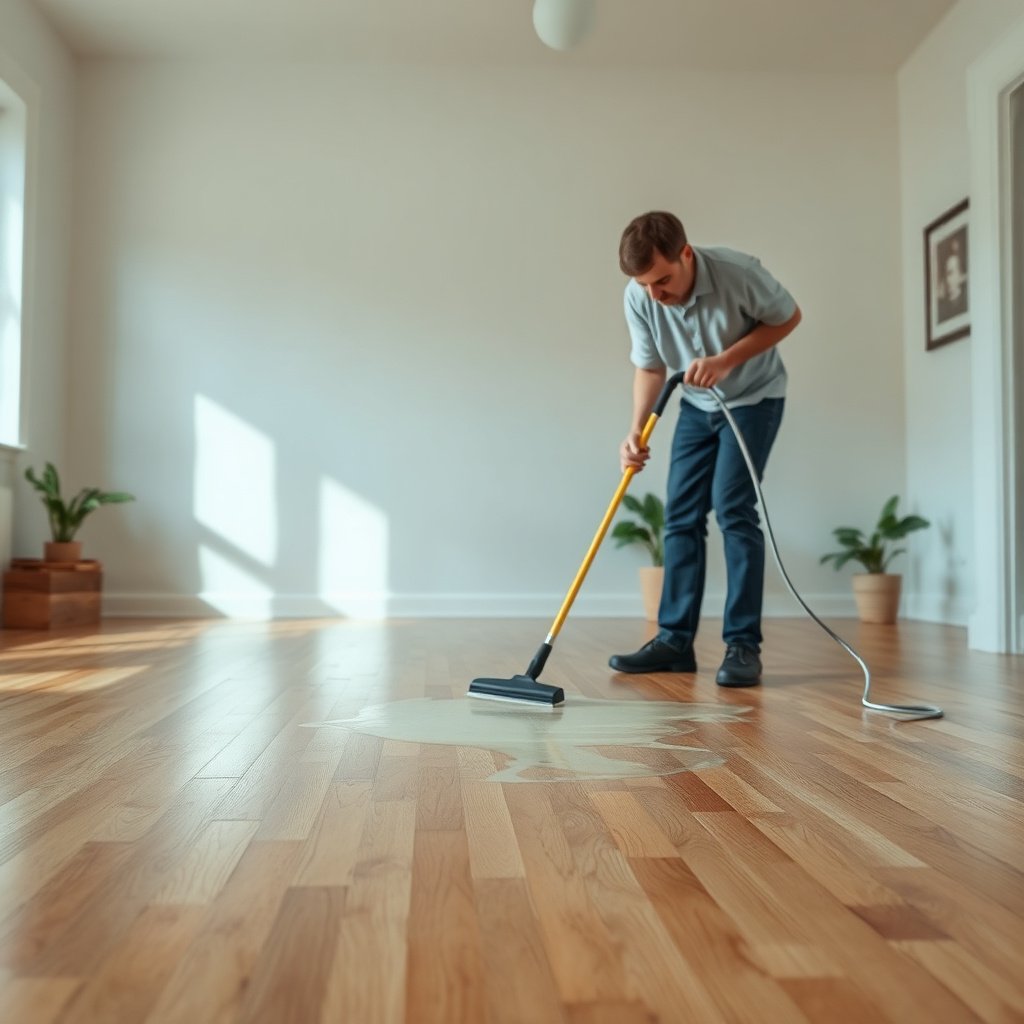
The first step is to confirm what you’re removing—actual grease behaves differently than waxy residue or oily film. The faster you match the residue type to the right method, the less likely you are to dull the finish, smear residue around, or leave behind a slick detergent layer.
– Check your senses: does it feel oily/slippery when dry, or do you see a dull haze that smears when wiped?
– If possible, identify the finish category: sealed/polyurethane vs waxed vs oiled/unfinished. This determines how tolerant the floor is to water, alkalinity/acid, and surfactants.
– Do a hidden-area test: apply your planned cleaner to a small inconspicuous patch and confirm it lifts haze without softening the finish, “fogging” it, or changing sheen.
Grease vs wax/oily film: what you’ll notice
| What you see/feel | Likely residue | Typical behavior during wiping | Best first move |
|---|---|---|---|
| Slick feel that returns quickly | Oily cooking residue + light film | Feels slippery again within days | pH-neutral degreasing + thorough rinse |
| Dull, cloudy haze | Wax/oil film or detergent film | Smears more than it “lifts” | Confirm with test; avoid harsh acids/strippers |
| Sticky spots or grabby texture | Polymerized oils or heavy buildup | Won’t come clean with light washing | Repeat gentle passes; consider finish-safe degreaser only after test |
Choose a safe cleaner to cut grease without harming the finish
The safest route for sealed hardwood is pH-neutral cleaning because it minimizes finish stress and reduces the odds of dulling. In general, “neutral” means close to pH 7 on the 0–14 pH scale—strongly acidic or strongly alkaline solutions drift farther from that stable zone and are more likely to haze, weaken, or discolor compatible coatings. (U.S. Environmental Protection Agency, pH Basics)
– Start with a pH-neutral hardwood floor cleaner diluted with warm water exactly per the label. Warm water helps loosen grease without turning your wash into soaking.
– For truly greasy areas (not just everyday dust), a small amount of mild dish soap in warm water can help because dish detergents use surfactants designed to break oils into smaller droplets. However, overuse increases the risk of soap residue, which later shows up as streaks or a slick feel.
– Avoid high-risk products: strong solvents, finish strippers, and abrasive scrubbers. These can permanently dull polyurethane sheen or create uneven gloss patches.
Why vinegar and harsh cleaners are risky on unknown finishes
Acidic cleaners can be a problem—especially on coatings that haze under chemical stress. Household vinegar used for cleaning typically contains at least 4% acetic acid (and many products are sold in the ~4–7% range). (U.S. FDA, 21 CFR 184.1021 for vinegar/acetic-acid standards) Even if vinegar works on some surfaces, a sealed hardwood finish can still dull or cloud, particularly if the chemistry is repeated.
Step-by-step: clean, degrease, rinse, and dry
The correct order matters because grease spreads easily if you start with heavy liquids or grit. A controlled sequence—dry removal first, gentle wash second, rinse third, quick drying fourth—is what prevents scratches, streaks, and moisture-related wood movement.
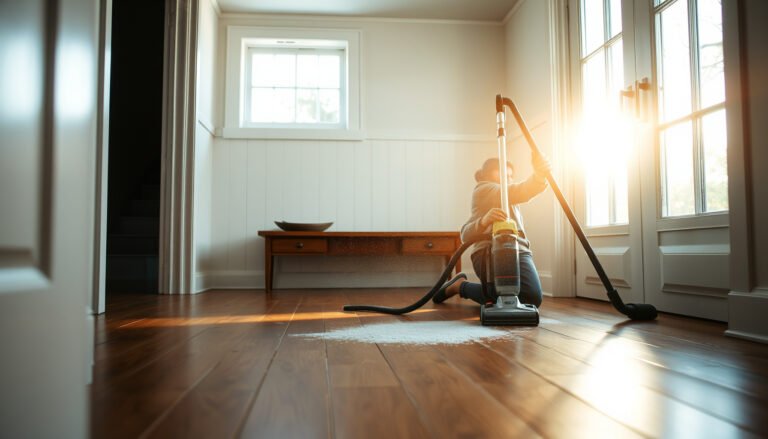
– Dry-clean first: Vacuum or sweep with a soft attachment, then dust-mop. This prevents grit from turning into micro-sand that can scratch the finish.
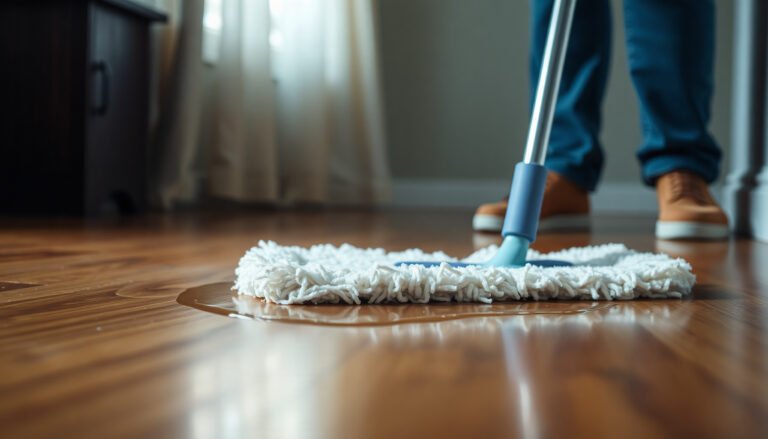
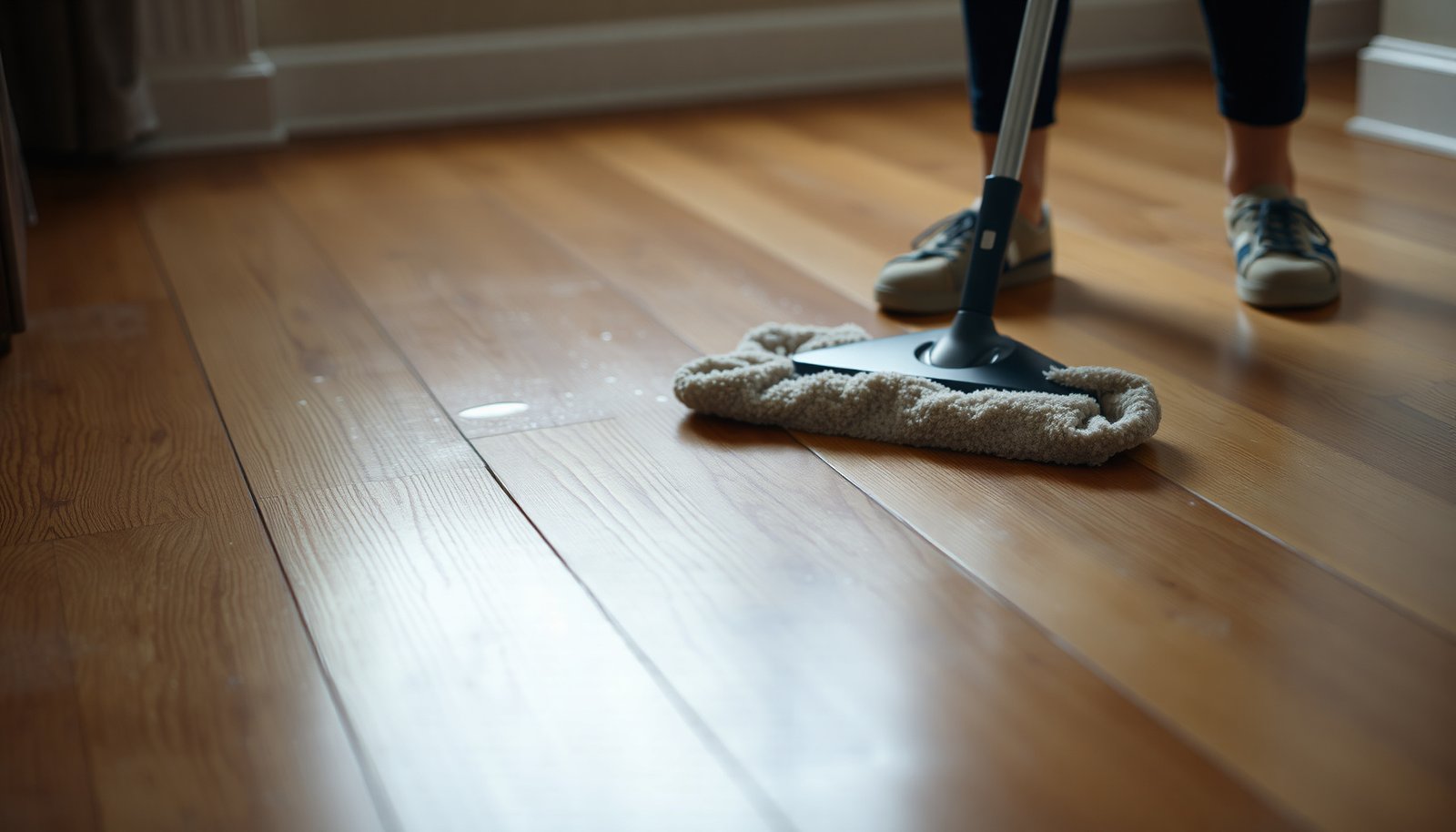
– Wash gently (no soaking): Apply cleaner to a damp (not dripping) microfiber pad or microfiber mop. Work in small sections and use light pressure. If the film is thick, let the diluted cleaner sit briefly (follow label directions), but don’t leave puddles.
– Rinse and dry right away: Use clean water (or a lightly damp pad) to remove loosened residue, then dry quickly with a clean cloth or dry mop. This step is crucial—residual detergent/surfactant is a common reason floors still feel “slick” after cleaning.
What “damp, not wet” really means
Wood is dimensionally stable only when moisture stays controlled. According to the USDA Forest Service’s Wood Handbook, wood swelling is strongly tied to moisture content relative to the fiber saturation point, commonly around ~25–30% moisture content—below that, swelling behavior changes dramatically. (USDA Forest Service, Forest Products Laboratory, Wood Handbook) That’s a science reason to avoid puddles and minimize edge wetting, even on sealed floors.
Escalate only when the buildup truly won’t lift
If the film keeps coming back, you’re usually not dealing with simple surface grime—you may be removing some grease but leaving behind a wax/oily residue layer. The key is escalating in a finish-safe way: repeat gentle cleaning first, then use targeted degreasing only after testing.
– Re-clean in passes: If the film remains, do another round of gentle washing (cleaner + microfiber) before jumping to aggressive chemicals. Repeated light agitation is safer than one heavy-handed scrub.
– Switch to finish-safe degreasing: Look for a product specifically designed for oily residue on finished hardwood. Always test in an out-of-sight area first and confirm you can rinse and dry without haze.
– If it’s wax buildup, treat it differently: Wax and some “build-up” films respond poorly to standard pH-neutral cleaning. Use only methods/products intended for wax removal on finished hardwood, and expect multiple careful applications rather than a single wipe-down.
Practical pros/cons of escalation paths
– Repeat pH-neutral passes
– Pros: Lowest finish risk; good for most sealed floors (especially kitchens)
– Cons: Can take several rounds for heavy buildup
– Finish-safe degreaser
– Pros: Better for true oily film that won’t release
– Cons: Requires correct product choice + hidden-area testing
– Wax-specific removal
– Pros: Most effective for wax build-up patterns
– Cons: Higher chance of changing sheen; may require reconditioning
What can go wrong (common mistakes and edge cases)
Even the right cleaner can fail if the process is sloppy—so watch for these recurring failure points. In 2026, many households have a mix of floor-care products (waxes, refinish boosters, residue from different cleaners), and that history affects what “grease” really is.
– Skipping rinsing: Soap residue can make floors look streaky or feel slick even after you think they’re clean. If you ever wonder whether it’s residue, wipe again with a clean, damp microfiber—if it smears, rinse more thoroughly.
– Over-wetting: Hardwood edges and seams can absorb moisture. Keep tools damp, not wet, and avoid leaving pooled water.
– Using the wrong pad: Aggressive scrub pads can scratch the finish and turn a once-uniform sheen patchy.
– Trying vinegar/harsh cleaners on uncertain finishes: Acidic or strong cleaners can haze, dull, or degrade coatings—especially polyurethane with specific formulation sensitivities.
– Steam cleaning: Heat and moisture can stress the finish and encourage problems at joints and seams.
Special note for returning residue
If the film comes back quickly (for example, within days of cleaning), it’s often not that you “didn’t clean enough.” It can be a layering issue—detergent left behind, wax accumulation, or oils polymerizing with cooking heat—so focus on rinse quality and finish-safe degreasing when needed.
Verdict: the best approach for greasy film (and who should skip this)
For sealed hardwood with grease-like dullness or slickness, the best reliable method is gentle pH-neutral cleaning, light microfiber agitation, thorough rinsing, and fast drying. That combination lifts residue sitting on top of a finish while minimizing the chance of stripping or permanent dull spots; if buildup persists, escalate with a finish-safe degreaser after a hidden-area test.
The downside: heavy residue often takes multiple rounds and careful section-by-section work, and you may still need to address wax-like layers if they’re the actual cause. Skip DIY (or stop early) if your floors are unfinished, have widespread discoloration, show previous patchwork refinish layers, or you can’t identify the finish. In those situations, a floor professional’s finish knowledge can prevent irreversible sheen damage—especially as product formulations change over time and as we’re seeing more “hybrid” floor-care routines in 2026.
Typical pH of Common Cleaning Agents (Why pH-Neutral Matters)
| # | Cleaner type | Typical pH (range) | Chemical tendency | Finish safety (sealed) |
|---|---|---|---|---|
| 1 | Water (neutral handling) | ~7.0 | Neutral | ★★★★☆ |
| 2 | pH-neutral hardwood cleaner (label-safe) | ~6.0–8.0 | Near neutral | ★★★★★ |
| 3 | Mild dish soap (typical) | ~7.5–9.0 | Mildly basic | ★★★☆☆ |
| 4 | Baking soda solution/paste (typical) | ~8.0–9.0 | Basic | ★★☆☆☆ |
| 5 | Ammonia-based cleaners (typical) | ~11–12 | Strongly basic | ★☆☆☆☆ |
| 6 | Household bleach (sodium hypochlorite, typical) | ~11–13 | Strongly basic/oxidizing | ☆☆☆☆☆ |
| 7 | Vinegar / acetic-acid solutions (typical) | ~2–3 (varies) | Acidic | ★☆☆☆☆ |
Quick scan checklist (save this)
| Step | Do this | Avoid this |
|---|---|---|
| Prep | Sweep/vacuum first | Scrubbing over grit |
| Cleaner | Use pH-neutral, diluted cleaner (label directions) | Strong solvents or stripper-type products |
| Agitation | Light pressure with microfiber pad/mop | Abrasive pads |
| Moisture control | Damp cleaning only | Wet mopping or puddles |
| Finish care | Rinse to remove residue, then dry quickly | Leaving soap/cleaner behind |
| If still slick/dull | Repeat gentle passes or use finish-safe degreaser (test first) | Jumping to harsh removers without a test |
If you’re dealing with greasy film in 2026, the most dependable strategy is controlled moisture, finish-safe chemistry, and rinse-first thinking. Gentle pH-neutral cleaning removes everyday cooking oils while protecting sealed polyurethane, and careful escalation (only when needed) addresses wax/oily residue without turning a localized haze into a larger sheen problem.
Frequently Asked Questions
How do I remove a stubborn greasy film from hardwood floors without damaging the finish?
Start by dust-mopping or vacuuming so grit doesn’t scratch the surface when you clean. Use a hardwood floor cleaner designed for sealed wood, or mix warm water with a small amount of dish soap to cut grease, then wipe with a damp (not wet) microfiber mop. Work in small sections, keep water off the seams and edges, and dry immediately with a clean towel to prevent residue buildup or warping. Avoid harsh degreasers, steel wool, and excessive water that can dull or strip the protective finish.
What’s the best cleaner for greasy film buildup on sealed hardwood floors?
For greasy film, look for a pH-neutral hardwood floor cleaner or a product specifically labeled for cutting grease on sealed wood. If the buildup is heavy, you can “spot treat” first with a degreasing cleaner made for floors, following the label’s dwell time and dilution instructions. After removing the film, rinse lightly with clean water (if the product recommends it) and buff dry to prevent remaining streaks. Always test any cleaner in an inconspicuous area to confirm it won’t cloud the finish.
Why do hardwood floors get greasy film even with regular cleaning?
Greasy film often comes from cooking vapors, tracked-in oils, cleaning products that leave residue, or improper mop solutions that don’t fully rinse away. Over time, oils bond to the finish and attract dust, forming a stubborn layer that standard damp mopping can’t remove. Using too much cleaner or using the wrong type of product can worsen the problem by leaving a thin surfactant film on the surface. A targeted degreasing approach and proper drying usually resolves the buildup.
How can I safely deep clean greasy buildup from hardwood floors using homemade solutions?
A gentle homemade option is warm water mixed with a few drops of dish soap (avoid creamy or oily additives), then apply with a microfiber cloth to control moisture. For tougher spots, use a vinegar solution sparingly only on sealed hardwood (e.g., a small amount diluted in water), but avoid vinegar on unfinished or waxed floors. Wipe, let it briefly loosen the grease, then immediately rinse with a damp microfiber using plain water and dry thoroughly. This method helps cut grease while minimizing finish damage.
Which cleaning methods should I avoid when removing greasy film from hardwood?
Avoid steam mops, soaking the floor, and leaving cleaning solutions to sit too long, because moisture and heat can damage hardwood and weaken the finish. Don’t use abrasive pads, magic erasers aggressively, or strong solvents that can strip or soften the coating. Also skip all-purpose cleaners with wax or oils, and avoid excess wax-based floor treatments that can turn into sticky residue. If the film is still present, repeat with a proper hardwood degreaser and controlled damp wiping rather than escalating to harsh chemicals.
📅 Last Updated: November 04, 2026 | Topic: How to clean stubborn greasy film from hardwood floors? | Content verified for accuracy and freshness.
References
- Wood flooring
- 404 Error
- https://www.bruce.com/flooring-resources/floor-care/how-to-clean-hardwood-floors/
- https://www.armstrongflooring.com/commercial/en-us/floor-care-and-maintenance/hardwood.html
- Safer Choice | US EPA
- https://www.cdc.gov/household/about-cleaning-and-disinfecting.html
- https://scholar.google.com/scholar?q=remove+greasy+film+from+hardwood+floors Google Scholar
- https://scholar.google.com/scholar?q=hardwood+floor+cleaning+best+practices+oily+residue+soap+build-up Google Scholar
- https://scholar.google.com/scholar?q=wood+floor+finish+cleaning+degreaser+surfactant+residue Google Scholar