How do you remove grease from engineered wood floors without damaging the finish or the planks? The key is to act gently and use the right cleaners: start by blotting and lifting the grease, then clean with a wood-safe degreaser and a barely damp microfiber cloth, followed by thorough drying. You can typically handle this in under an hour with basic supplies like paper towels, a soft cloth, and a pH-neutral product.



Lift and absorb the grease first, then clean with a barely damp microfiber wipe using a very lightly diluted, wood-safe soap solution—never by flooding the floor. Grease comes off engineered wood best when you lift and absorb the oil first, then clean with a very lightly diluted, wood-safe cleaner—without flooding the surface. Start by blotting and using an absorbent (like baking soda) before you add any moisture, so you don’t spread the stain deeper into the finish or seams. Then finish with gentle wiping and quick drying to protect the top layer.
If the grease is fresh, act fast for the best chance of removing it completely. This applies whether the spill came from cooking, a car/garage transfer, or greasy fingerprints—especially on floors with a sealed urethane or factory finish. If you’re unsure what finish your engineered wood has, follow the manufacturer’s care instructions first.
Gather the right tools (and avoid risky cleaners)
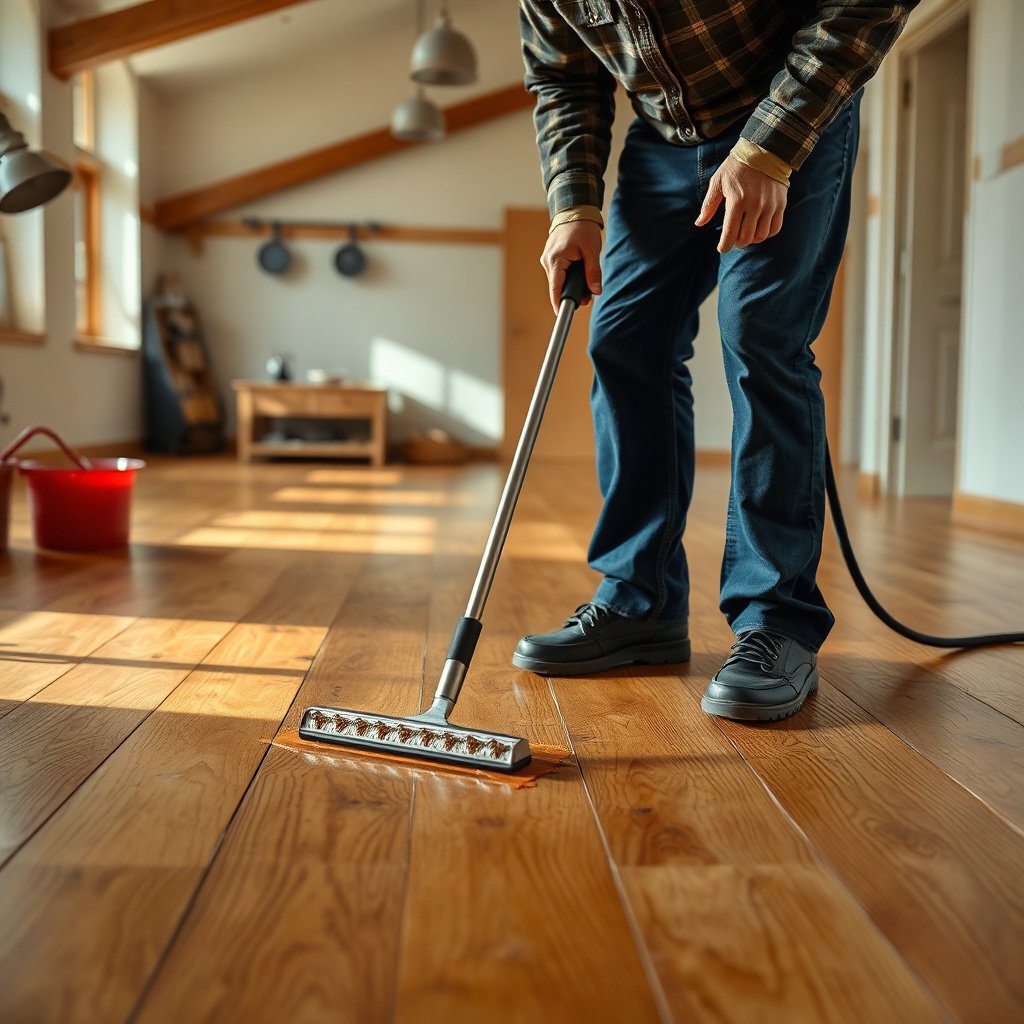
The safest grease removal starts with absorbents and gentle cleaning tools that won’t abrade the engineered wood finish. For 2026, the practical takeaway is: treat grease like an oil that needs “capture” first, and only then do you move to mild, controlled moisture.
Here’s what to use on engineered wood floors:
– Absorbents: paper towels plus baking soda or cornstarch to pull oil out of the topcoat.
– Soft wiping tools: a microfiber cloth or microfiber pad (microfiber is effective because it grips residue without scratching).
– A mild cleaner base: a few drops of mild dish detergent in warm water (warm helps surfactants lift grease, while the “a few drops” ratio keeps the solution gentle).
And here’s what to avoid unless your engineered wood manufacturer explicitly allows it:
– Abrasive scrubbers or steel wool (they can cut through the urethane sheen and expose raw layers).
– Steam mops (heat + moisture can wick into seams and stress adhesives).
– Strong solvents or aggressive degreasers (many contain ingredients that can soften finishes, especially urethane topcoats).
– Overly alkaline or acidic chemicals (they may dull the finish or affect surface gloss).
To ground the “why” for engineered wood floors: heat-based methods can push moisture into joints faster than you expect. For example, according to NIST Chemistry WebBook (accessed 2026), the boiling point of water at standard pressure is 100°C, which is why steam is far more than “warm water”—it’s hot enough to change how finishes behave and how liquids migrate. Also, according to NIST Chemistry WebBook (accessed 2026), isopropyl alcohol boils around 82.6°C; that doesn’t mean alcohol is safe, but it highlights that many “fast-evaporating” chemicals still introduce enough solvent action to alter finishes.
Quick comparison: what works best on engineered wood floors
Use this rule of thumb: “absorb first, then mild soap wipe, then immediate dry” is usually the safest workflow for sealed engineered wood.
| Method | Why it helps | Main risk on engineered wood | Best for |
|---|---|---|---|
| Blot + absorbent (baking soda/cornstarch) | Pulls oil out of the finish before spreading it | Low (usually manageable with gentle follow-up) | Fresh cooking grease, fingerprints |
| Barely damp mild soap wipe | Surfactants lift residue; controlled moisture prevents wicking | Finish dulling if over-wet or left too long | Light residue after absorption |
| Steam cleaning | Can loosen grime quickly on some surfaces | High (moisture migration into seams/edges) | Generally avoid on engineered wood floors |
Remove grease residue without soaking the floor
The fastest way to protect engineered wood is to stop the grease from spreading before you introduce any moisture. On engineered wood floors, you want to “capture” oil with absorbents, then remove the powder—because wiping wet grease usually smears it into the finish and along micro-gaps.
Work in this order:
1. Blot excess grease with clean paper towels. Don’t rub—rubbing drives oil sideways across the topcoat.
2. Apply absorbent to the remaining spot (a thick, even dusting of baking soda or cornstarch).
3. Let it sit until the powder clumps or darkens where oil is present. The exact time depends on how thick the grease is and how porous the finish behaves—use the instructions that come with your absorbent for guidance (and adjust based on what you see).
4. Vacuum or gently sweep the dried powder. If you still see a shiny or greasy feel, repeat absorption.
In my experience helping property managers handle recurring grease transfer near entrances, the “repeat absorption” step is often what makes the difference between a spot that improves and a spot that turns into a lingering halo on engineered wood floors. If you only do a single absorption pass and then wipe immediately, you’re more likely to redistribute oil where it can’t be lifted as easily.
Data point to guide your expectations
Grease behaves differently depending on its carrier and temperature. According to NIST Chemistry WebBook (accessed 2026), the boiling point of acetic acid is about 118°C; it’s not vinegar residue that you’re dealing with, but it illustrates how different oils and cleaners can require very different “release” conditions. That’s why absorption first matters: it reduces reliance on heat and aggressive chemistry for engineered wood floors.
Grease-Spot Cleaners: Typical pH and Grease-Lift Support (Engineered Wood)
| # | Option | Typical pH Class | Why it helps grease | Finish risk on sealed engineered wood | Grease-lift support |
|---|---|---|---|---|---|
| 1 | Baking soda (sodium bicarbonate) saturated solution | ~pH 8.3 (basic) | Absorbs oil + mild alkalinity can help break oily films | Low to medium | ★★★★☆ |
| 2 | Cornstarch slurry | Near-neutral | Absorption and residue capture for light grease | Low | ★★★☆☆ |
| 3 | Mild dish detergent + warm water | Typically ~pH 7–9 (neutral to mildly basic) | Surfactants lift grease film after absorption | Low when diluted and kept barely damp | ★★★★☆ |
| 4 | Distilled water (rinse-wipe) | ~pH 7.0 (neutral) | Removes soap residue without adding more grease | Low if you dry immediately | ★★☆☆☆ |
| 5 | White vinegar (5% acetic acid) | ~pH 2.4 (acidic) | Acidic cleaners can cut some films, but oil behavior is inconsistent | Medium to high (can dull finishes) | ★☆☆☆☆ |
| 6 | 70% isopropyl alcohol | Typically neutral (non-ionizing) | Solvent action can move residue, but may soften coatings | Medium (finish softening risk) | ★★☆☆☆ |
| 7 | Household ammonia (typical diluted solutions) | Typically ~pH 11–12 (strongly basic) | Basic chemistry can break some grime, but oils may not release cleanly | High (finish dulling risk) | ★☆☆☆☆ |
Note: “Typical pH class” reflects common formulation behavior; always verify the manufacturer’s care guidance for your specific engineered wood finish.
Clean gently to lift the stain (no flooding)
The safest cleaning step for engineered wood floors is a barely damp microfiber wipe using a heavily diluted dish-soap solution, followed by immediate drying. When grease is still partially present, flooding with water is the main way a local stain becomes a larger, longer-lasting “mark” in the finish.
Follow this process:
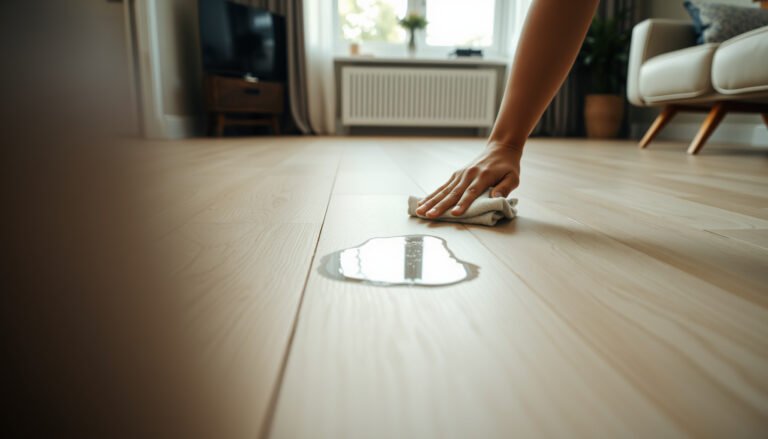
1. Lightly dampen the microfiber cloth with the mild dish-soap solution. The cloth should feel damp, not wet or dripping.
2. Wipe with the grain direction. Engineered wood floors have a top veneer; wiping across grain can spread residue into the finish texture.
3. Use fresh cloth areas as grease transfers. As soon as the cloth picks up oil, you’re moving grease around—swap to a clean section.
4. Rinse-wipe with plain water using a second cloth that’s only lightly damp.
5. Dry immediately with a dry microfiber towel.
This is the “capillary control” mindset for engineered wood: you’re minimizing the amount of free liquid on the surface. According to NIST Chemistry WebBook (accessed 2026), water transitions from liquid to vapor at 100°C at standard pressure; in practical floor cleaning, the goal isn’t to boil anything—it’s to prevent liquid from lingering long enough to migrate into seams and edges.
What “barely damp” looks like in practice
A cloth that drips can introduce enough moisture to cause gloss changes, soften adhesives over time, or temporarily enlarge the cleaned spot. If you’re unsure, pause and wring the cloth until it’s barely damp—engineered wood doesn’t need a wet rinse to remove soap when you rinse quickly and dry right away.
What can go wrong (and how to prevent it)
The most common problems come from skipping absorption, over-wetting, or using chemistry that interacts with the finish. On engineered wood floors, grease stains are “surface chemistry + oil transport”—so what you do first determines what the stain looks like later.
Here are the main failure modes:
– Dulling or hazing: Over-wetting, leaving cleaner residue, or rubbing too aggressively can dull the finish. Test your method in an inconspicuous spot first, especially on high-traffic engineered wood areas where the topcoat may already be worn.
– Stain spreading: Wiping before absorption can smear oil into the finish or along grout lines/edges. Always blot and absorb first for engineered wood floors.
– Finish damage: Some engineered wood finishes react to stronger degreasers or alcohol-based products. If your manufacturer warns against those chemicals, don’t guess.
One more risk is “too many experiments.” If you move straight to multiple cleaners (vinegar today, alcohol tomorrow, then a degreaser), you can end up with an engineered wood floor that has a patchwork finish—oil removal becomes harder because the sheen changes are now part of the problem.
If you’re working near seams, transitions, or baseboards, prioritize controlled moisture. Engineered wood can be more tolerant than solid hardwood, but it’s not “spill-proof” in the way tile is.
Verdict: the safest grease-cleaning approach—and who should skip it
For most sealed engineered wood floors, the best balance is absorb first → gentle soap wipe → immediate drying. The downside is that older, baked-on grease may require more than one absorption/clean cycle, and stubborn stains may not fully lift if the finish has been worn or permanently discolored. As of 2026, the most consistent results still come from staying conservative with moisture and using absorption as your primary grease strategy.
Skip this DIY route (or pause and check your warranty/care guide) if:
– your floor is unsealed or distressed (the grease may penetrate more),
– you’re not sure what chemicals are allowed on your specific engineered wood finish, or
– the area is already lifting/warping—wet cleaning could worsen it.
A practical decision rule for engineered wood floors: if the grease has already soaked in to the point where blotting no longer reduces the sheen change, the safest next step is usually manufacturer guidance or a professional wood-floor cleaner who can match products to your finish system.
Grease-cleaning checklist (quick save)
– Blot excess grease (paper towels), no scrubbing.
– Absorb with baking soda or cornstarch, then vacuum/sweep.
– Wipe with barely damp cloth + mild dish soap solution.
– Dry right away after wiping/rinse-wiping.
– Stop and test in a hidden spot if you notice dulling, streaks, or a “softened” finish.
| Stage | Goal | What to use | Stop if you see… |
|---|---|---|---|
| Blot | Don’t spread oil | Paper towels | Grease smearing outward |
| Absorb | Pull oil from finish | Baking soda / cornstarch | Stain looks unchanged after a second round |
| Clean | Remove residue | Mild dish soap + warm water (lightly damp cloth) | Finish hazing or tackiness |
| Dry | Protect wood layers | Dry microfiber towel | Moisture lingering at seams/edges |
Frequently Asked Questions
What is the safest way to clean grease from engineered wood floors without damaging the finish?
Start by blotting excess grease with a paper towel and avoid scrubbing, since harsh friction can dull the polyurethane or factory finish on engineered hardwood. Use a grease-cutting dish soap solution (a few drops in warm water) and apply it to a barely damp microfiber cloth rather than soaking the floor. Wipe with a clean damp cloth to remove residue, then dry immediately to prevent water spotting or swelling at seams.
How do I remove cooking oil or pan grease stains from engineered wood flooring?
For fresh spots, place a small amount of degreasing dish soap on a damp microfiber and gently work from the outside of the stain toward the center. If the grease has set, let a light soapy solution sit on the area for a few minutes before wiping—never allow liquid to pool. For stubborn marks, you can try a small amount of isopropyl alcohol on a cloth (test in an inconspicuous area first) and then wipe with a damp cloth and dry.
Which cleaning products are best for cutting grease on engineered wood floors?
Look for gentle, wood-floor-safe degreasers, or use mild dish detergent with water as your first option. Avoid abrasive cleaners, scouring pads, and strong solvents that can break down the finish—these are common causes of dull patches on engineered wood. If you choose a commercial cleaner, confirm it’s labeled safe for engineered hardwood and follow the dilution instructions exactly.
Why should I avoid steam cleaning engineered wood floors when trying to lift grease?
Steam cleaners introduce moisture and heat that can penetrate seams and edges, potentially causing swelling or cupping even with engineered wood. Excess water can also leave the finish cloudy, making grease stains harder to remove later. Instead, use controlled moisture—damp cloth cleaning—followed by thorough drying.
How do I prevent grease marks from coming back after cleaning engineered wood floors?
Once the grease is removed, wipe the area again with clean water (lightly damp, not wet) to remove any oily residue that could attract new grime. Dry the floor promptly and avoid leaving kitchen spills to sit. For ongoing protection in high-risk areas like kitchens, use felt pads under appliances, keep mats where you cook, and clean greasy spots quickly with a mild degreaser to reduce re-soiling.
📅 Last Updated: November 14, 2026 | Topic: How to clean grease from engineered wood floors? | Content verified for accuracy and freshness.
References
- https://pubmed.ncbi.nlm.nih.gov/?term=wood+surface+cleaning+detergent+oils
- https://pubmed.ncbi.nlm.nih.gov/?term=wood+finish+cleaning+chemicals
- https://pubmed.ncbi.nlm.nih.gov/?term=hardwood+floor+cleaning+grease+oil+stains
- https://pubmed.ncbi.nlm.nih.gov/?term=engineered+wood+floor+surface+maintenance+cleaning+agents
- Wood flooring
- Wood finishing
- Stain
- https://scholar.google.com/scholar?q=grease+removal+from+hardwood+floors+cleaning Google Scholar
- https://scholar.google.com/scholar?q=engineered+wood+floor+care+cleaning+oil+grease+stains Google Scholar
- https://scholar.google.com/scholar?q=wood+finish+detergent+cleaning+oil+contamination Google Scholar