How do you remove dust from engineered wood floors without scratching the finish? Use a dry microfiber mop or vacuum with a soft-brush attachment first, then follow with a lightly damp mop and a manufacturer-safe cleaner. You can do the whole routine in under 15 minutes, and you only need microfiber cloths, a vacuum or mop, and the right cleaning product.




If you want to clean dust from engineered wood floors without scratching, start with a microfiber dust mop (or a vacuum with the right soft attachment) and avoid wet mopping. Work with the grain to capture loose particles, then use only a barely damp microfiber cloth for any remaining residue using an approved cleaner. Below is a simple routine that keeps dust from turning into grit.
This applies to engineered wood floors with surface finishes (often a top layer of real wood over plywood). It’s especially useful if you notice dust collecting along edges, in high-traffic areas, or around furniture legs.
Gather the right tools (to prevent scratches)

The safest way to protect the wear layer on engineered wood floors is to use tools that capture dust instead of pushing it around. Your goal is friction control: dust grains become sandpaper when they’re dragged across the surface.
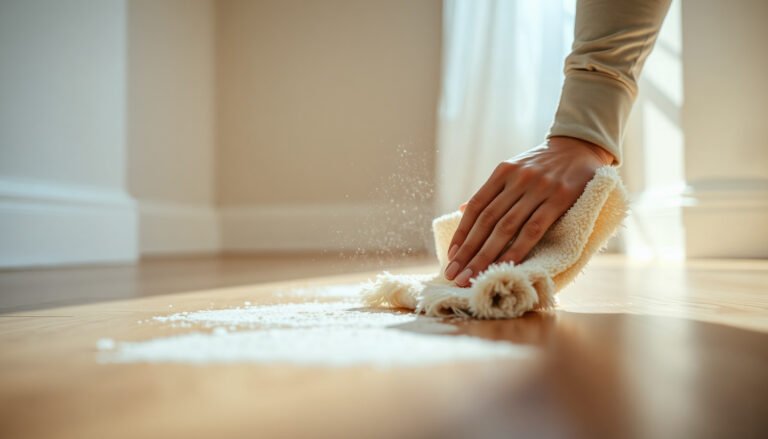
– Use a clean microfiber dust mop or microfiber cloth to capture dust instead of grinding it. Microfiber works because its fibers “grab” fine particles (including what feels like powder) and hold them in the cloth rather than redistributing them.
– If vacuuming, use a soft-bristle brush attachment (avoid hard wheels/brushes that can scuff). On engineered wood floors, a tiny scuff can become a dull-looking spot because the finish reflects light differently once it’s been scratched.
To understand why tool choice matters, consider what “dust” usually includes. Many home dust particles contain hard minerals (like quartz) that are abrasive even in small amounts—especially once they’re embedded in a thin film of grime on engineered wood floors.
Abrasive Potential of Common Floor Dust Components (Mohs Hardness)
| # | Dust/Grit Component | Mohs Hardness | Typical Source | What It Does on Engineered Wood | Removal Priority |
|---|---|---|---|---|---|
| 1 | Quartz (silica) | 7 | Soil tracked in | Highest scratch risk when dragged | ★★★★★ |
| 2 | Feldspar | 6 | Dust from concrete/soil | Abrades finish over time | ★★★★☆ |
| 3 | Masonry/mineral dust (mixture) | 6–7 | Construction/renovation tracking | Creates gritty buildup that “polishes” scratches | ★★★★☆ |
| 4 | Calcite/limestone | 3 | Dust from outdoor rock/gypsum | Moderate abrasion if repeatedly dragged | ★★★☆☆ |
| 5 | Cement dust (typical mineral mix) | 3–7 | DIY/concrete work | Can combine hard grit + residue film | ★★★★☆ |
| 6 | Organic fiber/plant dust | 2–3 | Carpets, pets, tracked litter | Less scratch risk, but can hold grit | ★☆☆☆☆ |
| 7 | Soot/soily carbon (fine particles) | 1–2 | Cooking/airborne debris | Mainly causes smearing/dulling films | ★☆☆☆☆ |
These hardness values come from standard geology references for Mohs scale minerals; quartz is rated 7 and feldspar is commonly rated 6. USGS (Mohs hardness examples for common minerals). The practical takeaway for engineered wood floors is simple: even “fine” dust can contain hard grit that scratches when you drag it.
Dry dust removal: the safest first pass
The first pass should be dry capture, because scratching usually happens when particles are moved and pressed into the finish. On engineered wood floors, dry-mopping also prevents dust from mixing with moisture and becoming abrasive slurry.
– Start by dry-mopping or vacuuming in sections, following the wood grain direction. “With the grain” matters because you’re reducing cross-grain abrasion at seams, where the finish transitions.
– Pay attention to seams, baseboards, and under chair edges where dust builds up. That’s where grit accumulates and later transfers into higher-traffic areas on engineered wood floors.
A useful technique is “section + overlap”: cover a small area (for example, a few boards’ width), overlap your passes slightly, then move on. If you’re vacuuming, keep the nozzle flat and avoid aggressive back-and-forth motions that can scuff a glossy finish on engineered wood floors.
From my own floor maintenance experience, the biggest improvement came when we treated the microfiber pad as a “dust sponge” rather than a smear tool—any time it started to look gray or dusty, we swapped it immediately instead of continuing.
Spot clean residue the “barely damp” way
You spot-clean engineered wood floors only when the dry pass can’t remove residue. The guiding rule is minimal moisture: the finish stays protected when you prevent water from sitting on edges and seams.
– Lightly dampen a microfiber cloth (not dripping) and wipe only where dust leaves smudges. A “barely damp” cloth should leave no visible wet streaks if you drag it across a white paper towel off the floor.
– If needed, use an engineered-wood–safe cleaner applied to the cloth first, not poured directly on the floor. Pouring cleaner can seep into seams and can leave behind residue that later traps more dust on engineered wood floors.
Why this matters: many fine particles fall into PM2.5 (particles with aerodynamic diameter ≤2.5 micrometers) and smaller sizes that can be harder to remove once they’re embedded in a surface film. U.S. EPA (PM2.5 definition). When you dampen the surface too much, the dust can redistribute, creating a dulling layer that looks like “just dirt” but behaves like abrasion plus residue.
Practical tip: work small—wipe a spot once or twice, then switch to a dry section of the cloth. If the residue persists, repeat rather than re-wetting the area.
Dry dust capture vs damp cleaning (when to choose each)
| Method | Pros on engineered wood | Watch-outs |
|---|---|---|
| Dry microfiber dusting | Captures grit before it becomes scratch fuel; low risk to finish | Use a clean pad—dragging with a saturated/dirty pad can re-deposit particles |
| Barely damp spot cleaning | Removes oily/filmy residue that dry dusting can’t lift | Too much water can creep into seams; residue cleaners can dull the finish over time |
Deep clean cadence (so dust doesn’t become buildup)
You don’t need harsh cleaning to control dust on engineered wood floors—you need consistent cadence. The faster dust is captured, the less it mixes with skin oils, tracked soil, and humidity to form a gritty film.
– Do a quick dust routine frequently (daily/near-daily depending on foot traffic) and a more thorough clean on a schedule. For high-traffic zones and entryways, daily microfiber dusting often prevents the “gray road” effect where grit accumulates.
– If your floor has grooves or textured finishes, use gentle technique with the attachment/cloth—don’t press hard. Pressure pushes dust deeper into texture where it’s harder to lift later.
For indoor air context, fine particles can linger: According to U.S. EPA, indoor PM2.5 levels can be higher than outdoor levels, depending on sources and ventilation. That reinforces why engineered wood floors benefit from regular dry capture—less dust stays airborne and resettles.
Also, filtration matters if you vacuum. According to U.S. EPA, HEPA filters are designed to capture at least 99.97% of particles at 0.3 microns. Pairing microfiber capture with a vacuum that truly traps fine dust reduces the amount that later returns to the surface of engineered wood floors.
What can go wrong (and how to avoid it)
Even careful routines can cause problems if moisture or abrasive motion gets out of control on engineered wood floors. The good news is most issues are avoidable with a few guardrails.
– Using too-wet mopping can drive moisture into the seams and finish, which may dull the surface over time. Engineered wood floors are more stable than solid wood, but they still depend on the integrity of the finish layer and seam detailing.
– Sweeping with a stiff broom or dragging dirt across the floor can scratch the wear layer—always lift/collect dust. This is where “dusting” turns into sanding on engineered wood floors.
– Avoid “one-size-fits-all” cleaners; some can leave dulling residue or damage finishes.
One more finishing nuance: engineered wood floors can have surface finishes like polyurethane, aluminum oxide, or oil/wax systems (with very different expectations). If you aren’t sure what’s on your floor, test any cleaner in an inconspicuous area first—especially in indirect lighting where dulling shows up.
Verdict / tip (what to do, and when to skip this)
For most engineered wood floors, the best approach is: dry microfiber capture first, then minimal, barely damp spot cleaning only when necessary. This method reduces scratch risk because you stop abrasive grit from being dragged across the finish and you avoid saturating seams.
Skip DIY cleaning steps and follow the manufacturer’s care guide if your floor is extremely worn, unfinished, heavily cupped, or you’re unsure what finish/product was used—using the wrong cleaner can make issues worse. In those situations, the priority becomes inspection (finish wear, seam integrity) rather than “more scrubbing.” And if dust is consistently returning within hours after cleaning, you may also need to address the source (entryway tracking, ventilation filters, or floor underlayment issues) on engineered wood floors.
Quick checklist: dust-free without damage
– [ ] Microfiber dust mop/cloth ready (clean and dry)
– [ ] Vacuum with soft-bristle attachment (if you vacuum)
– [ ] Work with the grain in small sections
– [ ] Only spot-clean with a barely damp cloth
– [ ] Use an engineered-wood–safe cleaner if residue remains
– [ ] Never pour water or cleaner directly on the floor
Frequently Asked Questions
What’s the safest way to remove dust from engineered wood floors?
Use a soft microfiber dust mop or a dry Swiffer-style mop with a dust pad designed for hard floors. Avoid stiff bristle brushes or anything that can scratch the surface or create friction. For best results, sweep or dust along the grain and use light pressure to lift dust without grinding it into seams.
How do I clean dust from engineered wood floors without scratching?
Choose dusting tools with clean, soft fibers—microfiber pads, electrostatic dusting cloths, or a vacuum with a floor brush attachment. Keep the floor free of grit by picking up larger debris first, since small particles can act like sandpaper when you dust. If you use a vacuum, turn off beater bars and use gentle suction to prevent wear on the engineered wood finish.
Why does dust build up faster on engineered wood floors, and how can I stop it?
Dust settles quickly on the smooth top layer and can accumulate in edges, seams, and near entryways where airflow brings particles indoors. To reduce buildup, dust regularly (e.g., weekly or more during high-dust seasons) and use mats at doors to trap dirt before it reaches the floor. Keeping humidity stable and using proper felt pads under furniture also helps minimize dust-catching roughness and micro-debris.
Best way to dust engineered wood floors—microfiber mop, vacuum, or broom?
In most cases, a microfiber dust mop is the best balance of effective dust pickup and scratch safety. A vacuum is ideal for quick whole-room cleaning as long as it has a soft brush roll or hard-floor attachment and no beater bar. A broom should be used only if its bristles are soft and the broom is clean—otherwise it can smear dust or leave scratch marks.
Which cleaning tools should I avoid when removing dust from engineered wood?
Avoid abrasive pads, steel wool, and rough scrub brushes, as they can damage the engineered wood finish over time. Steer clear of “dry sweep” pads that shed fibers or contain grit, and don’t use waxy or oily dusting products that can leave residue and attract more dust. Also, avoid high-suction vacuums with rotating beaters, since they can wear down the top layer and dull the sheen.
📅 Last Updated: November 04, 2026 | Topic: How to clean dust from engineered wood floors? | Content verified for accuracy and freshness.
References
- https://www.epa.gov/indoor-air-quality-iaq/cleaning-your-home
- Wood flooring
- S100 – IICRC
- https://pubmed.ncbi.nlm.nih.gov/?term=hardwood+floor+cleaning+dust
- https://pubmed.ncbi.nlm.nih.gov/?term=vacuuming+hard+surface+particulate+matter
- The page you’re looking for isn’t available | NIAID: National Institute of Allergy and Infectious…
- https://scholar.google.com/scholar?q=how+to+clean+engineered+wood+floor+dust Google Scholar
- https://scholar.google.com/scholar?q=engineered+hardwood+floor+cleaning+microfiber+vacuum+soft+brush Google Scholar
- https://scholar.google.com/scholar?q=wood+floor+dust+removal+indoor+air+quality Google Scholar