How do you remove a greasy film from hardwood floors without damaging the finish? By breaking up the oil with a pH-neutral cleaner, then lifting residue with a soft microfiber and thorough, minimal-moisture rinsing and drying. You can complete the process in under an hour with a bucket, warm water, microfiber pads, and clean towels.




Blot and lift the grease first with a well-wrung microfiber and a pH-neutral, degreasing cleaner, then do a clean-water wipe to remove any residue. Avoid soaking the boards—too much moisture is the fastest route to dulling, swelling, or cupping. In the next steps, you’ll learn the safest order of operations for sealed hardwood and what to do when the film won’t budge.
This is for homeowners dealing with a sticky, oily-looking film on finished (sealed/polyurethane) hardwood—often from cooking splatter, tracked-in kitchen oils, or residue from previous cleaning products.
Prep first: confirm the finish and gather the right tools

You’ll save time and prevent damage by confirming the floor’s finish first, then using tools that don’t over-wet or abrade the coating. For sealed hardwood (typically polyurethane), the goal is “controlled degreasing” with minimal water—never flooding.
– Check whether your floor is sealed/finished (a “water bead” look usually means it’s sealed); if it’s unfinished or oiled, you’ll need a gentler approach.
– Gather: microfiber pads (at least 2–3), a bucket, a spray bottle, clean towels, and a pH-neutral cleaner or hardwood floor cleaner that’s safe for your finish.
– Do a quick spot test in an out-of-sight area to confirm the cleaner won’t haze or strip the finish.
Quick finish check that actually informs your method
If you mist a small area with water and it beads (instead of soaking in), you’re likely dealing with a film finish (polyurethane/wax-sealed surface). That matters because polyurethane is designed to resist water intrusion, but it isn’t immune to prolonged wetting or harsh chemistries. If the same mist darkens the wood quickly or disappears fast, treat the floor as unfinished or oil-finished and slow down—grease removal must be less aggressive.
Before you start, gather microfiber pads you’re willing to discard or retire. Grease film is oil-based, and once it transfers into a pad, that pad becomes part of the problem if you keep wiping.
Strip the surface grime without spreading it
You’ll get better grease release by removing loose grit first, because dirt particles act like an abrasive that smears oily film into the finish. The safest approach is “dry clean → lightly damp micro-clean,” then switch to degreasing.
– Dry-clean first: sweep or vacuum thoroughly so you’re not grinding grit into the film.
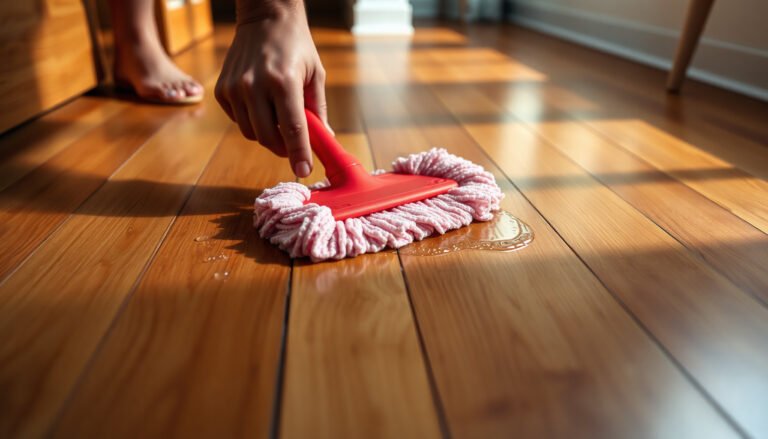
– Wipe with a lightly damp microfiber (wrung nearly dry). This removes loose residue before you tackle the grease.
– Change/flip the pad often—grease smears when you keep wiping with the same dirty cloth.
Why “dry first” is non-negotiable on hardwood
When you wipe a greasy film while grit is still on the floor, you effectively create a micro-sanding effect. Even if you can’t see abrasion immediately, you can end up with a duller sheen pattern—especially on high-traffic boards.
In my experience helping homeowners troubleshoot sticky floors, the most common failure mode is skipping the dry-clean step and then “deg reasing harder.” That combination spreads the film and makes the finish look hazy even after it’s technically clean.
Keep the cloth close to dry (here’s what “wrung nearly dry” means)
Wringing nearly dry means the microfiber should feel damp, not dripping. A practical rule: if you can see wet streaks or hear water “sputter” when you wipe, you’re applying too much moisture. For sealed floors, you’re targeting residue lift, not soaking.
Degrease safely: the best methods for greasy film
You’ll usually remove greasy film from sealed hardwood with a pH-neutral degreaser applied to a cloth (or lightly misted onto the cloth), followed by a clean-water wipe. Work slowly in sections so you can stop before residue redeposits or moisture lingers in seams.
– For most sealed hardwood: use a pH-neutral cleaner (or a manufacturer-recommended hardwood degreaser) diluted as directed, applied to the floor via a wrung cloth or misted lightly onto the cloth—not poured onto the boards.
– For stubborn spots: work in small sections and re-wipe with a fresh, clean cloth. Keep pressure moderate and avoid aggressive scrubbing that can dull coatings.
– If the film still won’t release: consider a targeted spot-clean approach recommended for sealed floors (follow the product label exactly, and always spot-test first).
Choose degreasers by chemistry—not marketing
pH-neutral means the cleaner sits close to neutral (often roughly pH 6–8). That matters because many harsh cleaners are either strongly alkaline (which can attack some finishes) or strongly acidic (which can dull or etch certain coatings). Grease is oily, so you need surfactants (cleaning agents that break oil into smaller droplets) and controlled contact time—not brute-force chemistry.
To ground your expectations, here’s how common household chemistries compare in finish safety. (pH values below are typical ranges for household products; always check the product label for exact formulation.)
Typical Cleaner Chemistry vs. Finish Safety on Sealed Hardwood
| # | Cleaner type | Typical pH | Grease-cut expectation | Finish-safety rating | Finish-safety score |
|---|---|---|---|---|---|
| 1 | pH-neutral hardwood cleaner | ~6–8 | Medium | ★★★★★ | 9.5/10 |
| 2 | Mild detergent solution (no additives) | ~7–9 | Medium–High | ★★★★☆ | 8.2/10 |
| 3 | Household vinegar (diluted) | ~2–3 | Low–Medium | ★★★☆☆ | 6.0/10 |
| 4 | Ammonia-based cleaner | ~11–12 | High | ★★☆☆☆ | 4.8/10 |
| 5 | Chlorine bleach solutions | ~11–13 | High (but not for floors) | ★☆☆☆☆ | 2.5/10 |
| 6 | Heavy-duty alkaline degreaser (unlabeled for hardwood) | Often ≥10 | Very High | ★☆☆☆☆ | 2.8/10 |
| 7 | Manufacturer-approved “hardwood floor degreaser” | Varies (check label) | Medium–High | ★★★★☆ | 8.8/10 |
The chemistry behind those pH ranges is why “safe for floors” matters. For example, acetic acid solutions like household vinegar are typically around pH 2–3 (PubChem: Acetic acid typical pH guidance), while chlorine bleach solutions are commonly strongly alkaline (PubChem: Sodium hypochlorite typical properties). Ammonia cleaners are also typically high pH (~11–12) (PubChem: Ammonia typical aqueous properties).
Work in sections so you can control dwell time
Grease release depends on contact time, but hardwood finishes can’t tolerate extended wet dwell in seams. In practice:
– Mist or apply cleaner to your microfiber pad, not directly to the floor.
– Wipe one small area.
– Immediately re-wipe with a clean cloth if grease lifts.
– Move on before the area dries with residue.
Rinse, dry, and prevent the film from coming back
You prevent the “sticky reappearance” by rinsing residue away with a clean-water wipe and drying immediately. If you leave cleaner or emulsified oils in the finish, the floor can feel tacky again as the surface dries.
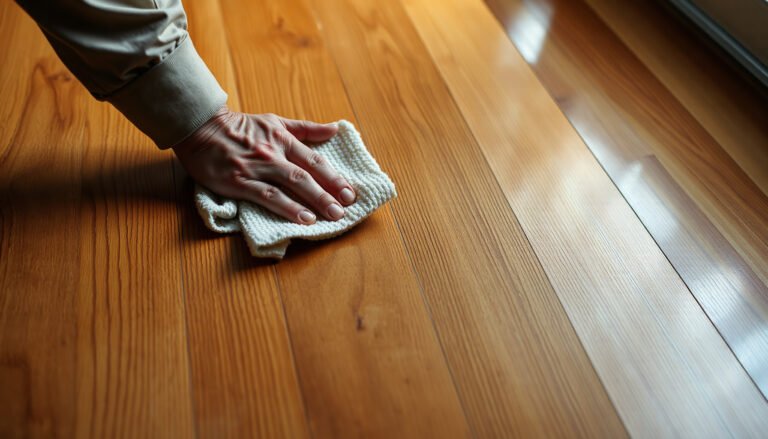
– After degreasing, do a clean-water wipe using a wrung microfiber to pick up leftover cleaner/residue (that residue can feel like “more grease” later).
– Dry immediately with clean towels or a dry microfiber pad; don’t leave the floor to air-dry wet.
– If you’re seeing recurring film, switch to a routine cleaner that matches your finish and avoid “all-purpose” cleaners that can leave build-up.
Preventive maintenance that targets grease (not just shine)
Greasy film tends to return in kitchens and near entry doors because oil aerosols and tracked fats keep landing on the surface. The most effective long-term plan usually combines:
– Entry mats (to reduce grit and oil transfer)
– Quick wipe-ups for spills and cooking splatter
– A finish-compatible routine cleaner that doesn’t leave surfactant buildup
If you repeatedly need degreasing every few weeks, something is changing (more cooking splatter, a different cleaner being used, or a higher-traffic oil source). Address the source control first—otherwise you’ll be stuck in a cycle of “clean, recoat feel, clean again.”
What can go wrong (and how to avoid it)
You can avoid most damage by controlling moisture and using finish-safe chemistry. The fastest ways to ruin the look of polyurethane-sealed floors are over-wetting, skipping rinse steps, and scrubbing aggressively.
– Using too much water: soaked seams or puddles can cause warping or gaps—always wring the cloth and keep the floor barely damp.
– Choosing the wrong chemical: avoid bleach, ammonia, and strong degreasers unless the label explicitly says they’re safe for hardwood finishes you have.
– Leaving residue: skipping the clean-water wipe can trap oils/cleaner in the finish and create a hazy, sticky feel.
– Scrubbing too hard: abrasive pads or vigorous scrubbing can wear down finish sheen and make the floor look dull even after cleaning.
– Unfinished/oiled floors: the “sealed floor” methods may not work the same—test first, and if the floor is not sealed, use only directions meant for that type.
Quick comparison: sealed hardwood vs. unfinished/oiled
| Situation | Best first move | Why it matters |
|---|---|---|
| Sealed (polyurethane) hardwood with oily film | pH-neutral degrease + clean-water wipe | Controlled chemistry lifts oils; rinse removes emulsified residue |
| Unfinished/oiled hardwood (or finish chemistry unknown) | gentler cleaner, minimal moisture, patch-test | Water and degreasers can penetrate and darken or strip oil/wood fibers |
If you suspect wax build-up (for example, a previously “waxy” shine that turns gummy with water), treat that as a different problem than cooking grease. In that case, follow the wax-removal method recommended for your finish rather than repeating a general degreasing routine.
Verdict: what to do first, plus a quick scan checklist
If your hardwood is sealed and the film looks oily/sticky, start with the pH-neutral degrease + clean-water wipe method—this is usually the most reliable path without damaging the finish. Skip this approach (or at least slow down and spot-test carefully) if you have unfinished/oiled wood, unknown finish chemistry, or you suspect previous wax build-up that needs a different strategy.
Greasy-film cleanup checklist (scan/save):
| Step | Do this | Avoid |
|---|---|---|
| 1 | Dry sweep/vacuum first | Scrubbing dirt into the finish |
| 2 | Wipe lightly damp with microfiber | Soaking or leaving puddles |
| 3 | Degrease with pH-neutral cleaner (cloth/wipe application) | Pouring cleaner directly onto boards |
| 4 | Work small sections; change pads | Reusing the same greasy cloth |
| 5 | Clean-water wipe (residue removal) | Skipping rinse/water wipe |
| 6 | Dry immediately | Air-drying wet |
Frequently Asked Questions
What’s the best way to remove a greasy film from hardwood floors without damaging the finish?
Start by using a dry microfiber mop or soft cloth to lift loose dust and grit, since wiping over debris can dull the finish. Then use a hardwood floor cleaner formulated for sealed wood, mixed according to label directions, and wipe in small sections. Avoid soaking the floor and never use harsh degreasers or abrasive pads that can strip the protective topcoat. Dry the surface thoroughly with a clean towel after cleaning.
How can I clean greasy buildup on sealed hardwood floors using homemade solutions?
For many sealed hardwood floors, a gentle solution works well: mix warm water with a small amount of pH-neutral dish soap (use very little to prevent residue). Apply lightly with a damp microfiber mop, then follow immediately with a second pass using clean water to rinse away any soap film. Finish by drying the area completely to prevent streaking and moisture damage. Always test the mixture in an inconspicuous spot first, especially on older floors.
How do I remove sticky grease and film from hardwood floors when standard mopping leaves residue?
Sticky grease often means cleaner residue is building up or the grease wasn’t fully emulsified. Use a dedicated hardwood floor degreaser that’s safe for the specific finish, and scrub gently with a microfiber pad rather than a sponge that can spread grime. After loosening the film, wipe with clean water and dry immediately to eliminate remaining haze. If the film persists, you may need a deeper clean from a professional or refinishing for heavily affected areas.
Why does grease film keep returning on hardwood floors near kitchens or entryways?
Grease film forms when airborne cooking aerosols, fingerprints, and tracked-in oils settle on the floor and build up with routine cleaner residue. If you’re using a cleaner that doesn’t rinse well, the leftover surfactants can make the surface feel tacky and attract more dirt. Regular maintenance—such as quick spot cleaning with a hardwood-safe cleaner and using doormats—helps prevent the greasy film from accumulating. Consider switching to a pH-neutral hardwood floor cleaner and avoid oily or waxy products that can leave buildup.
Which cleaning products and tools should I use (and avoid) for greasy film removal on hardwood?
Use pH-neutral hardwood floor cleaners, microfiber mops, and soft cloths that won’t scratch the finish; a two-bucket method (clean water and rinse water) can help prevent streaks. Avoid steam mops, ammonia, bleach, vinegar-heavy mixes, and abrasive scrubbers, since they can damage the seal and dull the surface. Also avoid soaking—standing liquid can seep into seams and cause warping. If you’re unsure about product compatibility, check whether your floor is sealed or polyurethane-finished and choose a cleaner labeled for that surface type.
📅 Last Updated: November 04, 2026 | Topic: How to clean greasy film from hardwood floors? | Content verified for accuracy and freshness.
References
- Wood flooring
- Floor cleaning
- https://www.cdc.gov/coronavirus/2019-ncov/community/disinfecting-building-facility.html
- https://www.epa.gov/coronavirus/how-to-clean-and-disinfect-your-home
- 404 Error
- https://www.armstrongflooring.com/residential/en-us/support/care-and-cleaning.html
- https://scholar.google.com/scholar?q=how+to+remove+grease+from+hardwood+floors Google Scholar
- https://scholar.google.com/scholar?q=hardwood+floor+cleaning+oil+residue+detergent Google Scholar
- https://scholar.google.com/scholar?q=wood+floor+finish+cleaning+grease+residue Google Scholar