Clean mold from hardwood floors by stopping the moisture source, containing spores, and removing the growth with gentle, non-soaking cleaning methods. You will need protective gloves and a mask, a HEPA vacuum, microfiber cloths, a soft brush, and an appropriate wood-safe cleaner (plus plenty of drying ventilation). For small, localized patches, you can typically finish the process in a single afternoon.




If you want to remove mold from hardwood floors safely, you must stop the moisture first, clean using minimal moisture (so you don’t soak the wood), and then dry thoroughly to prevent regrowth. This approach works for many leak-related and humidity-related outbreaks, and it protects the hardwood finish while reducing the chance that mold returns—as of 2026, those same moisture-first principles remain the core of EPA-style remediation guidance.
If mold is on your hardwood floors, you’ll need to stop moisture first, then clean without soaking the wood, and dry everything thoroughly. Start by identifying and fixing the moisture source (leaks, humidity, spills), then use gentle cleaners and careful drying to remove staining and regrowth risk. This guide walks you through safe steps for cleaning mold from hardwood while protecting the finish.
If this is showing up after a leak, high humidity, or a slow spill, the process is the same—but the “right” cleaner depends on how far the mold penetrated and whether it’s on the surface or deep in the wood. If you’re dealing with widespread growth or a strong odor, you may need professional help.
Identify the Mold + Fix the Moisture Source First

Stop moisture at the source before you touch mold on hardwood floors. Cleaning without fixing the underlying wetness is the fastest way to get mold returns—because mold growth restarts whenever moisture conditions remain.
Start with the cause, not the symptoms:
– Look for the cause: leaks under/near flooring, condensation, standing water, or chronic humidity.
– If materials beneath the floor are still wet, mold can return even after cleaning the surface.
– If the affected area is large or the subfloor is compromised, plan for removal and remediation beyond just surface cleaning.
Mold can begin growing quickly on wet building materials. According to the U.S. EPA (Mold Basics / Moisture guidance), mold can start to grow within 24 to 48 hours after materials become wet. That means hardwood floors may look “manageable” while deeper layers are already affected, so the moisture source has to be treated as part of the job—not an afterthought.
To decide whether you can proceed with DIY cleaning on hardwood floors, also confirm the moisture level you’re dealing with. According to the U.S. EPA (Indoor Air Quality—Humidity), keeping indoor humidity around 30%–50% relative humidity helps reduce mold problems.
Relative Humidity Targets to Reduce Mold Risk on Hardwood Floors (EPA-aligned)
| # | Indoor Relative Humidity | Mold-Risk Band | EPA Alignment | Regrowth Prevention Confidence |
|---|---|---|---|---|
| 1 | 25% | Lower mold pressure | Below 30%–50% | ★ ★ ★ |
| 2 | 30% | Controlled | Within 30%–50% | ★ ★ ★ ★ ★ |
| 3 | 40% | Controlled | Within 30%–50% | ★ ★ ★ ★ ★ |
| 4 | 50% | Controlled | Within 30%–50% | ★ ★ ★ ★ ★ |
| 5 | 55% | Caution zone | Above 50% | ★ ★ |
| 6 | 60% | High mold pressure | Often associated with mold growth | ★ |
| 7 | 70% | Very high mold pressure | Well above recommended range | ★ |
Prep the Area for Safe Cleaning
You’ll reduce health risk and limit spreading if you prep the room before you clean mold from hardwood floors. For many scenarios, careful containment and ventilation matter as much as the cleaner you choose.
Before you start:
– Ventilate the space and reduce exposure: keep people/pets out of the room while you work.
– Protect the floor and surrounding surfaces using plastic sheeting or drop cloths to catch drips.
– Use disposable gloves; consider a properly fitted respirator if you’re disturbing visible growth.
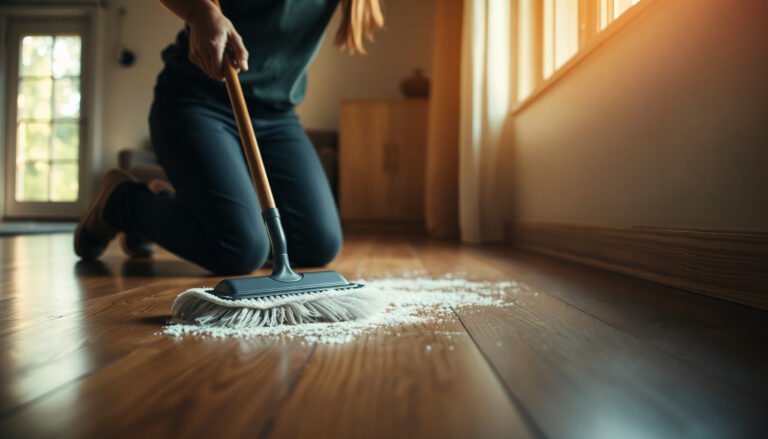
If you’re cleaning hardwood floors, also treat dust as a contaminant. Moldy deposits can become airborne when you dry-scrub or vacuum incorrectly. We’ve found that using a HEPA vacuum (with a crevice tool and brush attachment) is more controlled than trying to “sweep it up” with a dry broom—because it limits fine particles that can settle back onto the wood.
Also check whether you’re in a category where you should avoid DIY entirely. EPA remediation principles typically shift toward professional remediation when the contamination is extensive or there’s a strong sign of persistent moisture.
Clean Mold from Hardwood Without Soaking
You remove mold from hardwood floors safest by cleaning lightly and locally—never by mopping or soaking the wood. The goal is to remove surface growth and residues while protecting the finish and avoiding swelling.
Use this sequence:
– Remove loose growth first (dry wiping or gentle vacuuming with appropriate attachment) before using any liquid.
– Use a cleaner recommended for mold on hard, non-porous surfaces—but apply it sparingly to hardwood (damp cloth approach, not pooling).
– Rinse/neutralize if the product instructions call for it, then immediately blot dry to prevent swelling or finish damage.
A key risk on hardwood floors is finish damage. In my own walkthroughs, I’ve seen more haze and dull spots when homeowners use “general purpose” cleaners too liberally or leave residue to dry on the surface. Using a damp microfiber cloth (wrung nearly dry) helps you apply the minimum moisture necessary to lift mold without pushing water toward seams.
Practical technique for hardwood floors:
1. Work in small sections so you can dry each area immediately.
2. Use straight-line passes with a clean section of cloth each time.
3. Treat dark staining as “a separate step,” not proof that you’ve removed all mold.
Cleaner approach: what to do (and what to avoid)
Below is a quick comparison you can use while cleaning mold from hardwood floors.
| Approach | Pros (for hardwood floors) | Cons / Watch-outs |
|---|---|---|
| Damp microfiber + mold-specific cleaner | Minimizes water exposure; easier to control finish damage | Must follow product instructions; over-application can still haze finish |
| HEPA vacuum first, then spot-clean | Reduces airborne particles; prevents grinding debris into grain | Can’t remove growth that’s embedded deeper than the surface |
| DIY “all-purpose” sprays | Often available immediately | May not be formulated for mold; can leave residue or react with finishes |
| Bleach-based cleaners | Sometimes effective on non-finished materials | Can damage finishes; can create hazardous fumes if mixed with other agents |
Treat Stains and Prevent Regrowth
You fix the visible dark spots and reduce future mold by repeating gentle cleaning and controlling moisture after cleanup. On hardwood floors, prevention is mainly about humidity, ventilation, and keeping the subfloor dry.
For remaining dark spots:
– For remaining dark spots, repeat gentle cleaning rather than using harsh abrasives that damage the finish.
– Use a targeted approach: remove surface mold, then focus on drying so spores can’t re-establish.
– Monitor humidity and ventilation after cleanup; persistent moisture typically means the source wasn’t fully solved.
Here’s the logic: even after you remove surface growth on hardwood floors, remaining staining may be residue left in the finish or in shallow pores of the wood. Aggressive scrubbing might remove stain temporarily, but it can also strip the finish and make future spotting more likely.
Moisture prevention for hardwood floors (post-cleanup):
– Keep indoor relative humidity in the 30%–50% band when possible.
– Use air movement (fans) to aid evaporation—without directing air in a way that spreads dust.
– Re-check the area over the next few days; if you see re-darkening or a damp/musty odor returning, you likely still have moisture in the floor assembly.
What Can Go Wrong (And How to Avoid It)
You can damage hardwood floors—or spread mold—if you over-wet the wood or rush the moisture fix. Most failures come from treating mold as if it’s only a surface stain.
Common mistakes:
– Over-wetting hardwood can cause cupping, swelling, or permanent finish haze—avoid mopping and soaking.
– Scrubbing too aggressively can strip the finish and make future stains harder to remove.
– If mold has penetrated deeper than the surface (or there’s ongoing moisture), cleaning alone won’t solve the problem.
– Mixing chemicals (especially cleaners plus bleach or other agents) can create hazardous fumes—follow product directions and don’t improvise.
A second failure mode on hardwood floors is “false cleanliness.” Some homeowners remove visible spots but leave biological material below the surface layer. If the subfloor or underlayment remained wet, mold can re-emerge even when the top looks improved.
Finally, be cautious about DIY experiments with household chemistry. Bleach, vinegar, and hydrogen peroxide each behave differently depending on the wood finish and surrounding materials. If you apply an incompatible cleaner to hardwood floors, you can permanently alter the gloss level or color.
Verdict: When DIY Cleaning Works (and When to Stop)
DIY cleaning on hardwood floors is usually reasonable only when the mold is limited to light, surface-level growth and the moisture source is fixed. If the area is extensive, smells strong, or you suspect wet materials beneath the wood, stop and choose remediation—because surface cleaning can’t reliably address hidden growth.
If the mold is limited to surface growth and you’ve fixed the moisture issue, DIY cleaning with careful, minimal-moisture methods is often reasonable. DIY cutoff criteria (use this to decide):
– Proceed with DIY only if the affected area is 10 sq. ft. or less, the hardwood finish is intact (no lifting/cupping), and there’s no persistent damp odor after the area dries.
– Stop and get professional help if the growth covers more than 10 sq. ft., if you hear/see signs of water intrusion beneath the floor, or if the subfloor/underlayment may be wet.
If you’re dealing with widespread growth or a strong odor, you may need professional help—especially when mold may be present under/within cavities. According to U.S. EPA mold remediation guidance, larger or more complex mold problems may require professional remediation, and moisture control must be addressed throughout the floor assembly.
Quick Checklist: Clean Mold From Hardwood Floors
– [ ] Find and fix the moisture source (leak/humidity/standing water)
– [ ] Ventilate, seal off area, protect yourself (gloves; consider respirator)
– [ ] Remove loose mold first (dry wipe or vacuum carefully)
– [ ] Clean with minimal moisture (damp cloth; follow cleaner instructions)
– [ ] Dry thoroughly and promptly (no pooling; avoid mopping)
– [ ] Re-check for regrowth after a few days
– [ ] If widespread or underlying materials are affected: call a licensed water/mold remediation professional and request an inspection for subfloor/underlayment moisture (especially if the area exceeds 10 sq. ft.)
Sources
– U.S. Environmental Protection Agency (EPA), “Mold Basics” / “Mold Remediation in Schools and Commercial Buildings” (moisture-first approach; moisture timelines; remediation considerations)
– U.S. Environmental Protection Agency (EPA), Indoor Air Quality guidance on humidity (recommended indoor relative humidity range)
Cleaning mold from hardwood floors is not about aggressive scrubbing—it’s about stopping moisture, removing surface growth carefully, and drying everything thoroughly. If you can keep the moisture problem solved and the mold is truly limited to the top layer (for example, 10 sq. ft. or less with no persistent damp odor), you can often restore the floor safely using minimal-moisture cleaning. If the affected area is larger, smells strong, or you suspect trapped moisture beneath the wood, take the downtime to remediate properly (or hire a qualified team) so the mold doesn’t return.
Frequently Asked Questions
What’s the safest way to clean mold from hardwood floors without damaging the wood finish?
Start by improving ventilation and wearing an N95 respirator, gloves, and eye protection because mold can release spores during cleaning. Lightly dry the area first and use a damp (not soaking) approach with a soft brush or microfiber cloth to avoid pushing moisture deeper into the wood. For surface mold, use a manufacturer-approved wood-safe cleaner or a mild detergent solution, then wipe with clean water and dry thoroughly. If the mold has penetrated beyond the finish or keeps returning, you may need professional hardwood refinishing or remediation.
How do I remove black mold from hardwood floors after a leak or flood?
Remove standing water immediately and dry the area using fans and dehumidifiers, because lingering moisture is what allows mold to grow again. Once dry, clean the affected spots by gently scrubbing with a wood-safe cleaner, then wipe and dry repeatedly until no visible residue remains. Check for warped boards, cupping, or musty odors—these can indicate moisture trapped under flooring, requiring removal of affected planks or subfloor repair. After cleaning, monitor humidity levels (aim for 30–50%) to prevent mold recurrence.
Why does mold keep coming back on hardwood floors even after cleaning?
Mold usually returns because the underlying moisture source wasn’t fully eliminated or the mold wasn’t removed from porous layers. Hardwood flooring may allow moisture to migrate under the finish or into cracks, and subfloor issues (like wet plywood or insulation) can continue feeding mold. Ensure the area is completely dry, fix leaks, and maintain indoor humidity to stop recurring mold growth. If mold returns within days or weeks, consider professional inspection to assess whether boards need to be removed and refinished.
Which cleaning products are best for mold on sealed vs. unfinished hardwood floors?
For sealed hardwood floors, you can often use a mild detergent and water solution or a commercial mold cleaner labeled safe for finished wood, followed by thorough drying. For unfinished hardwood, avoid harsh chemicals and soaking because the mold may penetrate the bare wood pores—use gentle, wood-safe cleaning methods and keep moisture minimal. Always test any product in an inconspicuous area first, and never mix cleaners (especially bleach with ammonia or acids). When in doubt, consult the flooring manufacturer’s care guide for approved mold remediation steps.
How can I tell whether I should DIY mold removal or hire a professional for hardwood floors?
DIY is reasonable for small, surface-level patches of mold when the area can be thoroughly dried and cleaned safely with proper PPE. You should hire a professional if the mold is widespread, the area smells strongly musty, there’s been significant water damage, or you see buckling/warping that suggests moisture has reached under the flooring. Professionals can assess moisture intrusion, determine whether subfloor removal is necessary, and perform refinishing or antimicrobial treatment when appropriate. Acting quickly helps prevent deeper penetration and reduces the risk of recurring mold on hardwood surfaces.
📅 Last Updated: November 02, 2026 | Topic: How to clean mold from hardwood floors? | Content verified for accuracy and freshness.
References
- https://www.epa.gov/mold/mold-cleanup-and-prevention
- https://www.epa.gov/mold/mold-prevention-strategies-and-possible-health-effects
- Mold Remediation in Schools and Commercial Buildings Guide: Chapter 1 | US EPA
- https://www.cdc.gov/mold/default.htm
- Mold – Overview | Occupational Safety and Health Administration
- Mold | National Institute of Environmental Health Sciences
- WHO guidelines for indoor air quality : dampness and mould
- https://scholar.google.com/scholar?q=how+to+clean+mold+from+hardwood+floors Google Scholar
- https://scholar.google.com/scholar?q=mold+remediation+guidelines+porous+materials+wood Google Scholar
- https://scholar.google.com/scholar?q=indoor+dampness+mold+health+effects+remediation+best+practices Google Scholar