
Choosing vinyl floors for a hallway comes down to picking the most durable, slip-resistant option that can handle heavy foot traffic and frequent cleaning. If you want a clear winner, choose a waterproof luxury vinyl plank (LVP) with a thick wear layer and a textured finish—these perform best in the real-world wear patterns of hallways. Use this guide to match the right thickness, underlayment, and installation style to your space so you avoid warping, scuffing, and early failure.




Choosing vinyl floors for a hallway comes down to three things: heavy foot traffic durability, real slip resistance, and moisture/soil tolerance near entrances. Start by confirming the vinyl construction (rigid core vs. glue-down vs. sheet), then verify the wear layer and safety specs before you commit—because hallways fail most often at edges, locks, or the first steps at the doorway.
If you’re planning a hallway renovation (especially one that sees daily shoe traffic), this guide walks you through what to look for on labels/spec sheets, what to verify about your subfloor, and the mistakes that most often lead to lifting edges or premature wear.
This guide is for homeowners and contractors selecting vinyl floors for a hallway where shoes track grit, salt, and moisture—especially in homes with exterior doors or entry mats that get heavy use. It’s also useful if you want to compare options like click-lock LVP/LVT, glue-down LVT, or vinyl sheet flooring using the same checklist.
Hallway conditions to check before buying
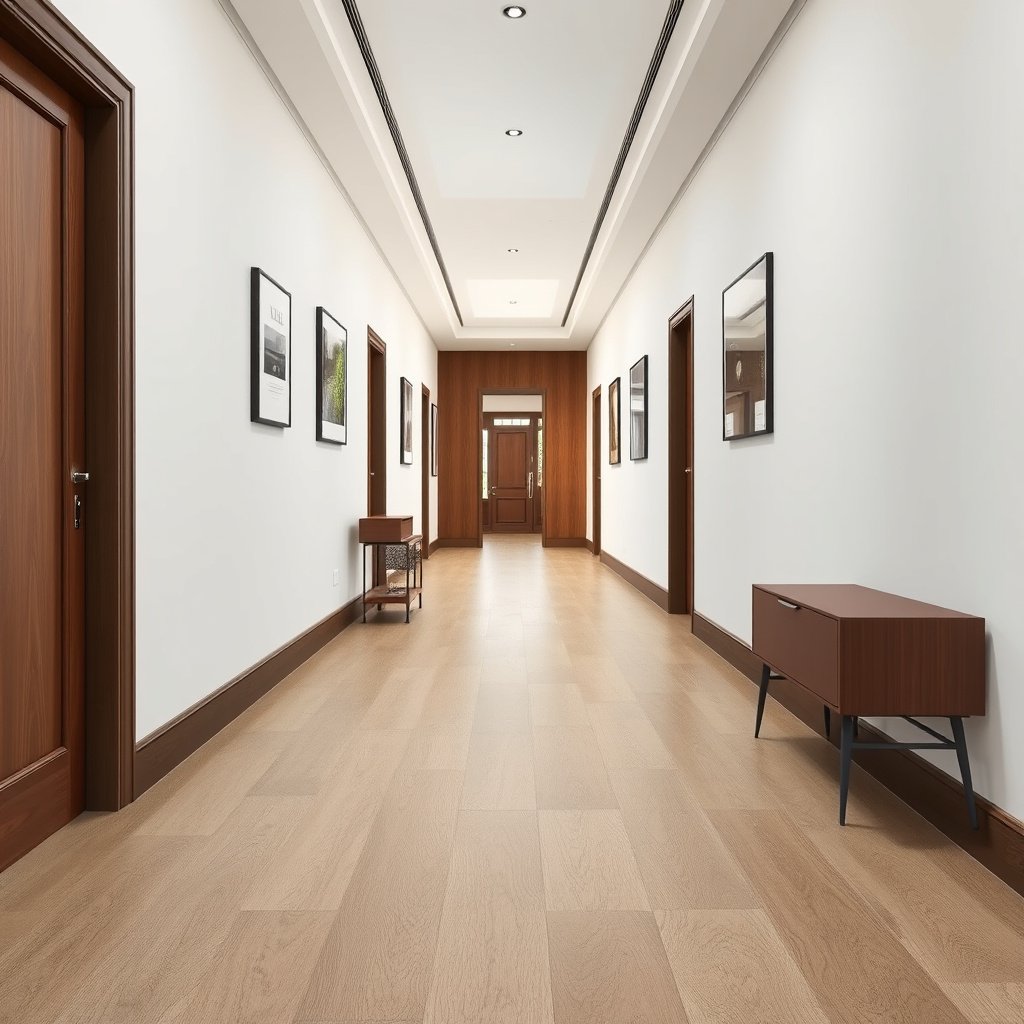
Your hallway vinyl should be chosen based on how “entry-like” the traffic pattern is, not just on the room size. Before you compare products, assess grit, moisture exposure, and where the heaviest wear concentrates (the doorway zone and any tight turns).
According to ASTM F710, resilient floors are sensitive to subfloor condition and preparation, and unevenness is a leading cause of installation problems at seams and edges. ASTM F710
In real homes, hallway vinyl floors often experience the highest soil abrasive load right at the exterior door transition, because tracked sand and dirt act like fine grit.
If a hallway sees wet boots or umbrellas, you must treat it as a moisture risk zone and confirm the product’s water/moisture guidance before installing vinyl floors for a hallway.
Start with these hallway “condition checks” that directly affect vinyl floors for a hallway:
– Think about how “entry-like” your hallway is (tracked-in grit, occasional wet umbrellas, salt/sand in winter).
Vinyl floors for a hallway are tough, but grit and particulate matter are what accelerate wear at scuff points. If you routinely see sand/salt near the threshold, plan for a higher wear layer spec and a surface finish that tolerates grit without rapid dulling.
– Measure your exposure to moisture and humidity and plan for what the floor can handle (especially around exterior doors).
The risk isn’t only puddles—it’s also repeated dampness and humidity cycling. If the hallway runs close to an exterior door, consider how water gets under mats (and how long it stays there), then check the manufacturer’s moisture testing requirements for your slab/subfloor type.
– Identify traffic intensity and direction (turns, narrow spots, and the area right at the doorway usually wear faster).
If you have a narrow corridor, tight corners, or a “funnel” from the entry, you’ll get localized scuffing where shoes land and pivot. Vinyl floors for a hallway should be selected with those patterns in mind—durability specs must match not only “high traffic,” but high abrasion and impact.
Choose the right vinyl type and construction
The best hallway vinyl type is the one that matches your subfloor condition and how you plan to install it. In general: floating click-lock vinyl is often easier for DIY, glue-down can be very stable, and vinyl sheet reduces seam risk where you want the fewest transitions.
Rigid-core vinyl (often sold as click-lock LVP/LVT) is designed to float, which can simplify installation while still requiring a properly prepared, flat subfloor.
Glue-down LVT/LVP requires adhesive and substrate preparation that aligns with the adhesive and flooring manufacturer instructions; otherwise, bonding failures can occur.
Vinyl sheet flooring can reduce seam-related entry points for dirt and moisture movement compared with planked floors, but it still depends on correct subfloor prep and moisture control.
Use this construction decision framework for vinyl floors for a hallway:
– Floating click-lock vinyl (often rigid core) is typically easier to install, but you still need a solid, flat subfloor.
Click-lock systems depend on the floor staying flat so locks engage and remain stable under load. Even small subfloor humps can create stress at seams and corners—exactly where hallway traffic concentrates.
– Glue-down vinyl can be a good fit when you want maximum stability, but it’s more sensitive to prep and adhesive requirements.
Glue-down can feel “more solid” and may resist movement better in challenging hallway layouts. However, it’s less forgiving if the subfloor is dusty, uneven, or outside the adhesive’s moisture limits.
– Vinyl sheet flooring can be a good hallway option if you prefer fewer seams; confirm it’s rated for the spaces you’re covering.
Fewer seams often means fewer edges for abrasive grit to pile up. That said, sheet still requires correct subfloor flatness and moisture conditions—especially near exterior doorways.
Click-lock vs glue-down vs sheet: what matters most
| System | Best when | Main risk if mis-matched |
|---|---|---|
| Click-lock (floating) | Subfloor is flat, you want easier installation | Lock stress and edge lift when the base isn’t flat or the perimeter isn’t handled correctly |
| Glue-down | You want strong stability and can meet adhesive/prep specs | Adhesive bond failures tied to moisture, dust, or incorrect adhesive/substrate pairing |
| Sheet | You want minimal seams in a hallway | Subfloor bumps/low spots telegraph through and compromise appearance or performance |
Pick thickness, wear layer, and slip resistance
The most important spec for vinyl floors for a hallway isn’t overall thickness—it’s the wear layer and the surface performance (including slip resistance). Choose a product whose documented durability and traction match real hallway use, not just marketing claims.
For LVP/LVT, wear-layer performance is a more direct indicator of scuff/abrasion resistance than overall plank thickness.
Slip resistance is often higher-impact in hallways because tracked dirt can reduce traction even when the area looks dry.
Many resilient floor safety evaluations reference ASTM D2047 using a dynamic coefficient of friction (DCOF) approach for slip resistance. ASTM D2047
Here’s how to shop the specs like a pro for vinyl floors for a hallway:
– Compare durability using the specs that actually matter:
– For LVP/LVT: wear layer thickness/rating (and sometimes the surface finish category).
– For construction: overall build quality and whether the surface includes a tougher topcoat system for scuffs.
– Prioritize slip resistance for hallways—people often underestimate this because hallways “feel dry” most of the time.
The hallway might look dry, but shoes can bring fine moisture and abrasive grit. Look for documented slip resistance testing (often ASTM D2047-based) and verify whether the rating applies to the way your hallway is used (dry vs contaminated/wet).
– Check compatibility with your cleaning routine (avoid products that the manufacturer says can damage finishes or embedded texture).
In a hallway, cleaning is more frequent. If the manufacturer restricts cleaners or disallows certain stripping/polishing products, follow those rules—otherwise you can accelerate scuffing, dullness, or surface breakdown.
Hallway Vinyl Spec Targets That Prevent Early Failure (2026)
| # | Spec to verify for hallway vinyl | What “strong” looks like | Why it matters in a hallway | Impact on early failure risk |
|---|---|---|---|---|
| 1 | Wear-layer durability (LVP/LVT) | Documented wear-layer spec (not just “residential use”) | Reduces scuff/abrasion where shoes land | ★★★★★ |
| 2 | Slip resistance (documented) | Slip rating/test method stated (commonly ASTM D2047) | Traction matters with tracked grit | ★★★★★ |
| 3 | Installation method match (click-lock vs glue-down vs sheet) | Plan matches the manufacturer’s approved install system | Prevents lock failure or bond failure | ★★★★☆ |
| 4 | Subfloor flatness tolerance | Use manufacturer tolerance; common benchmark is ASTM F710 limits | Stops seam lift and edge tenting | ★★★★★ |
| 5 | Moisture testing method + limits | ASTM test method stated + acceptable RH/MC/MVER range | Prevents edge swelling and bond issues | ★★★★☆ |
| 6 | Underlayment (only for click-lock where required) | Manufacturer-approved underlayment system used | Maintains lock performance and comfort | ★★★☆☆ |
| 7 | Cleaning limitations for the top surface | Approved cleaners listed; restrictions clearly stated | Limits premature dulling and residue buildup | ★★☆☆☆ |
Installation details that affect durability
The fastest way to protect hallway vinyl floors is to install them to the letter of the manufacturer’s subfloor, moisture, and clearance rules. Even the best wear layer won’t fix edge lifting caused by flatness issues, trapped moisture, or incorrect installation details.
According to ASTM F710, resilient flooring performance depends heavily on subfloor flatness and proper preparation prior to installation. ASTM F710
According to ASTM F1869, moisture vapor emission is reported in lb/1000 sq. ft./24 hr when using the calcium chloride test. ASTM F1869
Many warranties for click-lock and rigid-core flooring require exact adherence to approved underlayment, expansion gaps, and moisture conditions to remain valid.
A hallway is unforgiving, so installation for vinyl floors for a hallway must be treated as a system:
– Your subfloor flatness matters more than many people expect—use the manufacturer’s installation requirements, not generic rules of thumb.
In addition to the manufacturer’s number, a commonly cited benchmark for resilient installation prep is 3/16 in over 10 ft as referenced in ASTM F710 preparation guidance. ASTM F710 (Always treat this as a benchmark, not your installer’s excuse to skip the manufacturer’s required tolerance.)
– Plan for door clearances, transitions, and expansion/contraction rules (especially for click-lock floors).
Hallways often have multiple door swings and transitions to tile or hardwood. If gaps are too tight at doorways or if you skip the required perimeter allowance, click-lock joints can experience stress and “zipper” gaps over time.
– Address prep items up front: patching dips, smoothing ridges, and ensuring moisture conditions are within manufacturer limits.
Moisture control is not just about whether water exists—it’s about whether moisture moves under the floor. I’ve seen hallway vinyl failures start where mats stay damp overnight; —and the fix always starts before the planks go down.
Moisture testing: what to follow (not just what to measure)
For vinyl floors for a hallway, moisture testing must match the manufacturer’s testing method and acceptable range.
If you’re using concrete, ensure your moisture test plan aligns with the method the flooring line specifies (commonly RH probes per ASTM F2170, or MVER via ASTM F1869). ASTM F2170 ASTM F1869
What can go wrong when choosing hallway vinyl
Hallway vinyl fails early when shoppers choose based only on appearance or overlook the “weak links” (subfloor prep, slip resistance, and moisture movement). If you want durable vinyl floors for a hallway, prevent the failure modes below before installation—not after.
Premature wear in hallways often traces back to impact/scuff concentration where shoes repeatedly land, which is why documented wear-layer specs matter.
Resilient flooring warranties commonly include exclusions tied to improper installation, moisture conditions, and use of unapproved cleaners.
Even rigid-core floating floors can show edge issues when the substrate is not flat enough for the manufacturer’s tolerance. ASTM F710
Here are the most common problems we see (and how they connect to vinyl floors for a hallway):
– Buying based on appearance alone:
The most common regret is premature wear where shoes repeatedly land—especially right at the doorway and along the main path.
– Skipping slip-resistance verification:
Assuming slip performance is the same across a product line can be risky; hallways can be more hazardous because dirt can act like an abrasive and traction modifier.
– Poor subfloor prep:
Even strong vinyl can fail at seams/edges if the base is uneven or improperly prepared. Flatness issues create stress that shows up as gapping, edge curl, or cosmetic damage.
– Using the wrong underlayment (for click-lock) or skipping the needed one:
Underlayment is not just for comfort—it can influence locking performance and how the floor behaves under compression.
– Ignoring warranty limitations tied to installation, moisture, or cleaning products:
Always read the exclusions. If the warranty requires a specific moisture test method, exact adhesive, or approved cleaners, deviating can void coverage.
Best-way verdict: what to buy and who should skip it
For most busy hallways, the best choice is vinyl with a documented wear layer, proven slip resistance, and an installation plan that matches your subfloor reality. The second-best choice is “fix the base first” when moisture or flatness is questionable.
The safest path for vinyl floors for a hallway is matching the floor’s construction type (click-lock, glue-down, or sheet) to the approved installation system and substrate conditions.
If moisture testing shows the slab/subfloor is outside the manufacturer’s acceptable range, resilient flooring warranties typically won’t cover failures.
In 2026, buyers still make the same hallway vinyl mistake: choosing for looks first and tolerances second.
– For most busy hallways: choose LVP/LVT or rigid-core vinyl that’s explicitly rated for residential heavy traffic, and verify slip resistance plus the stated wear-layer durability.
Then confirm your installation method is consistent with the product’s instructions for your hallway layout.
– If your hallway subfloor is questionable (not flat, patchwork, or moisture-prone), don’t “hope the vinyl fixes it.”
Plan on correcting prep first, or choose an installation system that the manufacturer confirms for your conditions (and get that approval in writing).
– Downsides to watch (even when specs look good):
– Many vinyl floors are sensitive to moisture sitting under edges/spills that aren’t cleaned promptly (exact limits vary by product).
– Some surface finishes show scuffs sooner than others even if the wear layer is adequate—test the surface care guidance in writing.
– Who should skip this DIY approach:
– If you can’t meet the manufacturer’s prep requirements (flatness/moisture/adhesive rules), consider professional installation or a different flooring plan.
– If you have a long history of moisture issues in that hallway, before installing any resilient flooring.
Hallway vinyl checklist + FAQ
Use this quick scan when comparing hallway vinyl options so you don’t miss the specs that determine whether edges lift or the surface keeps looking good into 2026.
| What to check | What “good” looks like | Where to find it |
|---|---|---|
| Traffic rating / intended use | Listed as suitable for residential/high-traffic use | Product label/spec sheet |
| Wear-layer / durability | Clear durability info for LVP/LVT (not vague marketing) | Manufacturer specs |
| Slip resistance | Rated/indicated for safety in wet/dry conditions (as applicable) | Manufacturer documentation |
| Subfloor flatness + prep | Matches the manufacturer’s stated installation requirements | Installation guide |
| Moisture limits | Testing method and acceptable range stated | Installation guide |
| Installation method | Click-lock/glue-down/sheet matches your plan | Product + install guide |
| Cleaning + maintenance | Compatible cleaners/tools are specified | Care guide |
| Warranty terms | Exclusions for moisture, installation, and cleaning | Warranty document |
FAQ:
– Should I choose glue-down or click-lock vinyl for a hallway?
It depends on your subfloor and comfort level with prep. Click-lock is often simpler, but glue-down may be more stable when installed exactly per the adhesive and prep specs.
– How do I know if my vinyl is durable enough for daily shoe traffic?
Use the product’s stated wear layer/durability information and intended use—not just thickness or price.
– Is vinyl okay if my hallway gets wet from umbrellas or boots?
Only if the product’s moisture/water guidance supports it. If spills linger or moisture is recurring, you’ll need to follow the manufacturer’s limits and address the cause first.
– What’s the biggest reason hallway vinyl fails early?
Usually inadequate subfloor prep (especially unevenness) or not following the install and care instructions tied to the warranty.
Sources
If you tell me your hallway size, whether it’s near an exterior door, and whether your subfloor is concrete or wood, I can suggest what to prioritize (click-lock vs glue-down vs sheet) from the right spec categories.
Choosing vinyl floors for a hallway is mostly about matching the product to the reality of entry traffic: abrasive grit, moisture risk near doors, and concentrated wear at turns and thresholds. If you treat the process like a spec-and-system decision—construction type, wear layer, slip resistance, plus correct flatness and moisture testing—you’ll significantly reduce the odds of edge lifting and premature surface wear through the busiest months of 2026 and beyond.
Frequently Asked Questions
What type of vinyl flooring is best for a hallway?
For most hallways, luxury vinyl plank (LVP) or luxury vinyl tile (LVT) is a great choice because it’s durable, comfortable underfoot, and often looks like real wood or stone. Look for a wear layer that’s rated for heavy foot traffic, especially if your hallway connects to entrances or bedrooms. If moisture is a concern (near a front door or mudroom area), choose vinyl flooring designed for damp environments and ensure proper subfloor preparation.
How do I choose the right thickness and wear layer for hallway vinyl floors?
In a hallway, prioritize a thicker wear layer rather than just overall thickness, because that wear layer resists scuffs from shoes and furniture movement. Many homeowners find that LVP with a higher AC rating (or similar commercial wear rating) performs better in high-traffic areas. For added stability and quieter walking, consider a thickness around 4–6 mm for click-lock vinyl or thicker options for glue-down vinyl depending on your subfloor condition.
Which vinyl floor finish looks best and stays scratch-resistant in a hallway?
A low-sheen or matte finish often hides scuffs and small scratches better than high-gloss surfaces, which can show wear more quickly. Choose vinyl floors with realistic embossing (like embossed-in-texture) for a more natural look and better traction. If you have pets or frequent foot traffic, look for scratch-resistant coatings and a wear layer suited for residential “heavy traffic” use.
Why is water resistance and subfloor prep important when installing vinyl in a hallway?
Hallways often collect dirt, tracked-in moisture, and small spills, so selecting water-resistant vinyl flooring helps protect against warping and damage. Even the best vinyl can fail if the subfloor has cracks, uneven spots, or moisture issues, so clean, level, and properly prep the subfloor before installation. If you’re using a floating click-lock option, ensure moisture barriers are included or recommended for your floor system and climate.
How do I pick the right color and layout so vinyl floors work with hallway design?
Choose hallway vinyl colors that complement your walls, trim, and lighting, and consider a slightly warmer tone if the space feels cool or narrow. Light vinyl can make hallways feel larger, while mid-tone wood-look planks can hide everyday wear and dirt more effectively. For layout, longer plank lengths can visually elongate the space, and straight plank alignment often makes hallways feel more modern and cohesive.
📅 Last Updated: October 25, 2026 | Topic: How to choose vinyl floors for a hallway? | Content verified for accuracy and freshness.
References
- https://www.epa.gov/indoor-air-quality-iaq/volatile-organic-compounds-vocs
- Redirecting…
- vinyl flooring volatile organic compounds – Search Results – PubMed
- Vinyl flooring
- Vinyl composition tile
- Vinyl composition tile
- Flooring
- https://scholar.google.com/scholar?q=how+to+choose+vinyl+flooring+for+a+hallway+wear+layer+thickness+slip+resistance Google Scholar
- https://scholar.google.com/scholar?q=voc+emissions+from+vinyl+flooring+luxury+vinyl+tile+lvt+indoor+air+quality Google Scholar
- https://scholar.google.com/scholar?q=luxury+vinyl+plank+installation+and+maintenance+guidelines+resilient+flooring Google Scholar