
If you need to waterproof laminate floors in a retail store, the fastest route to a durable, spill-proof install is a full-system approach: proper subfloor prep, a perimeter moisture barrier, and sealed joints with an appropriate laminate-floor seam waterproofing product. This guide answers the practical question that matters in retail—how to stop water from getting into seams and underlayment where damage starts. Expect clear steps for sealing, where to focus around traffic lanes and wet zones, and what to avoid so the surface stays walkable and intact under daily abuse.




Waterproof laminate in a retail store is less about applying one “wet-look coat” and more about moisture control: protect against vapor coming from below, then seal only the joints/edges using an approach approved for laminate—plus keep water from repeatedly reaching seams with better entry and cleaning habits. In practice, that means correct vapor barrier/subfloor prep first, and then targeted seam/edge sealing and maintenance so everyday wetting doesn’t become a long-term leak pathway.
If your store has high foot traffic, frequent mopping, wet customers near entrances, or spills from carts/cleaning, these steps matter—because laminate is engineered to float and move, not to be permanently submerged. This is aimed at retail owners/managers (or contractors) working with laminate that must look good day-to-day while staying protected against everyday moisture.
Waterproofing strategy that actually fits laminate
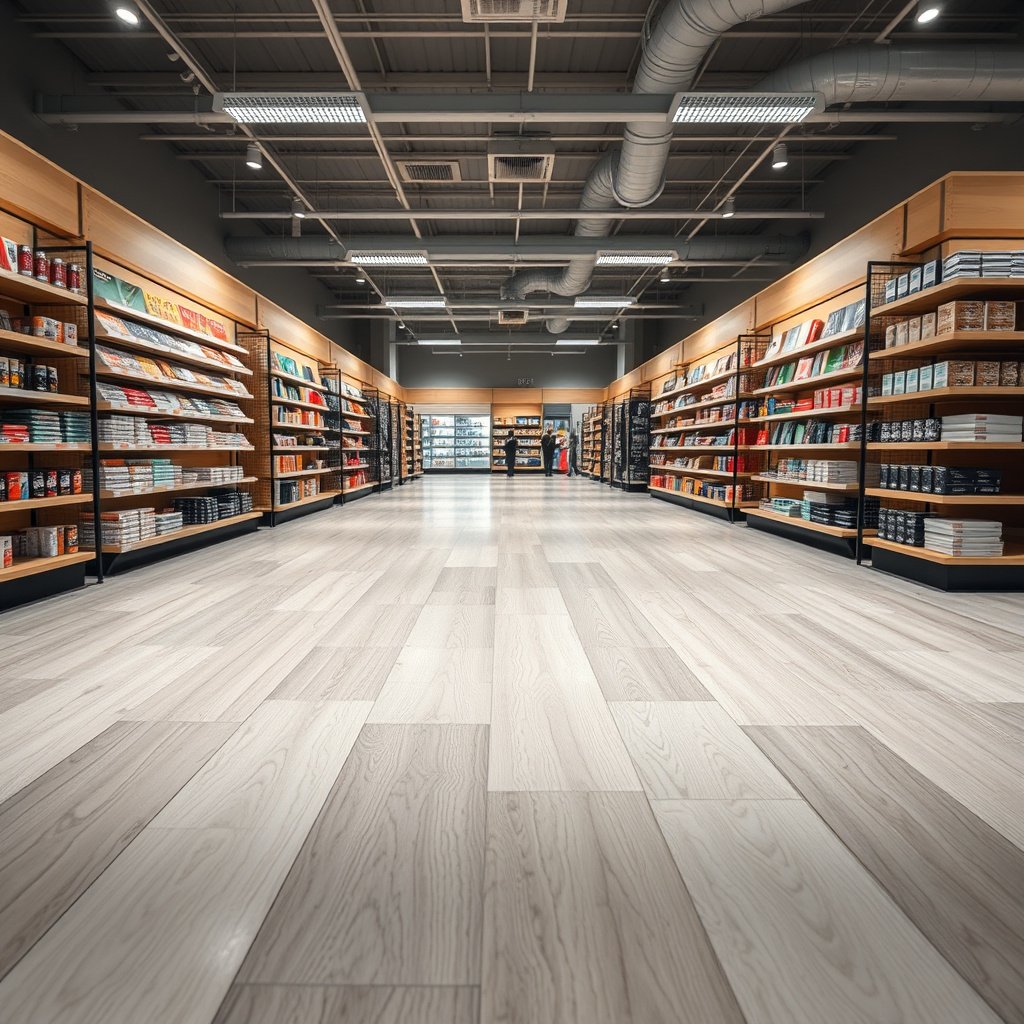
The strategy that works for laminate is to treat it like a moisture-control assembly (vapor barrier + installation-correct movement + seam/edge protection), not a surface-coating project. The goal is to stop moisture from reaching the joint lines—because seams and transitions are where water repeatedly “finds a way in.”
“Waterproof laminate” claims typically refer to resistance under normal spills, not guaranteed performance under sustained standing water or improper installation conditions.
ASTM E1745 defines vapor retarder classifications based on permeance, which is the key metric for whether moisture vapor can pass from slab to floor system. ASTM E1745
In laminate and other floating floors, movement (expansion and contraction) is built into the system, so sealing over expansion gaps can create buckling or seam separation that worsens water entry.
Confirm what “waterproof” means for your specific product
– Start with the manufacturer’s installation guide and warranty language and confirm whether your laminate is rated/approved for the moisture conditions in a retail environment.
– Pay special attention to how your brand defines “waterproof,” “water-resistant,” or “suitable for wet areas.” Many products mean better surface/edge resistance, not that the core is designed for continuous moisture exposure.
Plan for the real weak points in retail
In retail, the highest-risk areas are where water repeatedly contacts edges or where liquid can wick under boards:
– Seam lines (floating-joint edges)
– Perimeter edges and wall interfaces
– Transitions: doorways, floor vents, stair steps, ramps, and column bases
– Penetrations: around pipes, plumbing chases, floor-mounted fixtures, and electrical/in-floor conduit openings
Quick comparison: moisture-control system vs. “coat everything”
If you’re deciding between an installation-correct moisture-control approach and a generic coating strategy, here’s the practical contrast:
| Approach | Strengths | Likely failure points in retail |
|---|---|---|
| Vapor barrier/underlayment + laminate-approved seam/edge sealing | Controls moisture vapor from below and protects seam entry routes while preserving movement | Fewer problems if (1) subfloor flatness is corrected and (2) expansion gaps are respected |
| “Coat the whole floor” sealant or surface waterproofing film | Might improve surface scuff resistance | Risk of incompatibility with floating installation rules, seam performance, and warranty coverage; trapped movement can open new gaps |
Prep the subfloor and install moisture barriers correctly
The foundation of laminate waterproofing is boring but decisive: a flat, clean, dry subfloor and the exact vapor barrier/underlayment system your laminate manufacturer specifies. If moisture vapor is coming up from below, seam sealing alone usually can’t compensate.
Most laminate failures that look like “water damage” are actually a combination of moisture migration and movement—seals fail first when subfloor conditions are wrong.
ASTM E1745 uses permeance (perm) to classify vapor retarders, which is the measurable property that determines how much moisture vapor can pass. ASTM E1745
ASTM F2170 describes in-situ relative humidity testing for concrete slabs, which helps verify moisture conditions before installing moisture-sensitive flooring systems. ASTM F2170
Start with flatness, dryness, and cleanliness
– Fix out-of-flat areas before sealing anything. Laminate tolerates movement, but it does not tolerate large unevenness that stresses joints and edges.
– Remove debris and construction dust; particulate can compromise underlayment contact and can interfere with joint/seam systems.
– Ensure the subfloor is dry enough for your laminate’s warranty conditions. If you suspect intermittent wetting from HVAC, plumbing, or building envelope leaks, address that source first—otherwise you’re sealing symptoms.
Use the exact underlayment/vapor barrier combination specified
– Install the exact underlayment/vapor barrier combination listed in your laminate manufacturer’s installation guide: ()
– Don’t “substitute later” because a product is similar. In my experience reviewing retail installs that developed seam separation, the root cause was often a mismatched underlayment/vapor system—not the sealant used afterward.
Respect perimeter space and floating movement
– Leave expansion space at the perimeter per the laminate guide.
– Do not block expansion gaps with sealant. Blocking expansion gaps can trap moisture and prevent normal movement, which can lead to buckling, edge lift, and reopened seams that invite water again.
– If you’re sealing edges, do it in the way the system specifies—typically at the right interface and with the right material—so you protect edges without locking movement.
Seal seams, edges, and store transitions (where water gets in)
The best way to “waterproof” laminate seams is targeted sealing: protect seam lines, edges, and transitions using methods approved for laminate—not generic caulk or a one-size-fits-all waterproofing adhesive. Retail moisture almost always reaches the floor system through seams and interruptions in the floating plane.
Seam sealing is only as effective as the joint fit and installation details; water entry routes are often the first place you see swelling or edge breakdown.
Penetrations (pipes, vents, floor-mounted fixtures) are common hidden pathways because they interrupt underlayment continuity and create complex edge geometry.
Expansion and contraction are part of floating laminate performance, so edge sealing must be applied without interfering with the expansion gaps called out in the installation instructions.
Seal joint lines with a laminate-approved method
– Seal joint lines using a method approved for your laminate flooring—for example, a seam-filling system made for laminate rather than generic bathroom caulk.
– Follow your manufacturer’s instructions for whether sealing is required, optional, or limited to certain areas (like wet zones, entrance runs, or spill-prone aisles).
Apply edge protection at walls, door jambs, and transitions
Transitions are where retail water behavior becomes “real”: customers enter, carts scatter moisture, and mops push liquid around corners.
– Apply edge protection at walls, door jambs, and transitions using materials that won’t interfere with expansion (follow the product/installer instructions for “”).
– In doorways and other interruptions, use the correct trim/transition system so the floating floor isn’t pinned while still keeping water from wicking into the underlayment layer.
Don’t forget penetrations
For penetrations, plan for both water control and movement:
– Around pipes: use the penetration seal details from your flooring system (often a combination of gaskets, foam backer, and a compatible sealant).
– Around vents/floor-mounted fixtures: ensure the underlayment isn’t left exposed in a way that creates a direct wicking channel.
– If you’re building a maintenance routine, include quick visual checks for any “ringing” around penetrations after heavy cleaning weeks.
Protect the floor from repeated retail moisture
The most reliable “waterproofing” in a retail store is preventing repeated wetting from ever reaching the seams. Even a strong installation can struggle if your cleaning and entrance routine repeatedly dumps water along the same high-traffic lines.
Laminate systems perform best when cleaning avoids flooding; damp cleaning reduces the amount of liquid available to reach seams and edges.
Entry mats reduce tracked moisture and debris, lowering how often water contacts flooring interfaces near entrances.
Seasonal deep cleans and high-frequency mopping cycles increase the chance that minor seam wear becomes a water pathway if the workflow doesn’t include inspections.
Reduce exposure with entry-matting and spill response
– Upgrade entry matting at exterior doors and interior transitions. In many retail layouts, the “first 10 feet” is where moisture exposure becomes predictable and manageable—so focus protection there.
– Train staff on a rapid response workflow:
– blot/spill absorb first,
– then damp-clean rather than soak,
– and never leave puddles to evaporate across seams.
Use laminate-safe cleaning methods
– Use laminate-safe cleaning—typically damp microfiber mopping, not wet mopping.
– Avoid practices that flood the surface. Even when the floor resists surface water, excess liquid increases the odds that moisture finds micro-gaps at seams and transitions.
– If you use cleaners, stick to those recommended by the laminate manufacturer for compatibility (avoid harsh solvents or aggressive products that can degrade surface finishes).
Add maintenance checks into your retail workflow
Retail is not “install and forget.” As of 2026, most stores that sustain laminate performance treat maintenance like a schedule, not an afterthought:
– Inspect seam lines and edge caulking after:
– heavy cleaning weeks,
– seasonal deep cleans,
– winter/spring transitions (salt brine, rain, and wet boots).
– If you catch a small seam opening early, you often prevent a much larger repair later.
Common Polyethylene Vapor Barrier Thickness vs. Permeance (75°F)
| # | Material | Gauge | Approx. Permeance (perms) | ASTM E1745 Class | Moisture-blocking |
|---|---|---|---|---|---|
| 1 | Polyethylene vapor barrier (LDPE) | 4-mil | 0.09 | Class I | ★★★★★ |
| 2 | Polyethylene vapor barrier (LDPE) | 6-mil | 0.06 | Class I | ★★★★★ |
| 3 | Polyethylene vapor barrier (LLDPE) | 8-mil | 0.05 | Class I | ★★★★★ |
| 4 | Polyethylene vapor barrier (LDPE) | 10-mil | 0.04 | Class I | ★★★★★ |
| 5 | Polyethylene vapor barrier (LLDPE) | 15-mil | 0.03 | Class I | ★★★★★ |
| 6 | Polyethylene vapor barrier (LLDPE) | 20-mil | 0.02 | Class I | ★★★★★ |
| 7 | Polyethylene vapor barrier (HDPE laminate) | 30-mil | 0.01 | Class I | ★★★★★ |
Note: exact permeance depends on material formulation and test conditions; always defer to the laminate manufacturer and vapor retarder documentation for project-specific requirements.
What can go wrong (and why it matters in retail)
Most laminate “water damage” problems come from installation rule-breaking, not from laminate being inherently unsuitable for every store. In retail, the most costly failures happen when a small seam/edge issue turns into a repeated wetting cycle.
If a vapor barrier is missing or underspecified, seam sealing can’t stop moisture vapor transport—water problems start at joints and edges. ASTM E1745
Improper handling of expansion gaps can lock the floating floor and lead to buckling or separation, which opens new leak pathways.
Over-wetting during cleaning increases the amount of liquid available for wicking under boards, especially around transitions and penetrations.
Using the wrong “waterproof” product
– Many sealants/coatings aren’t compatible with laminate installation rules and can void warranties or fail at the seams.
– If the manufacturer requires specific seam systems, stick to those—not “whatever is waterproof in bathrooms.”
Skipping the vapor barrier or using the wrong underlayment
– Even perfect seam sealing won’t correct moisture vapor traveling through a slab.
– Underlayment mismatches can change how the floating system sits and moves, which can indirectly weaken seam integrity over time.
Trapping movement with blocked expansion gaps or pinned transitions
– Sealing over expansion gaps (or installing transitions that prevent movement) can cause buckling or seam separation.
– Once a separation opens, water becomes more likely to migrate below the boards in retail conditions where floors repeatedly get wet.
Over-wetting during cleaning
– Retail mopping can be “damp” in theory and “wet” in practice—especially when multiple passes are needed.
– If you notice faster edge breakdown near mop routes, entrances, or spill zones, adjust the cleaning workflow and add spot inspections.
A fast pros/cons decision filter (useful for store rollouts)
| Choice | Pros | Cons / risk in retail |
|---|---|---|
| Laminate-specified vapor barrier + seam system | Higher likelihood of warranty-compliant performance | Requires correct installation details and staff/contractor discipline |
| Generic waterproof caulk along seams | Might seem like quick protection | Often incompatible with movement; can crack, peel, or trap moisture |
| Frequent wet mopping to “keep it spotless” | Fast turnaround for visible cleanliness | Increases seam exposure; can shorten maintenance intervals |
Verdict, quick checklist, and FAQ
If you do moisture control correctly (vapor barrier + subfloor prep + laminate-approved seam/edge sealing) and manage day-to-day exposure with damp, laminate-safe cleaning and strong entry-matting, you can significantly improve laminate performance in a retail store—especially under the constant “everyday wetting” that retail creates. However, if you truly need standing-water resistance (like floors that are regularly flooded), you may be better served by a different flooring type; laminate is usually not designed to be fully waterproof everywhere in uncontrolled spill scenarios.
Laminate flooring performance in retail depends on moisture vapor control plus joint/edge protection; surface sealing alone usually doesn’t address moisture migration. ASTM E1745
ASTM E1745 and ASTM F2170 are commonly used frameworks for evaluating vapor retarding and slab moisture conditions when relevant to floor covering installations. ASTM E1745; ASTM F2170
Quick checklist (scan/save)
| Area | What to do | Why it matters |
|---|---|---|
| Subfloor | Verify flatness and dryness before install | Moisture + movement destroys seals first |
| Vapor barrier/underlayment | Use the exact option listed in your laminate guide | Prevents moisture vapor reaching joints |
| Expansion gaps | Keep perimeter gaps; don’t block them | Allows floor movement; avoids buckling |
| Seams | Seal with an approved laminate seam system | Joints are the main water entry route |
| Edges/transitions | Seal at doorways/penetrations using compatible materials | Prevents water migrating under boards |
| Cleaning | Use laminate-safe damp cleaning; limit pooling | Reduces repeated seam exposure |
| Maintenance | Inspect after heavy traffic/cleaning cycles | Catch early failures before they spread |
Frequently Asked Questions
How do you waterproof laminate flooring in a retail store without damaging the planks?
Start by using a laminate flooring system rated for moisture-prone areas and confirm the manufacturer allows installation over moisture barriers. Seal all seams and edges with a commercial-grade laminate seam sealer or waterproofing caulk made for the specific underlayment type. Keep spills from penetrating by sealing around doors, transitions, and baseboards, and maintain floor-wax or cleaners that are compatible with laminate surfaces.
What is the best way to prevent water from seeping under laminate flooring in a commercial space?
In retail environments, water often enters at expansion gaps, thresholds, and joint lines, so focus waterproofing where penetration starts. Install a full-coverage underlayment with an attached vapor barrier (or a separate 6-mil+ moisture barrier) and overlap and tape the seams carefully. Use door-threshold kits and caulk transitions so water and cleaning runoff can’t migrate under the laminate.
Which underlayment and moisture barrier should you choose for waterproof laminate floors in a shop?
Look for underlayment specifically designed for laminate waterproofing support, with a built-in vapor barrier and documented moisture protection. If you’re in a higher-risk setting (frequent mopping, spills, or coastal humidity), choose an underlayment with stronger moisture-blocking properties and seam-taped joints. Always follow the flooring warranty requirements—using the wrong underlayment can void coverage and reduce water resistance.
Why do laminate floors fail in retail stores after routine mopping, and how can you stop it?
Most laminate “water damage” happens when water gets into the tongue-and-groove joints, expansion gaps, or along the perimeter where edges aren’t sealed. Retail cleaning methods can add extra moisture if mops are too wet or if spills sit for long periods. Improve waterproofing by sealing seams, using a proper underlayment vapor barrier, and adopting cleanup procedures that remove standing water quickly.
How do you waterproof around baseboards, doorways, and transitions where laminate meets other flooring?
Waterproofing at edges is critical because water tends to travel along gaps and building junctions. Apply waterproof caulk at the perimeter where molding meets the wall and at any expansion gaps, and use transition strips with sealing where laminate meets tile, carpet, or entry mats. For doors and thresholds, install commercial threshold reducers or kits designed to block water movement while still allowing for floor expansion.
📅 Last Updated: October 24, 2026 | Topic: How to waterproof a laminate floors with retail store? | Content verified for accuracy and freshness.
References
- Laminate flooring
- Waterproofing
- Underlayment
- F1869 Standard Test Method for Measuring Moisture Vapor Emission Rate of Concrete Subfloor Using …
- F2170 Standard Test Method for Determining Relative Humidity in Concrete Floor Slabs Using in sit…
- https://www.sciencedirect.com/search?qs=laminate%20floor%20moisture%20barrier
- https://pubmed.ncbi.nlm.nih.gov/?term=laminate%20flooring%20moisture
- https://scholar.google.com/scholar?q=waterproofing+laminate+flooring+sealing+joints Google Scholar
- https://scholar.google.com/scholar?q=laminate+floor+underlayment+moisture+barrier+installation Google Scholar
- https://scholar.google.com/scholar?q=concrete+moisture+vapor+testing+ASTM+F2170+laminate+flooring Google Scholar