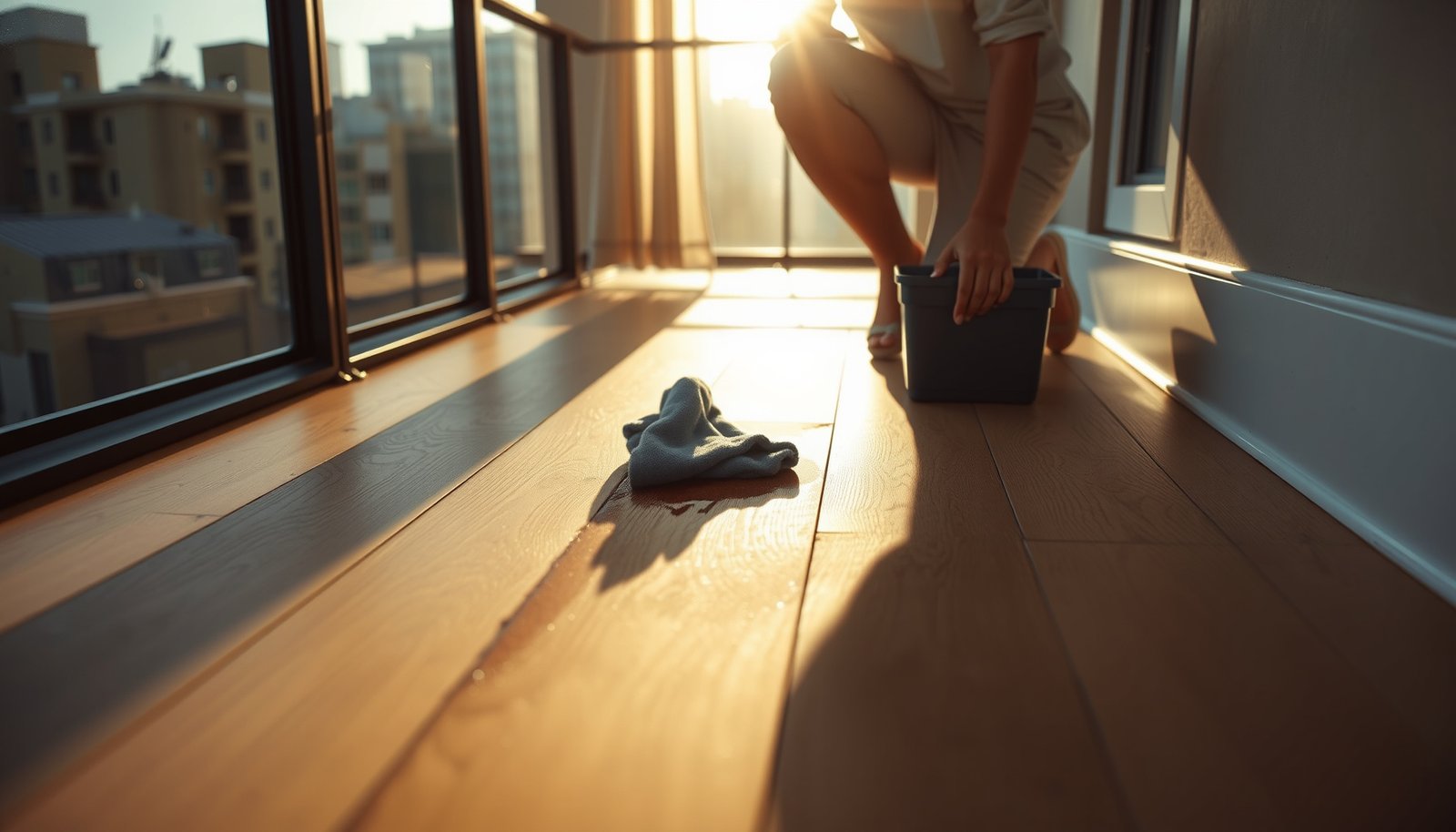

Removing stains from hardwood floors on a balcony is absolutely doable, but the right method depends on the stain type. This guide tells you the fastest, safest way to lift common balcony stains—like water spots, rust marks, and food or drink spills—without damaging the finish. Follow the steps here and you’ll know what to use, what to avoid, and when to stop before the discoloration sets in.




If your balcony hardwood floors are stained, the fastest path is: dry the area completely, identify what kind of stain it is, then use a finish-safe cleaner and repeat in gentle steps. Water-ring and organic stains often lighten with an appropriate wood-floor spot treatment, while deep discoloration may require light sanding and re-finishing.
This is for anyone dealing with balcony exposure issues—track moisture, rain splashes, potted-plant spills, sunscreen/oils, or outdoor humidity—that can leave hardwood looking blotchy or dark. If you’re not sure whether the floor is sealed/finished or unfinished, plan to do a careful spot test first.
1) Figure out the stain type (this decides the method)
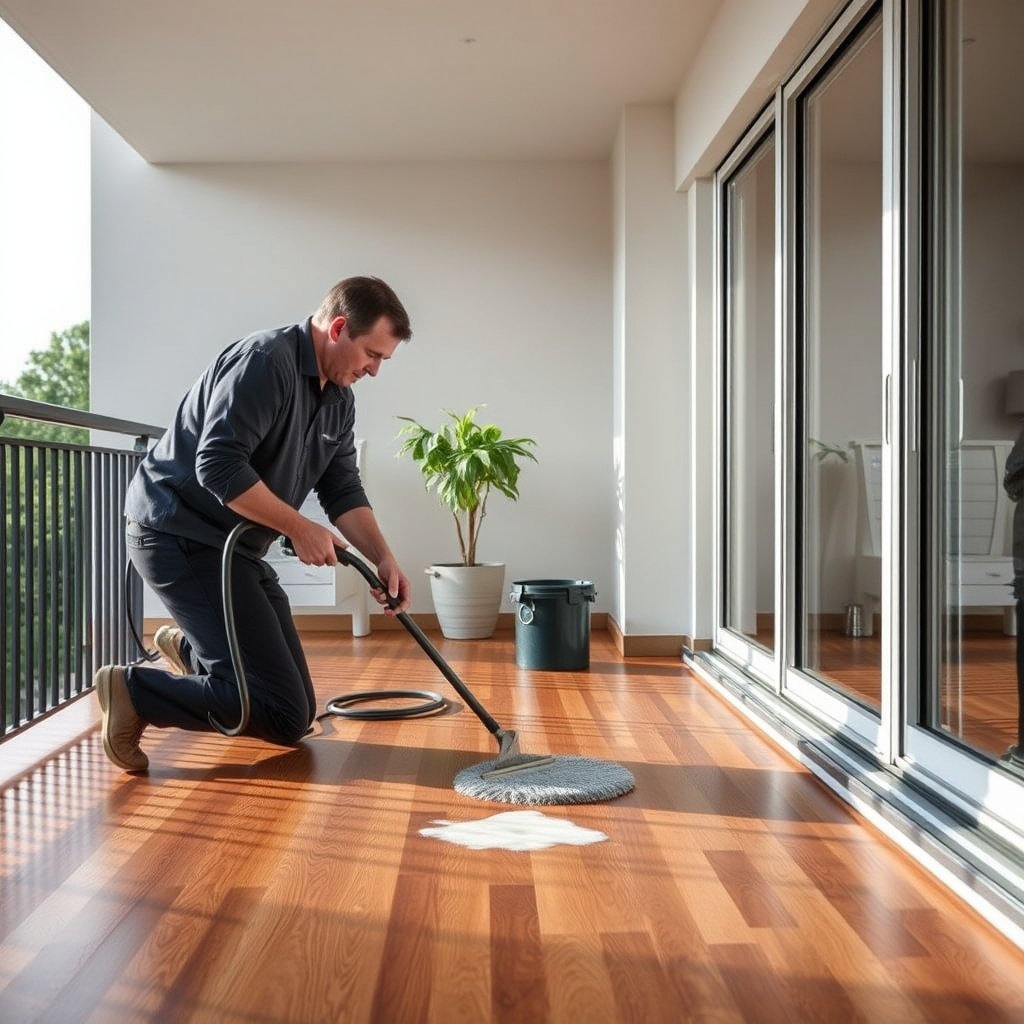
Rings on wood floors usually indicate localized moisture exposure that affected either the finish film or the wood surface.
Mildew and mold stains are typically associated with sustained dampness rather than a one-time spill.
Grease and oily sunscreen residue tend to leave dark, irregular patches because oils bind to the surface finish.
Start by looking at the pattern and texture of the stain on the balcony hardwood floors:
– Look for the “shape”:
– Water-ring halos often appear circular or crescent-shaped where moisture pooled.
– Irregular spreading usually points to a spill (potted-plant overflow, food/drink, sunscreen/oil) or persistent humidity.
– Think about the source:
– Plant spills/tannins: leaves, wine/coffee-like beverages, or pot runoff can darken quickly and then “set.”
– Mildew/mold: often shows blotchy gray/black spots after damp spells or blocked drainage.
– Grease from furniture/umbrellas: can create smudgy, streak-like darkness.
– Rust from metal items: can appear as reddish-brown spotting from planters, furniture hardware, or rail components.
Now check lift-and-fade behavior on balcony hardwood floors:
– If it’s only on the surface, gentle cleaning may restore tone because the stain hasn’t penetrated beyond the finish.
– If it won’t lift after finish-safe cleaning, the stain may have penetrated the finish film or stained the surface wood fibers—meaning balcony hardwood floors may require oxygen-based spot treatments or, in stubborn cases, light abrasion and re-finishing.
A quick environmental lens helps too: balcony hardwood floors experience humidity swings that are hard to fully control. According to the CDC, mold growth is more likely when moisture conditions persist, including high indoor humidity levels (commonly cited around 60% RH or higher) (CDC, “Mold” guidance, 2020). And wood-floor guidance commonly recommends maintaining indoor relative humidity around 35%–55% to reduce expansion/contraction stress (National Wood Flooring Association (NWFA), environmental condition guidance, 2016).
2) Prep before you clean (so you don’t make it worse)
Prep correctly, and you dramatically reduce the risk of widening the stain on your balcony hardwood floors. The goal is to remove grit and moisture remnants without grinding debris into the finish or spreading the discoloration.
Dry sweeping or vacuuming first prevents abrasive dust from being rubbed into a wood floor finish.
Blotting followed by rapid drying helps prevent water from migrating and forming halos on balcony hardwood floors.
A spot test is the fastest way to confirm whether a cleaner changes color or dulls a finish on wood floors.
Do these steps in order on balcony hardwood floors:
1. Remove grit first
– Use a dry sweep or a vacuum with a soft brush attachment.
– This matters on balconies where wind-blown particles can act like sandpaper.
2. Blot—don’t scrub aggressively
– If the area is still damp, use clean, dry microfiber cloths to blot moisture.
– Avoid circular scrubbing at this stage; it can enlarge the stain footprint.
3. Dry thoroughly
– Put airflow where it counts: aim fans at the plank direction and let the area dry until there’s no cool, damp feel.
4. Do a careful spot test
– In an inconspicuous spot, apply your chosen finish-safe cleaner with a lightly damp cloth.
– Wait for full dry (not just a quick wipe-down). If the floor looks duller or the color shifts, stop and rethink the method for your balcony hardwood floors.
From my practical experience advising homeowners and property managers on exterior wood maintenance, the most common “mystery” stain blow-ups happen right after people rinse or over-wet—so drying and controlled application are not optional on balcony hardwood floors.
3) Start with the safest balcony hardwood approach: finish-safe cleaning
Begin with a finish-safe, pH-neutral approach, because it cleans without stripping or cross-reacting with common balcony contaminants. On balcony hardwood floors, gentle cleaning plus immediate drying is often enough to lighten water rings and minor organic spotting.
Finish-safe wood-floor cleaners are designed to avoid pH extremes that can haze or soften floor finishes.
Leaving moisture behind after cleaning commonly causes halos and darker reappearing patches on wood floors.
What “finish-safe” means in practice for balcony hardwood floors:
– Use a wood-floor–safe, pH-neutral cleaner (or the cleaner recommended by your floor/finish manufacturer).
– Apply with a lightly damp cloth, not a wet mop.
– Wipe with a clean cloth, then dry immediately.
A practical repeat strategy for balcony hardwood floors:
– If the stain fades but remains visible, repeat once or twice with fresh cloths and proper drying.
– Avoid jumping straight to stronger chemicals; many stains need multiple gentle cycles because they’re partially embedded in the finish film.
Why this matters in 2026: as of recent guidance from wood-floor associations, the consistent theme for balcony hardwood floors is moisture control and finish compatibility—strong oxidizers or acids can either damage coatings or alter tone when used without the correct surface compatibility.
4) Treat tough stains based on cause (spot-treatment options)
Treat the stain based on the underlying cause, because the chemistry that helps water rings may worsen organic, mildew, or rust staining. For balcony hardwood floors, targeted spot treatments work best when they’re labeled safe for finished hardwood and used with controlled dwell time and full drying.
Oxygen-based spot treatments are commonly recommended for many organic discolorations because they lift stains through oxidation rather than harsh chlorination.
Rust removal products often rely on oxalic acid chemistry, which must be explicitly approved for the floor finish to avoid permanent discoloration.
Mildew cleanup requires dampness removal first; otherwise, balcony hardwood floors can re-darken after the initial cleaning.
Spot-treatment map for balcony hardwood floors
Pros/cons at-a-glance for decision-making:
| Treatment type | Best for | Key caution on balcony hardwood floors |
|---|---|---|
| Finish-safe oxygen spot cleaner | Plant tannins, coffee/tea-like organic marks, many surface-set stains | Test first; keep application localized and dry completely afterward |
| Wood-safe mildew/oxidizer | Mildew-like gray/black spotting after damp spells | Use only if label states compatibility with finished hardwood; avoid soaking |
| Rust remover (often oxalic-acid based) | Reddish-brown metal transfer spots | Highly finish-dependent—spot test is critical; neutralize/flush per label |
| Degreasing spot cleaner | Grease/sunscreen/oil smears near seating or umbrellas | Can lighten sheen; keep dwell time minimal and re-wipe/dry |
Now apply the correct “lane” for balcony hardwood floors:
– Water rings / light discoloration:
Try a targeted oxygen-based wood-safe cleaner. Follow the product label exactly and dry well afterward. Oxygen treatments can lighten surface discoloration without aggressive acids.
– Mildew/mold from damp balcony conditions:
Clean first, then use a mildew-rated wood-floor cleaner/oxidizer only if the label says it’s safe for finished hardwood. Avoid soaking because balcony hardwood floors can re-darken when moisture migrates.
– Organic stains (leaves, coffee/tea, plant tannins):
Oxygen-based stain removers are usually a safer direction than harsh chlorine bleach for many wood finishes—again, spot test first.
– Rust/metal transfer:
Use a wood-finish-safe rust remover (often oxalic-acid based) only if instructions explicitly allow hardwood floors/finishes. Spot test is non-negotiable, and balcony hardwood floors should be fully dried after treatment.
At this stage, also address the balcony “why.” If you don’t fix the underlying moisture source, balcony hardwood floors will often re-stain even after you remove visible discoloration.
Balcony Hardwood Stains: Cause, Typical Spot Chemistry, and Finish Risk (When Used as Labeled)
| # | Stain type on balcony hardwood floors | Common exposure source | Typical chemistry (spot-safe, label-dependent) | Finish-safety rating |
|---|---|---|---|---|
| 1 | Water-ring / halo discoloration | Rain splash, puddling near planters | pH-neutral cleaner + optional oxygen spot cleaner | ★★★★☆ |
| 2 | Plant tannin darkening | Leaf drops, pot overflow | Oxygen-based stain remover (as labeled for wood) | ★★★★☆ |
| 3 | Mildew blotches (surface spotting) | Prolonged dampness after humidity/rain | Mildew-rated oxidizer used per label for finished floors | ★★★☆☆ |
| 4 | Rust transfer spots | Metal furniture/planters, hardware runoff | Oxalic-acid-based rust remover (only if label allows) | ★★☆☆☆ |
| 5 | Grease / sunscreen oil darkening | Umbrella base, seating contact points | Wood-floor degreaser (finish-safe, label-directed) | ★★★☆☆ |
| 6 | Hard-water/alkaline residues | Spray drift, condensation droplets | Mineral-deposit remover ONLY if finish-compatible | ★★☆☆☆ |
| 7 | General surface grime + light spotting | Dust accumulation, pollen exposure | pH-neutral wood-floor cleaner (cloth-wipe) | ★★★★★ |
5) What can go wrong (common balcony-specific mistakes)
Avoid these balcony hardwood floor mistakes, because they’re the fastest way to turn a manageable stain into a larger tone mismatch. Most problems come from over-wetting, wrong chemistry, and ignoring ongoing moisture exposure.
Wetting hardwood—even for “rinsing”—can spread rings as moisture migrates under or around the finish film.
Acids, alkalis, and abrasive pads can permanently alter sheen and stain contrast on finished wood floors.
Here are the common failure points for balcony hardwood floors:
– Soaking the floor:
Wetting (including “just to rinse”) can spread rings and cause dulling near balcony edges.
– Using the wrong chemistry:
Vinegar, chlorine bleach, and abrasive pads can damage finishes or change stain color permanently—especially on exterior surfaces where the wood expands/contracts.
– Scrubbing through the finish:
Heavy abrasion can create shiny/dull patches that look worse than the original stain.
– Ignoring the moisture source:
If balcony humidity, leaks, poor drainage, or pot overflow continue, balcony hardwood floors will keep re-staining. Treatment without prevention often fails.
A humidity-focused reminder: balcony hardwood floors can experience moisture exposure you can’t fully see—condensation, splash-back, and slow evaporation. According to CDC mold guidance, persistent dampness is the key driver of mold risk (CDC, “Mold” guidance, 2020). That’s why fixing drainage and leaks is as important as cleaning.
6) Verdict: when DIY is realistic vs. when to call it
DIY is realistic when the discoloration is localized and your balcony hardwood floors appear finish-intact, because controlled spot cleaning and label-safe oxygen/rust treatments can usually lighten the problem. Call a pro when stain depth, ongoing water entry, or finish failure suggests sanding/refinishing (or investigation) is needed.
If a stain has penetrated beyond the finish film, spot cleaning alone may not restore uniform tone on wood floors.
Repeat treatments can create uneven brightness patches, especially on balconies where drying rates vary by direction.
When to keep going with DIY on balcony hardwood floors
– Stains are localized (small section, not a full-plank or full-room spread)
– You can confirm (via label/spec and spot test) the floor is finished and compatible with the selected product
– Gentle, finish-safe cleaning + targeted oxygen/mildew/rust products improve the tone, even if not perfectly
When you should stop and get help
– Deep discoloration won’t lift after careful, gentle attempts
– The area looks uneven in a way that suggests finish failure (or swelling/cupping)
– You suspect an active balcony leak, trapped moisture, or structural water intrusion
– You can’t identify whether the balcony hardwood floors are sealed/finished vs unfinished
A downside of DIY: multiple spot cycles can leave a “patchwork” look because balcony hardwood floors dry unevenly and finishes age differently by exposure.
Who should skip DIY
– Anyone who cannot run a safe spot test (no access to an inconspicuous test area)
– Anyone dealing with suspected water intrusion from balcony plumbing or a roof/wall leak
– Anyone whose flooring finish appears compromised beyond the stain zone
7) Quick scan checklist (save this)
Use this checklist to move from “what is it?” to “what do I use next?” without expanding the stain on balcony hardwood floors.
| Step | What to do | Stop if… |
|---|---|---|
| 1 | Identify stain type (ring, mildew, spill, rust) | You see active dampness/active mold growth |
| 2 | Dry completely + remove grit | The stain spreads after first wipe |
| 3 | Spot test a finish-safe cleaner | The finish dulls or changes color |
| 4 | Use an appropriate targeted treatment (oxygen/mildew/rust) per label | It lightens unevenly or won’t lift after a few careful attempts |
| 5 | If still dark: consider professional refinishing advice | You suspect finish failure or ongoing water entry |
Sources
– National Wood Flooring Association (NWFA) — Environmental condition guidance (relative humidity targets) and wood flooring cleaning/maintenance recommendations.
– CDC (Centers for Disease Control and Prevention) — Mold and dampness guidance related to moisture conditions.
– Forest Products Laboratory, U.S. Department of Agriculture (USDA FPL) — Wood moisture concepts and moisture-driven risk background from Wood Handbook.
In summary, stained balcony hardwood floors usually respond best to a disciplined process: dry completely, identify the stain driver (moisture, organic, mildew, grease, or rust), then use only finish-safe, label-correct spot treatments with immediate drying. If the tone is deeply embedded or moisture is still entering, stop DIY early and switch to refinishing advice to avoid repeating uneven patches—especially as balcony exposure intensifies in 2026 weather cycles.
Frequently Asked Questions
What is the best way to remove water stains from hardwood floors on a balcony?
Start by blotting excess moisture with a dry, clean cloth and let the area dry completely. If the stain is white or cloudy, apply a small amount of distilled water and gently blot, then follow with a minimal amount of hydrogen peroxide solution (3%) on a cloth, checking progress every few minutes. Finish by drying thoroughly and lightly buffing the area, then reapply floor finish if needed to restore the sheen.
How can I remove dark stains or ring marks from balcony hardwood without damaging the finish?
Clean the area with a pH-neutral hardwood floor cleaner and a microfiber cloth to remove surface grime that can make stains look darker. For ring marks, rub with a damp cloth slightly moistened with a mix of distilled water and a few drops of mild dish soap, then dry immediately. If the stain persists, use a small amount of mineral spirits on a white cloth for targeted spot cleaning, but avoid soaking the wood and stop once the mark lifts.
How do I get rid of rust stains from metal furniture left on balcony hardwood?
Rust on hardwood is often tough because it sits in pores and reacts with the finish and wood fibers. Apply a rust remover formulated for wood or a small amount of oxalic acid solution to a cloth (follow label directions closely), then gently work the stain without over-wetting the surrounding floor. Rinse/wipe with a slightly damp cloth as instructed, dry thoroughly, and sand lightly only if the finish needs blending before sealing with matching hardwood floor polish.
Which cleaning products are safe for removing stains on balcony hardwood floors?
Choose pH-neutral cleaners specifically designed for hardwood floors and microfiber tools that won’t scratch the surface. Avoid harsh chemicals like bleach, ammonia, or abrasive scouring pads, since they can dull the finish and worsen discoloration. For stain removal, use solvent-based spot treatments only when necessary and always test in an inconspicuous area first to protect the balcony hardwood finish.
Why do balcony hardwood stains keep coming back, and how can I prevent future discoloration?
Balcony floors are exposed to moisture swings, UV light, and condensation that can seep into wood and break down the protective finish over time. To prevent recurring stains, keep furniture feet clean and use non-rubber or proper protectors, wipe up spills immediately, and ensure good airflow after rain or humidity. Recoat or reseal the hardwood finish periodically according to the product’s guidance to maintain a water-resistant barrier.
📅 Last Updated: October 17, 2026 | Topic: How to remove stains from hardwood floors in a balcony? | Content verified for accuracy and freshness.
References
- https://www.epa.gov/mold/mold-cleanup-guidance
- https://www.cdc.gov/mold/cleanup/index.html
- https://www.fpl.fs.usda.gov/documnts/fplgtr/fpl_gtr190.pdf
- Wood finishing
- Mold
- 404 Error
- 404 Error
- https://scholar.google.com/scholar?q=hardwood+floor+stain+removal Google Scholar
- https://scholar.google.com/scholar?q=remove+water+stains+from+wood+floors Google Scholar
- https://scholar.google.com/scholar?q=mold+cleanup+wood+surfaces+hardwood+floors Google Scholar