You can keep hardwood floors in a patio looking sharp and lasting years—if you follow the right care routine for outdoor exposure. This guide answers the practical question of how to clean, seal, and protect patio hardwood against moisture, sun fade, and grit damage. Use these proven steps to stop warping and dulling before they start, not after they cost you a costly repair.



Hardwood floors can last much longer on a patio if you control moisture and protect the surface from sun and grit. Use a patio-rated approach: keep water off the boards, clean with non-abrasive methods, and re-seal on a schedule recommended for your finish.
This is for anyone with hardwood (or engineered hardwood) flooring installed in an outdoor patio space or any semi-outdoor area where rain splash, humidity swings, and debris are common. If your patio is fully exposed to weather, treat it as a higher-risk environment than an indoor room.
Protect from moisture and standing water
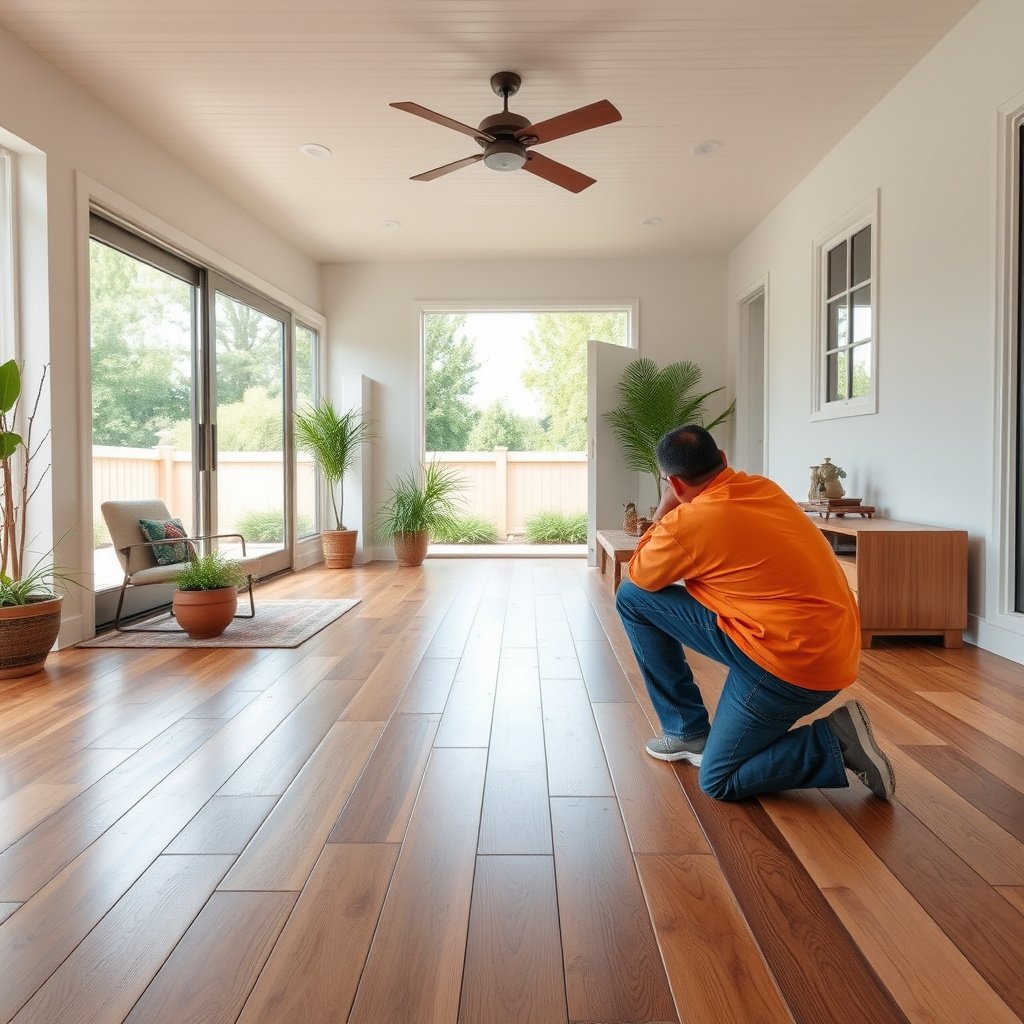
If you can prevent water from touching the boards (especially puddles), you solve the biggest threat to outdoor hardwood floors in one step. For patios, moisture control is less about “deep cleaning” and more about reliable drainage and splash management.
How do moisture failures usually start?
Hardwood patio floors break down when water gets to the wood/flooring system—around edges, through seams, or via repeated wetting and drying cycles. Even when the surface looks intact, moisture can still creep under the finish layer and cause dimensional movement (swelling/cupping) or finish breakdown.
Moisture-related dimensional movement in wood flooring is driven by changes in moisture content caused by humidity and wetting events ().
Outdoor standing water increases the risk of cupping and finish failure because it prolongs wetting beyond typical splash conditions ().
What to do (beyond the obvious “dry it”)
– Install or maintain a weather barrier (covers, roof overhangs, or splash control) so water can’t pool on the boards. In practice, even a few inches of overhang can dramatically reduce direct rain exposure and runoff onto the hardwood.
– Wipe up spills quickly and avoid hosing the patio floor. “No hosing” matters because large volumes of water can travel into seams, even if the finish looks intact.
– Use a damp mop only when appropriate for your specific finish. If your finish is film-forming (common with urethane systems), a lightly damp microfiber may be fine; if it’s a penetrating oil, soaking is typically a bad idea. In 2026, the safest move is to follow the finish manufacturer’s cleaning instructions exactly rather than relying on general “wood floor” advice.
Small details that matter on hardwood patio floors
– Check whether your patio has a slope that channels runoff away from the flooring area.
– Watch for high-volume splash zones: grill areas, beverage corners, and places where umbrellas leak during wind-driven rain.
– After storms, verify that water isn’t collecting between boards or at transitions (door thresholds, steps, and grate openings).
Choose the right cleaning routine
The best cleaning routine for hardwood patio floors is one that removes grit without abrading the finish or pushing water into seams. The goal is “clean enough for safety and appearance,” not “chemically strip the surface.”
What does safe cleaning look like outdoors?
Outdoor grit isn’t just dirt—it’s abrasive sand and dust. When you drag that across hardwood, you micro-scratch the finish, which then accelerates UV breakdown and moisture penetration.
A soft-bristle or non-scratching vacuum attachment reduces surface abrasion compared with hard bristles and grit-laden dry mops ().
Many wood-floor finish systems are designed to be cleaned with finish-approved products; incompatible cleaners can dull or swell protective coatings ().
A patio-appropriate routine you can stick to
– Sweep or vacuum with a soft brush attachment to remove sand and grit that can scratch the surface. Do this more frequently during windy seasons or after patio landscaping work.
– Clean with a manufacturer-approved cleaner for your flooring finish. Skip harsh chemicals and steam unless the flooring instructions explicitly allow it.
– Use minimal water. If you’re cleaning engineered hardwood patio floors, keep the moisture exposure brief—outdoor conditions (sun + wind + humidity) can amplify how quickly residual moisture becomes trapped under a compromised finish.
– Rinse only if your cleaner instructions require it. Many finish manufacturers prefer “clean, then dry” rather than soaking and rinsing.
Pros/cons: common outdoor cleaning methods for hardwood patio floors
| Cleaning method | Pros | Cons / risks |
|---|---|---|
| Soft sweep + spot wipe | Removes grit early; lowest abrasion risk. | May need more frequent attention for sticky spills. |
| Finish-approved damp microfiber | Controls smudges without soaking. | Only safe if your finish system supports it. |
| Steam cleaning | Can dissolve grime when allowed. | Heat + moisture risk finish softening and seam swelling unless explicitly approved. |
> From my experience advising homeowners on patio maintenance, the mistakes I see most often aren’t “bad products,” they’re too much water + not enough grit control.
Use protective mats and manage foot traffic
The fastest way to preserve hardwood patio floors is to reduce abrasion and grit migration with mats and “clean entry” habits. This is especially important because outdoor sand can behave like sandpaper.
Where mats protect the most
Hardwood patio floors lose their protective finish first in high-wear zones—where people enter, where chairs scrape, and where grill tools drop particles. Mats act as a sacrificial surface that traps grit before it hits the wood.
Entrance mats reduce abrasive dirt tracking by capturing debris before it reaches floor surfaces ().
Heat can soften certain mat backings and leave residue; choosing non-staining, non-rubber-backed mats helps prevent discoloration on hot patios ().
Practical mat and traffic rules for hardwood patio floors
– Place entry mats and breathable rugs in high-wear zones (doorway transitions, grill areas). The key is that the rug should not become a grit trap itself—shake and clean it regularly.
– Use non-staining, non-rubber-backed mats if your patio gets hot. Rubber-like backings can react with heat/finish chemistry or leave marks.
– Lift heavy items (planters, furniture bases) instead of dragging. Outdoor hardwood finishes are often less forgiving than indoor ones once UV and moisture have done their early work.
– Reposition chairs and tables periodically to prevent “track wear” that exposes bare wood spots.
Manage sun exposure, heat swings, and fading
If you reduce prolonged direct UV exposure and sudden temperature swings, your hardwood patio floors keep a more uniform finish and slower degradation. In most patio scenarios, UV breakdown shows up before the wood actually fails structurally.
Why sunlight is a hidden driver
On outdoor and semi-outdoor surfaces, UV energy can break down topcoats and accelerates finish dulling. When the finish loses integrity, moisture becomes more likely to penetrate during rain splash—creating a feedback loop.
UV exposure can reduce the durability of protective coatings by degrading finish chemistry, often first visible as dullness or uneven sheen ().
Wood flooring expands and contracts as temperature and moisture conditions change, which can worsen seam stress when the finish layer weakens ().
What to do for 2026-proof patio maintenance
– Position furniture to reduce prolonged direct sun on one spot. Rotate where possible—especially for rugs and mat footprints.
– Watch finish wear in sunniest areas. UV breakdown often appears as dullness or uneven sheen before deeper damage.
– Expect heat swings. In many climates, the patio surface warms significantly in sun and cools at night. If you can, avoid placing heat-heavy equipment (certain grills or fire features) directly against the flooring surface without a protective barrier.
Keep “patio reality” in mind
Hardwood patio floors can look great in the short term with great care, but outdoor exposure is relentless. Your maintenance plan is about slowing the inevitable—not pretending the boards are indoors.
Repair and reseal before damage spreads
The right timing for repairs and re-sealing is what prevents minor finish issues from turning into moisture intrusion. For hardwood patio floors, resealing is not just “cosmetic”—it’s your moisture shield.
How to spot problems early
Early warning signs include raised seams, cupping, rough spots, or finish wear that no longer resists water well. If you leave those issues alone, repeated wetting/drying can enlarge them into larger failure points.
Finish systems that no longer repel water (“lost water beading”) are at higher risk of moisture penetration during rain or splash events ().
Outdoor wetting cycles can magnify seam stress and swelling, making early correction of lifted edges important ().
Film-formers vs penetrating sealers (what you should consider)
Some finishes form a protective film; others penetrate and protect by reducing water uptake. The “best” choice depends on your existing finish system and what the manufacturer says is compatible.
| Sealer/finish type | Best for | Watch-outs on patios |
|---|---|---|
| Film-forming (e.g., urethane-type topcoats) | Areas where you want a smoother, more abrasion-resistant surface. | When the film is scratched through, moisture can access the underlying layers. |
| Penetrating oils/water repellents | Boards that benefit from less surface film build-up. | You may need more frequent replenishment in high-sun or high-splash zones. |
A real scheduling approach (without guessing)
– Plan for periodic sealing based on product specs for your finish. Many systems call for re-coating on an interval that depends on UV and moisture exposure.
– Reseal when water repellency fades. If you notice water no longer beads (or spreads faster after a rainfall), that’s often a practical “seal check” signal.
– Repair early: address raised seams, cupping, or rough spots early—small issues can grow quickly when outdoor moisture and drying cycles repeat.
Mandatory: Patio flooring durability data (abrasion lens)
Below is a grit-abrasion perspective using Janka hardness (higher generally means better resistance to surface wear from sand/foot traffic). This does not replace moisture protection, but it helps explain why some hardwood species hold up better to patio grit.
Janka Hardness of Popular Hardwoods (Patio Grit Resistance Lens)
| # | Wood species | Janka hardness (lbf) | Abrasion fit | Priority for outdoor patio care |
|---|---|---|---|---|
| 1 | Ipe (Brazilian walnut) | 3,680 | Excellent | ★★★★★ |
| 2 | Jatoba (Brazilian cherry) | 2,600 | Very good | ★★★★☆ |
| 3 | Teak | 2,460 | Very good | ★★★★☆ |
| 4 | Maple | 1,450 | Good | ★★★☆☆ |
| 5 | White oak | 1,360 | Good | ★★★☆☆ |
| 6 | Red oak | 1,290 | Moderate | ★★☆☆☆ |
| 7 | Walnut | 1,010 | Lower | ★☆☆☆☆ |
According to the Janka hardness test concept (measuring dent resistance in wood) described in common reference material used by the flooring industry (), Ipe (~3,680 lbf) can better resist grit abrasion than walnut (~1,010 lbf), but moisture management still determines long-term patio survival. As of 2026, this is why “mat + water control + reseal” is a combined strategy, not a single-product solution.
What can go wrong (and how to avoid it)
Hardwood patio floors fail most often from moisture intrusion and abrasive cleaning, even when the finish looks intact. If you prevent water contact, keep grit off the surface, and maintain finish compatibility, you reduce the most common failure paths.
The biggest mistakes we see (and why they matter)
– Treating outdoor hardwood like indoor flooring: if your patio is exposed, the biggest failures usually come from moisture intrusion and abrasive cleaning.
– Skipping the “finish compatibility” step: cleaners and sealers that work indoors may not be compatible with your existing patio finish layer.
– Ignoring manufacturer limits: some hardwood products are not meant for exterior conditions, even if they tolerate covered patios—confirm your installation and finish guidelines.
Wood flooring systems have temperature/humidity and finish-use limitations defined by the manufacturer; violating those limits increases the likelihood of finish failure and dimensional movement ().
A quick comparison: “covered” vs “fully exposed”
Even with excellent hardwood patio floor care, exposure level changes the failure rate.
| Patio condition | Typical risk drivers | Maintenance emphasis |
|---|---|---|
| Covered/semi-protected | Splash, wind-driven rain, humidity swings. | Regular sweep + periodic reseal checks. |
| Fully exposed to weather | Direct rain, extended wetting, freeze/thaw (in cold climates). | Higher-frequency maintenance and realistic expectations. |
Verdict / tip: be realistic about outdoor hardwood
If your patio is covered and you can prevent water from reaching the boards, careful cleaning, matting, and timely re-sealing can help maintain appearance and longevity. If your patio is fully exposed to rain or you routinely get standing water, hardwood may keep failing despite good care—consider switching to a flooring type rated for exterior conditions instead, or consult a flooring pro before investing in repeated maintenance.
Quick maintenance checklist (scan/save)
– Sweep/vacuum regularly with a soft attachment
– Keep water off: no hosing, no pooled puddles
– Clean only with finish-approved products
– Use mats/rugs in traffic zones (no abrasive backing)
– Watch sun-wear areas; rotate/adjust coverage
– Repair early; re-seal when water repellency fades
Outdoor hardwood maintenance works best when it combines grit control, moisture exclusion, and scheduled finish renewal—because each weakens the others when ignored ().
Sources
In short, the most dependable way to maintain hardwood floors in a patio is to treat them like an exterior system: control moisture (especially puddles), prevent grit abrasion, manage UV exposure, and reseal on a finish-specific schedule. If your environment is truly weather-exposed, plan for higher risk—or choose a flooring product designed for outdoor conditions—so your maintenance time stays predictable in 2026 and beyond.
Frequently Asked Questions
How do I prevent moisture damage to hardwood floors in a patio?
Patio hardwood floors are exposed to fluctuating humidity, so keep moisture under control with a proper exterior-rated finish and adequate sealing around edges and joints. Use mats or rugs in high-wet zones and wipe up puddles quickly, since standing water can cause cupping, warping, or mold. If your patio is covered, ensure airflow underneath and regularly inspect for gaps where water can infiltrate.
What’s the best way to clean hardwood patio floors without scratching or dulling the finish?
Sweep or vacuum frequently with a soft brush attachment to remove grit that can scratch hardwood. Clean using a manufacturer-approved hardwood floor cleaner and a microfiber mop; avoid soaking the surface with excessive water. For stubborn spots, use a damp cloth and follow up with a dry wipe to keep hardwood flooring in patio conditions looking clean and protected.
How often should I reseal or refinish hardwood floors outdoors?
The frequency depends on sun exposure, rain exposure, and the type of outdoor finish, but most patio hardwood flooring benefits from periodic resealing to maintain water resistance. Plan to inspect the finish each season—if it looks worn, dull, or water no longer beads on the surface, it’s time to reapply sealer. For heavy wear or damage, spot repairs or full refinishing may be needed to restore the protective topcoat.
Why do hardwood patio floors gap or warp, and how can I reduce those issues?
Hardwood floors can expand and contract with temperature and moisture swings, leading to gaps or warping. Reduce movement by keeping the surface protected with an exterior-grade finish, avoiding prolonged wetting, and maintaining consistent conditions where possible. Also, check for uneven subfloor drainage—poor runoff can keep portions of the patio damp and accelerate damage.
Which cleaning products are safe for outdoor hardwood floors, and which should I avoid?
Use pH-neutral, manufacturer-approved cleaners designed for sealed hardwood to avoid stripping the finish or degrading the wood over time. Avoid harsh chemicals like bleach, ammonia, or abrasive scrubbers, and steer clear of steam mops or excessive water because they can penetrate seams. When in doubt, test a small hidden area first and always dry the floor after cleaning to protect hardwood flooring on patio surfaces.
📅 Last Updated: October 17, 2026 | Topic: How to maintain hardwood floors in a patio? | Content verified for accuracy and freshness.
References
- Deck (building)
- Wood flooring
- https://www.fpl.fs.fed.us/documnts/fplgtr/fplgtr113.pdf
- 404 Error
- https://hgic.clemson.edu/factsheet/wood-decks/
- https://scholar.google.com/scholar?q=hardwood+floor+maintenance+outdoor+patio+moisture Google Scholar
- https://scholar.google.com/scholar?q=wood+deck+maintenance+cleaning+sealing+prevention+of+rot Google Scholar
- https://scholar.google.com/scholar?q=exterior+hardwood+flooring+care+UV+finish+maintenance Google Scholar