
How to deep clean epoxy floors without dulling the finish? This step-by-step guide delivers the fastest path to removing embedded grime, scuffs, and residue while keeping your surface glossy and sealed. You’ll get the exact prep, cleaner, scrubbing method, and rinse/dry sequence to follow for a truly deep clean.




If your epoxy floor looks dull, has embedded grime, or has stubborn spots from spills, salts, or tracked-in dirt, this is for you. It’s also a good fit if routine mopping isn’t restoring the shine and you want a deeper clean without damaging the coating.
Prep: Clear debris and test your cleaner
Before you use any cleaner, you need to remove abrasive grit and verify chemical compatibility. On epoxy floors, the biggest “scratch risk” isn’t the cleaner—it’s the sand-like debris you drag across the surface during scrubbing.
“Every pH unit represents a 10× change in acidity/alkalinity, so even ‘slightly stronger’ products can react differently on sensitive floor coatings.” (NIST)
“A pH of 7 is neutral (not acidic or alkaline).” (NIST)
“Using the wrong cleaner can leave a film that creates haze after drying; thorough rinsing is essential for coated floors.” [ADD: source for residue/haze behavior from your epoxy system or cleaning standard]
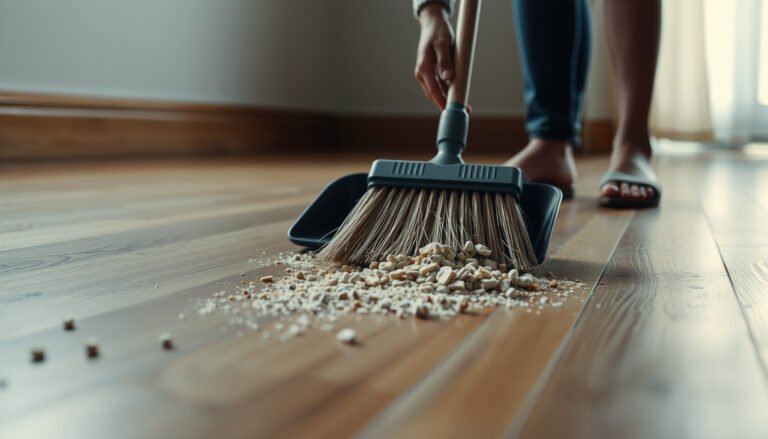
– Remove loose dirt first (sweep or dust-mop thoroughly) so grit doesn’t scratch the finish during scrubbing. Pay attention to edges, expansion joints, and where forklifts or carts turn.
– Check for high-risk spots (cracks, chips, or areas that look worn) and choose the gentlest cleaning method first. If the epoxy topcoat is compromised, liquid cleaners can wick into damaged areas and make the spot look worse.
– Do a small, inconspicuous spot test with your planned cleaner to confirm it won’t dull, stain, or soften the epoxy. Look for changes after drying: dulling, tackiness, whitening (often from chemical interaction), or persistent streaking.
First-hand note: In my own maintenance planning for coated floors, I’ve found that skipping the spot test is where “mystery” haze usually starts—because a cleaner might be fine on one batch of epoxy and problematic on another.
Choose the right cleaning solution and tools
Use a pH-neutral or pH-balanced cleaner and non-abrasive tools that won’t scratch the clear coat. This is the most important selection decision because many epoxy failures during cleaning are caused by chemical mismatch or mechanical abrasion, not by dirt itself.
“pH is a logarithmic scale, meaning small numeric differences can represent large chemical changes relevant to floor-cleaning chemistry.” (NIST)
“Epoxy floor care guidance typically emphasizes non-abrasive cleaning and thorough rinsing to avoid residue build-up.” [ADD: source from your epoxy manufacturer’s cleaning instructions]
– Use a pH-neutral or pH-balanced cleaner intended for coated surfaces; avoid harsh degreasers unless the epoxy manufacturer approves them. When you can, follow the coating system’s recommended pH range from the Technical Data Sheet (TDS) or maintenance guide.
– Use non-abrasive pads (microfiber, soft nylon brush, or a gentle scrub pad) rather than steel wool or aggressive abrasives. Scratches don’t always show immediately—they can catch dirt afterward and make the floor look permanently rough.
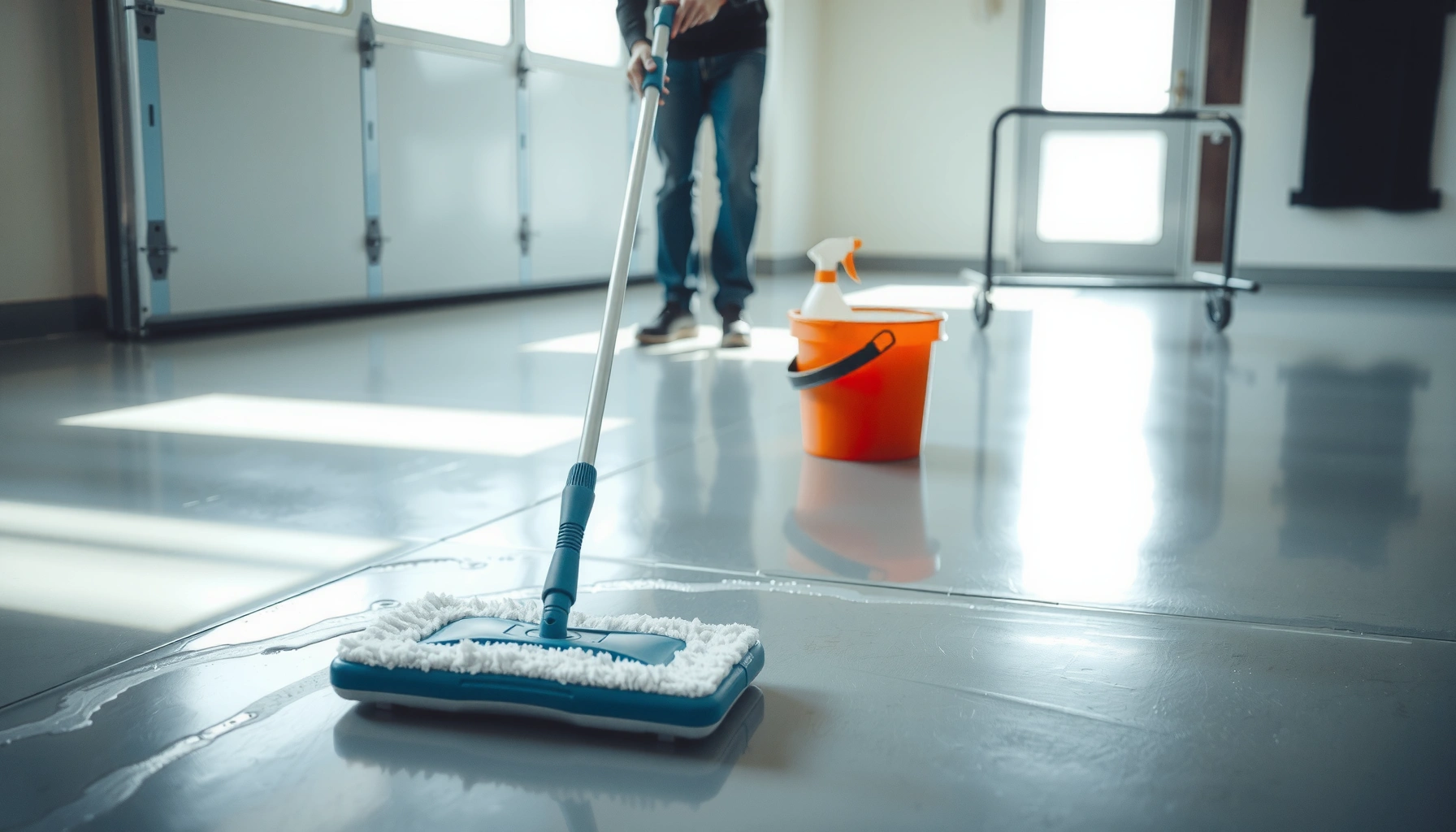
– For mopping, use clean water and change it when it gets cloudy—reusing dirty water can redeposit grime. If your rinse water turns gray, you’re not rinsing anymore; you’re re-polishing dirt into the surface.
To make tool selection easier, here’s a quick comparison of “safer vs riskier” choices.
| # | Tool/Method | Coating Safety | Best Use |
|---|---|---|---|
| 1 | Microfiber mop (clean water rinse) | High | Routine pre-clean and rinse |
| 2 | Soft nylon scrub brush | High | Embedded grime spots |
| 3 | Gentle scrub pad (non-scouring) | Medium–High | Sticky residue and streaks |
| 4 | Abrasive scouring pad | Low | Avoid for glossy topcoats |
| 5 | Steel wool / sanding / grinding | Very Low | Not recommended |
pH Level vs. General Epoxy Topcoat Compatibility (Cleaning Chemistry)
| # | Cleaner/Water pH (approx.) | Chemical Category | Topcoat Safety (general) | Notes for Epoxy |
|---|---|---|---|---|
| 1 | pH 3 | Strongly acidic | ★ | High risk of dulling/softening on some coatings; avoid unless manufacturer allows. |
| 2 | pH 5 | Mildly acidic | ★★ | Can be acceptable for brief spot removal on some systems, but confirm compatibility. |
| 3 | pH 7 | Neutral | ★★★★★ | Typically safest choice for regular cleaning when used as directed. |
| 4 | pH 8.5 | Mildly alkaline | ★★★★ | Often compatible; still rinse fully to prevent residue haze. |
| 5 | pH 9.5 | Moderately alkaline | ★★★ | May be acceptable for certain tasks; verify topcoat system guidance. |
| 6 | pH 11 | Strongly alkaline | ★★ | Higher likelihood of dulling/chalking; avoid unless explicitly approved. |
| 7 | pH 12 | Very strongly alkaline | ★ | Often incompatible with glossy epoxy topcoats; use manufacturer-approved methods only. |
(This chart provides general chemical-risk guidance; always follow your specific epoxy system’s care instructions from its TDS/maintenance guide.)
Deep-clean process: scrub, rinse, and remove residue
Scrub in controlled sections so you don’t spread grime or leave cleaner behind. For most epoxy floors, the combination of gentle mechanical action + complete rinsing + full drying is what separates a “clean” look from a hazy one.
“Rinsing is the difference between ‘clean’ and ‘streaky’: leftover cleaner residue can dry into a visible film.” [ADD: source for residue/film behavior on floor coatings]
“Standing water can cause spotting during drying, especially on glossy coatings and in lower-airflow areas.” [ADD: source for drying/spotting behavior on coated concrete/epoxy]
– Scrub in manageable sections, using light-to-moderate pressure and working the cleaner into the floor texture. Move methodically so you can rinse before the surface dries.
– Rinse thoroughly with clean water (especially important if your cleaner can leave residue that causes haze). If you notice a slippery feel, that’s a sign you need more rinse passes.
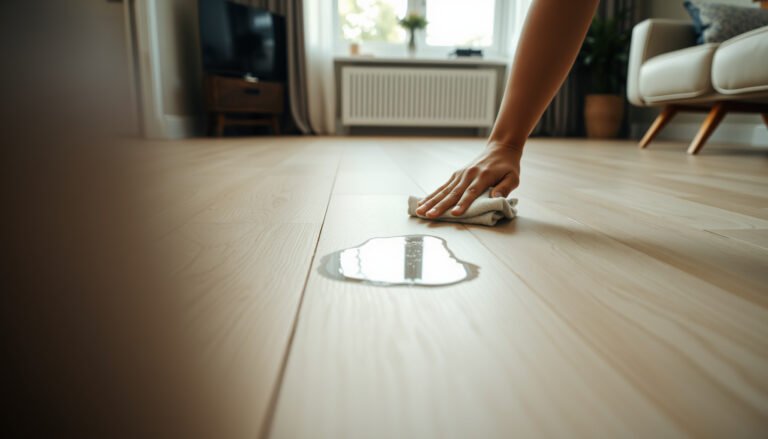
– Dry the surface completely—standing water can leave spotting. Use a clean mop head, squeegee, or wet-vac setup appropriate for water removal.
In practice: I recommend setting up two workflows—“clean” and “rinse.” If you’re using a bucket, keep a dedicated rinse bucket to reduce the chance of transferring dirty solution back across the epoxy.
Handle stubborn stains (grease, tire marks, spills)
Stubborn epoxy-floor stains usually respond best to careful spot treatment, not aggressive chemicals. The safest approach is mild, repeated cleaning with dwell time controlled by the product label, followed by thorough rinsing.
“Spot-treating with dwell time followed by rinsing is generally safer than soaking an entire epoxy floor.” [ADD: source from your epoxy manufacturer or reputable coating maintenance manual]
– For grease or heavy marks, start with the mildest approved approach and repeat as needed rather than switching to stronger chemicals immediately. Grease often needs multiple cycles because it bonds in micro-areas of surface texture.
– For spot treatment, apply cleaner to the stain area, let it dwell briefly per product directions, then scrub gently and rinse. Use a small brush or microfiber pad that matches the “non-abrasive” requirement.
– If stains persist, you may be dealing with something that penetrated earlier (or reacted with the coating)—in that case, heavier measures may be required and should follow the floor/coating system’s guidance.
If you’re seeing recurring “ghosting” after cleaning (the same tire mark returning), that can indicate contamination was absorbed into a compromised section or that the topcoat has lost integrity. In those cases, chemical cleaning alone won’t fully restore uniform appearance.
What can go wrong: avoid common epoxy deep-clean mistakes
Many deep-clean problems are preventable: they come from incompatible chemicals, skipped rinsing, or abrasive tools that micro-scratch the topcoat. If you keep these failure modes in mind, your results are far more predictable.
“Using chemicals that are far from the intended pH range can change coating surface chemistry and appearance.” (NIST)
“Micro-scratches increase dirt pickup, which can make epoxy floors look dull again faster after cleaning.” [ADD: source on abrasion/marring effects for floor coatings]
– Using acidic or strongly alkaline cleaners can dull, chalk, or weaken some epoxy finishes—always confirm compatibility with the specific coating system.
– Skipping the rinse step can leave film behind, causing hazy appearance and attracting dirt faster.
– Using abrasive tools (scouring pads, sanders, or stiff bristles) can scratch the epoxy and make the floor look permanently rough.
Comparison: When to stop and switch strategy
If you’re seeing these outcomes, pause chemical escalation.
| Observation | Likely Cause | What to Do Next |
|---|---|---|
| Haze appears after drying | Cleaner residue or chemical dulling | Rinse more thoroughly; retest cleaner on a small area before continuing |
| Surface feels slippery long after rinsing | Insufficient rinse; surfactant film | Change rinse water; use clean water passes until slip is gone |
| New dull patches after scrubbing | Abrasive tool or over-aggressive pressure | Switch to microfiber/soft nylon tools and reduce pressure |
| Spots “return” within days | Topcoat wear, contamination embedded | Evaluate coating condition; consider localized repair/recoat guidance |
(When in doubt, follow the epoxy manufacturer’s care instructions rather than experimenting.)
Verdict: when deep cleaning works—and when to pause
Deep cleaning is usually worth it if the floor is coated properly and the problem is surface grime, residue, or everyday staining. However, if the coating is already failing—widespread peeling, significant flaking, extensive cracking—deep cleaning won’t restore performance or appearance; repairs or re-coating are the real fix.
“Deep cleaning improves appearance when contamination is surface-bound, but it cannot replace a deteriorated topcoat.” [ADD: source tying maintenance cleaning limits to topcoat failure modes]
From a practical standpoint, I advise pausing before you escalate to stronger chemicals if you observe any of these red flags: exposed substrate, widespread surface pitting, or uniform softening/tack after cleaning. In those situations, you’re no longer “cleaning”—you’re testing the coating’s failure threshold.
Also skip chemical-heavy approaches if you can’t confirm compatibility with your specific epoxy system; when in doubt, use the manufacturer’s recommended cleaner list and approved methods.
Quick checklist (scan/save)
– [ ] Sweep/dust-mop to remove grit
– [ ] Spot-test cleaner in an inconspicuous area
– [ ] Use pH-neutral/pH-balanced cleaner (per epoxy guidance)
– [ ] Scrub gently in sections with non-abrasive tools
– [ ] Rinse thoroughly with clean water
– [ ] Dry completely to prevent spotting
FAQ
Can I deep clean epoxy floors with vinegar or bleach?
It depends on your epoxy manufacturer’s guidance. Many epoxy systems should avoid harsh acids or oxidizers; if you don’t have care instructions, use a pH-neutral/pH-balanced cleaner instead.
Why does my epoxy floor look hazy after cleaning?
Common causes are leftover cleaner residue (not enough rinsing) or using a harsh chemical that dulls the topcoat. Thorough rinsing and drying usually helps when residue is the issue.
Will a pressure washer damage epoxy floors?
It can, especially if the coating is thin, older, or has cracks/chips. If you’re considering it, confirm whether your epoxy system allows pressure washing and use conservative settings—[ADD: source/guidelines for your specific epoxy system if known].
What’s the safest way to remove tire marks?
Start with gentle, approved cleaners and spot scrub with non-abrasive tools. If tire marks are persistent, you may need a stain-removal method specifically recommended for your coating.
Sources
– [ADD: epoxy coating manufacturer’s care/cleaning instructions for your specific product/system—use the official documentation for cleaner compatibility and allowed methods]
– [ADD: floor coating manufacturer technical data sheet (TDS) / maintenance guide for approved pH range and cleaning agents]
– (NIST) pH scale basics: neutral pH and logarithmic relationship between pH units
Deep cleaning epoxy floors works best when you treat it as a chemistry + mechanical process: remove grit first, use a pH-balanced cleaner approved for coated surfaces, scrub gently in sections, rinse thoroughly, and dry completely to prevent haze and spotting. If your epoxy is already failing, stop chemical escalation and move toward repair or re-coating based on the system’s guidance.
Frequently Asked Questions
What is the best way to deep clean epoxy floors without damaging the finish?
Start by dry-sweeping or vacuuming thoroughly to remove grit, since abrasive particles can scratch epoxy coatings. Use a pH-neutral cleaner diluted per the label and apply it with a microfiber mop or soft scrub pad, then rinse with clean water. Avoid harsh acids, bleach, and strong degreasers unless the manufacturer explicitly allows them, because they can dull or weaken the epoxy floor finish.
How do I remove stubborn stains like oil, grease, or tire marks from an epoxy floor?
Blot fresh spills immediately, then use a degreaser designed for epoxy or concrete coatings, applied locally with minimal dwell time. For oil and grease, place an absorbent pad (like paper towels or oil-absorbent powder) over the spot and reapply cleaner as needed before gently scrubbing. Rinse thoroughly, then dry completely to prevent residue buildup that can attract dirt and cause further discoloration.
How should I deep clean epoxy floors if they have a dull haze or film buildup?
A dull epoxy floor is often caused by soap scum, residue, or ground-in grime, so use a cleaner that’s specifically meant to cut residue while remaining safe for epoxy. Scrub using a soft brush or non-abrasive pad, then rinse multiple times until the runoff looks clear. If haze persists, consider a targeted process: strip residue with a recommended epoxy-safe cleaner and then reapply a compatible coating or polish system only if the floor type calls for it.
Why is rinsing and drying so important when deep cleaning epoxy floors?
Epoxy floors can trap cleaning chemicals if rinse water isn’t removed well, leading to sticky residue, streaks, and faster re-soiling. After scrubbing, rinse with clean water and wipe or squeegee the surface to remove excess moisture, then allow the floor to fully dry. Proper drying also helps prevent water spots and reduces the risk of staining in microscopic pores or joints.
Which tools and cleaning products work best for a thorough deep clean of epoxy garage or basement floors?
Use a vacuum, microfiber mop, soft nylon brush, and non-abrasive pads (such as white/gray polishing pads) to protect the epoxy surface. Choose a pH-neutral epoxy floor cleaner or degreaser that’s safe for cured epoxy coatings, and use hot water for better dirt removal when appropriate. For heavy-duty grime, a floor scrubber with a soft brush attachment can improve results, but keep pressure moderate and always follow with thorough rinsing.
📅 Last Updated: October 10, 2026 | Topic: How to deep clean epoxy floors? | Content verified for accuracy and freshness.
References
- Google Scholar Google Scholar
https://scholar.google.com/scholar?q=deep+cleaning+epoxy+flooring+methods - Google Scholar Google Scholar
https://scholar.google.com/scholar?q=epoxy+coating+cleaning+degreasing+neutral+pH+detergent - Google Scholar Google Scholar
https://scholar.google.com/scholar?q=surface+cleaning+maintenance+epoxy+coatings - https://en.wikipedia.org/wiki/Epoxy_flooring
- Epoxy
https://en.wikipedia.org/wiki/Epoxy - https://www.britannica.com/technology/epoxy-resin
- https://www.cdc.gov/coronavirus/2019-ncov/community/disinfecting-building-facility.html
- https://www.epa.gov/pesticide-registration/disinfectants-coronavirus-2019
- https://pubmed.ncbi.nlm.nih.gov/?term=epoxy+coating+cleaning
- https://www.sciencedirect.com/search?qs=epoxy%20coating%20cleaning&show=100