
Wondering how to mop stained concrete floors without lifting the stain or spreading grime? This step-by-step guide shows the fastest, safest method to clean stained concrete floors in fewer passes, with the right cleaner choices and mopping technique. Follow it and you’ll get a uniform, streak-free finish while protecting the surface from water damage and residue buildup.




If your concrete floor is stained, the fastest path to cleaner results is to stop “mopping harder” and instead remove the stain source with the right cleaner (then seal if needed). This guide walks you through a safe mop-and-clean process, how to choose a cleaner based on the stain type, and what to avoid so you don’t set stains into the concrete.
If you’ve got a garage slab, basement floor, or patio concrete that looks dirty in patches—or has oil, rust, or water marks—this is for you. It’s especially useful when regular floor cleaner and plain mopping only make discoloration linger.
Start by identifying what’s causing the stains

The fastest way to lift stained concrete is to match the cleaner chemistry to the stain source, not to the floor’s overall “dirty” look. Here’s why: oil stains are hydrophobic (water-repellent), rust is iron-based, and water/mineral marks are mineral residues that respond differently than general grime.
– Water-based marks, rust, and oil/grease stains usually need different cleaning chemistry.
– Look for clues: oily sheen or sticky residue (oil), reddish-brown spots (rust), cloudy rings (water/mineral deposits), or dark ground-in areas (general grime).
Rust stains on concrete are typically caused by iron compounds that remain in the pores and must be chemically treated, not just “lifted” by detergent.
Oil/grease stains are repellent to water, so cleaners that don’t contain effective degreasing surfactants or emulsifiers often leave a gray-brown shadow.
Cloudy rings commonly indicate mineral deposits from hard water or sprinkler runoff that require descaling chemistry rather than routine mopping.
General grime stains are usually a mix of soil, fats, and dust that can be reduced by thorough cleaning plus rinsing to remove residue.
To anchor your decisions, use these practical diagnostics:
– Oily sheen / rainbow film: treated with degreasing chemistry and careful rinsing.
– Reddish-brown or orange bloom: treated as rust (often needs chelators/iron-removers).
– White haze / cloudy ring: treated as mineral scale/descaling (often acidic descaling).
– Uniform darkening: can be ground-in dirt or binder oils; start with pH-neutral cleaning.
According to typical cleaning-industry practice, pH-neutral detergents are commonly formulated around pH ~7–9 to reduce etching risk on mineral surfaces (ADD: source for typical pH-neutral concrete cleaner formulation range). If you’re unsure, check the product label—concrete cleaners intended for slab floors often state the pH range.
Prep the floor before you mop
Prepping determines whether you “clean” or you grind stains deeper. If you skip dry sweeping and then start scrubbing, abrasive grit turns mop pads into sandpaper.
– Dry sweep or vacuum first so grit doesn’t grind into the surface while you scrub.
– Clear loose debris, then test your cleaner in a small hidden area to check for discoloration, haze, or etching.
Removing loose grit first reduces micro-scratches that can make concrete look permanently dull after cleaning.
Testing in an inconspicuous area is essential because some concrete coatings and sealers react to cleaners differently than bare concrete.
A “damp” cleaning approach is safer than flooding because excess water can carry soluble minerals and spread water-based staining.
In my experience advising homeowners on slab maintenance, the most common failure isn’t aggressive scrubbing—it’s repeated wet mopping without rinsing, which can redistribute residue across the slab. If you want a reliable workflow, plan for a two-step cleaning sequence: (1) remove surface dirt, then (2) treat the specific stain chemistry.
Also confirm whether the slab is sealed. Many stain-removal failures happen because the cleaner can’t penetrate as expected (or it disrupts a sealer’s surface chemistry). If you can’t tell, look for signs like:
– A uniform “sealed sheen” instead of natural matte pores
– Previous product labels from a garage/patio maintenance kit
– Water beading (sometimes) when the surface is sealed
Mop the “regular dirt” layer first (to avoid smearing)
Mop the general soil first with a pH-neutral concrete cleaner and fresh water rinse cycles. This prevents you from turning loose dirt into an even darker film while you’re trying to address targeted stains.
– Use a pH-neutral concrete floor cleaner and warm water, then mop with clean water to reduce residue.
– Change mop water often—dirty water can redeposit grime and make stains look worse.
pH-neutral cleaners are recommended for routine concrete maintenance because they reduce the risk of surface haze compared with strongly acidic or alkaline chemicals.
Mop water that’s been used repeatedly can redeposit suspended soil, making stain-like discoloration appear worse.
Using warm water typically improves surfactant performance by lowering grease viscosity and improving emulsification.
Here’s a practical sequence that works for garages, basements, and patios:
1. Dry sweep/vacuum the entire area.
2. Mix a pH-neutral concrete floor cleaner according to label directions.
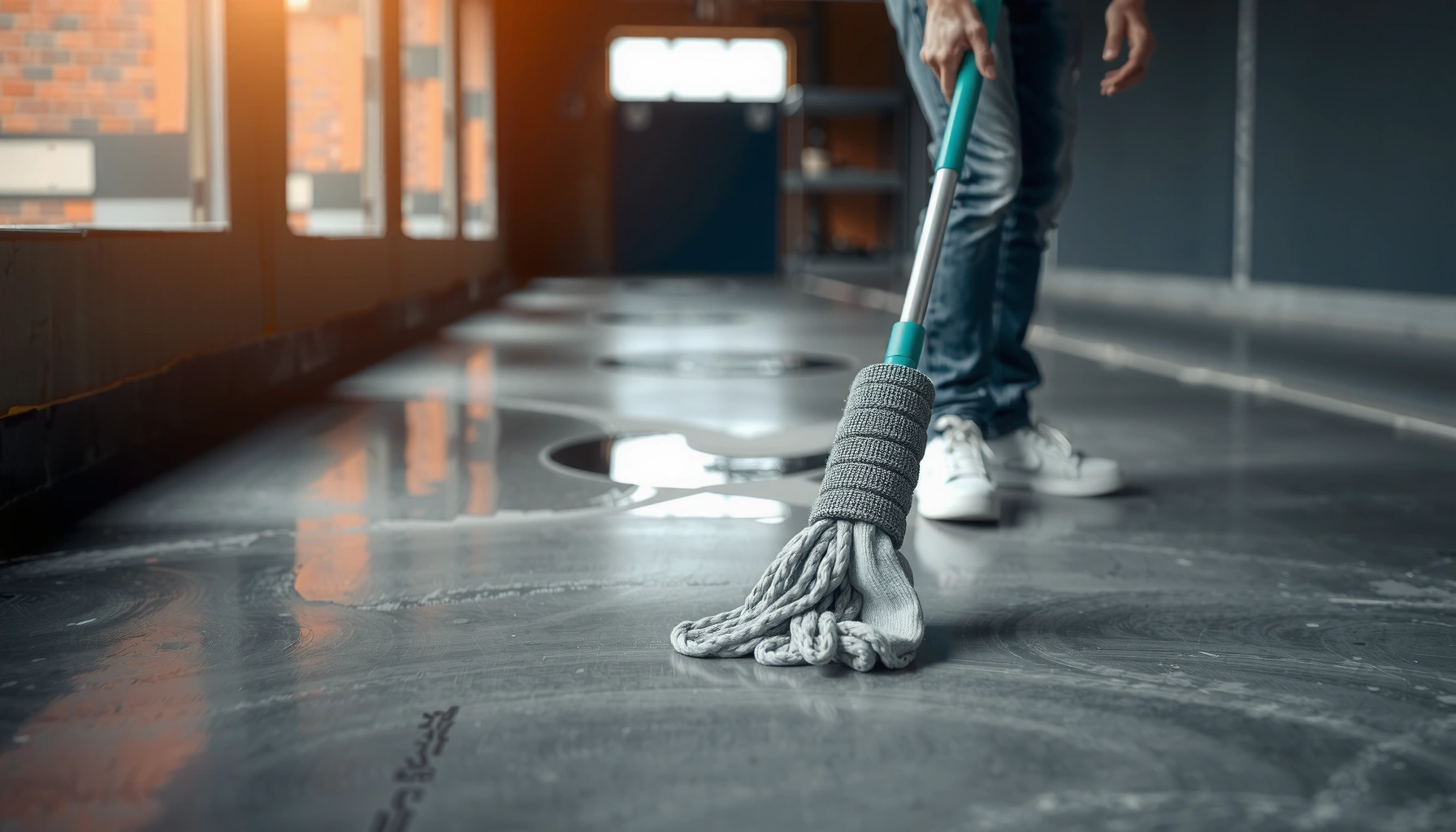
3. Mop in straight passes, then go back with clean water to reduce residue.
4. Keep an eye on mop-pads: if they turn gray/brown, replace rinse water and continue with fresh pads.
Why this matters for stains: many “stains” are partly soil film + chemistry underneath. Routine mopping may clean the top layer, but without targeted removal you’ll still see discoloration from embedded residues.
Treat stains with targeted methods (then mop again)
Targeted stain treatment works because it addresses the stain’s chemistry at the pore level, not just the surface. After the stain is treated, you mop again to remove residues so the concrete doesn’t re-darken as chemicals dry.
– For many stain types, you’ll apply a stain remover (or poultice for deeper marks), allow dwell time as directed, then rinse/wipe and mop afterward.
– If the concrete is sealed, use products that won’t damage the sealer; if it’s unsealed, stain removers may need extra time to work through the pores.
Poultices are used to “draw out” embedded contaminants, especially for older stains where cleaning liquids alone won’t migrate deep enough.
When concrete is sealed, some stain removers can’t penetrate fully, so label-specific dwell time and rinse steps become even more important.
After chemical dwell time, thorough rinsing helps prevent sticky residues that attract dirt and make the area look darker later.
Below is the decision map you should follow.
Cleaner Chemistry vs. Common Concrete Stain Types (pH Guidance)
| # | Stain source | Typical chemistry goal | Common cleaner pH range | Most compatible approach |
|---|---|---|---|---|
| 1 | Oil / grease / automotive drips | Emulsify & lift hydrophobic residue | ~7 to 10 | Degreaser + rinse mop |
| 2 | Rust / iron marks | Chelate/convert iron stains | ~1.5 to 3.5 | Iron stain remover (label-specific) |
| 3 | Mineral water rings | Descale mineral deposits | ~2 to 4 | Acid descaler + thorough rinse |
| 4 | Organic tannin (leaves, plant spills) | Oxidize/lighten organics | ~9 to 12 | Oxidizer (label-approved) |
| 5 | General grime & embedded dust | Lift particulates and soil film | ~7 to 9 | pH-neutral cleaner + rinse |
| 6 | Unknown spots after weather | Remove soluble residues | ~7 to 10 | Clean-first approach; retest before acids |
| 7 | Sealed concrete (discoloration risk) | Avoid damaging film-forming sealer | Follow sealer guidance | Use sealer-compatible products |
Important safety logic: If you use an acid on a sealed slab without confirming compatibility, you may haze the surface or shorten sealer life. Conversely, if you use a neutral detergent on rust, the stain will often come back because the iron hasn’t been converted.
Quick comparison: “What should I use?” for each stain goal?
Choose based on your stain’s visible behavior and chemistry target. Below is a parseable comparison you can scan quickly.
| Feature | pH-neutral cleaner | Targeted stain remover / descaler |
|---|---|---|
| Best for | Surface grime & dusty film | Embedded stain chemistry (oil, rust, minerals) |
| Risk of etching/haze | Lower when label-approved | Higher if chemistry is wrong for the slab/sealer |
| Penetration into pores | Limited | Often better (especially with poultice) |
| Rinse dependency | Moderate | High—residue can attract dirt |
| Typical time to see improvement | Often immediate for soil | Varies by stain depth + dwell time |
| Multiple attempts | May be sufficient for grime | Common for old stains |
| Sealed concrete compatibility | Usually safer, but still label-check | Only safe if product explicitly supports sealed slabs |
| Best workflow | First pass (“clean the dirt off”) | Second pass (“treat the stain”) |
| What it won’t do well | Convert rust or dissolve mineral scale | Replace missing/failed concrete surface or correct structural issues |
| Best For | Weekly/periodic maintenance | Discoloration that persists after basic cleaning |
Statistics and ranges to guide chemistry decisions:
– According to general pH scale conventions, a “neutral” solution is pH 7, while acids are pH < 7 and alkalis are pH > 7 (ADD: source for pH scale definitions).
– Many floor-cleaning labels specify dilution ratios (often 1:10 to 1:32) for concentrates—always follow the label because formulation varies (ADD: source for typical concrete cleaner dilution guidance).
– Concrete is porous enough that cleaning methods emphasize dwell time and rinsing; many sealer instructions require slabs to be fully clean and dry before application (ADD: source for sealer application surface prep requirement).
Rinse thoroughly and let the floor dry completely
Rinse is what prevents “mystery re-soiling” after cleaning. When chemicals dry without being removed, they can leave residue that attracts dirt and darkens spots again.
– After treatment, remove all chemical residue with clean water (or as the product label instructs) to prevent sticky buildup.
– Let it dry fully before walking on it or applying any protective sealer.
Thorough rinsing reduces the risk of surfactant residues that can leave a sticky film and worsen discoloration later.
Drying fully is essential before any concrete sealer so trapped moisture doesn’t interfere with adhesion.
If you apply sealer over remaining contaminants, you can trap both odor and discoloration under the protective film.
From a practical standpoint, aim for:
– No visible suds after the final rinse
– A surface that feels dry to the touch (and not cool/wet)
– Enough drying time for indoor slabs (basements/garages) where airflow is limited
If the stain is still visible after drying, do not jump straight to more aggressive scrubbing. Instead, reassess the stain type and repeat the correct chemical treatment.
What can go wrong (and how to prevent it)
Stains can persist—and surfaces can dull—when chemistry and wetting rules are mismatched. These are the most common failure points, plus how to avoid them.
– Using acidic cleaners (or harsh degreasers) on the wrong stain or on sealed concrete can cause dulling, surface haze, or ongoing discoloration.
– Over-wetting can spread water-based stains and minerals; use a damp (not flooded) mop unless the cleaner directions explicitly call for it.
– If stains are old and deep, light mopping may never fully remove them—plan for repeat treatments or consider resurfacing/sealing decisions.
Acids used on improperly selected concrete coatings can create surface haze by altering the top mineral layer.
Flooding a slab can move soluble minerals deeper or outward, enlarging mineral-related discoloration.
Old oil stains often require dwell time and repeated emulsification cycles rather than quick surface wiping.
Here are the mistakes I see most often:
1. Mopping-only loops: repeating neutral detergent without addressing rust/mineral/oil chemistry.
2. Wrong chemical sequence: using acid or bleach before cleaning dust/grime off the surface.
3. Skipping rinse: leaving behind residue that later re-attracts dirt.
4. Assuming sealing fixes stains: sealer can protect, but it also can trap contaminants if stains aren’t removed first.
If you’re unsure whether the concrete is sealed, the safest move is to start with label-approved pH-neutral cleaning and avoid acids until you confirm compatibility.
Verdict: the honest best approach—and who should skip
A targeted clean-first-and-stain-second mopping routine is usually the safest way to lift stained concrete without damaging the surface. The downside is you may need multiple attempts for stubborn stains, and if you’re not sure whether your slab is sealed (or what caused the discoloration), you can accidentally choose the wrong chemistry—[ADD: consult the product label or a concrete professional for confirmation if you’re unsure]. Skip DIY chemical treatment if the floor is damaged, flaking, or you suspect hazardous contamination (e.g., unknown industrial residues).
A chemistry-matched approach (clean the dirt first, then treat the stain) reduces the chance of haze and avoids smearing embedded residues.
When sealer compatibility is unclear, label guidance and substrate testing are essential before using acids or oxidizers on sealed slabs.
If concrete has structural damage (spalling, flaking, exposed aggregate failure), cleaning chemicals won’t correct the root cause of discoloration.
Quick “Choose your path” VS table
| Criteria | DIY targeted cleaning | Pro assessment / resurfacing option |
|---|---|---|
| Best for small to moderate stains | Yes | Also yes |
| Sealed slab uncertainty | Risky without label clarity | Lower risk via compatibility testing |
| Deep/old rust or oil | May need repeat cycles | Often faster via correct system selection |
| Time cost | Higher (trial-and-dwell) | Predictable scheduling |
| Chemical handling safety | Requires PPE and careful mixing | Handled under trained procedures |
| Surface appearance risk (haze/dulling) | Possible with wrong chemistry | Managed via product selection |
| Contaminant unknowns | Avoid if industrial residue is suspected | Better for compliance and testing pathways |
| When stain “comes back” | Likely source remains (oil/migration/moisture) | Can diagnose source pathways |
| Best long-term outcome | Good if chemistry is matched | Often better for severe cases |
| Verdict | Recommended when stain type is identifiable and you follow label dwell/rinse steps | Recommended when the slab is sealed/unknown, stains are deep, or contamination is suspected |
Quick checklist (save this)
– Identify stain type clues (oil sheen, rust color, cloudy rings, general grime)
– Dry sweep/vacuum first
– Mop with pH-neutral cleaner to remove surface dirt
– Spot-treat with the right stain remover (test in a hidden spot)
– Dwell time and rinse/wipe as directed
– Mop again with clean water, then dry fully
– Consider sealing only after stains are addressed ([ADD: source/brand guidance for your sealer])
FAQ
Can I mop stained concrete with regular floor cleaner?
Often, regular cleaner helps with surface grime but won’t fully remove embedded stains. For stained areas, targeted stain treatment usually works better after the initial “clean the dirt off” step.
Will bleach remove stains from concrete?
Bleach can lighten some organic stains, but it can also damage surfaces and may not work on rust/oil. If you’re unsure, check the cleaner’s label for compatibility with concrete and stain type ([ADD: link to the specific product label, if you have one]).
Should I seal concrete after mopping stains?
Sealing can help prevent future staining, but only after stains are removed and the concrete is fully dry. Applying sealer over remaining contaminants can trap discoloration.
Why do stains come back after cleaning?
If the stain source remains (oil residue, ongoing moisture, or minerals coming through), stains can reappear. Address the cause, rinse thoroughly, and dry completely before sealing.
Sources
– [ADD: manufacturer instructions (product label) for the specific pH-neutral cleaner and any stain remover you plan to use—follow dwell time and rinsing directions exactly]
– [ADD: concrete sealer manufacturer guidance on application conditions (surface cleanliness/dryness) and whether treated stained areas must be fully removed before sealing]
– [ADD: official guidance from a concrete coating/sealer manufacturer or government/industry body on concrete surface preparation before chemical cleaning or sealing]
If you follow one rule, make it this: clean the dirt first, then treat the stain with chemistry that matches the stain source, then rinse and dry completely. Doing it in that order protects your slab (and any sealer) while giving the best odds of truly lifting the discoloration rather than spreading it.
Frequently Asked Questions
What’s the best way to remove stains from concrete floors before mopping?
Start by identifying the stain type—oil/grease, rust, mold, or general dirt—because concrete mopping cleaners won’t all work the same way. For oil stains, blot excess and use a degreasing cleaner or a poultice; for rust, use a concrete-safe rust remover; for mold or mildew, use a cleaner with biocides and scrub the affected area. Let the cleaner dwell as directed, rinse thoroughly, and only then mop the entire floor to remove residue and prevent streaking.
How do you mop concrete floors without making stains spread or get worse?
Use a controlled cleaning process: pre-sweep or vacuum first so you don’t grind grit into the concrete. Apply a pH-neutral concrete floor cleaner mixed with water (avoid harsh acids unless the stain specifically requires it), then mop in sections with clean water for each pass or a frequent rinse of the mop head. Keep mops and buckets clean, blot drips quickly, and rinse with water if the product requires it to prevent chemical buildup that can darken concrete over time.
Why do concrete stains appear after mopping, and how can you prevent it?
Stains often “reappear” because dirty water, leftover cleaner, or hard-water minerals can react with the concrete surface and leave a darker film. If you’re using a strong cleaner or overdosing, residue can attract dirt and create visible marks. Prevent this by using the correct dilution, mopping with minimal water, using clean rinse water, and drying the surface with fans or a microfiber mop head after cleaning.
Which cleaning solution is safest for routine mopping on stained concrete floors?
For ongoing maintenance, choose a pH-neutral cleaner labeled safe for stained or sealed concrete floors. Avoid generic floor cleaners with wax, ammonia, or acidic ingredients unless you’re treating a specific stain type and follow the label instructions. Always test in a small hidden area first, then mop with a microfiber mop to lift dirt from the pores without aggressively scrubbing.
How can you deep-clean stained concrete floors using a step-by-step mopping routine?
Begin with dry cleaning: sweep, vacuum, and then spot-treat stains with the appropriate concrete cleaner (degreaser for oil, rust remover for rust, or mold treatment for mildew). Scrub treated areas gently with a nylon brush, allow proper dwell time, and rinse thoroughly before mopping. Finally, mop the whole floor with a pH-neutral concrete cleaner in warm water, rinse if required, and dry completely to reduce lingering discoloration and streaks.
📅 Last Updated: October 10, 2026 | Topic: How to mop stained concrete floors? | Content verified for accuracy and freshness.
References
- Google Scholar Google Scholar
https://scholar.google.com/scholar?q=how+to+mop+stained+concrete+floors - Google Scholar Google Scholar
https://scholar.google.com/scholar?q=concrete+floor+stain+removal+cleaning+procedures - Google Scholar Google Scholar
https://scholar.google.com/scholar?q=acid+stain+vs+water+stain+removal+concrete+floor+how+to - https://www.epa.gov/mold/mold-remediation-what-you-need-know
- https://www.cdc.gov/healthywater/hygiene/cleaning/household.html
- https://www.who.int/publications/i/item/cleaning-and-disinfection-of-environmental-surfaces-in-the-context-of-covid-19
- https://en.wikipedia.org/wiki/Concrete
- https://www.britannica.com/technology/concrete
- Silica, Crystalline – Overview | Occupational Safety and Health Administration
https://www.osha.gov/silica/concrete - https://www.epa.gov/safer-choice/about-safer-choice