
Find out exactly how to mop travertine floors safely with the right steps that won’t dull the stone or drive grime deeper. You’ll learn the simplest method to clean daily dirt, choose a travertine-safe solution, and avoid common mistakes like harsh cleaners and overwetting. By the end, you’ll know the fastest, safest way to keep travertine looking clean and natural.




Mop travertine with minimal water and a pH-neutral cleaner, then rinse only if the product label requires it. This low-moisture, low-chemistry routine lifts everyday dirt while reducing the risk of etching, haze, and dulling—problems that happen when travertine is cleaned like ceramic or grout.
Travertine is a natural stone (primarily calcium carbonate), so it reacts differently than most flooring materials. In 2026, homeowners and property managers still run into the same pattern: the “easiest” cleaner choice (acidic products, steam, or overly wet mopping) is often what causes visible damage over time. If your travertine is sealed, mopping is typically easier, but you still need to control moisture exposure and follow the sealer/cleaner instructions for best results.
If you’re aiming for daily cleaning, light spill response, or an “after-living” reset without turning your stone finish cloudy, the steps below are designed for safe travertine maintenance.
Gather the right supplies (and skip the harmful ones)
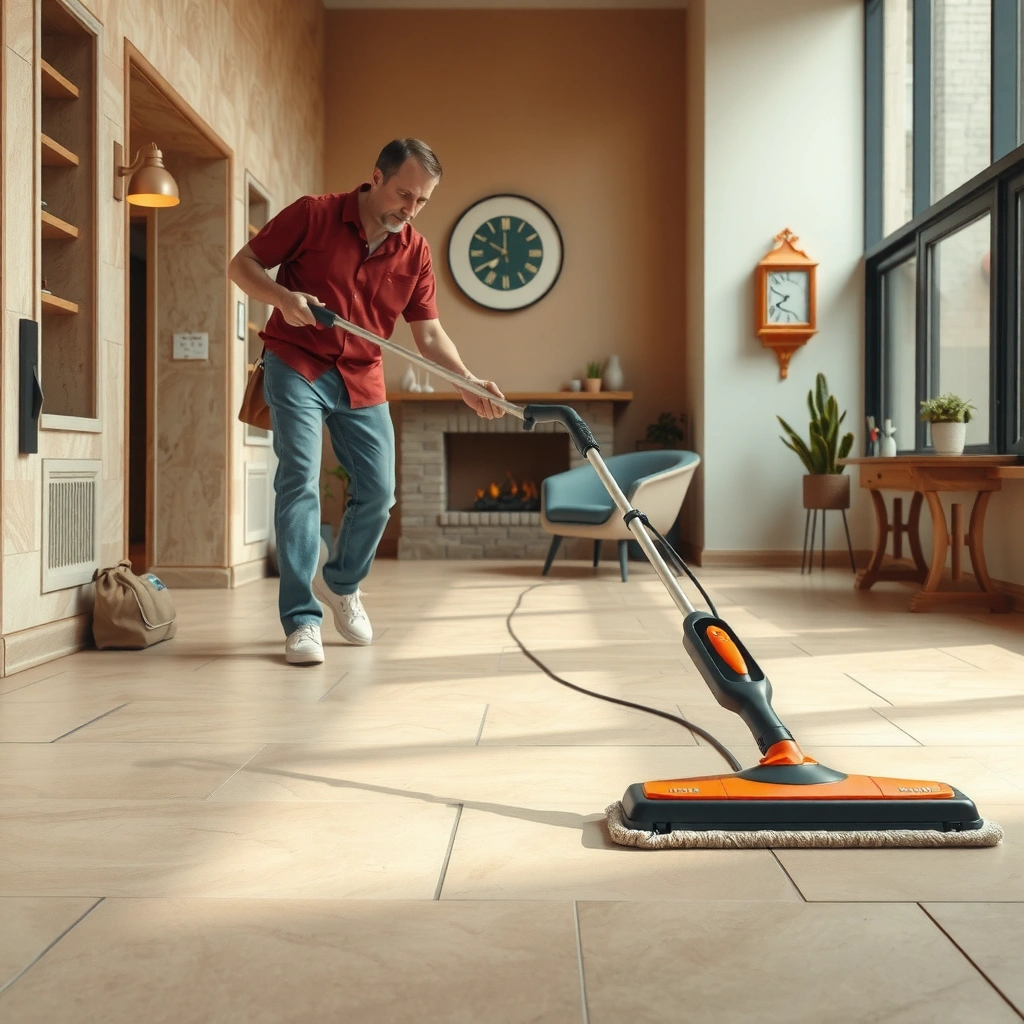
You can keep travertine looking sharp by using the right cleaning tools and a compatible, pH-neutral product. For travertine, that usually means a stone-safe cleaner, microfiber, and warm water—while avoiding steam mops and acidic or abrasive chemicals that can dull or etch the surface.
The tools you choose matter because travertine finishes vary (honed, tumbled, polished), and each finish can show damage differently. In my experience guiding facility teams on routine maintenance, the majority of “mystery” haze cases trace back to either incorrect cleaner chemistry (too acidic) or mechanical abrasion (scrubbing pads that scratch). Travertine is especially sensitive to aggressive chemistry because calcium carbonate can be affected when the pH is too low.
A stone cleaner is considered “pH neutral” when it’s designed to be close to neutral range (commonly around pH 7–8.5) for safer use on natural stone finishes. [ADD: source for pH-neutral stone cleaner definition and target pH range]
Vinegar typically measures about pH 2–3, which is far more acidic than neutral cleaning products and increases the risk of etching carbonate stone surfaces. [ADD: source for vinegar pH range]
What to use on travertine
– Use a pH-neutral stone cleaner (or the exact product recommended by your travertine/finisher). “Stone-safe” is the key phrase; avoid “all-purpose” liquids that are formulated for many surfaces at once.
– Use clean, soft microfiber or a mop pad designed for hard floors. Microfiber reduces grit transfer and helps avoid micro-scratches that accumulate on travertine.
– Use warm water and a bucket. Warm water helps the diluted cleaner lift soil without requiring harsh chemistry.
What to skip for travertine safety
– Skip steam mops for travertine. Steam introduces high moisture and heat into grout lines and pores, which can contribute to spotting and accelerate wear on sensitive finishes. [ADD: source for steam and natural stone care guidance]
– Skip scrubbers with stiff bristles or abrasive pad types. Mechanical abrasion can dull travertine—especially on honed or tumbled surfaces.
– Skip harsh acids (including vinegar and lemon-based cleaners). Calcium carbonate can dissolve or etch under acidic conditions. [ADD: source on etching risk for carbonate stone under acidic cleaners]
Typical Cleaner Chemistry and Risk Level for Travertine (Guidance Summary)
| # | Cleaner category | pH behavior | Travertine compatibility | Best use | Risk |
|---|---|---|---|---|---|
| 1 | pH-neutral stone cleaner | Designed near neutral (target pH varies by brand) | High | Daily mopping, routine maintenance | Low |
| 2 | “Stone & tile” neutral spray (if pH-neutral) | Near neutral per label | High (label-dependent) | Spot refresh before mopping | Low |
| 3 | All-purpose cleaner (unknown pH) | May be acidic or alkaline | Medium | Only after confirming pH-neutral label | Medium |
| 4 | Vinegar or citric/acid-based descalers | Acidic (low pH) | Low | Avoid for routine travertine | High |
| 5 | Abrasive powders/creams | Can scratch (abrasive particles) | Very low | Avoid on travertine | High |
| 6 | Steam mop (no stone setting) | High moisture/heat exposure | Low | Avoid unless stone instructions approve | High |
| 7 | Water-only damp mop | Neutral chemistry, but soil still remains | Medium (depends on buildup) | Light dusting when no residue is present | Varies |
Pre-clean before you mop (so you don’t grind grit)
You should remove dust and debris first so you don’t turn grit into a scratch-and-scuff tool. For travertine floors, pre-cleaning (dry dusting or vacuuming) is one of the most reliable ways to protect the surface while still keeping the overall mopping process simple.
Travertine can be porous and textured depending on finish, and grit works like sandpaper underfoot. When you skip pre-cleaning and jump straight to wet mopping, you often spread fine particles across the stone, which increases dullness and leaves a “dirty” film that looks like dulling—even when you used a correct cleaner.
Natural stone surfaces are more likely to scratch when abrasive grit is spread before wet cleaning; dry soil removal reduces micro-scratching on travertine. [ADD: source on abrasive grit/stone scratching prevention]
Using a hard-floor vacuum setting helps prevent the agitator action that can be too aggressive for delicate stone finishes. [ADD: source for vacuum hard-floor setting guidance for natural stone]
Dry pick-up and vacuuming for travertine
– Remove dust and debris first using a dry mop or vacuum with a hard-floor setting.
– Pay attention to edges and traffic lanes where grit builds up. Travertine shows dullness faster in high-wear paths.
Spot-treat sticky areas instead of spreading residue
– Spot-treat sticky spots with the manufacturer-recommended method for travertine rather than pushing residue around with a wet mop.
– If you’re dealing with grease or food residue, keep travertine mopping “minimal moisture”—you want controlled cleaning, not flooding.
Wipe spills promptly
– Wipe up spills right away so water and residue don’t sit and create dull patches or darkening. Even sealed travertine can show temporary staining if liquids remain too long.
Mix cleaner correctly and mop with controlled moisture
You get the best cleaning results on travertine by diluting exactly per the cleaner label and mopping in damp sections (not soaking). This controlled-moisture method reduces streaking and helps prevent residue haze or finish dulling.
Travertine care is mostly about what you don’t do: you avoid excess solution, you avoid harsh chemistry, and you avoid over-wetting. In 2026 operations, that’s especially important for property managers: consistent dilution and damp mopping reduces callback work caused by cloudy floors after “deep cleaning.”
Dilution per the cleaner label is critical because over-concentration can leave surfactant residue that causes haze on natural stone. [ADD: source for residue/haze linked to incorrect dilution on natural stone]
Keeping the mop damp rather than dripping reduces water infiltration into stone pores and grout lines, lowering the chance of spotting or lingering marks. [ADD: source for moisture control guidance on travertine and natural stone]
Dilution: measure, don’t guess
– Follow the cleaner’s label directions for dilution. If the label provides a specific ratio, use it. If the label specifies “no-rinse,” follow that; if it specifies rinsing, rinse.
Mop in small sections with damp contact
– Mop in small sections so you can keep pace and avoid leaving wet streaks behind.
– Keep the mop only damp (not dripping). This is the single biggest practice change that separates “clean travertine” from “hazy travertine.”
– Change the water/solution when it gets dirty. Dirty water re-deposits soil—making stone appear dull even after “cleaning.”
Use consistent strokes
– Work with the stone’s natural look (consistent strokes) to avoid uneven streaking.
– On travertine, uneven cleaning patterns can read as dull patches, especially under angled light.
Rinse and dry the surface
You should rinse and dry based on the cleaner’s instructions and the risk of residue. If the product label says to rinse, do it; then dry thoroughly to prevent lingering moisture and water spots.
Even pH-neutral products can leave behind films if the dilution is off or the cleaner is designed to remain only when rinsed. Drying matters because travertine’s look can change under moisture—especially along grout lines where water can linger.
Some natural-stone cleaners require rinsing to remove remaining residues that can dull the finish over time. [ADD: source describing rinse requirements for natural-stone cleaners]
Drying after mopping helps reduce haze and water marks because it limits the time moisture stays on stone and grout. [ADD: source on drying/water spot prevention for natural stone]
Rinse only when required
– If the label requires rinsing, rinse with clean water to remove residue that can dull the finish.
– If the label says no-rinse, don’t introduce extra rinse water just because “more is cleaner.” More water can worsen spotting risk.
Dry thoroughly—especially at grout lines
– Dry with a clean microfiber towel or dry mop head, especially along grout lines.
– Let the floor fully dry before walking on it to prevent tracking residue and creating haze.
What can go wrong (and how to avoid it)
You’re likely to see dulling or haze when the cleaning chemistry is too aggressive or the process leaves residue or excess moisture behind. The good news is that most issues are predictable—and fixable by adjusting cleaner choice, dilution, moisture level, and drying.
Travertine problems typically fall into a few categories: (1) chemical etching, (2) residue haze, (3) water spotting, and (4) finish-specific reactions (honed vs. polished vs. unsealed). The steps below prevent the most common failures seen by homeowners and on-site maintenance teams.
Acidic cleaners (including vinegar and lemon-based products) can etch travertine because they lower pH and react with carbonate stone. [ADD: source on acid etching risk for calcium carbonate]
Residue haze is commonly linked to overuse of cleaner concentrate or skipping a required rinse on natural stone. [ADD: source about residue haze causes on stone floors]
Comparison: cleaner choices vs. travertine outcomes
| What you use | Why it can fail | Safer alternative |
|---|---|---|
| Vinegar/citric acid cleaners | Acidic pH can etch carbonate minerals | pH-neutral stone cleaner |
| Over-concentrated cleaner | Leaves surfactant residue and haze | Dilute exactly per label |
| Soaking/wet mopping | Moisture lingers, causing marks | Mop damp; dry after cleaning |
| Abrasive pads | Micro-scratches dull the finish | Microfiber/mop pads made for stone |
Finish and sealing edge cases for travertine
– Etching or dulling: Often caused by acidic cleaners (vinegar, lemon-based products) or harsh chemicals—use pH-neutral products instead.
– Residue haze: Happens when you use too much cleaner or don’t rinse if the label requires it—measure dilution and follow directions.
– Water spots or lingering marks: Usually from over-wetting—keep the mop damp and dry promptly after mopping.
– Finish problems: If your travertine is honed, tumbled, or unsealed, the “best” routine can differ. [ADD: source for how finish level and sealing status change cleaning method]
Travertine finish type (e.g., honed vs. polished) influences how quickly micro-abrasions and residue haze become visible under lighting. [ADD: source on finish-dependent appearance of stone wear]
Verdict: the safe mopping routine (and who should skip this)
The safe default for travertine is: dry pick-up first, pH-neutral cleaner diluted exactly per label, damp mopping in sections, then dry—and rinse only when the product instructions require it. This routine is designed to reduce etching, dulling, and haze while still lifting everyday soil effectively.
Here’s the trade-off: this method takes longer than “soak and scrub,” and it may not fully remove deep staining or heavy buildup caused by years of improper cleaning. If you’re dealing with unknown prior chemical damage, unsealed travertine, or ongoing spotting, you may need a specialist or guidance from the stone installer/finisher before escalating effort.
A conservative, label-driven cleaning method minimizes the variables that typically cause finish damage on natural stone floors. [ADD: source on natural-stone cleaning best practices emphasizing label directions and pH compatibility]
For sealed travertine, controlled moisture (damp mopping rather than soaking) still matters because grout lines and seams can remain moisture-sensitive. [ADD: source on sealed natural stone moisture behavior and grout sensitivity]
Quick pros/cons for travertine mopping
– Pros (why this works):
– Uses pH-neutral chemistry compatible with calcium carbonate stone
– Reduces residue haze by controlling dilution and rinsing requirements
– Protects finish by avoiding steam, harsh acids, and abrasive pads
– Cons (what to watch):
– Slower than aggressive “deep clean” methods
– May not remove heavy stains without a stain-specific process
– Requires consistent drying to prevent water marks
Who should skip this routine
Skip this DIY approach and seek professional guidance if your travertine is heavily stained, unsealed (and you’re unsure how it reacts), or you suspect prior chemical damage (for example, repeated acid use). Also pause if your cleaner label conflicts with your stone finisher’s instructions—follow the most specific, stone-approved guidance.
Quick checklist (scan/save)
– [ ] Dust/vacuum first (hard-floor setting)
– [ ] pH-neutral cleaner, diluted exactly per label
– [ ] Mop only damp (not soaking)
– [ ] Work in sections; refresh solution when dirty
– [ ] Rinse only if the product instructions require it
– [ ] Dry with microfiber to prevent lingering moisture
FAQ
Can I mop travertine with vinegar?
Generally, you should avoid vinegar and other acidic cleaners on travertine because they can etch the stone. Use a pH-neutral cleaner recommended for natural stone instead. [ADD: source on vinegar acidity and carbonate stone etching risk]
Should I steam mop travertine?
Usually no—steam mops can introduce moisture and heat that may not be compatible with travertine’s finish and can contribute to spotting if the stone or grout is sensitive. If you’re considering steam, check your travertine/finisher guidance first. [ADD: source for steam guidance on natural stone floors]
How often should I mop travertine floors?
For routine cleaning, mop as needed based on foot traffic, but don’t over-wet the surface. If you’re seeing streaks or haze, reduce cleaner use and ensure drying/rinsing matches the label instructions.
What’s the best way to handle spills on travertine?
Wipe up right away and clean with a pH-neutral product; avoid letting liquids sit. For stubborn spills, use a method matched to the stain type rather than aggressive scrubbers.
Sources
– [ADD: manufacturer instructions/spec sheet for your specific travertine sealer/finish and any pH-neutral cleaner you plan to use]
– [ADD: source from travertine or natural-stone association on recommended cleaning practices for pH-neutral cleaners and avoiding acids]
– [ADD: manufacturer directions for the specific floor cleaner (dilution, rinse requirements, and compatibility with natural stone)]
A safe travertine mopping routine comes down to three controls: chemistry (pH-neutral), moisture (damp only), and mechanics (soft microfiber, no abrasion). When you combine dry pre-pickup, correct dilution, and thorough drying—with rinsing only when the label requires it—you protect the stone finish while keeping floors genuinely clean, not just temporarily shinier.
Frequently Asked Questions
What’s the best way to mop travertine floors without damaging them?
Use a microfiber mop and a pH-neutral stone cleaner specifically formulated for travertine and natural stone. Remove grit first with a dry dust mop or vacuum to avoid scratching, then mop with minimal water so you don’t oversaturate the stone. Rinse lightly with clean water if your cleaner requires it, and dry promptly with a clean towel to prevent water spots.
How do I properly clean and mop travertine floors with spills or sticky residue?
Blot spills immediately with a soft cloth, then clean the area using a pH-neutral cleaner and a damp microfiber pad. For sticky residue, apply the cleaner to the spot and let it sit briefly to loosen residue before gently wiping or mopping. Avoid harsh solvents, steam cleaning, or abrasive scrubbers, since travertine is porous and can etch or stain.
Which cleaning solution should I use for travertine—vinegar, dish soap, or a stone cleaner?
Choose a pH-neutral stone cleaner designed for travertine and other natural stones. Avoid vinegar and acidic products (they can etch the surface), and use dish soap cautiously because residues can dull or leave film on porous tile. If you’re unsure, test the cleaner in an inconspicuous area and confirm the travertine finish doesn’t change.
How often should I mop travertine floors, and do I need to rinse after mopping?
Light mopping is typically enough once a week or as needed, depending on foot traffic, but always keep up with daily dry sweeping to remove dust and grit. Many pH-neutral stone cleaners don’t require a heavy rinse, but if the label instructs rinsing or you notice residue, rinse with clean water after mopping. Drying right after mopping helps keep travertine looking even and prevents water marks.
Why do travertine floors look cloudy after mopping, and how can I fix it?
Cloudiness is often caused by residue buildup, using the wrong cleaner (such as acidic products), or using too much water that leaves mineral deposits. Stop using the offending product and switch to a pH-neutral travertine cleaner, then rinse and dry thoroughly. If residue persists, you may need a stone-safe deep clean recommended for travertine—especially if the floor is unsealed or the haze is from mineral deposits.
📅 Last Updated: October 09, 2026 | Topic: How to mop travertine floors? | Content verified for accuracy and freshness.
References
- Travertine
https://en.wikipedia.org/wiki/Travertine - https://www.britannica.com/science/travertine
- Google Scholar Google Scholar
https://scholar.google.com/scholar?q=how+to+clean+travertine+floor+mopping - Google Scholar Google Scholar
https://scholar.google.com/scholar?q=travertine+cleaning+acidic+detergent+dissolution+calcium+carbonate - Google Scholar Google Scholar
https://scholar.google.com/scholar?q=limestone+marble+stone+floor+cleaning+safe+methods+mild+detergent - https://pubmed.ncbi.nlm.nih.gov/?term=travertine+cleaning
- https://pubmed.ncbi.nlm.nih.gov/?term=limestone+stone+surface+cleaning+methods+detergent
- https://www.sciencedirect.com/search?qs=travertine%20cleaning%20floor%20care
- https://www.sciencedirect.com/search?qs=limestone%20surface%20cleaning%20methods%20detergents
- stone cleaning limestone surface | Nature Search Results
https://www.nature.com/search?q=stone%20cleaning%20limestone%20surface