
Removing stains from parquet floors safely starts with using the right cleaning steps for the type of mark—because the wrong cleaner can dull or damage the wood. You’ll get a clear, step-by-step method to lift common stains while protecting the finish, from gentle spot cleaning to targeted treatments. Follow these instructions and you’ll know exactly what to do—and what to avoid—so the stain disappears without compromising your parquet.




Blot the stain first, then remove it using the method that matches both the stain type (water vs. oil vs. ink) and your parquet finish (sealed/varnished vs. oiled/waxed). If gentle cleaning doesn’t lift the mark, escalate only to finish-safe “wood bleach,” and at the deepest level rely on professional sanding/re-finishing to restore an even look before the discoloration spreads further.
If your parquet shows a visible ring, dark spot, or discoloration from spills, tracked dirt, or pet accidents, this guide helps you decide what to do first—and what to avoid—especially when you’re unsure whether the stain is sitting on top of the finish or has soaked into the wood. As of 2026, the safest results still come from this exact decision path: identify the stain mechanism → match the finish chemistry → use the least aggressive method that works.
Identify the stain and your parquet finish first
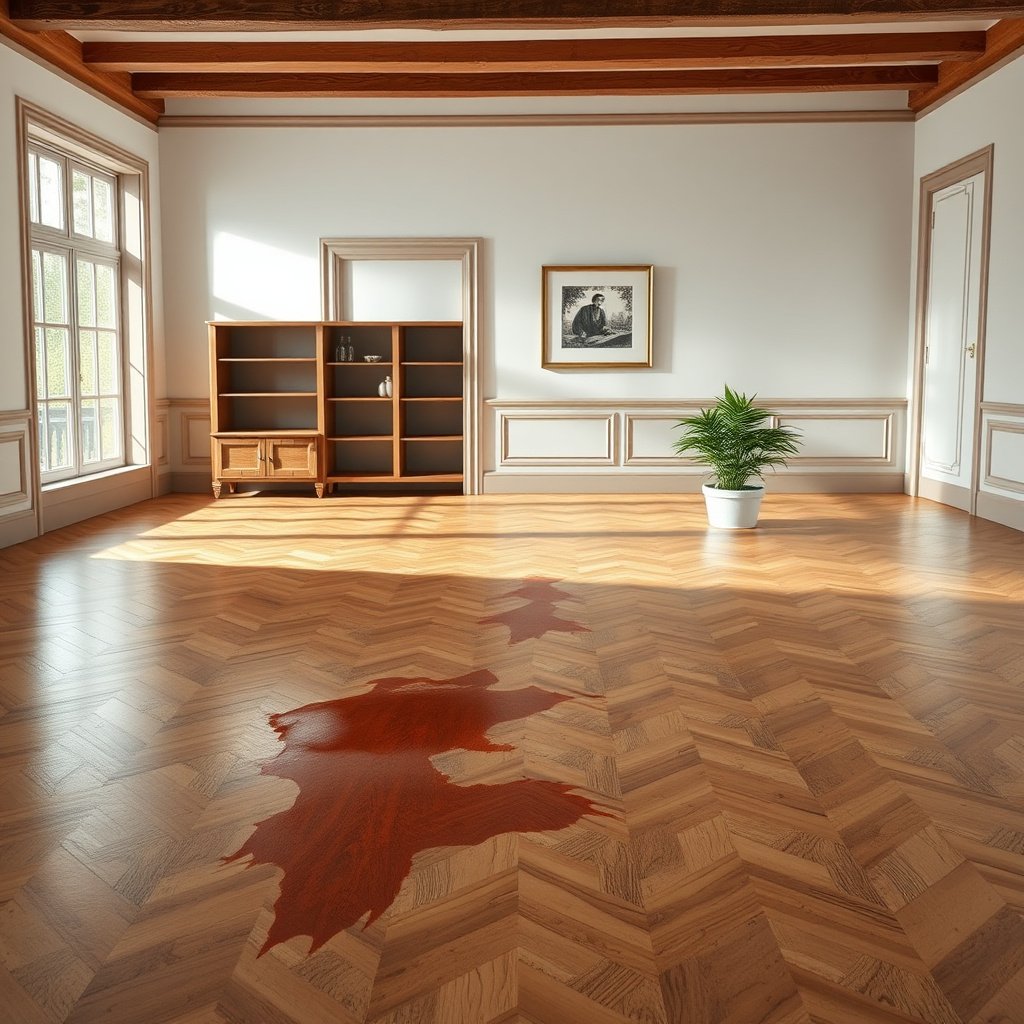
The safest stain-removal route depends on one quick diagnosis: determine whether the mark is caused by moisture sitting on the surface or by a substance that’s penetrated the parquet. Then match your cleaner to your finish, because sealed (varnished) and oiled/waxed parquet react very differently to water and solvents.
A moisture ring typically appears as a boundary line with a “halo,” because water temporarily changes how the finish refracts light while it’s wet.
Once a stain has darkened inside the grain, surface-only cleaning is often insufficient, since the colorant has migrated into the wood fibers.
Key checks you can do immediately
– Distinguish a ring from absorbed spotting
– Ring from moisture: often looks lighter or darker in a circular band, with the center sometimes appearing less affected once the area dries.
– Absorbed/darker spot: usually looks darker at the edges or has a “tighter” pattern that follows the grain, suggesting penetration.
– Identify sealed/varnished vs. oiled/waxed parquet
– Sealed/varnished: generally feels more “coated,” and water beads or spreads more slowly on top.
– Oiled/waxed: typically looks more matte or natural and can darken more readily when damp.
– Recall the source
– Water/tea/coffee/wine (tannin-rich)
– Grease/oil (lipid-based)
– Ink/dye (often pigment + solvent carriers)
– Urine/pet mess (salts + enzymes)
Why this matters (in practical terms)
Parquet floors are built from multiple wood layers and joints, so surface-cleaning can remove residue without restoring color if the stain has already migrated. Matching the finish type also reduces the chance of uneven sheen, whitening, or “ghosting” (a faded patch that won’t blend).
Prep the floor before you try to remove stains
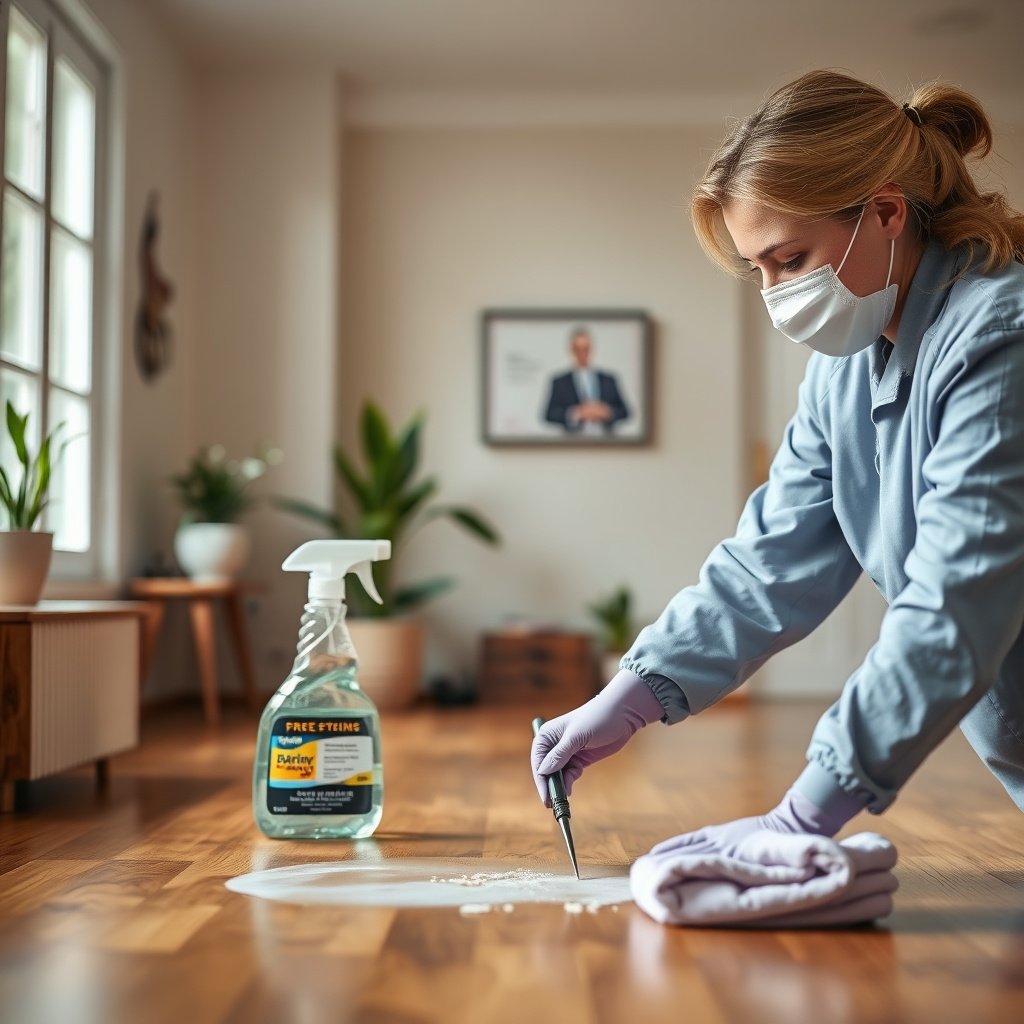
Prepping correctly is what prevents the “fix” from becoming permanent damage. Start by removing dust and grit dry, then use minimal moisture and always run a spot test so you don’t dull or haze the parquet finish.
Dry-sweeping or vacuuming first prevents grit from acting like micro-sandpaper and dulling parquet finishes.
Using a spot test in an inconspicuous area is the fastest way to confirm finish compatibility before you treat the full stain.
Tools and technique (the part most people skip)
– Vacuum or dry-sweep first
– Use a vacuum with a soft floor head or a microfiber dust mop.
– Avoid dragging any grit through the stain area—this is how light patches get “locked in.”
– Use microfiber, not abrasive pads
– Microfiber cloths lift soil and support controlled moisture application.
– Control moisture
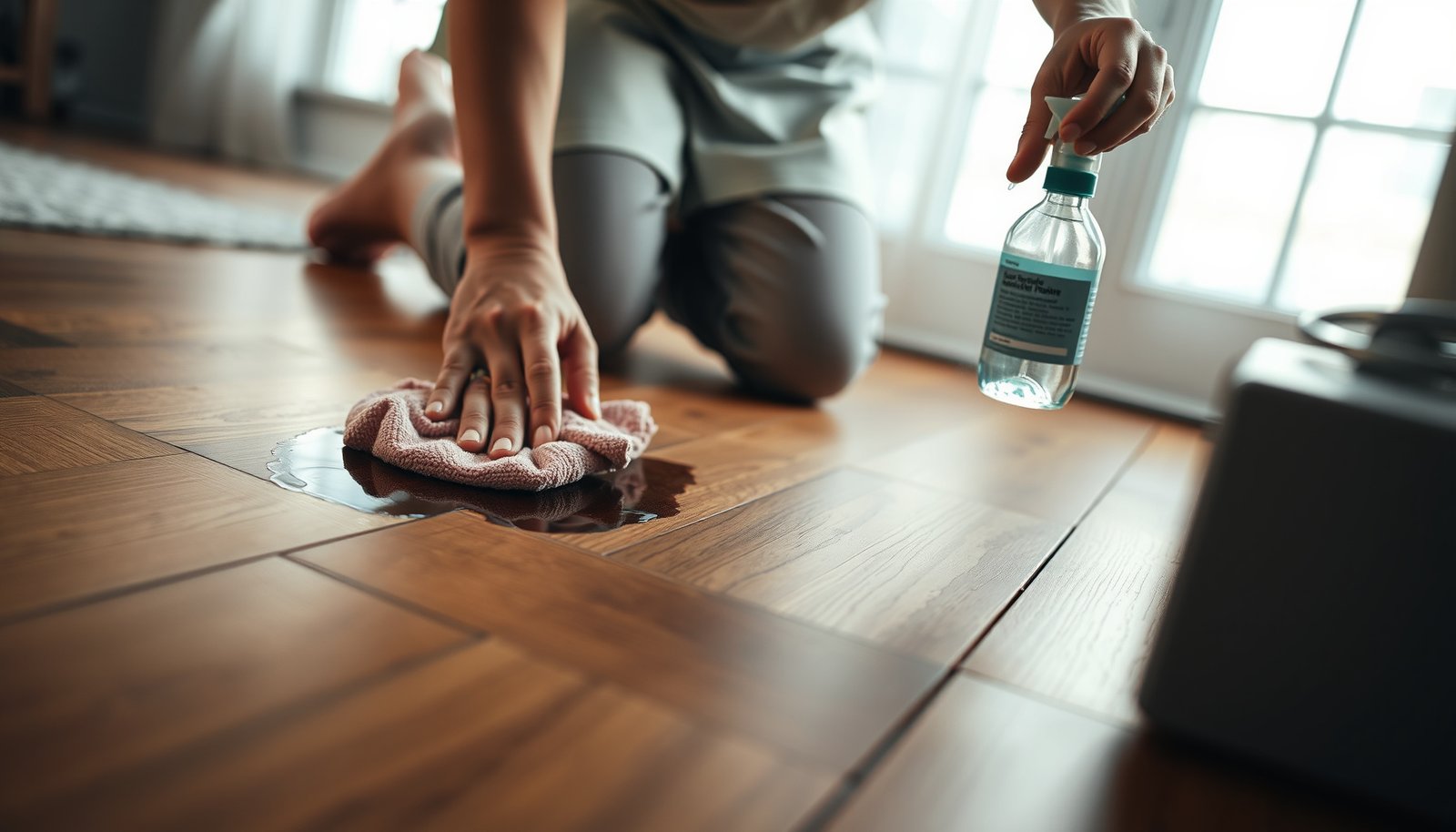
– Blot spills immediately.
– Keep liquids off seams and edges—over-wetting can spread discoloration beyond the visible stain.
– Do a finish test
– Pick an inconspicuous spot and apply the cleaner exactly as you intend to use it (same dilution, same wipe technique).
Quick chemical reality check (why pH-neutral matters)
Parquet floors often have a finish system designed to tolerate mild cleaners—not harsh acids/alkalis. In chemical terms, pH is defined as a logarithmic scale: pH = −log10(aₕ₊) (IUPAC, 2019) (IUPAC Gold Book, 2019). That’s why an “almost neutral” product can still cause long-term hazing if it’s consistently too acidic or too alkaline for your finish.
7 Chemicals Commonly Mentioned in Wood- and Stain-Cleaning Guidance
| # | Active chemical | CAS | Molar mass (g/mol) | Finish-risk indicator |
|---|---|---|---|---|
| 1 | Oxalic acid (ethanedioic acid) | 144-62-7 | 90.03 | ★★★☆☆ |
| 2 | Hydrogen peroxide | 7722-84-1 | 34.01 | ★★★☆☆ |
| 3 | Sodium percarbonate | 15630-89-4 | 225.20 | ★★★★☆ |
| 4 | Ethanol (alcohol) | 64-17-5 | 46.07 | ★★★☆☆ |
| 5 | Isopropyl alcohol | 67-63-0 | 60.10 | ★★★☆☆ |
| 6 | Acetic acid (vinegar’s main acid) | 64-19-7 | 60.05 | ★★★☆☆ |
| 7 | Ammonia | 7664-41-7 | 17.03 | ★★★★☆ |
Finish-risk indicator is a practical caution level based on chemical “strength” (oxidizers/alkalis/solvents) rather than a guarantee of compatibility—always follow your parquet finish manufacturer’s instructions.
Remove water rings and light discoloration
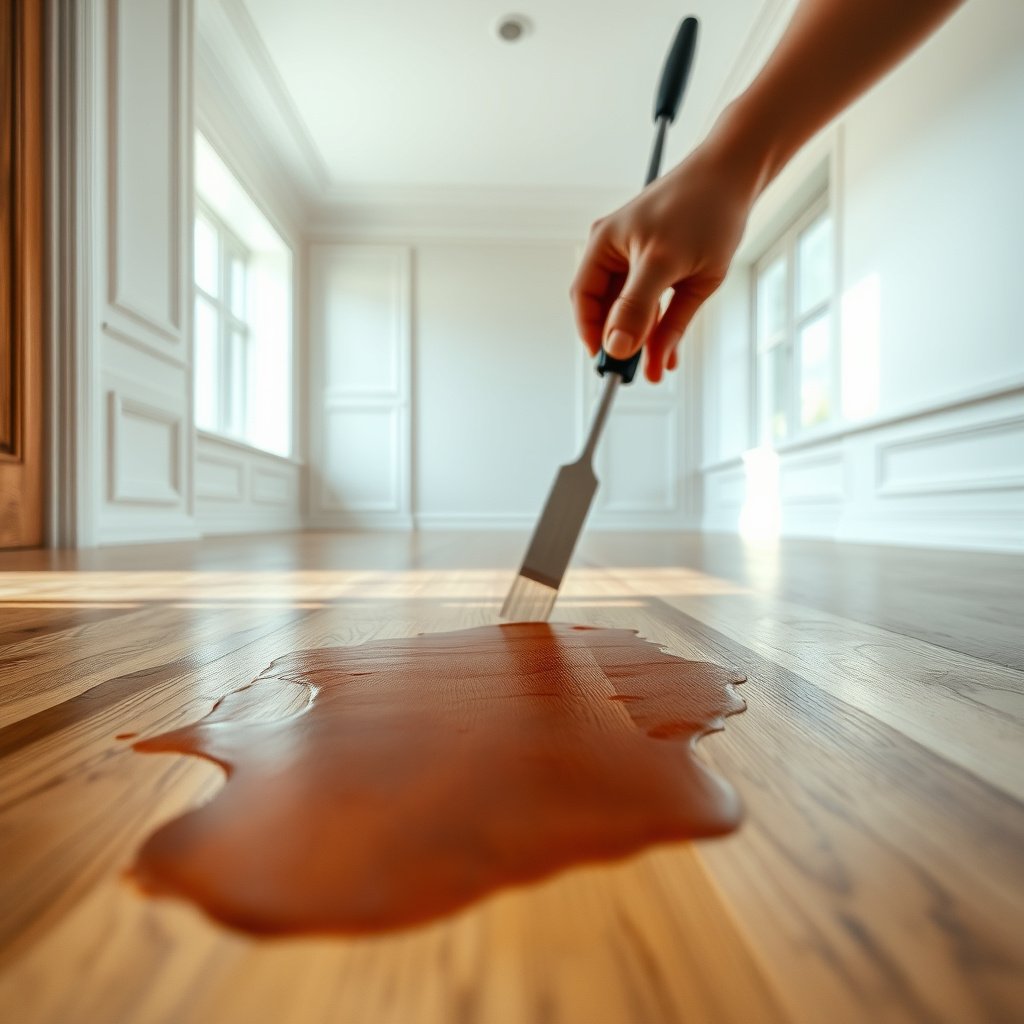
Your best first move for a water ring is gentle, pH-neutral cleaning plus thorough drying; only consider wood-bleach steps if the discoloration persists and your finish explicitly allows it. This approach keeps discoloration from deepening into the parquet and reduces the chance of uneven sheen.
If a water ring is mainly surface-related, careful blotting and pH-neutral cleaning can restore the look once the finish dries evenly.
For tannin-related darkening, oxalic-acid-based “wood bleach” can lighten discoloration—but compatibility depends on the parquet finish system.
Step-by-step for water rings
– Start gentle
– Wipe with a slightly damp pH-neutral wood-floor cleaner (or the product recommended by your parquet/floor finish manufacturer).
– Work from the outside edge toward the center to avoid spreading.
– Dry thoroughly
– After cleaning, dry immediately with a clean microfiber cloth.
– If the ring fades with drying, you likely avoided penetration.
– Escalate only if needed
– If the ring remains, consider a finish-compatible wood-bleach approach.
– For tannin-like darkening, wood bleach products often rely on reducing chemistry (commonly oxalic acid). In chemical terms, oxalic acid molar mass is 90.03 g/mol (PubChem, 2026) (PubChem, 2026).
– Use only manufacturer-approved products and follow dwell instructions precisely—overexposure can cause patchiness.
Practical indicators that it’s still surface-level
– The discoloration lightens after full drying.
– The spot edges look “soft,” and the grain doesn’t look uniformly dark.
– When you gently wipe with a finish-compatible cleaner, the sheen becomes more even.
Remove oil/grease, ink, and pet-related stains

The safest approach is different for oils, inks, and pet marks: oil needs absorption, ink needs careful solvent testing, and pet stains need enzyme action without flooding. If you jump to strong chemicals too early, parquet floors can end up with dull patches or persistent discoloration.
Grease/oil is best handled by absorption rather than repeated wet scrubbing, because oils migrate when the area stays damp.
Ink removal is highly finish-dependent; solvent strength and contact time can change sheen or lighten varnish.
For pet urine, enzyme cleaners are designed to break down odor-causing compounds rather than simply masking them.
Oil/grease (lipid) stains
– Blot excess first
– Don’t smear the oil outward.
– Use absorbent powder
– Apply absorbent powder compatible with your finish system (the right product depends on sealed vs. oiled surfaces).
– Remove residue carefully
– Once the oil lifts, vacuum or brush gently and wipe with a minimal-moisture method approved for your finish.
Ink and dye stains
– Spot test the mildest compatible solvent
– Some finishes tolerate alcohol-based cleaners; others can dull or spot.
– Stop immediately if sheen changes.
– Avoid aggressive rubbing
– Rubbing can spread pigment into surrounding pores and create a larger, lighter-than-original halo.
Pet stains and odor
– Use an enzyme cleaner formulated for wood/pet urine
– Ensure the product is appropriate for sealed vs. oiled/waxed parquet.
– Don’t flood
– Enzyme products should be applied in controlled amounts; excess liquid can carry salts deeper and widen the darkening.
Sealed vs. oiled: what changes in your workflow?
Parquet floors with different finish layers need different “physics.” Sealed parquet protects the wood, while oiled parquet often allows more movement of colorants and oils.
When the stain won’t lift: the “next steps” option
If cleaning doesn’t remove the discoloration, assume penetration and switch strategies carefully—because adding more liquid or stronger chemicals can make parquet damage more visible. At the deepest level, sanding and re-finishing may be the only consistent way to restore an even color and sheen.
If a stain remains after controlled, finish-compatible cleaning and thorough drying, the discoloration has likely migrated into the parquet wood.
For sealed parquet, sanding/re-finishing can restore uniformity when surface chemistry can’t reverse deep color changes.
What to do (and what to stop)
– Stop escalating wetting
– Further wetting can drive soluble components (tannins, salts) deeper.
– For sealed parquet
– Sanding/re-finishing is often the only complete reset when the finish layer is involved or the wood is permanently darkened.
– If you can’t match sheen and color reliably, consider a pro.
– For ongoing causes
– Fix the root issue first: leaks, repeated pet accidents, persistent dampness.
– If the source continues, parquet floors will re-stain no matter how carefully you clean.
A decision rule you can use today
– If the stain is fresh and you’re confident it’s from water/oil/ink/pet: try the finish-matched method once, then reassess.
– If the stain is old, spreading, or you see a persistent dark zone: pause DIY chemistry and plan for professional inspection or refinishing.
What can go wrong (and why stains get worse)
Stains worsen when the cleaning method conflicts with the parquet finish or when the floor is over-wet or over-scrubbed. These errors often create permanent visual differences—especially uneven sheen and deeper penetration—making future repairs harder.
Aggressive scrubbing can damage the finish and make shallow discoloration look larger or “ghosted.”
Using the wrong bleach or solvent can cause light patches and uneven sheen even if the stain gets paler.
Common mistakes
– Scrubbing aggressively
– This can scour the finish, causing “halo” effects that don’t match surrounding reflectivity.
– Choosing incompatible bleach/solvent types
– Finish systems vary widely; some tolerate certain oxidizers or acids, while others haze or spot.
– Over-wetting parquet
– Excess liquid can migrate discoloration through the grain and stress joints.
– Ignoring moisture problems
– If mold or long-term moisture is involved, surface cleaning is not a full solution. The parquet floor may keep deteriorating beneath the finish.
A simple risk framework (pros/cons style)
If you’re deciding how far to push DIY, consider this trade-off:
| Approach | Pros | Cons |
|---|---|---|
| Gentle pH-neutral cleaning + drying | Low risk to finish; often enough for fresh marks | Won’t reverse deeply penetrated colorants |
| Finish-safe wood bleach (when allowed) | Can lighten tannin-like discoloration without full refinishing | Higher risk of uneven color if compatibility/dwell time is off |
| Professional sanding & re-finishing | Most consistent visual restoration for deep stains | Costly; disrupts the space; requires finish/color matching |
Verdict: what’s safest, and who should skip DIY
If the stain is fresh and you can identify whether it’s water, oil, ink, or pet-related, DIY removal using gentle cleaning + finish-safe spot testing is usually the safest route. If the mark is deep, old, spreading, or you can’t confidently identify sealed vs. oiled parquet, stop sooner and plan for professional refinishing to avoid irreversible uneven patches.
When the discoloration appears to be “inside” the grain, repeated chemical attempts can worsen appearance by changing sheen rather than removing the cause.
Skip DIY when moisture is ongoing, because parquet stains often return if the underlying leak or dampness isn’t corrected.
Skip DIY (or get help) if:
– You suspect mold, active moisture, or repeated dampness under the parquet.
– Your parquet is antique/very thin, or you can’t confidently identify whether it’s sealed/varnished or oiled/waxed.
– You’ve already tried several removals and the sheen changed—your chances of ending with uneven color increase.
Quick scan checklist (save this)
| Stain type | Start with | Avoid |
|---|---|---|
| Water ring/light discoloration | Gentle pH-neutral cleaner + thorough drying | Steam, harsh abrasives, soaking the seams |
| Coffee/wine/tea/plant marks | Spot test cleaners; use only finish-compatible “wood bleach” if needed | Bleach products that aren’t meant for wood parquet finishes |
| Grease/oil | Absorbent powder + careful residue removal | Strong wet solvents that could soften the finish |
| Ink/dye | Finish-safe spot testing with the gentlest compatible cleaner | Rubbing until it spreads or changes sheen |
| Pet urine/odor | Enzyme cleaner designed for wood/pet urine (finish-compatible) | Flooding the area; mixing cleaners |
In summary, safe parquet stain removal comes down to disciplined sequencing: blot first, then match the method to the stain chemistry and the finish system, and stop escalation when penetration is likely. If you do need a deeper fix, professional sanding and re-finishing is usually the most reliable way to restore an even color and sheen—especially for old stains or any situation involving ongoing moisture.
Frequently Asked Questions
How do I remove water stains from parquet floors without damaging the wood?
Start by blotting up any moisture, then gently clean the area with a damp microfiber cloth and a small amount of pH-neutral wood floor cleaner. For light white water rings, try placing a slightly damp cloth over the stain and applying low heat with an iron (through a towel) for short intervals, then dry thoroughly. Avoid soaking the parquet and never use harsh chemical cleaners that can strip the finish or raise the grain.
What’s the best way to remove dark stains or discoloration on parquet flooring?
First identify whether the stain is on the surface (finish) or has penetrated the wood—surface stains usually wipe away with proper cleaning, while deep stains won’t. For surface marks, use a parquet-safe cleaner and a soft cloth, then dry immediately; for stubborn discoloration, you may need a specialty wood stain remover or light refinishing of the affected area. If the stain is deep, sanding and reapplying a matching finish or varnish may be the only reliable solution.
How can I remove oil or grease stains from a parquet floor?
Blot excess oil immediately—don’t rub—then sprinkle an absorbent like baking soda or a commercial wood-safe degreasing powder and let it sit to draw out the grease. After the absorbent lifts the oil, vacuum it gently and wipe with a slightly damp microfiber cloth using a pH-neutral cleaner, followed by thorough drying. Avoid steam cleaners and strong solvents, as they can damage parquet wood fibers and dissolve protective floor finishes.
Which cleaners are safe for removing stains from parquet floors?
Choose pH-neutral cleaners specifically labeled for parquet, hardwood, or wood floors, and always follow the manufacturer’s directions. Use soft microfiber cloths or non-scratch pads, and test any product in an inconspicuous spot to confirm it won’t dull the finish. Avoid bleach, ammonia, abrasive pads, and strong detergents, because they can strip sealants, cause discoloration, or leave dull patches.
Why does stain removal sometimes make parquet floors look worse, and how do I prevent it?
Many parquet stains worsen when water is overused, when cleaners are too harsh, or when the finish is stripped unevenly—this can highlight lighter or darker areas. Prevent this by cleaning promptly, using minimal moisture, and drying the area completely after treatment. For ongoing stain problems, consider protecting the floor with felt pads and rugs in high-risk areas, and keep a routine of gentle parquet floor cleaning to reduce stain buildup.
📅 Last Updated: October 15, 2026 | Topic: How to remove stains from parquet floors? | Content verified for accuracy and freshness.
References
- Parquet
- Wood stain
- Oxalic acid
- Checking your browser – reCAPTCHA
- Hydrogen peroxide
- Checking your browser – reCAPTCHA
- Bleach
- https://scholar.google.com/scholar?q=parquet+floor+stain+removal Google Scholar
- https://scholar.google.com/scholar?q=wood+floor+stain+removal+oxalic+acid Google Scholar
- https://scholar.google.com/scholar?q=sealed+wood+floor+cleaning+stains+hydrogen+peroxide Google Scholar