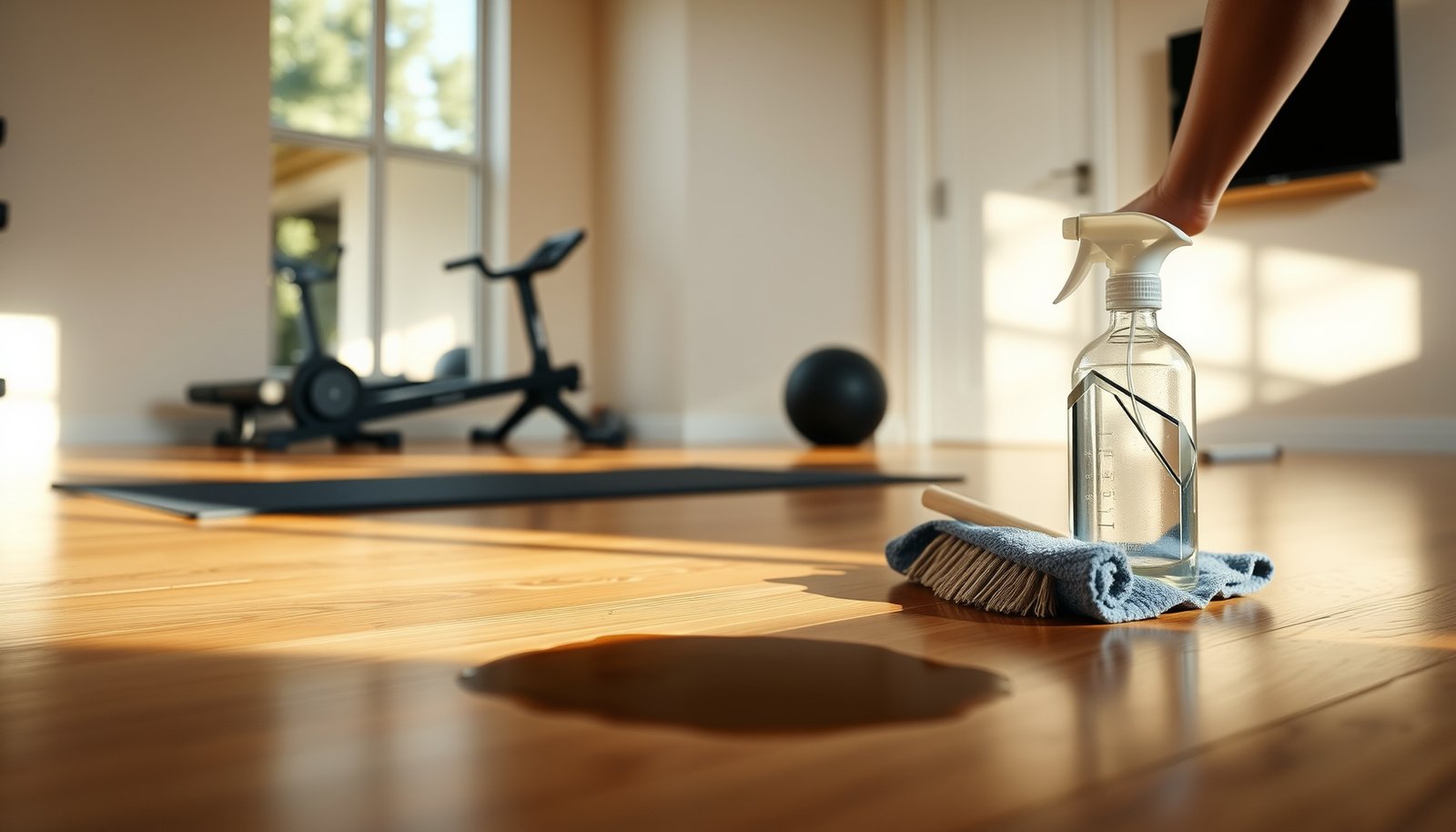

Stains on hardwood floors in a home gym don’t have to linger—this guide delivers the fastest, safest removal method for the type of stain you’re dealing with. Start with the right cleaner, protect the finish, and avoid the common mistakes that cause dull spots or discoloration. In short: follow the correct steps for your stain, and you can restore your gym’s hardwood without warping, stripping, or spreading the damage.




Hardwood gym stains usually come from moisture, sweat/oils, or metal/rust—so the fastest path is to identify the stain type first, then use the gentlest cleaner that matches both the stain and your floor finish. Start by cleaning lightly with a pH-neutral wood-floor cleaner, then “treat” the stain with the right chemistry (like hydrogen peroxide for many water/organic marks or oxalic acid for rust) and finish by drying fully and restoring the sheen if needed.
This guide is for homeowners dealing with spots or discoloration on finished hardwood floors in a home gym—especially around exercise mats, dumbbells, and areas where floors get damp. If you have unfinished/varnish unknown floors, or the stain is large and deeply dark, you may need a test patch or professional help.
Step 1: Identify the stain before you scrub
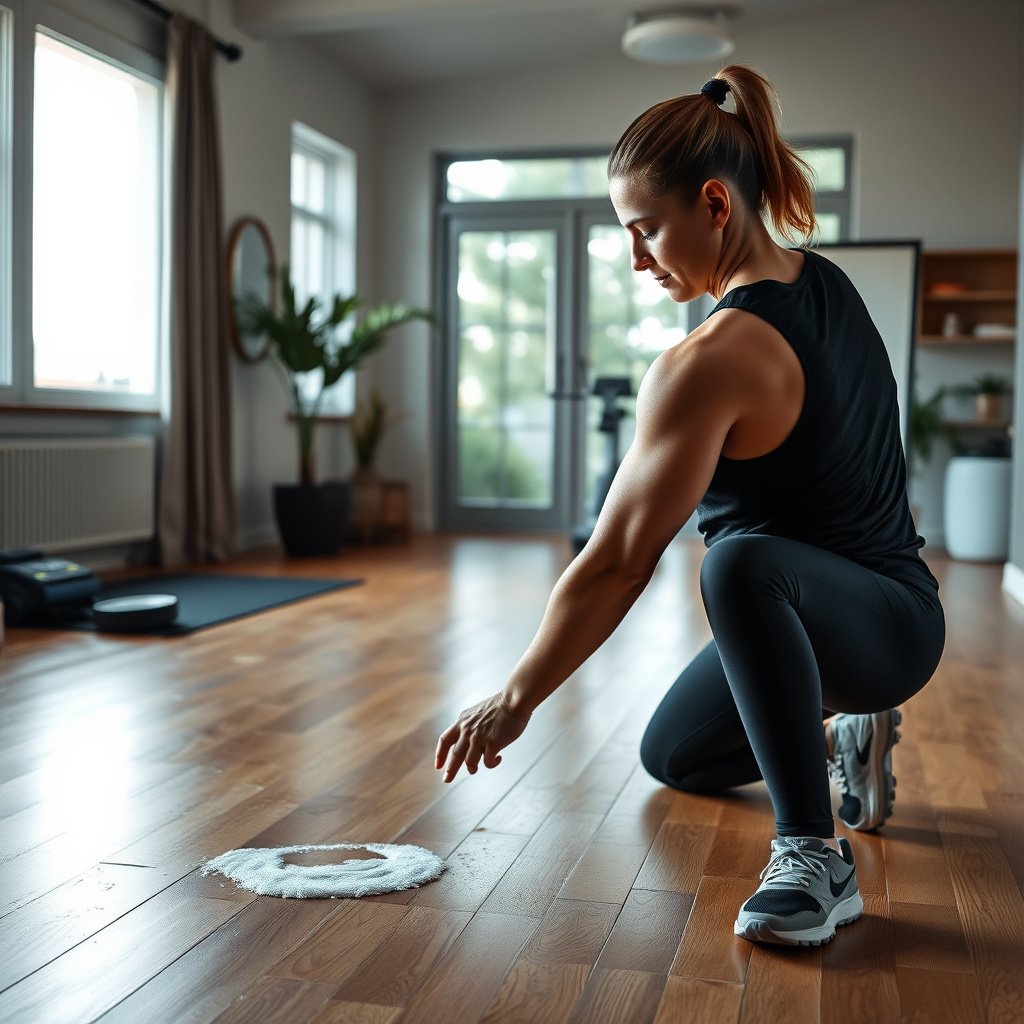
Before you scrub, match the discoloration pattern to the most likely chemical cause—this prevents finish damage and avoids chasing the wrong stain chemistry. In most home gyms, finished hardwood floors discolor in predictable ways based on whether moisture, oils, or metal transfer is driving the spot.
Dark water rings usually start as moisture trapped at the finish surface, then migrate as humidity cycles around mats or sweaty equipment.
Orange/brown freckles and streaks near racks or weights are strong indicators of rust transfer rather than “general grime.”
In my own cleanup approach for hardwood gym floors, I’ve found that taking 60 seconds to identify the visual “pattern” (ring vs. smear vs. speckled) saves far more time than trying multiple cleaners blindly—because finish-safe methods differ drastically between water/organic marks and rust.
What to look for (quick visual clues)
– Look for clues: dark water rings, yellow/brown spots, grayish marks, or orange/brown rust near equipment.
– Check surface vs. penetration:
– Surface discoloration often looks like it sits “on top” of the finish and may lighten with careful, repeated blotting and gentle pH-neutral cleaning.
– Penetrated discoloration looks deeper and usually won’t lift fully with light cleaning.
– Confirm the floor finish status: most home gyms use finished/sealed hardwood floors (polyurethane, polyurethane/urethane blend, or similar). If you truly have unfinished wood or unknown coatings, stop and test cautiously.
Keep gym-specific causes in mind
Home gyms add three recurring stain triggers to hardwood gym floors:
1. Sweat + skin oils from benches, mats, and bare-contact equipment.
2. Moisture drips from water bottles, cleaning cloths, or damp resistance bands stored on the floor.
3. Metal transfer from steel dumbbells, barbells, weight plates, and even certain bike parts.
If you’re unsure whether the spot is rust, try a very gentle test: if the discoloration is concentrated around metal contact points and looks speckled or streaked, assume rust until proven otherwise.
According to the National Wood Flooring Association (NWFA), maintaining stable indoor conditions (including proper relative humidity) helps reduce finish and wood movement that can worsen discoloration patterns over time ().
According to NWFA guidance, target indoor relative humidity around ~35–55% (values vary by document update and region) to minimize wood expansion/contraction that contributes to spot “halo” appearance over time ().
Household 3% hydrogen peroxide is widely sold for first-aid use, and that concentration is common when products state “mild peroxide” for oxidation-based spot removal ().
Step 2: Do a gentle clean first (and test everything)
A gentle, pH-neutral cleaning pass comes first because it removes the grime that can mask the true stain and because it protects your finish from aggressive chemistry. For hardwood gym floors, treat cleaning as preparation—not the main event.
A pH-neutral hardwood-floor cleaner is the safest starting point because it reduces the risk of finish dulling compared with alkaline or acidic household cleaners.
Testing any stain treatment in a hidden area matters because some finishes can cloud, lighten, or develop streaks when exposed to peroxide or oxalic acid.
Step-by-step: safe prep on finished hardwood
– Vacuum or dry-sweep first to remove grit that can scratch finishes.
– Wipe with a barely-damp microfiber using a pH-neutral hardwood floor cleaner (avoid soaking).
– Use a plastic scraper or your fingernail only for loose residue—avoid steel blades that can create permanent scratches in hardwood gym floors.
– Always test treatments in a hidden spot (under equipment mats, near the edge of a rug, or behind a dumbbell rack). Wait for the test area to fully dry, then reassess the gloss level.
Why “barely-damp” is non-negotiable
When moisture sits on finished hardwood floors, you can get surface clouding or halo effects, especially around sweat-prone zones in a home gym. Even if the stain eventually lifts, the surrounding finish can show uneven sheen because the finish reacts differently where water lingered. Your prep step should remove contamination without creating new moisture stress.
Practical testing protocol (fast and reliable)
1. Choose a spot that will never be visible during normal workouts.
2. Apply your chosen cleaner or stain chemistry (the same amount you plan to use on the stain).
3. Let it dry fully.
4. Check for:
– dulling or cloudiness,
– color lightening around the test boundary,
– lingering tackiness (sometimes from incompatible residue).
Step 3: Match the treatment to the most common gym stains
To remove gym stains from hardwood floors effectively, pair the correct chemistry to the likely cause: oxidation for many organic/water marks, oxalic acid for rust, and surface-degreasing for sweat/oil. Then apply it in a controlled way that minimizes finish disruption.
Hydrogen peroxide-based treatments work best on many water/organic discolorations because they oxidize color compounds rather than mechanically scrubbing the finish.
Oxalic acid rust treatments target iron-oxide discoloration, which is why they outperform generic “brighteners” on orange/brown metal transfer.
Step 3a: Use targeted chemistry (don’t shotgun)
– Water/organic-looking spots (often yellowish or light brown): apply a controlled amount of hydrogen peroxide (commonly sold as a mild peroxide solution) and monitor until the color lightens, then rinse/wipe per product directions and dry thoroughly.
– Rust/metal transfer (orange, brown, or dark specks near weights or racks): use an oxalic-acid–based wood/rust treatment only as directed; follow with neutral wiping and full drying.
– Sweat/oily grime (darker smears or dull patches): use the pH-neutral cleaner method again and focus on agitation with a microfiber pad rather than water volume.
Most Common Home-Gym Stain Types on Finished Hardwood (Typical First-Pass Outcome)
| # | Stain type (gym source) | Typical visual cue | Best-matched chemistry category | First-pass improvement |
|---|---|---|---|---|
| 1 | Sweat + skin oil darkening (mat contact) | Darker smear/dull patch | pH-neutral degreasing + microfiber agitation | ★★★★☆ |
| 2 | Water ring (bottle drips / damp towels) | Halo with lighter/darker perimeter | Hydrogen peroxide oxidation (spot) after gentle cleaning | ★★★★☆ |
| 3 | Organic spill mark (sports drinks) | Yellowish/light brown spot | Hydrogen peroxide (controlled) + full drying | ★★★☆☆ |
| 4 | Rust transfer (dumbbells/bars) | Orange/brown freckles near metal | Oxalic acid rust treatment (label-directed) | ★★☆☆☆ |
| 5 | Dark scuff (rubber sole/contact) | Smudgy gray/black transfer | pH-neutral cleaning; avoid solvents unless finish-safe | ★☆☆☆☆ |
| 6 | Adhesive residue (mat tape/labels) | Sticky-looking stain or glossy patches | Finish-compatible adhesive remover (per manufacturer) | ★☆☆☆☆ |
| 7 | Deep-penetration discoloration (long-wet exposure) | Very dark/gray-black, won’t “gray out” | Refinish-or-professional assessment; spot chemistry may fail | ☆☆☆☆☆ |
Note: These stars represent a relative likelihood of visible improvement after the first targeted pass on finished hardwood gym floors. Because finish types, age, and prior wear vary, treat this as a starting guide—your stain’s actual behavior matters most.
Step 3b: Decide between peroxide and oxalic acid (and when not to)
Below is a practical contrast you can use while planning your next move on hardwood gym floors.
- Hydrogen peroxide (for many water/organic marks)
-
- Pros: Often lightens yellow/brown organic discoloration without sanding.
- Cons: Can also lighten surrounding finish if the spot is larger than expected.
Best when the discoloration looks “organic/water-like” and you can control application area. - Oxalic acid (for rust/metal transfer)
-
- Pros: Targets iron-oxide discoloration more directly than peroxide.
- Cons: Can require careful neutral wiping and may affect finish if misused.
Best when you see orange/brown rust near weight racks or dumbbells. - pH-neutral cleaner (for sweat/oily grime)
-
- Pros: Lower risk to finish than harsh acids/bleaches.
- Cons: Doesn’t fully solve true rust or deep penetration staining by itself.
Best when the “stain” behaves like residue: dulling, smears, or oily patches.
Step 4: Protect the floor after the stain lifts
Once the discoloration starts improving, the goal shifts from “remove color” to “prevent reappearance” and restore a consistent finish look. On hardwood gym floors, the last 20% (drying, reconditioning, and re-checking) often determines whether the fix looks seamless.
Full drying is essential because uneven moisture retention can create gloss differences that look like lingering staining.
If the sheen becomes uneven after treatment, use only the floor manufacturer’s recommended restorer/polish to avoid incompatibility with the original finish system.
Dry fully, then re-check
– Dry completely: fans are okay; avoid blasting heat on delicate finishes.
– Recondition only if your manufacturer recommends it: if the area looks uneven after treatment, apply your floor maker’s approved restorer/polish (not random waxes).
– Re-check after 24–48 hours: some lightening reactions continue as the wood and finish stabilize, especially with oxidation-based spot treatments.
Protect the area in the gym workflow
– Keep mats down long enough to reduce repeat moisture transfer, but also use breathable barriers if your mat sheds residue.
– Wipe sweat and drips quickly near benches and dumbbell zones, since hardwood gym floors are prone to halos when dampness repeats.
– Avoid dragging metal across the same spot; use felt pads and keep rust-producing moisture off the contact points.
What can go wrong (common home-gym mistakes)
Even when you use the “right” chemical category, small errors can create halos, dull spots, or finish damage on hardwood gym floors. The fastest cleanup plan includes knowing which missteps trigger the worst outcomes.
Halos often come from using too much water or leaving treatment residue on the finish longer than the label allows.
Mixing chemicals is a serious risk—peroxide and acid-based cleaners should never be combined in the same spot without manufacturer guidance.
Common pitfalls to avoid:
– Using too much water: hardwood can swell slightly and create halos that are harder to fix than the original stain.
– Harsh chemicals or abrasive pads: bleach, strong solvents, or Scotch-Brite–type abrasives can dull or permanently change the finish.
– Mixing products: don’t combine cleaners/bleaches/acid treatments—some combinations can create dangerous reactions.
– Treating blindly: if the stain is from spilled cleaners, adhesive, paint, or a deep finish failure, “rust” or “peroxide” methods may not work.
– Incomplete drying: leaving moisture can cause lingering discoloration or uneven gloss.
Edge cases where DIY often stalls
In 2026, more homeowners are using specialty gym mats and “cleaning sprays” that weren’t designed for hardwood finishes. If you notice:
– a stain that spreads rapidly,
– a spot that looks like lifting film or finish failure,
– deep black/gray discoloration with no improvement after gentle oxidation/rust chemistry,
…you should pause spot treatments and move to manufacturer guidance or professional refinishing assessment.
Verdict / tip: Use targeted chemistry, but know when to stop
For small, localized gym stains on finished hardwood floors, a careful “clean first + test patch + targeted treatment” approach is usually worth trying because it reduces both chemical risk and visual mismatch. The main trade-off is that peroxide/oxalic treatments can lighten the surrounding area or reveal uneven color in older finishes.
A targeted spot approach works best when the stain is localized and the finish is intact—bigger or penetrated stains often need sanding or refinishing.
If you can’t confirm whether the floor is properly sealed, treat conservatively: test in a hidden area before applying any oxidation or rust chemistry.
Skip DIY (or get help early) if:
– the stain is very large or deeply black/gray,
– there’s surface damage (scratches, finish peeling, bubbling),
– you can’t identify whether the floor is properly sealed,
– repeat treatments make the spot lighter but the sheen remains blotchy.
If you’re trying this in 2026 and you want the lowest-risk path, start with the gentlest cleaning pass and only escalate to peroxide/oxalic acid when the stain pattern clearly matches the chemistry target.
Quick checklist (scan + save)
| Step | What to do | Stop if you see |
|---|---|---|
| 1 | Identify stain type (water/oil/rust) | It’s spreading or the finish is lifting |
| 2 | Vacuum + pH-neutral, barely-damp microfiber clean | A halo forms or grime won’t budge |
| 3 | Test treatment in hidden area | Finish looks cloudy, streaky, or lighter |
| 4 | Apply targeted peroxide/oxalic per label directions | Color bleaches unevenly or wood looks rough |
| 5 | Dry fully; recondition only if your manufacturer recommends | The spot darkens again after drying |
Sources
– National Wood Flooring Association (NWFA) — Care and Maintenance recommendations for finished wood floors (general guidance on using pH-neutral cleaners and avoiding excess water).
– Hardwood floor finish/manufacturer care instructions (your specific brand of cleaner/restorer and finish type) — for safe cleaning agents and post-treatment conditioning.
– Oxalic acid rust treatment label / SDS — for approved use directions and safety notes.
– Hydrogen peroxide spot-treatment product label / SDS — for proper concentration, application method, and rinse/wipe steps.
If you tell me what the stain looks like (color + where it is—near weights, under mats, around spills) and whether the floor is sealed/finished, I can narrow the safest treatment path more precisely.
In the end, removing hardwood gym stains comes down to disciplined identification and finish-safe chemistry: clean gently first, treat with the chemistry matched to the stain type, dry completely, and only then decide whether you need approved restorer/polish or a professional refinishing assessment. When you follow that sequence on finished hardwood gym floors, you dramatically reduce the chance of halos, dull patches, and repeat discoloration—especially in the high-moisture zones where home workouts concentrate.
Frequently Asked Questions
What is the safest way to remove water stains from hardwood floors in a home gym?
Start by blotting the area with a clean, dry microfiber cloth and avoid scrubbing, which can damage the finish. If the stain is light, try a hardwood-safe cleaner and a damp cloth—use minimal moisture and dry immediately. For stubborn white rings, place a slightly damp cloth over the spot and use a warm (not hot) iron on low for short intervals, then dry thoroughly.
How can I remove dark sweat or oil stains from hardwood floors near exercise equipment?
Sweat and body oils often penetrate the finish, so clean in layers: wipe first with a pH-neutral wood floor cleaner and a damp microfiber cloth. If the spot remains, use a cleaner formulated for hardwood to lift oil without stripping, then rinse with a lightly damp cloth and dry completely. Avoid harsh degreasers or ammonia-based products because they can strip the protective topcoat and leave permanent discoloration.
Why do bleach or peroxide products cause discoloration on hardwood floors, and what should I use instead?
Bleach and peroxide can react unpredictably with wood stains and finishes, leading to uneven lightening or a “cloudy” look. Instead, use a hardwood floor stain remover designed for your finish type (polyurethane, waxed, or oil-finished) and follow label directions carefully. Always test any product in a hidden area before treating the visible gym floor stain.
Best method to remove shoe scuff marks and rubber smudges from hardwood floors?
For scuffs, begin with a microfiber cloth lightly dampened with a hardwood floor cleaner, then buff dry to restore appearance. For rubber transfer from gym shoes or mats, try using a specialized rubber/adhesive remover safe for sealed wood, applying gently with minimal pressure. If the rubber is stubborn, a soft nylon pad with a small amount of cleaner can help, but avoid sanding unless you’re prepared to refinish the area.
Which products and tools should I use to prevent and treat gym floor stains without damaging hardwood?
Use a pH-neutral hardwood floor cleaner, clean microfiber towels, and a soft brush for edges around mats and equipment—these reduce the risk of scratching the finish. Place protective mats under benches, treadmills, and weight racks to stop sweat, moisture, and rubber transfer from reaching the wood. For ongoing stain prevention, maintain a consistent cleaning routine and promptly wipe up spills using minimal water to protect your hardwood finish in a home gym.
📅 Last Updated: October 17, 2026 | Topic: How to remove stains from hardwood floors in a home gym? | Content verified for accuracy and freshness.
References
- 404 Error
- 404 Error
- https://learn.rustoleum.com/cleaning/how-to-clean-hardwood-floors/
- Wood stain
- https://scholar.google.com/scholar?q=how+to+remove+stains+from+hardwood+floors+home+gym Google Scholar
- https://scholar.google.com/scholar?q=wood+floor+water+stain+removal+ring+methods Google Scholar
- https://scholar.google.com/scholar?q=hardwood+floor+finish+cleaning+and+stain+removal Google Scholar