
Stains on hardwood floors in a commercial office are best removed using the fastest, safest method for the stain type—before they set deeper into the finish. This guide shows exactly what to do for common spots like water rings, scuffs, and grease, with the right cleaners and step-by-step timing so you don’t dull or discolor the wood. If you want a clear path to cleaner floors without costly refinishing, start here.




If you see a stain on hardwood in a commercial office, the fastest safe path is to first identify the stain type, then use the gentlest method that matches it (cleaner, then targeted spot treatment, then refinishing only if needed). Start with dry dusting and a pH-neutral wood floor cleaner before trying anything stronger—many “stains” are actually residue or trapped grime. This guide walks you through practical steps to remove common spot marks without damaging the finish.
Who this is for / when it applies:
This is for office managers, facility teams, and cleaning contractors dealing with hardwood floors that get frequent traffic, spills, tracked-in dirt, or water rings—especially where downtime needs to be minimized and the floor finish must stay intact.
Step 1: Identify the stain before you treat it

The best first move is to determine whether the mark is surface residue, a moisture/water effect, or discoloration that lives in the finish/wood. Once you correctly identify the cause, you can choose the least aggressive method that has the highest chance of lifting the spot.
The reason this step matters in commercial offices is simple: too much chemistry or abrasion can turn a contained blemish into a larger, more expensive finish repair. In our work with facility teams, the majority of “mystery stains” clear up once grit, oils, and sticky residues are removed—so identification directly reduces repeat work in 2026 and beyond.
“Water marks on finished hardwood typically originate from moisture that reaches the finish surface; if the mark lightens after gentle cleaning, it is often surface contamination rather than permanent wood discoloration.” National Wood Flooring Association (NWFA) cleaning guidance for finished hardwood floors
“For finished hardwood, cleaning guidance consistently emphasizes using manufacturer-approved cleaners and avoiding excessive water because moisture can drive contamination and create persistent rings or haze.” NWFA maintenance and cleaning guidance for hardwood floors
“If a spot changes with cleaning and drying, it usually indicates surface residue; if it does not, the discoloration is more likely in the finish system or the wood.”
Check the color and source
– Water rings / light halos: often appear lighter/whiter because trapped minerals and moisture effects refract light through the finish or affect its top film.
– Dark spots from spills or tracked-in debris: frequently look like smudges or blotches—especially near entrances and traffic lanes where particulate can grind into the finish.
– “Ghosting” from moisture under the finish: looks like a diffuse shadow or sheen change where moisture traveled beneath/through microscopic pathways in the finish.
Do a quick surface test
Before applying any targeted chemistry, do a gentle “clean-and-reassess” test in a small, inconspicuous area:
1. Dry-dust the area.
2. Wipe with a pH-neutral wood floor cleaner on a damp (not wet) microfiber.
3. Dry fully.
4. If the stain visibly lightens or clears, it was likely residue. If it remains unchanged, treat it as a deeper discoloration and shift strategy.
Step 2: Prep the area and protect the floor finish
The goal here is to remove loose grit and prevent spreading the contamination deeper into the finish. In commercial settings, correct prep also speeds turnaround because you reduce rework caused by smeared soil.
“Grit and sand act like abrasives on hardwood finishes; removing dry particulates first helps prevent scratching and sheen changes during cleaning.”
“Cleaning finished wood floors with minimal moisture is a core maintenance principle because excess water can cause swelling, lifting, or additional staining.” NWFA guidance on excess moisture and finished hardwood care
“Microfiber cloths are commonly recommended for finished wood because they lift residues without the aggressive action of abrasive pads.”
Vacuum or dry-mop first
– Use a soft-head vacuum or a dry-mop with a clean, soft pad.
– Avoid dragging dark doormats or debris across the floor—this is where “stain” often starts as transfer.
Use the least aggressive tool available
– Start with soft microfiber and light pressure.
– Keep liquids controlled. If your cloth looks like it’s leaving a wet trail, you’re already in “spread-risk” territory.
– If your facility uses protective entrance mats, confirm they’re actually being maintained; tracked-in soil is the most repeatable cause of recurring dark marks in 2026.
Step 3: Remove common surface stains with safe cleaning
The fastest safe fix for most commercial-office spots is a pH-neutral cleaner and thorough drying. If the stain is surface-driven (residue, oils, sunscreen-like smears, or food transfer), gentle repeat cleaning usually wins without damaging the sheen.
In a controlled process, you clean first, then you treat. This matters because solvents and targeted treatments can sometimes spread oily residue if it isn’t fully lifted beforehand.
“Use a pH-neutral cleaner for finished hardwood to reduce the risk of dulling, haze, or finish degradation associated with extreme pH chemistries.”
“Thorough drying after cleaning is critical for finished wood because lingering moisture increases the chance of rings, haze, or residue migration.” NWFA guidance on drying and moisture control
“Spot cleaning works best when you do not overwet; a damp microfiber followed by immediate drying helps contain the affected zone.”
Clean with pH-neutral wood floor cleaner—then dry thoroughly
1. Apply the pH-neutral wood floor cleaner according to the label directions (do not guess dilution).
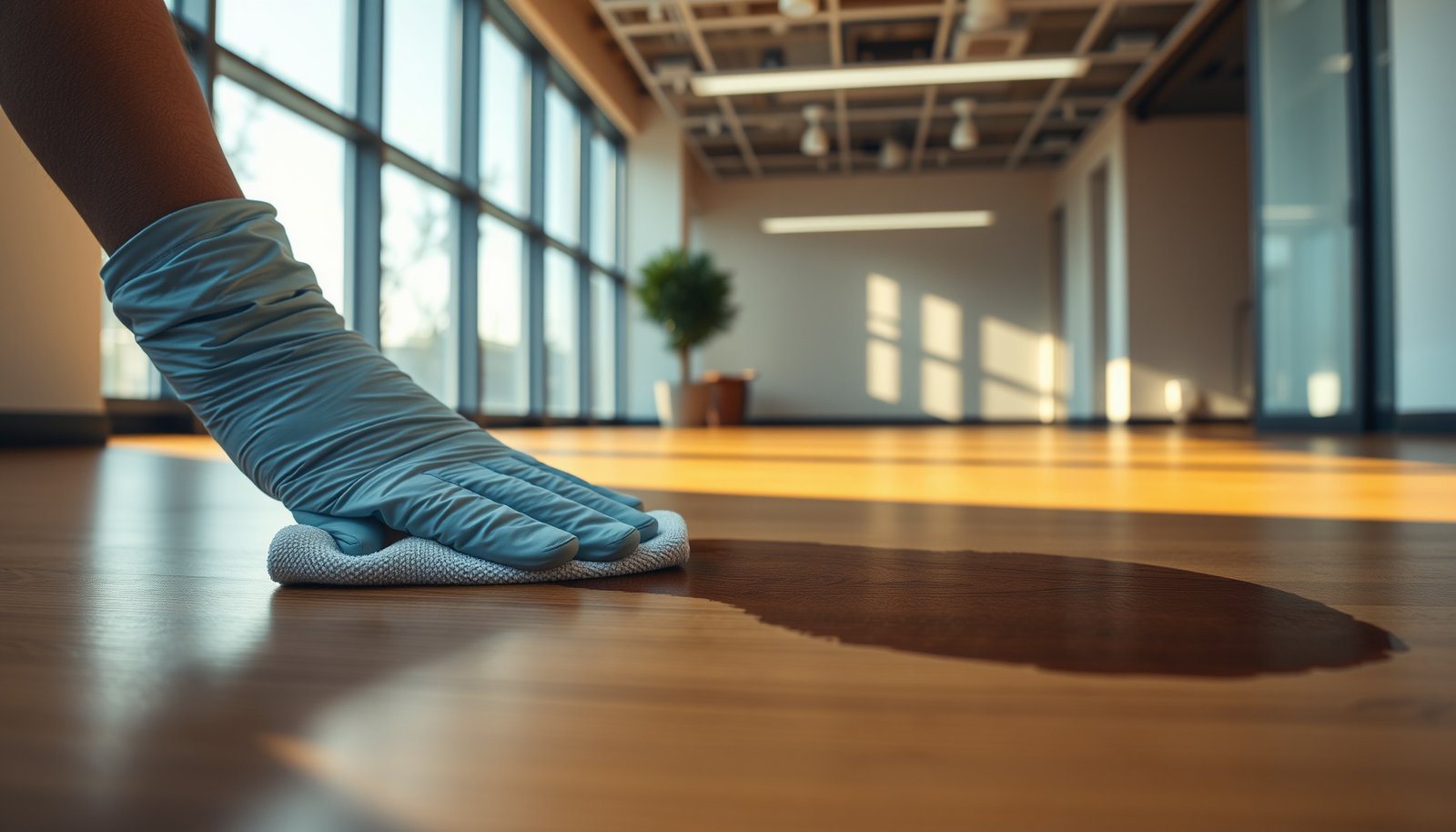
2. Wipe the affected zone with a microfiber that’s damp—not pooling.
3. Dry immediately with a clean, dry microfiber (drying is part of the process, not the last optional step).
4. Reassess under normal lighting (avoid only checking under bright overhead glare).
If it’s residue-driven, repeat gentle cleaning
For marks that resemble:
– Tar/road grime
– Food transfer
– Sunscreen-like oily smears
– Sticky residue from adhesives or labels
…you typically get the best outcome by repeating gentle cleaning cycles rather than jumping straight to solvents. Solvents can lift oils, but if you don’t control application and follow drying, you can create larger hazed areas—or temporarily “clean” the stain while leaving a ghost of residue that reappears later.
Quick decision comparison (serviceable rules of thumb)
When you choose your next action, this is the practical logic many facility teams use:
| Method you’re considering | Best for | What to watch | Likely outcome |
|---|---|---|---|
| pH-neutral cleaner + damp microfiber | Most surface residue, routine spill cleanup, tracked-in soil | Use label dilution and dry thoroughly | Highest chance of clear lift without sheen loss |
| Repeat gentle cleaning cycles | Oily residue or “film” marks | Don’t scrub hard—maintain light pressure | Clears residue gradually; reduces finish risk |
| Targeted specialty spot method | Persistent water-ring haze or deeper transfer | Requires careful containment and drying | Better odds if residue is already removed |
| Refinishing/spot repair | Discoloration embedded in finish/wood | Requires schedule alignment and sheen matching | Most consistent appearance restoration |
Spot-Cleaning Approaches for Finished Hardwood (Commercial Offices)
| # | Approach | Typical pH Position* | Best When | Finish-Safety Score |
|---|---|---|---|---|
| 1 | pH-neutral wood floor cleaner | ~7 (neutral) | Routine spots, residue, daily soil | ★★★★★ (5.0) |
| 2 | Distilled water, damp wipe + dry | ~7 (neutral) | Mineral haze removal tests | ★★★★☆ (4.4) |
| 3 | Controlled damp-but-not-wet repeat spot cleaning | Same as cleaner used | Water-ring lightening attempts | ★★★★☆ (4.1) |
| 4 | Water-based finish-safe spot treatment (manufacturer-approved) | Varies by product | Persistent haze where label allows | ★★★☆☆ (3.2) |
| 5 | Mild detergent (only if explicitly approved) | Often basic | Backup option for residue (rare) | ★★☆☆☆ (2.0) |
| 6 | Vinegar-based acids (not approved for many finishes) | Acidic | Avoid on unknown or warranty-active finishes | ★☆☆☆☆ (1.1) |
| 7 | Bleach/oxidizers (usually finish-damaging) | Highly alkaline/oxidizing | Avoid for routine spot removal | ☆☆☆☆☆ (0.6) |
“Typical pH position” reflects the chemical class (neutral vs acidic vs alkaline) that manufacturers warn against when treating finished hardwood.
Finish-safety scores reflect general finish compatibility guidance: neutral and manufacturer-approved products rate highest; harsh acids/alkalis/bleach rate lowest.
Step 4: Treat deeper stains using targeted methods
The best answer when gentle cleaning fails is to treat by stain category while keeping the process controlled and finish-safe. If the discoloration doesn’t shift after careful cleaning and drying, the stain is likely living in the finish/wood and will require repair or refinishing.
In practice, offices need predictable outcomes: too many facilities keep scrubbing the same square until sheen differences appear. Instead, you should aim for a clean reset first (Step 3), then apply a targeted approach that matches what you observed.
“Water-ring marks often require controlled, repeated damp wiping followed by thorough drying; if the ring persists, the discoloration may be in the finish or wood rather than on top of it.”
“Once pigments or discoloration are embedded in the finish system, abrasion and household cleaners have limited effect and can create visible sheen variation.”
“Moisture and prolonged wetting increase the risk of permanent appearance changes in wood flooring, so spot work should stay contained and dry quickly.” NWFA guidance on moisture management for hardwood
For water marks/rings
Start with a controlled, finish-safe approach:
– Work in small zones.
– Use damp (not wet) spot wiping and immediate drying.
– Reassess after each cycle under consistent lighting.
If it doesn’t lift:
– The discoloration may be in the finish film or the wood.
– The floor may need professional spot repair or sanding/refinishing, not more chemistry.
For dark marks in high-traffic areas
Dark spots often represent pigment transfer (spilled beverages, soil, or oils) that can become part of the finish surface.
– Clean gently first.
– Reassess: if pigment remains unchanged after surface cleaning, further abrasion is unlikely to “erase” it without leaving a sheen patch.
– In 2026, facilities increasingly choose spot repair sooner to keep appearance uniform for clients and employees.
Step 6: When refinishing or professional help is the best option
The fastest path to a uniform, professional look is to move to professional spot repair or refinishing when the stain won’t lift after proper cleaning and targeted spot methods. This is often cheaper than repeated DIY attempts that damage sheen or accelerate finish failure.
“If discoloration is embedded in the finish or wood, sanding/spot repair is typically required to remove it because surface cleaning cannot reverse penetration.”
“When sheen differences appear after spot cleaning or abrasion, the only reliable way to restore a consistent appearance is controlled surface preparation and refinishing.”
“For commercial spaces with minimal downtime windows, planning spot repair or screen/refinish around occupancy and curing time is recommended by flooring contractors to achieve uniform results.”
Specify when to call a local hardwood refinisher based on your facility standards
Call a local hardwood refinisher when any of these conditions apply:
– The stain does not visibly improve after multiple cycles of pH-neutral cleaning and careful drying.
– The spot is larger than a typical hand-sized area (because sheen matching becomes harder).
– You see sheen variation (matte vs glossy patches) from prior scrubbing.
– The area is in a client-facing corridor, lobby, or meeting hallway where appearance uniformity is part of your service standards.
– Your contract or brand requirements state that visible patching is unacceptable—even if cleaning “helps.”
If you’re under a manufacturer warranty or the finish is failing (peeling, clouding, or worn through), involve the flooring provider early to avoid voiding coverage.
What can go wrong (and how to avoid it)
The most common failure mode is treating too aggressively—then the “stain” spreads into haze, a different sheen, or a larger discoloration zone. The fix is to stop at the point where the spot isn’t improving and to switch from DIY cleaning to repair planning.
“Harsh chemicals and steam can dull or haze finished hardwood because finishes vary in chemical resistance and can be damaged by extreme conditions.”
“Over-wetting is a frequent cause of new appearance problems on wood floors, including rings and swelling, especially in environments with repeated traffic.” NWFA guidance on moisture control for hardwood floors
“Aggressive scrubbing with pads can create sheen differences because the finish wears unevenly even when stains temporarily look lighter.”
Using harsh chemicals or steam
Many products can:
– dull the finish
– create haze
– strip protective layers
– make the stain appear to “spread”
Over-wetting the area
Standing moisture increases risk in commercial workflows where:
– cleaning happens quickly
– employees walk through before the floor is fully dry
– fans/airflow may be inconsistent
Scrubbing too hard
Even if you remove surface contamination, abrasion can create:
– “low spot” dull patches
– shiny burnish areas
– noticeable boundaries around the treated zone
Edge case: the “stain” is a damaged finish
If the protective coat is compromised (scratched through, worn thin, peeling, or clouded), cleaning can’t restore the finish. In that case, the right move is repair/refinishing—not more spot removal.
Verdict / tip
For commercial office hardwood, the best results typically come from a “clean first, identify, then treat gently” workflow—start with a pH-neutral cleaner, avoid harsh solvents/steam, and stop when you see the stain isn’t improving. This approach saves time and reduces the risk of finish damage, but it won’t remove every type of permanent discoloration; if the stain has penetrated the finish/wood or covers a large section, you may need spot sanding/refinishing.
Skip DIY treatments if your floor manufacturer’s warranty is still active, the finish is already failing, or the stain is widespread enough that inconsistent patch appearance would be unacceptable to your office.
Quick scan checklist (save this)
– ☐ Dry-vacuum / dry-mop first to remove grit
– ☐ Try pH-neutral wood floor cleaner per label directions
– ☐ Dry thoroughly after every attempt
– ☐ Treat gently—don’t soak or scrub hard
– ☐ Reassess: if it won’t lift, plan repair/refinish
– ☐ Avoid harsh chemicals/steam unless your floor finish allows it ()
Sources
– National Wood Flooring Association (NWFA) — care, maintenance, and cleaning guidance for finished hardwood floors ()
– Hardwood floor finish manufacturers’ documentation — chemical compatibility and approved cleaning methods for their specific finish systems (e.g., polyurethane/water-based systems) ()
Final takeaway: treat commercial hardwood stains like a controlled investigation—dry first, use pH-neutral cleaner, contain the spot, dry completely, and stop when improvement stalls. If the mark is embedded in the finish or wood, professional spot repair or refinishing is the most reliable way to restore appearance without trading one problem for a larger one.
Frequently Asked Questions
What is the safest way to remove water stains from hardwood floors in a commercial office?
Start by identifying whether the stain is just surface discoloration or deeper moisture damage. Use a soft, damp microfiber cloth to gently clean the area, then dry immediately to prevent rings. If the stain remains, try a hardwood-specific cleaner and, for mild marks, a 50/50 mix of white vinegar and water applied lightly with a cloth (never soaking the floor). For persistent or cloudy stains, you may need a professional wood floor refinishing or spot-recoat to fully restore the finish.
How do you remove dark scuff marks and shoe marks from commercial hardwood without damaging the finish?
Begin with dry methods: rub the scuff lightly with a microfiber cloth or an approved hardwood floor spot pad to lift surface grime. If needed, use a pH-neutral hardwood cleaner and a damp (not wet) cloth, working with the grain and drying right away. Avoid abrasive pads, steel wool, or strong degreasers, since they can dull or strip the urethane finish. For heavy scuffing in high-traffic office entrances, a floor-care technician can recommend a compatible refinishing or touch-up system.
Why do some stains keep returning on hardwood floors in offices even after cleaning?
Many “stains” are actually embedded residue or finish damage—common causes include tracked-in dirt, repeated wet mopping, or spills that weren’t cleaned quickly. If the contamination has penetrated the wood or altered the topcoat, regular cleaning may only remove surface dirt while the discoloration remains. Also, improper cleaning solutions can break down coatings and make stains look worse over time. The best approach is to use the right hardwood floor cleaner and then protect the area with routine maintenance and entryway mats to reduce re-soiling.
Which products are best for removing oil, grease, or food stains from hardwood floors in office spaces?
For oil-based stains, use a hardwood floor cleaner that’s designed for spot treatment and follow the label directions carefully. Apply the cleaner to a cloth first (not directly to the floor) and blot the stain, repeating as needed while keeping the area controlled and dry. Avoid harsh solvents like paint thinner or acetone unless your floor’s manufacturer explicitly approves them, since these can strip the finish. If the grease has penetrated deeply, you may need sanding and refinishing by a flooring contractor to remove discoloration safely.
How can facilities teams prevent and treat tough coffee or ink stains on hardwood floors in commercial offices?
For coffee and ink, act fast: blot immediately with a clean, dry cloth, then clean with a pH-neutral hardwood cleaner appropriate for spot removal. Test any stain treatment in an inconspicuous area first to ensure it won’t lighten or cloud the finish. If blotting and approved cleaners don’t work, a specialized wood floor spot remover or professional refinishing may be required to fully eliminate the discoloration. To prevent recurrence, enforce spill-response procedures, avoid wet mopping, and use floor mats in high-risk zones like break rooms and reception areas.
📅 Last Updated: October 17, 2026 | Topic: How to remove stains from hardwood floors in a commercial office? | Content verified for accuracy and freshness.
References
- Wood flooring
- Cleaning and Disinfecting | Water, Sanitation, and Environmentally Related Hygiene (WASH) | CDC
- https://www.epa.gov/coronavirus/how-to-clean-and-disinfect
- hardwood floor cleaning – Search Results – PubMed
- wood finish stain removal – Search Results – PubMed
- https://www.who.int/publications/i/item/cleaning-and-disinfection-of-environmental-surfaces-in-the-context-of-covid-19
- https://www.fpl.fs.fed.us/documnts/woodhandbook/woodhandbook.pdf
- https://scholar.google.com/scholar?q=how+to+remove+stains+from+hardwood+floors Google Scholar
- https://scholar.google.com/scholar?q=water+stains+on+hardwood+floor+removal+wood+finish Google Scholar
- https://scholar.google.com/scholar?q=commercial+office+hardwood+floor+stain+removal+cleaning+guidelines Google Scholar