To prevent scratches on industrial floors, the most effective strategy is controlling abrasive traffic at the source—using the right floor protection mats and correctly selected wheel or caster materials for forklifts and carts. Pair that with strict housekeeping and impact-management practices, like protective bumpers and routine surface inspections, to stop grit and sharp debris from grinding the finish. Follow these controls and you’ll reduce visible damage faster than relying on coatings alone.




Scratches on industrial floors are mostly preventable by controlling what contacts the surface, how that contact is cleaned, and how loads are moved. Start by protecting high-traffic areas (and the bottom of equipment) with the right floor coverings, mats, or coatings, then build cleaning and maintenance routines that won’t grind debris into the finish.
Scratches are rarely “random.” In warehouses, loading docks, and production facilities, they typically track repeat contact points—dock transitions, turning zones, conveyor transfers, pallet jack routes, and the lower edges of racks and equipment—where grit and abrasion get repeatedly pressed into concrete, epoxy, polyurethane, or other sealed finishes. This guidance is designed for facility managers, maintenance teams, warehouse supervisors, and contractors who maintain scuffed concrete and coating systems where wheels/casters, carts, forklifts, cleaning tools, and transfer hardware touch down every shift.
Map the scratch “sources” first (before you buy anything)
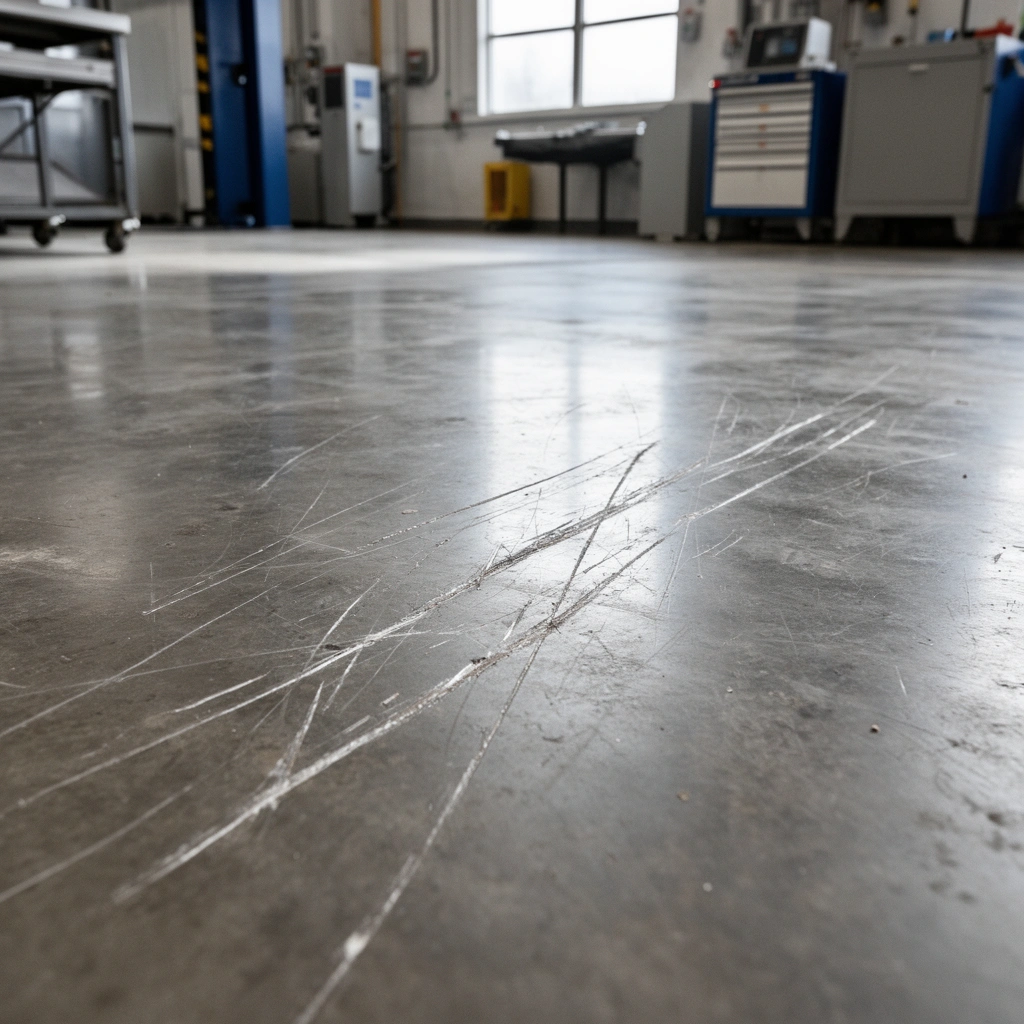
The fastest way to reduce scratches is to identify the exact contact events that create them—then address those events at the source rather than “trying everything.” Most scuffed floors are the result of recurring abrasion at a small number of predictable locations such as dock plates, thresholds, turning zones, rack undercuts, and aisle ends.
Start with a walk-through using real traffic patterns (forklift routes, cart staging, pallet jack hand-offs, and scrubber paths). Then verify the floor behavior by surface type, because bare concrete, epoxy systems, and polyurethane/urethane topcoats don’t respond the same way to the same contact forces and debris.
Scratches usually originate where wheels, casters, pallet jack hardware, or dock transitions repeatedly contact the same floor patch—not across the whole slab.
Different floor systems (bare concrete vs. epoxy vs. polyurethane) exhibit different “scratch initiation” mechanisms because their surface layers and hardness vary.
Identify where scratches originate (hotspots you can measure)
Focus on door thresholds, dock plates, and transfer edges first. These locations concentrate: (1) impact/roll-over, (2) trapped grit, and (3) misalignment between two floor elevations (even small lip changes can “catch” wheels/casters).
Also check:
– Turning zones: the inside radius of forks and casters is where angled wear concentrates.
– Aisle ends and staging lanes: equipment backs up, turns, and pivots more often than mid-aisle travel.
– Under racks and equipment: rotating or pivoting loads can rub the floor where access is limited and dust buildup is common.
Check the “attack angles” (why the same traffic looks worse in one spot)
Scratches are typically deeper where sharp edges and abrasive grit are aligned with the wheel direction of travel. Look for:
– Damaged wheels/casters with chipped edges or worn tread (including embedded debris).
– Grit under tires from dock areas, roll-up doors, or outside traffic.
– Falling hardware: loose fasteners, clamp brackets, pallet jack forks, or conveyor components that contact the floor during routine adjustments.
Review the floor condition by type
Bare concrete can develop hairline abrasion paths quickly when the surface is contaminated with silica/aggregates or when abrasive cleaning is used. Coated floors (epoxy, polyurethane, sealed concrete systems) often scratch through at the “weakest layer” first—commonly where adhesion is compromised by insufficient substrate prep, moisture issues, or topcoat system mismatch.
Use the right protection where traffic concentrates
The most effective scratch prevention is layered protection: cover the wear zone, protect the equipment contact point, and stop repeated scrape events before they happen. Instead of coating the entire facility once a scratch appears, protect the few square meters that see repeated rolling, pivoting, and drop-impact.
Protection works best when it’s targeted and installed with transitions so wheels don’t catch an edge. It should also be compatible with your floor type and cleaning method (wet washdown, dry sweeping, chemical usage, etc.).
Dock mats and transitional strips reduce scratch risk by smoothing elevation changes and limiting direct contact between wheels and concrete or coating edges.
Replacing chipped or hardened caster wheels can prevent “edge-guided” abrasion, which commonly creates linear scuff marks on coated floors.
Add floor protection strategically (not everywhere at once)
Good placements include:
– Dock mats at receiving transitions (especially where dock plates sit above slab grade).
– Wear strips or transitional lanes at doorways and grade changes.
– Anti-fatigue tiles or modular wear pads in longer standing/wheel staging areas—use these only where rolling loads and cleaning flows won’t undermine seams.
– Wheel-wear pads at transfer points where carts and hand trucks repeatedly stop, pivot, or change direction.
Protect equipment contact points
Floor coverings help, but equipment is usually the “scratching tool.” That means:
– Ensure wheel and caster materials are suitable for your floor system (non-marking where required, softer where compatible with your coatings, and resistant to chemical exposure).
– Keep wheel/caster assemblies in spec: brakes functioning, stems aligned, and bearings maintained so wheels don’t “chatter” across the surface.
– For conveyors, verify transfer skids and contact materials so the conveyor belt or transfer hardware doesn’t drag abrasive fines.
Control impact with guards and bump points
Many “mystery” scratches are actually repeated scrape events:
– Add rack leg bumpers or vehicle bump guards at impact-prone locations.
– Place guarding so fork tips, cart frames, or pallet jack bodies don’t ride the floor during routine docking or staging.
Choose coatings and finishes for abrasion resistance
The right coating choice reduces scratch-through risk, but only when it matches your abrasion pattern and chemical/temperature environment. Coating systems don’t “make abrasive debris disappear”—they reduce damage by improving surface hardness, abrasion resistance, and cohesion of the top layers.
This is also where many facilities waste money: they choose an “abrasion-resistant” product without confirming the substrate preparation and system compatibility needed to prevent scratches from starting at adhesion failures.
Abrasion testing methods such as ASTM standards are used to quantify wear/scuff resistance of floor coating systems under controlled conditions.
Coating failures often begin when substrate prep is inadequate, which can create weak top layers that scuff and scratch through faster than the rest of the system.
Start with performance targets from manufacturers
When planning a surface upgrade, ask the coating manufacturer for:
– Abrasion/scuff resistance expectations for your specific traffic (forklifts vs. foot traffic vs. carts).
– Chemical resistance and washdown compatibility if you use detergents or sanitizers.
– Temperature tolerance (cold rooms, steam cleaning, hot work areas) because thermal movement can increase wear at interfaces.
Ensure proper substrate prep
Scratch-through frequently starts at weak adhesion points. Your system specs may require grinding, shot-blasting, or other preparation steps to achieve the surface profile and bond strength the coating needs.
Key practical checks:
– Verify moisture conditions where the substrate transitions between coating batches.
– Confirm the coating installer followed required cure windows (premature loading can reduce performance).
Match the system to the use case
Here’s a practical comparison of common industrial floor finishes and where each tends to hold up best.
| Finish type | Scratch/abrasion behavior (typical) | Best for | Watch-outs |
|---|---|---|---|
| Sealed concrete | Surface protection can scuff when abrasive grit is embedded and pulled by traffic. | Light to moderate wheel traffic where cleaning is controlled. | If sealant is worn in hotspots, scratches concentrate quickly. |
| Epoxy (2K) coatings | Can resist scuffing well, but can scratch through if topcoat thickness/adhesion is inadequate. | Medium abrasion zones with controlled cleaning. | Moisture or poor prep increases risk of delamination that exposes softer layers. |
| Polyurethane/urethane topcoats | Often improves chemical and abrasion resistance over epoxy when engineered as a system. | Washdown or mixed chemical environments. | Compatibility depends on the full build (primer + body + topcoat) and correct cure. |
| Polyaspartic / fast-cure systems | Designed for rapid turnaround; abrasion performance depends on the specified wear layer. | Turnaround-driven renovations with planned traffic control. | Fast-cure success depends on staging, prep, and adherence to recoat intervals. |
> Note: For performance verification, rely on manufacturer documentation and test methods appropriate to flooring (for example, standardized abrasion/scuff testing in product specs). [ADD: source for the specific abrasion test standard used in your coating datasheet.]
Three concrete data points to anchor decisions
– According to ASTM D4060 (abrasion testing method), wear results are generated using standardized abrasive wheels and specified test parameters so products can be compared under controlled conditions ([ADD: ASTM D4060 standard documentation]).
– According to ASTM C957 (related industry practice for concrete floor coatings), preparation and application are governed by system requirements because performance depends on the entire coating build, not a single layer ([ADD: ASTM C957 or relevant coating system guideline]).
– According to ASTM F2170 (in-situ moisture measurement practice used for coatings and flooring acceptance), moisture levels are measured to help prevent coating failures caused by substrate conditions ([ADD: ASTM F2170 standard documentation]).
If you’re specifying a system in 2026, align your procurement checklist with these kinds of documented methods rather than relying on marketing “abrasion resistant” labels.
Prevent grit and abrasive transfer during cleaning
The quickest way to stop scratches from getting worse is to prevent grit from being moved during cleaning. Many facilities “improve cleanliness” while unknowingly creating micro-scratches by grinding embedded sand, dust, and abrasive particles into coatings or into the surface profile of concrete.
In practical terms, cleaning success means removing contaminants—not spreading them into a thin layer that traffic compacts into the finish.
Vacuum-assisted cleaning and properly maintained tools reduce the chance of re-depositing abrasive grit compared with uncontrolled sweeping on coated surfaces.
Worn pads, dirty squeegees, and clogged vac heads can increase debris transfer, turning cleaning tools into abrasion tools.
Use cleaning methods that don’t re-sand the floor
Implement a method chain such as:
– Dust control first (vac system where feasible, or controlled pickup rather than dry sweeping).
– Microfiber/approved pads for your coating type.
– Signage and training so staff doesn’t “cut corners” with abrasive implements in high-wear zones.
Maintain tools so they don’t become the scratch source
Cleaning tool condition matters as much as cleaning chemistry:
– Replace pads before they become embedded with grit.
– Inspect squeegees and scrub heads for worn edges and debris buildup.
– Clean vac heads/filters per schedule so they keep capturing fine particles.
Keep dry debris out of traffic paths
Entries and receiving areas are where grit is introduced. Add:
– Doormats and controlled entry systems at perimeter doors.
– A staged cleaning plan so dock transitions are cleaned before high-traffic runs start (rather than after abrasive dust has already spread).
What can go wrong (common mistakes and limits)
Prevention can fail if mats have the wrong transitions, coatings are installed without required prep, or cleaning methods grind debris into the surface. Even the best product can’t compensate for damaged wheels/casters, embedded grit, or poorly matched floor protection.
The limitations below are worth treating as “failure modes”—if you recognize one, you’ll troubleshoot faster.
Overusing abrasive pads increases micro-scratching even when the floor looks cleaner, because abrasion mechanisms still occur during scrubbing.
Without transitions, mats and wear strips can create wheel/caster “catch points,” producing localized scratch lines at the mat edge.
Common mistakes and their consequences
– Overusing abrasive cleaning pads: “heavy duty” scrubbing often increases micro-scratches rather than removing them.
– Installing protection without transitions: wheels/casters can catch on edges and scratch a narrow strip repeatedly.
– Skipping surface prep before coatings: coating failures can appear first as rapid scuffing, scratch-through, or peel.
– Choosing coatings without confirming abrasion performance: abrasion resistance varies widely across systems and application builds.
– Ignoring wheel/caster condition: even a durable coating scratches quickly if equipment wheels are chipped, misaligned, or loaded with grit.
Comparison: prevention tactics—where each tends to work best
| Tactic | Main scratch mechanism addressed | Typical deployment | Limit |
|---|---|---|---|
| Dock mats & wear strips | Elevation mismatch + direct abrasive contact | Dock doors, thresholds, transfer lanes | If seams lift or transitions are missing, scratching concentrates at edges |
| Wheel/caster maintenance | Edge wear and grit “engraving” | Forks, pallet jacks, hand trucks, carts | High debris environments still require cleaning discipline |
| Abrasion-focused coating systems | Surface wear resistance + cohesion/adhesion | Medium/high traffic zones after prep | Coating life depends on correct installation, cure, and traffic control |
| Grit removal cleaning workflow | Prevents re-deposit of abrasive fines | Entries, docks, weekly deep clean cycles | Tool condition and staff training must be monitored continuously |
In our planning work with maintenance teams (and from recurring field observations), the most common pattern in scuffed facilities is grit transfer during cleaning + damaged wheel edges in the same hotspot. When those two align, scratches accelerate even if coatings are relatively durable.
Verdict: a practical prevention plan (and who should skip it)
The most reliable approach is layered: protect the highest-wear zones, keep equipment contact surfaces in spec, and run a cleaning process that removes grit instead of grinding it into the finish. Here is the practical order: map hotspots → protect transitions → standardize equipment contact points → clean without re-sanding.
If your floors are already severely damaged—especially heavily delaminated coating areas—prevention alone may not restore appearance or performance. Consider repair or resurfacing first, then prevent recurrence with the same layered controls.
A prevention plan is most effective when it addresses the full scratch chain: hotspot contact, equipment condition, and debris management during cleaning.
If a coating system has widespread failure (e.g., delamination), attempting only cosmetic burnishing/buffing will not stop future scratch-through.
VS: choose prevention vs. repair/resurface (decision support)
| Criteria | Prevention-first (protect + clean + maintain) | Repair/resurface first (system health) |
|---|---|---|
| Scratch coverage | Localized scuffs with clear coating still intact | Widespread scratch-through across large zones |
| Delamination/peel | Minimal or no lifting observed | Delamination present (soundness concerns) |
| Adhesion symptoms | Surface wear only | Fast scuffing after cleaning cycles; rapid degradation |
| Substrate condition | Concrete sound, no moisture-driven failures | Moisture issues, spalling, or contaminated surface |
| Cleaning abrasiveness | Debris transfer possible; workflow fixable | Top layer already compromised by prior abrasive cleaning |
| Equipment condition | Wheels/casters can be maintained and upgraded | Frequent wheel damage indicates ongoing mechanical/operational problems |
| Transition compliance | Mats/strips can be reinstalled correctly | Frequent catching at edges suggests retrofit is overdue |
| Downtime constraints | You can stage incremental improvements | You need a “clean reset” with controlled cure and load planning |
| Budget philosophy | Optimize cost by fixing root causes first | Avoid paying for repeated cosmetics while the system keeps failing |
| Risk of recurrence | High if maintenance isn’t enforced, but fixable | High until underlying system health issues are corrected |
What I’d do in planning terms (without pretending to “test products”): I’d start with hotspot protection and cleaning workflow first because they typically show measurable reduction in new scratches quickly. But if coating failure signs appear (peel/delamination), I’d pause “cosmetic fixes” and focus on system repair and correct substrate prep, because prevention can’t fully compensate for compromised adhesion and failing top layers.
Caster/Tire Tread Materials and Their Typical “Marking vs. Wear” Profile (Industrial Use)
| # | Tread/material | Typical hardness range* | Scratch propensity | Notes for sealed epoxy/PU floors |
|---|---|---|---|---|
| 1 | Non-marking rubber (urethane-free) | 55–75 Shore A | Low ★★★★☆ | Good choice when you must reduce visible scuffing |
| 2 | Polyurethane (non-marking) | 80–95 Shore A | Moderate ★★★☆☆ | Often durable under load; match formulation to coating compatibility |
| 3 | Thermoplastic rubber (TPR) | 60–85 Shore A | Low ★★★★☆ | Good for noise reduction and smoother contact |
| 4 | Hard nylon/PP | 70–90 (relative stiffness) | High ★★☆☆☆ | Can increase scuffing if grit is present or tread is chipped |
| 5 | Steel wheel/caster (bare) | N/A (metal hardness) | Very high ★☆☆☆☆ | Use only with appropriate protection/guards |
| 6 | Compressed rubber with grit pickup potential | 45–70 Shore A | Variable ★★★☆☆ | Scratch risk depends heavily on debris conditions |
| 7 | Composite “soft tread” wear pads | Tuned blends (typically softer) | Low to moderate ★★★★☆ | Best at transfer points when installed with transitions |
\Hardness ranges vary by manufacturer and formulation. Validate with your wheel/caster or floor protection datasheets before final selection. [ADD: source for tread hardness ranges used in your supplier specs.]
Quick checklist to scan and save
– Identify scratch hotspots (turning zones, docks, transitions).
– Inspect equipment contact points (wheels/casters/pallet jack parts).
– Add wear protection at transfer points (mats/strips/wear pads).
– Use a coating/finish matched to abrasion needs and environment.
– Clean to remove grit, not grind it (tool condition + method).
– Train staff on traffic paths, cleaning tools, and inspection frequency.
FAQ
What’s the fastest way to reduce scratches on industrial floors?
Start with hotspots: add wear protection at the main transfer/turning areas and fix equipment wheel/caster damage so grit and sharp edges aren’t repeatedly contacting the surface.
Can I buff out scratches to prevent more damage?
Buffing can improve appearance on some finishes, but it won’t stop future scratching if the real causes (wheel condition, debris transfer, abrasive cleaning) remain. It’s best as part of a broader prevention plan.
Do mats really help, or do they just move the problem?
They help when installed correctly with proper transitions and when they’re maintained. If mats sit unevenly or collect grit, they can worsen scratching nearby.
What should we check first on forklifts and carts?
Check wheel/caster integrity (cracks, missing edges, uneven wear), ensure wheels rotate freely, and inspect for embedded debris after changes in dock/loading areas.
Which matters more: coating quality or cleaning practices?
Both matter, but cleaning practices often determine whether grit gets ground into the finish. Even good coatings can show scuffing faster when cleaning tools move abrasive debris.
Conclusion
Scratch prevention on industrial floors works when you treat it like a controlled system: locate the true sources, protect the exact contact zones, choose an abrasion-appropriate coating or finish as part of a matched system, and clean in a way that removes grit instead of redistributing it. If your coating is already failing broadly, prevention won’t replace repair or resurfacing—so verify system health first, then lock in the layered controls that stop scratches from coming back.
Frequently Asked Questions
What are the most effective ways to prevent scratches on industrial floors?
Start by addressing the highest-risk contact points, like forklift tires, pallet edges, and moving machinery. Use floor protection such as roll-out mats, corner guards, and skid-resistant protective covers for high-traffic zones and loading docks. Pair these with the right floor finish and regular cleaning to reduce grit buildup, which is a major cause of abrasion and surface damage.
How can you reduce damage from forklift traffic on industrial concrete floors?
Ensure forklifts use the correct tire type (often polyurethane or non-marking options) and keep tires properly inflated and in good condition to avoid hard contact. Install forklift traffic lanes with protective floor coatings or wear-resistant top layers, and mark safe turning areas to prevent repeated scuffing. A simple maintenance routine—like prompt debris removal and routine inspections of floor condition—also helps minimize scratch-causing particles.
Why do industrial floor scratches happen even with regular cleaning?
Most scratches come from abrasive particles like dust, sand, metal shavings, and rubber debris that get ground into the surface. Regular cleaning may not remove fine grit if the wrong method is used, or if cleaning equipment is worn or contaminated. Using industrial floor cleaning systems, including proper sweepers, micro-surface vacuums, and low-abrasion pads, can significantly reduce scratch formation.
Which floor coatings or sealers help protect against scratching in warehouses and plants?
Look for industrial epoxy coatings, polyurethane systems, or urethane-fortified sealers designed for abrasion resistance and chemical durability. For high-scratch environments, consider clear protective topcoats or wear layers that improve impact resistance and reduce scuffing. Selecting a coating compatible with your concrete condition and expected traffic loads (forklifts, foot traffic, pallet jacks) is critical for long-term scratch prevention.
What is the best way to protect floors from pallet and equipment movement scratches?
Use pallet corner protectors, edge guards, and appropriate rack inserts to reduce direct metal-on-floor and hard-plastic-on-concrete contact. For equipment, apply caster cups, floor sliders, or anti-scuff pads and ensure carts and machinery wheels are maintained and aligned. Combine these measures with a preventative maintenance plan—routine inspection, timely spot repairs, and reapplication of protective top layers—to keep industrial floors looking intact and reduce costly downtime.
📅 Last Updated: October 12, 2026 | Topic: How to prevent scratches on industrial floors? | Content verified for accuracy and freshness.
References
- Google Scholar Google Scholar
https://scholar.google.com/scholar?q=preventing+scratches+on+industrial+concrete+floors+maintenance - Google Scholar Google Scholar
https://scholar.google.com/scholar?q=floor+coatings+abrasion+resistance+warehouse+scratch+prevention - Google Scholar Google Scholar
https://scholar.google.com/scholar?q=mechanisms+of+concrete+surface+wear+and+abrasion+prevention - Abrasion
https://en.wikipedia.org/wiki/Abrasion - Concrete
https://en.wikipedia.org/wiki/Concrete - Workplace health, safety and welfare – HSE
https://www.hse.gov.uk/pubns/indg244.htm - https://www.fhwa.dot.gov/pavement/preservation.cfm
- https://www.gsa.gov/real-estate/real-estate-services/other-services/facilities-standards
- https://www.cdc.gov/niosh/topics/indoorenv/floors.html
- https://www.whatsyourimpact.org/what-is-warehouse-floor-maintenance/