
Prevent scratches on hardwood floors in a warehouse by controlling what touches the boards—use proper floor protection under racks and forklifts, maintain wheel and caster condition, and enforce grit-free entry. If you want the fastest, most reliable reduction in damage, prioritize barrier systems (rubberized skid plates, correct forklift attachments, and protective pads) combined with strict cleaning to remove abrasive debris. Follow these steps and you’ll protect your floor finish without slowing warehouse operations.




Preventing scratches on warehouse hardwood floors comes down to two priorities: keep abrasive grit from grinding into the finish, and prevent hard wheel/pallet contact from scuffing or gouging the surface. When entry traffic sheds dust before it hits wood—and when every cart, forklift, and staging contact point is protected—you reduce both everyday scuffs and the deeper damage that shows up later as “rough” gouges. This guide lays out practical controls you can implement across the real routes your team uses (and tune as operations change in 2026).
This is for warehouse managers, facilities teams, and contractors responsible for protecting wood flooring in high-traffic areas—especially where forklifts, pallet jacks, rolling carts, and frequent sweeping/mopping are part of daily operations.
Control dirt and grit at every entry point
The fastest way to prevent scratches on hardwood floors in a warehouse is to stop abrasive grit at the door—before it becomes a “moving sandpaper” under wheels and footwear. In practice, most visible scratching starts at receiving/loading lanes, forklift pathways, and repeat staging routes where sand and dust ride in from trucks and dock traffic.
Abrasive scratching accelerates when hard mineral particles are carried onto a finished floor and then pressed by wheels, carts, or foot traffic.
According to the Mohs mineral hardness scale developed in 1812, quartz (common sand) is about 7, while calcite is about 3—meaning sand particles can abrade many floor finishes much more aggressively.
– Use walk-off mats/entry flooring systems so trucks, shoes, and wheels shed sand/dust before they reach the wood.
In warehouses, “walk-off” works best when it’s long enough for multiple steps/wheel rotations. For dock doors and frequent pallet staging, use a system designed for wheeled traffic (not just comfort mats).
– Position “clean” and “work” zones clearly (e.g., where carts are staged vs. where they enter production/receiving).
Label and physically separate where “dirty” items wait (receiving staging) from where carts rest (kitting, picking, equipment storage). Clarity reduces accidental cross-over that tracks grit onto the floor.
– Build in a consistent removal routine for grit: sweep/vacuum before mopping, and don’t let “dry dust” accumulate overnight.
For hardwood, grit removal must happen before any damp cleaning because wet mopping can bind dust into a gritty film that increases micro-scratching. A practical rule: clean the grit first, then clean the residue second.
Grit reality check: what the floor is actually being asked to survive
Hardwood floors don’t scratch because “hardwood is soft.” They scratch because the finish layer (polyurethane, oil, or wax system) gets mechanically abraded by carried-in particles and contact points. If your team controls grit hardness exposure, you protect the finish longer—especially where forklift tires and pallet wheels apply pressure.
Abrasive Particles Common to Warehousing (Mohs Hardness → Abrasion Aggressiveness)
| # | Abrasive particle (source) | Mohs hardness | Typical warehouse origin | Wear risk | Abrasive aggressiveness (1–10) |
|---|---|---|---|---|---|
| 1 | Quartz (sand) | 7.0 | Dock dirt, track-out | ★★★★★ | 7 |
| 2 | Feldspar | 6.0 | Concrete dust, aggregate carry-in | ★★★☆☆ | 6 |
| 3 | Calcite (limestone dust) | 3.0 | Pallet/box areas with mineral dust | ★☆☆☆☆ | 3 |
| 4 | Hematite (iron oxide) | 5.5–6.0 | Brake/metal wear carry-in | ★★★☆☆ | 6 |
| 5 | Corundum (aluminum oxide) | 9.0 | Grinding residues, abrasive media drift | ★★★★★ | 9 |
| 6 | Silicon carbide | 9.5 | Maintenance grit, abrasive dust | ★★★★★ | 10 |
| 7 | Alumina | 9.0 | Abrasive and metalworking dust | ★★★★★ | 9 |
Protect hardwood where equipment touches down
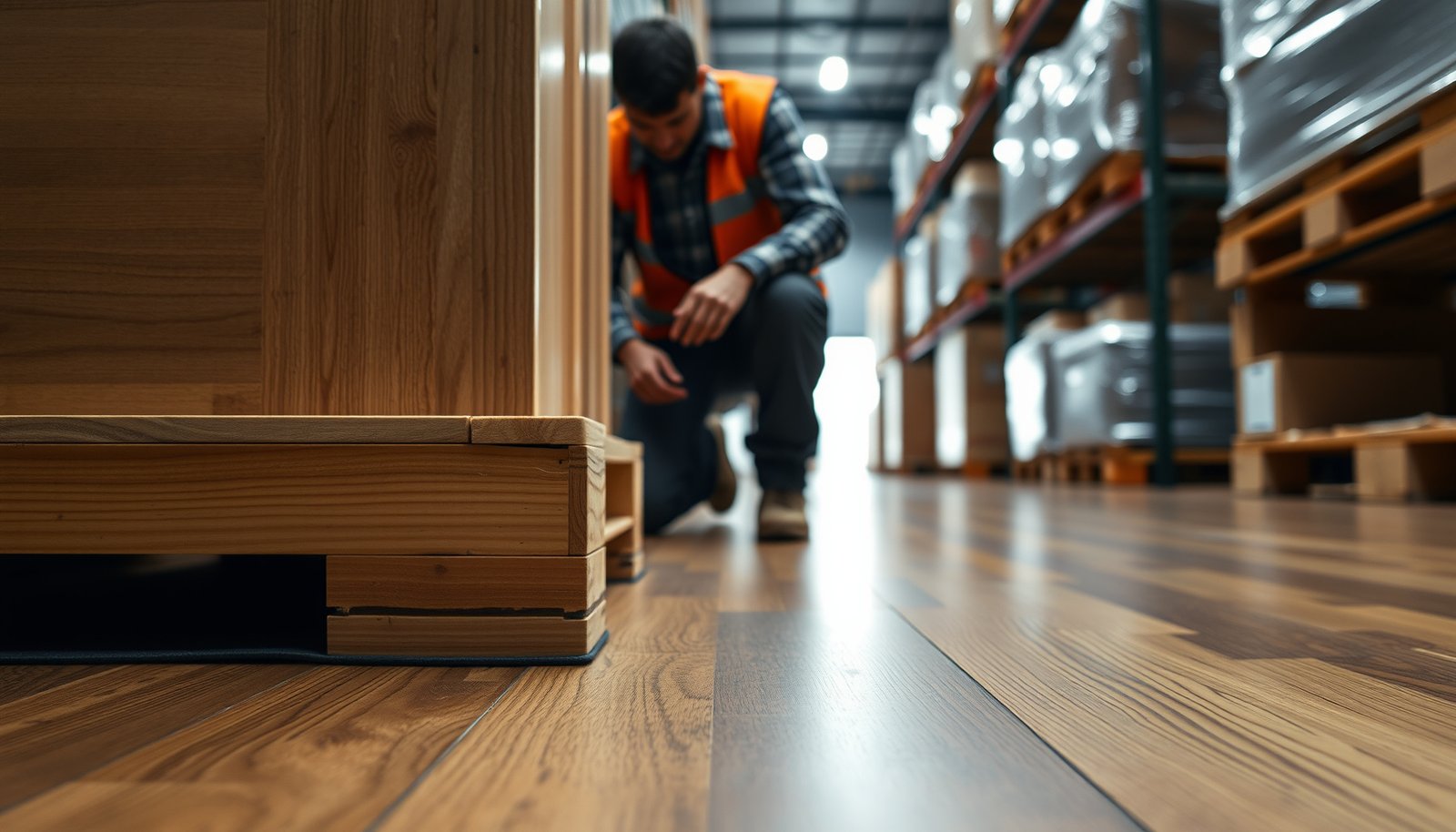
Hardwood floors scratch most where wheels, casters, pallet edges, and cart contact points repeat daily. The goal is simple: ensure equipment wheels roll and land softly on protected, finish-safe surfaces—without dragging, rubbing, or “hammering” spots that quickly wear the clear coat or oil film.
Caster and wheel condition matters because damaged rubber, flat spots, or loose bearings can turn rolling contact into a scraping action that abrades the finish.
According to the Mohs mineral hardness scale (1812), many common tracked-in grit minerals (e.g., quartz at ~7) are harder than typical floor finishes, so even “small” wheel scuffing can rapidly expose vulnerable layers.
– Inspect and maintain caster and wheel conditions: worn wheels, loose bearings, or damaged rubber can turn into scratch tools.
Build this into equipment PM: check wheel tread wear, confirm the wheel footprint contacts smoothly, and remove carts that show wobble or metal-on-floor conditions.
– Add floor protection for high-contact areas (for example, chair-style protectors for carts, wheel covers where appropriate, and protective pads on pallet handling equipment).
Use protection designed for the load and the contact geometry. A protector that doesn’t cover the true wear path (or shifts under load) can create new catch points.
– Avoid dragging: train staff not to pull loads across the floor, and set up routes/staging so items are moved with controlled lifts or direct placement.
Dragging is where scuffs become gouges because the finish gets sheared, not merely abraded. The fix is both behavioral (training and supervision) and operational (staging height, route design, and clear “lift before move” rules).
A practical way to audit “contact points” fast
In 2026, many facilities are relying on higher SKU density, more pick activity, and tighter turns—so contact points multiply. Do a route walk on a typical shift and watch only for three things:
1) wheel/caster landing zones, 2) pallet edge pivot points, and 3) cart turning radii.
From my experience in facilities walkthroughs, the most visible scratch bands usually trace forklift turning habits plus pallet-jack repositioning—not the straight-line transport.
Use floor-cleaning methods that won’t grind in abrasives
The right cleaning method prevents scratches by removing grit without turning mops and pads into abrasion tools. For hardwood floors in warehouses, that means using finish-compatible systems, avoiding abrasive scrubbing media, and controlling moisture so you don’t swell seams or lift edges—damage that later appears as “wavy” scratches and roughness.
Cleaning abrasive dust with abrasive pads can increase surface wear by grinding particulate into the finish rather than lifting it away.
Over-wetting wood flooring can worsen seam visibility and damage development by increasing moisture movement into and along the plank edges.
– Follow the floor finish care approach (polyurethane, oil/wax systems, etc.): use cleaning tools and pads that match the finish so you don’t dull or expose the wood.
If your finish is polyurethane, many facilities need finish-safe neutral cleaners and non-abrasive pads. If it’s an oil or wax system, maintenance typically targets film renewal without stripping. When you change cleaners, confirm compatibility with the flooring manufacturer’s care instructions.
– Prefer microfiber or manufacturer-approved cleaning media over abrasive scrubbing pads that can create a “sandpaper” effect.
In warehouse settings, microfiber’s job is to encapsulate and lift fine particles—especially after dry sweeping has removed the bulk grit. If you skip the dry step, microfiber can still smear grit instead of removing it.
– Use moisture carefully: over-wetting can swell wood seams and make damage more likely to show as visible scratches or roughness.
Aim for a controlled, damp approach rather than saturating. Also ensure cleaning equipment is well-maintained (no leaking buckets, no overspray, and no reused dirty mop water).
Microfiber vs. abrasive scrubbing pads (what changes the risk)
| Method | Pros | Cons / risk on hardwood |
|---|---|---|
| Microfiber (finish-safe) + correct cleaner | Lifts fine debris with less mechanical abrasion; helps maintain film integrity when used with compatible products. | Requires a “sweep first” workflow to avoid smearing grit; dirty pads can re-deposit particles. |
| Abrasive pads/scrubbers (not finish-approved) | Can remove heavy soil quickly on some hard surfaces. | Often accelerates wear by dulling the finish and increasing micro-scratching; can expose wood grain sooner in high-traffic paths. |
Add inspections and fast repair so small issues don’t become gouges
Prevention breaks down when minor scuffs are left to accumulate and traffic keeps reworking them. The most effective warehouse program uses short, frequent inspections on scratch-prone routes and a fast-repair workflow so early finish loss gets addressed before it turns into a gouge.
Routine spot checks catch early finish wear on forklift pathways and loading/unloading lanes before damaged spots widen with repeated wheel contact.
Early repair is more cost-effective because blending small scuffs is typically easier than restoring an area after deep abrasion exposes more substrate.
– Schedule routine spot checks for scratch-prone zones: entries, forklift pathways, loading/unloading lanes, and equipment storage corners.
Do inspections on the same cadence each week (and after major process changes). High-traffic zones should get more frequent checks because damage grows with every pass.
– Address early damage quickly with the method recommended for your specific hardwood finish—small scuffs handled early are easier to blend than deep gouges.
The repair method depends on finish type and system (polyurethane touch-up vs. oil film maintenance vs. refinishing steps). Follow the manufacturer’s guidance to avoid contaminating adjacent areas or locking in visible differences.
– Review traffic patterns periodically: if a route changes or new equipment is added, re-check contact points and protective setup.
In 2026, many warehouses re-slot equipment seasonally and add new SKUs—new routes produce new scratch bands. Treat route changes like a trigger for a mini-audit.
What can go wrong (and when to adjust)
Even well-designed scratch prevention programs fail when implementation details slip—especially mat cleanliness and protection alignment. The fix is to remove the “failure modes” that quietly turn prevention into an abrasive delivery system.
Mats that are not cleaned on schedule can trap grit and act as an abrasive layer, increasing scuffing instead of reducing it.
Misaligned or wrinkled floor protection can create catches at cart and wheel transitions, producing new scratch patterns.
– Mats that don’t get cleaned can trap grit and act like an abrasive layer—swap/clean on a real schedule, not “when it looks bad.”
Establish a defined mat maintenance interval tied to dock traffic and seasons (winter road grit often changes the risk profile).
– Wheel upgrades can backfire if the wheel material isn’t compatible with hardwood finishes or if it’s only partially installed—verify contact across the full wheel footprint.
For example, wheel tread material, hardness, and mounting can change how forces transmit to the floor finish.
– “Temporary” floor protection that’s misaligned (wrinkles, raised edges, uneven seams) can cause catches that scratch when carts roll over them.
If a protector can be shifted by load or has edges that lift, treat it as a hazard—not as a solution.
– If your hardwood is already worn thin at the finish layer, normal maintenance may reduce new damage but not fully restore scratch resistance.
In that case, prioritize finish restoration or localized refinishing per manufacturer guidance.
Verdict / tip: focus on grit control + equipment contact protection
If you do just two things consistently, make them: (1) abrasive control at entries, and (2) protection/maintenance for every wheeled and pallet-handling contact point. The upside is straightforward—less finish wear, fewer visible scratch bands, and lower likelihood of deep gouges that require costly restoration.
Scratch prevention in warehouse hardwood floors depends more on controlling abrasive particles and protecting repetitive wheel/pallet contact points than on “stronger” cleaning.
A prevention program needs both operational controls (entry cleaning workflow, no dragging) and physical controls (wheel/caster maintenance and finish-safe protection at contact zones).
The downside is operational: walk-off systems, equipment checks, and finish-safe cleaning take coordination and training, so results depend on how reliably those routines are followed. If your warehouse is constantly contaminated with heavy sand/grit that can’t be controlled at the source, you may need more aggressive entry control and possibly alternative flooring in the worst-traffic zones.
Quick scan checklist (save this for training)
– [ ] Walk-off mats/entry system installed where vehicles/staff/equipment enter
– [ ] Mats cleaned/replaced on a defined schedule
– [ ] Carts/forklift attachments inspected for wheel/caster wear and damage
– [ ] No dragging—loads are lifted/placed, not pulled across the wood
– [ ] Cleaning tools are finish-safe (no abrasive pads)
– [ ] Sweep/vacuum before wet cleaning to avoid grinding dust into the finish
– [ ] Spot checks done in forklift paths, loading zones, and equipment staging areas
– [ ] Small scuffs handled quickly using the correct repair approach for your finish
Frequently Asked Questions
What are the best ways to prevent scratches on hardwood floors in a warehouse?
Start by using high-quality protective flooring solutions like warehouse-grade mats at entry points, loading zones, and high-traffic aisles to reduce abrasion. Use corner and edge guards on pallets, racks, and carts, and require protective pads on forklift forks, pallet jack wheels, and moving equipment. For added protection, consider applying a durable commercial floor finish or coating designed for hardwood wear resistance and recoat on a maintenance schedule.
How can you stop forklift and pallet jack damage that causes hardwood scratches?
Make sure all forklift attachments are maintained and padded—use fork protectors, maintain correct fork height, and ensure wheels and casters are in good condition to prevent metal-to-wood contact. Implement an operating standard such as slowing down in storage areas, avoiding dragging pallets across the floor, and keeping forks level when turning. Regularly inspect equipment for sharp edges, worn components, and debris that can act like sandpaper against hardwood.
Which cleaning and maintenance routine minimizes abrasive scratching on warehouse hardwood floors?
Use dry cleaning methods first, such as dust mopping with soft microfiber pads or vacuuming with brush attachments, to remove grit that grinds into the finish. Sweep using non-abrasive tools and keep sand, dust, and concrete dust under control with entry mats and routine debris removal. Clean spills promptly with manufacturer-approved hardwood cleaners, and avoid harsh chemicals or abrasive pads that can strip the protective layer and expose the wood to deeper scratches.
Why do warehouse traffic and debris cause hardwood floor scratches, and how can you reduce it?
Scratches often come from grit, small particles, and sharp contaminants carried in on tires, pallets, and shoes; these act like sandpaper on a hardwood finish. Reduce this by using a comprehensive matting system at doors and dock areas, encouraging controlled entry, and enforcing housekeeping schedules for dust and debris. Consider implementing a “no dragging” policy for pallets and routinely check that storage racks and pallet conditions don’t create scrape points.
What type of floor protection or coatings are best for preventing scratches in commercial hardwood warehouse settings?
Choose a commercial-grade hardwood floor finish or protective coating with high scratch resistance and suitability for warehouse traffic, then apply it according to the floor and product manufacturer guidelines. Use mats and area rugs (commercial-rated, non-slip) in zones where carts, pallet jacks, and foot traffic are concentrated to prevent wear-through. Recoat or refinish based on wear patterns and inspection results to maintain the protective top layer that helps prevent scratches from becoming permanent damage.
📅 Last Updated: October 17, 2026 | Topic: How to prevent scratches on hardwood floors in a warehouse? | Content verified for accuracy and freshness.
References
- Wood flooring
- 1910.22 – General requirements. | Occupational Safety and Health Administration
- 1910.178 – Powered industrial trucks. | Occupational Safety and Health Administration
- wood floor abrasion – Search Results – PubMed
- wood floor finish wear tribology – Search Results – PubMed
- Workplace transport – HSE
- https://scholar.google.com/scholar?q=warehouse+wood+floor+scratch+prevention Google Scholar
- https://scholar.google.com/scholar?q=wood+floor+abrasive+wear+finish+maintenance+felt+mat Google Scholar
- https://scholar.google.com/scholar?q=industrial+facility+floor+protection+matting+abrasion Google Scholar