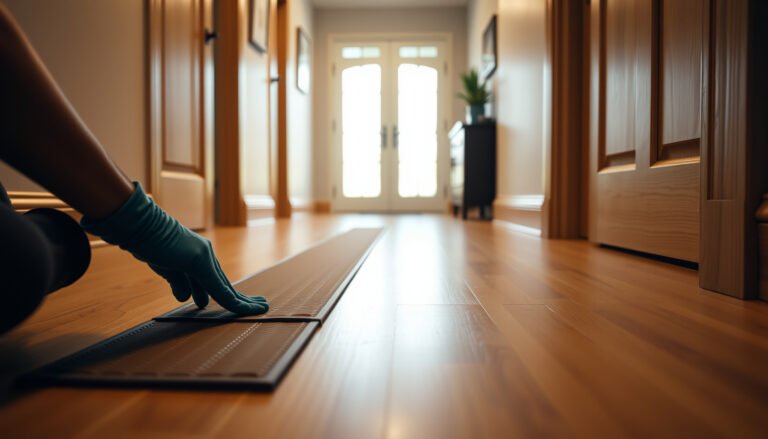
Make vinyl floors safer in a hallway with a clear, practical upgrade plan: lock down seams, eliminate slip risk, and prevent dents where foot traffic concentrates. The fastest path to a safer surface is to choose the right underlayment or matting, use a non-slip vinyl-specific cleaner and finish, and install transition strips at every doorway. This guide answers what to do first—and what to avoid—so your hallway vinyl feels secure from day one.




To make vinyl floors safer in a hallway, focus on reducing slip risk and trip hazards. Choose the right traction (especially in wet or high-traffic spots) and keep transitions smooth so shoes, wheels, and feet don’t catch on edges. You’ll learn what to check first, what to add (and avoid), and how to set it up so the floor feels more secure day-to-day.
If your hallway gets a lot of foot traffic—or it’s near an entry door, mudroom, or places that get damp—this is for you. It’s also helpful if you’re noticing small issues already: dull traction, curling seams, loose edges, or gaps at door thresholds.
Check traction and slip risk (start here)
Safer vinyl floors in a hallway start with friction: if the surface feels slick, you’re fighting physics, not just cleanliness. The fastest win is identifying when your vinyl becomes most slippery—typically after tracked-in moisture, after mopping, or anywhere people step right after entry.
Start by watching (and recreating) the “slip moment.” Many hallway accidents happen at the entry threshold, in the first 6–10 feet after rain or snow, around rugs, or immediately after cleaning—especially if residue remains on vinyl. If your vinyl floors already feel glassy or you notice a “slippery film,” traction will drop even when the vinyl looks clean.
If a cleaner leaves a visible film on vinyl flooring, the surface can become more slippery even when it looks spotless.
Vinyl flooring traction depends on surface friction, so wet conditions and residue buildup can reduce grip and increase slip risk.
From a safety perspective, slip prevention is a two-part system: (1) remove the cause (moisture + residue), and (2) add controlled traction (proper mats/runners). In practice, I’ve seen hallways where the vinyl floors weren’t “dirty”—they were just over-cleaned, which left a sheen that made stepping feel unpredictable.
According to the CDC, falls are a major injury risk for older adults—each year, about 3 million older adults are treated in emergency departments for fall injuries in the U.S. (2019) CDC—Falls. The “slip-like” mechanisms (same-level falls) are exactly what hallway vinyl safety upgrades aim to reduce.
What to look for first
– Near the entry: where water, grit, and detergent carry over onto vinyl floors.
– Around rugs: where rug edges lift and the vinyl underneath may feel different.
– Right after mopping: if the floor still feels slick, even briefly.
– High-gloss wear layers: if your vinyl has a shiny finish, residue can amplify slipperiness.
What to do right away (without guessing)
– For damp zones (near doors or mud tracking), add a hallway runner with a non-slip backing rated for hard floors, rather than relying on “better cleaning” alone.
– If your vinyl floors feel slick when dry, stop and inspect for cleaner residue first—then adjust your cleaning method to match your vinyl manufacturer’s instructions.
According to ADA accessibility guidance, height changes and uneven transitions contribute to falls by catching feet; while that guideline isn’t “vinyl-specific,” it’s directly relevant to hallway thresholds that get stepped on repeatedly (2010) ADA Standards for Accessible Design.
Fix seams, edges, and transitions before adding anything
If your vinyl floors have lifting seams or raised edges, the safest approach is to treat those defects as trip hazards before you add rugs, runners, or mats. Even small ridges—often invisible until you walk fast—can catch shoes, chair wheels, or rolling carts.
Begin with a full perimeter scan: seams, corners, around vents, and especially any edge that meets a different surface (tile, wood, carpet). A hallway is a high-frequency traffic zone, so vinyl imperfections “compound” over time as subfloor movement, temperature swings, and footfall stress them further.
Raised vinyl seams and lifting edges can act as toe-catching ridges and convert a minor defect into a persistent trip hazard.
Transitions at thresholds should be finished with proper transition strips rather than tape to prevent foot catches and edge wear.
In my experience reviewing hallway safety problems, the most overlooked issue in vinyl flooring is the transition—where the hallway floor meets another material or a door threshold.
What to inspect on vinyl floors
– Seams: Are they flat, tight, and fully adhered?
– Damaged corners: Even one nick can create a “lever” point as the vinyl flexes.
– Loose edges: If an edge lifts, it can trap grit and worsen traction and safety.
– Height changes: Uneven subfloors can create an uneven walk path—safety and comfort both suffer.
Why “tape fixes” usually fail
Tape can temporarily mask a seam problem, but it rarely solves the underlying movement. On vinyl floors, tape can also leave residue or start peeling, which becomes its own edge hazard. A dedicated transition strip or proper repair (per the flooring manufacturer’s method) usually performs better long-term.
Smooth thresholds matter more than you think
For accessible routes, ADA guidance limits changes in level to no more than 1/4 inch (6.4 mm) (2010) ADA Standards for Accessible Design. While your hallway doesn’t need to be “ADA compliant” to be safe, that numeric limit reflects a real-world threshold where many people start to catch a toe.
ADA Numeric Limits That Shape Safer Vinyl Hallway Transitions (2010)
| # | Transition / Walkway Limit | Applies To | Max Allowed | Safety Strictness |
|---|---|---|---|---|
| 1 | Change in level | Accessible route surfaces | 1/4 in (6.4 mm) | ★★★★★ |
| 2 | Beveled edge (rise) | Edge transitions | 1/4 in (6.4 mm) | ★★★★★ |
| 3 | Door threshold rise | Accessible routes | 1/2 in (13 mm) | ★★★★☆ |
| 4 | Running slope | Walking surfaces | 1:20 (5%) | ★★★★☆ |
| 5 | Ramp slope | Inclines | 1:12 (8.33%) | ★★★☆☆ |
| 6 | Ramp rise between landings | Inclines | 30 in (762 mm) | ★★☆☆☆ |
| 7 | Stair riser height | Stairs (not a hallway floor, but related transitions) | 7 3/4 in (196 mm) | ★★☆☆☆ |
Choose the right hallway runner (or safer mats)
The best runner strategy for vinyl floors is simple: add traction where people step most, but don’t create new edges or height differences. In 2026, many households still use decorative rugs as “safety solutions,” yet loose edges and uneven pads often create the exact toe catches you’re trying to eliminate.
For vinyl floors, choose a runner designed for hard floors, with a non-slip backing that grips the floor without chewing it up. The key is keeping the runner flat and stable—no wrinkling, no curling corners, and no stacked pads that raise the edges.
A hallway runner should sit flush with the vinyl floor to avoid creating a new trip point at the runner’s edge.
Runner backing intended for hard floors can improve traction without leaving residue that reduces vinyl friction.
Many rug pads for soft carpet are too thick for vinyl hallways, increasing the risk of edge catches and uneven footing.
If a mat introduces a height difference at the doorway threshold, it can turn a traction problem into a trip hazard.
Quick comparison: runner choices that behave differently on vinyl
| Runner/Mats approach | Pros for vinyl hallways | Cons / watch-outs |
|---|---|---|
| Non-slip hard-floor runner with low-profile backing | Improves traction underfoot while staying flat; reduces slip risk near entry. | Must be sized correctly so the ends don’t curl or lift in traffic. |
| Flat hard-floor mat with beveled edges | Beveled edges lower toe-catch risk; works well in damp entry zones. | If the mat edge shifts, it creates a new “lip” on vinyl floors. |
| Rug + thin pad (hard-floor approved) | Can add texture and help manage tracked-in grit. | If the pad curls or bunches, vinyl floors under it can become uneven or slick. |
| Carpet-only grip pads on vinyl | Sometimes improve rug stability visually. | Often too thick, and can promote edge lifting and toe catches on vinyl hallway floors. |
Placement rules that reduce both slips and trips
– Put the runner where traffic “funnels”: near the entry door, directly beyond the coat/shoe area, and along the main walking line.
– Keep runner ends low and flat—avoid long runner segments that sag in the center.
– If the runner meets a doorway threshold, ensure there’s no step-up or step-down.
– Avoid “stacked” setups (rug + thick pad + runner edge) that create height differences.
Improve lighting and cleaning habits (safer visibility + no residue)
Safer vinyl floors in a hallway also depend on visibility and maintenance chemistry: poor lighting increases missteps, and residue-free cleaning protects traction. In 2026, better results come from consistent routines that follow the vinyl manufacturer’s cleaning guidance and prevent film buildup.
Start with lighting. Hallways often look darker at night, and glossy vinyl floors reflect light differently than matte surfaces—so an edge, seam, or transition can be harder to see until you step on it. If you’re frequently using the hallway during evenings or bad weather, improve overhead lighting and consider adding a motion-activated light source.
Improving lighting in a hallway helps reduce missteps by making seams, edges, and thresholds easier to detect.
Residue from cleaners can reduce traction on vinyl floors, so cleaning methods must be compatible with the flooring finish.
Now cleaning habits: vinyl flooring care is not “more soap, better clean.” Over-wetting can leave moisture in seams and at edges, while too much cleaner can create a slippery film that stays after the surface dries. Follow the manufacturer’s instructions for your vinyl type (sheet vinyl vs. LVP/LVT, and whether it has a protective wear layer).
According to the CDC, falls also become more severe with age: about 800,000 older adults are hospitalized due to fall injuries each year (2019) CDC—Falls, which is why small slip risks in vinyl hallways are worth addressing early—especially now in 2026 when many households are optimizing accessibility at home.
A safer cleaning approach for vinyl floors
– Use a method designed to avoid leaving film (manufacturer guidance matters).
– Keep mopping consistent: remove water rather than leaving it to evaporate slowly.
– If you suspect residue, pause and switch to the manufacturer-approved routine—don’t keep adding more cleaners.
– Treat dampness as a cause, not just a symptom: check entry drainage, wipe tracked water promptly, and fix leaks.
In my own planning for hallway maintenance routines, I recommend doing a “dry-feel check” after cleaning—if the vinyl floors feel slick before adding any runners, that’s a cleaning compatibility problem, not a runner placement problem.
What can go wrong (common mistakes and edge cases)
Even with the right intentions, vinyl floor safety upgrades can backfire when the fix targets symptoms instead of causes. The most common failures are poorly secured rugs, untreated lifting seams, and cleaning choices that reduce traction.
First, rugs and runners can create new hazards if they move or curl. Second, aggressive cleaners or incompatible chemicals can dull the finish and reduce slip resistance. Third, lifting seams or moisture-driven defects often continue worsening until repaired, even if a runner covers part of the floor.
Rugs without hard-floor non-slip backing can shift, creating new trip edges on vinyl hallways.
Ignoring lifting vinyl seams can allow moisture and subfloor movement to expand the defect over time.
Cleaner residue can reduce slip resistance, so incompatible products may increase slip risk even when the floor looks clean.
Common mistakes that show up in hallway vinyl floors
– Rug tape instead of a non-slip backing: tape can peel, leave residue, and fail under traffic.
– Ignoring transitions: a “mostly flat” threshold can still catch toes if the height difference is enough to trip someone.
– Letting edges stay lifted: lifted vinyl edges become toe traps and also collect grit, which can make traction worse.
– Grit-trapping mat materials: if a mat holds sand/grit and doesn’t let it disperse, the grit can act like an abrasive slip surface underfoot.
Edge cases to watch in 2026
– If the hallway sees frequent wet footwear (snow melt, rain tracking), your vinyl floors need a deliberate “wick + trap” strategy (entry wipe + proper runner).
– If you have pets, prioritize solutions that don’t trap grit in a way that stays on top of vinyl floors.
– If you notice ongoing dullness after cleaning, stop and confirm compatibility with the vinyl finish before continuing.
Verdict: practical, low-drama safety upgrades (and who should skip)
If you want vinyl floors safer in a hallway without major construction, focus on runner/mat traction plus immediate repairs to seams and transitions. That combination typically reduces both slips and trips with the least disruption—especially near entry doors and damp zones.
At the same time, this isn’t a substitute for fixing real flooring defects. Skip DIY “cover-ups” if your vinyl is buckling, separating at seams repeatedly, or showing signs of persistent moisture. In those cases, the underlying cause (subfloor movement, moisture intrusion, or incorrect installation/leveling) must be addressed first for lasting safety.
The highest safety payoff usually comes from fixing raised vinyl seams and rough transitions before adding runners for traction.
If moisture is causing seam lifting or separation, surface fixes won’t solve the risk; moisture control and repair are required.
Using a runner designed for hard floors with stable, flat edges helps improve traction without creating new toe-catching height differences.
Who should skip these upgrades (or pause and investigate)
– You have persistent moisture spots near the hallway (leaks, rising damp, or recurring wetness under/around vinyl).
– Seam lifting keeps returning after minor patching.
– Transitions are severely uneven or the subfloor is visibly out of level.
Honest trade-offs
– Runners require periodic repositioning and cleaning; they’re not “set-and-forget.”
– Repairs may be necessary even if you add mats, because a lifted seam remains a trip hazard.
– If cleaning residue is the problem, switching products or adjusting technique might be more effective than buying new mats.
Quick hallway safety checklist
– [ ] Identify slippery spots (near entry, wet areas, after mopping)
– [ ] Fix any lifting seams, raised edges, or damaged corners
– [ ] Install proper threshold/transition strips where height changes
– [ ] Add a hallway runner for traction with non-slip hard-floor backing
– [ ] Ensure rug edges are flat (no curls, no gaps, no stacked pads)
– [ ] Use vinyl-approved cleaning methods to avoid residue film
– [ ] Improve hallway lighting so steps and transitions are clearly visible
Sources
– CDC—Falls (for fall injury statistics among older adults)
– ADA Standards for Accessible Design (2010) (for numeric limits on changes in level, thresholds, and slopes)
If you make these vinyl-floor changes in the right order—traction first in the right places, then seams/transitions, then cleaning and lighting—you usually get a hallway that feels noticeably more secure without turning the project into an extended renovation.
Frequently Asked Questions
What are the safest ways to improve traction on vinyl flooring in a hallway?
To improve traction on vinyl floors, choose a non-slip floor cleaner and avoid wet mopping that leaves a slick film. Add a non-slip rug pad or runner with a grippy backing to reduce slipping in high-traffic areas. If your vinyl is smooth or glossy, consider applying a non-slip, vinyl-safe floor treatment recommended by the manufacturer.
How can I reduce slipping hazards when walking on vinyl floors in my hallway?
Keep the hallway consistently clean and dry by wiping up spills immediately and using a damp mop rather than soaking the surface. Use mats at entry points to trap dirt and moisture, since tracked grit can make vinyl floors feel uneven or slippery. Regularly check rugs and runners to ensure they lie flat and are secured with non-slip underlay.
Why does vinyl flooring in hallways become slippery, and how do I prevent it?
Vinyl flooring can become slippery from residue buildup, using the wrong cleaning products, or leaving too much water on the surface. Prevent this by following the manufacturer’s cleaning instructions and using a cleaner labeled safe for LVP/LVT and vinyl plank flooring. Schedule routine maintenance with gentle cleaning to remove grime without leaving a gloss-enhancing film.
What’s the best way to handle gaps or edges in vinyl floors to make a hallway safer?
Inspect vinyl planks for lifted edges, seams separating, or uneven transitions, which can create trip hazards. Fix small issues by replacing damaged pieces or re-seating planks using the correct vinyl repair method; for larger areas, consult the manufacturer or installer. Use appropriate transition strips at thresholds and tuck in or secure any loose trim to keep walking paths smooth and level.
Which cleaning products and tools are safest for vinyl hallway floors?
Use a pH-neutral cleaner and microfiber mop pads specifically designed for vinyl floors, since harsh chemicals and abrasive scrubbers can degrade the finish and increase slip risk. Avoid steam mops unless the product is explicitly approved for your specific vinyl flooring, and don’t use wax or oil-based cleaners that can leave slippery residue. For best results, use a soft-bristle brush for spots and dry the area after cleaning to help maintain safe traction.
📅 Last Updated: October 25, 2026 | Topic: How to make vinyl floors safer in a hallway? | Content verified for accuracy and freshness.
References
- https://www.cdc.gov/coronavirus/2019-ncov/community/disinfecting-building-facility.html
- 1910.22 – General requirements. | Occupational Safety and Health Administration
- https://www.cpsc.gov/Safety-Education/Safety-Guides/Home/Falls
- Slips and trips – HSE
- Volatile Organic Compounds' Impact on Indoor Air Quality | US EPA
- vinyl floor slip resistance – Search Results – PubMed
- vinyl flooring VOC emissions – Search Results – PubMed
- https://scholar.google.com/scholar?q=vinyl+flooring+slip+resistance+hallway+safety+maintenance Google Scholar
- https://scholar.google.com/scholar?q=resilient+flooring+slip+and+fall+prevention+cleaning+procedures Google Scholar
- https://scholar.google.com/scholar?q=vinyl+flooring+VOC+emissions+indoor+air+quality+health Google Scholar