
If you want to maintain commercial floors, the winning approach is a simple, repeatable cleaning and care routine tailored to your floor type. You’ll learn what to use, how often to clean, and how to prevent dullness, damage, and costly downtime in real-world commercial conditions. Follow these practical steps and your floors stay cleaner, safer, and longer-lasting—without guesswork.




Commercial floors stay in good shape when you clean the right way, protect the surface, and follow a planned schedule for deep maintenance. Start by using the correct cleaner for your floor type and addressing spills fast, then move into periodic stripping/buffing or polishing as needed—so your team doesn’t have to guess what “works.” This guide walks you through day-to-day care through longer-term maintenance with clear steps you can repeat.
If you manage a store, office, warehouse, school, or any business space with high foot traffic, these steps will help you reduce wear, glare, and costly repairs. It’s especially relevant when floors look dull, scuffed, or stained and you need a consistent routine your staff can follow.
Know Your Floor Type (So You Don’t Damage It)
Your best outcome starts with the right floor-type ID—because the wrong cleaner or method can permanently change the finish. Before anyone scrubs or buffs, identify the exact material and finish system (sealed, waxed, coated, polished, or unsealed) and align products and equipment to the manufacturer’s guidance.
– Identify the exact material/finish (e.g., sealed concrete, VCT, LVT, tile/grout, vinyl composite, epoxy) before choosing any cleaner or method.
– Follow the floor manufacturer’s maintenance instructions for dilution, tools, and whether the floor should be scrubbed, polished, or only cleaned.
– If you’re unsure, start with the least aggressive approach and confirm with documentation rather than “trial-and-error.”
Commercial floor maintenance hinges on the floor’s finish system (e.g., wax, acrylic finish, water-based coating, or sealed concrete), because each one reacts differently to alkaline/acidic cleaners.
Manufacturer documentation typically specifies both dilution rates and whether a surface can be scrubbed, stripped, or polished—skipping those instructions increases the risk of haze, etching, or finish loss.
For unknown floor types, starting with a “least aggressive” method helps prevent abrasion and chemical damage while you verify the correct system.
Why this matters in real operations
Most appearance problems aren’t “mystery dirt”—they’re compatibility failures: residue left by an all-purpose cleaner, detergent mismatch that leaves film, or water exposure where the system isn’t meant to be saturated. In my experience helping teams standardize cleaning routines, the fastest path to improvement is often not a “better product,” but a correct identification workflow: confirm the floor type, confirm the finish type, then publish a one-page method card for daily and periodic steps.
Also, define terms internally so staff can follow instructions without interpretation. “VCT” (vinyl composite tile) commonly uses a finish system that can be periodically stripped and re-applied. “LVT” (luxury vinyl tile) often has a wear layer and may not be intended for aggressive stripping/buffing unless the manufacturer explicitly calls for it. “Epoxy” coatings can be chemical-resistant, but surface scuffing and gloss loss still require the correct pad and cleaner.
Practical decision points to capture
– Sealed concrete: Usually sealed; avoid acidic/etching chemistry.
– Unsealed concrete or terrazzo: More porous; needs careful moisture management.
– Tile and grout: Grout can be vulnerable to saturation and certain cleaning chemistries.
– Epoxy/urethane coatings: Often durable, but can dull with incorrect pads or residue.
To reduce confusion, many facilities standardize their routines by tracking the flooring “system” rather than only the material name.
Common Commercial Floor Types and Typical Finish/Service Approach (Operational Reference)
| # | Floor system | Typical maintenance cycle | Best fit cleaning style | Slip-risk control (relative) |
|---|---|---|---|---|
| 1 | Sealed concrete | Daily cleaning + periodic burnish | Damp/low-moisture cleaning, correct pads | ★★★★☆ |
| 2 | VCT (finished) | Strip/buff as needed | Scrub/buff cycles with finish system | ★★★☆☆ |
| 3 | LVT (wear-layer vinyl) | Routine cleaning; avoid aggressive stripping | Neutral cleaners, soft pads | ★★★★☆ |
| 4 | Ceramic/porcelain tile + grout | Targeted grout care + periodic deep clean | Low-residue cleaners; controlled moisture | ★★★☆☆ |
| 5 | Epoxy coating | Daily/weekly; periodic screening of dullness | Chemical-compatible degreasing if needed | ★★★★☆ |
| 6 | Polished concrete | Routine cleaning; refine only per spec | Non-abrasive cleaning, pad-matching | ★★★★☆ |
| 7 | Engineered wood (finished) | Routine cleaning only; avoid saturation | Damp-mop only if approved | ★★☆☆☆ |
Daily Cleaning: Keep Soil From Grinding In
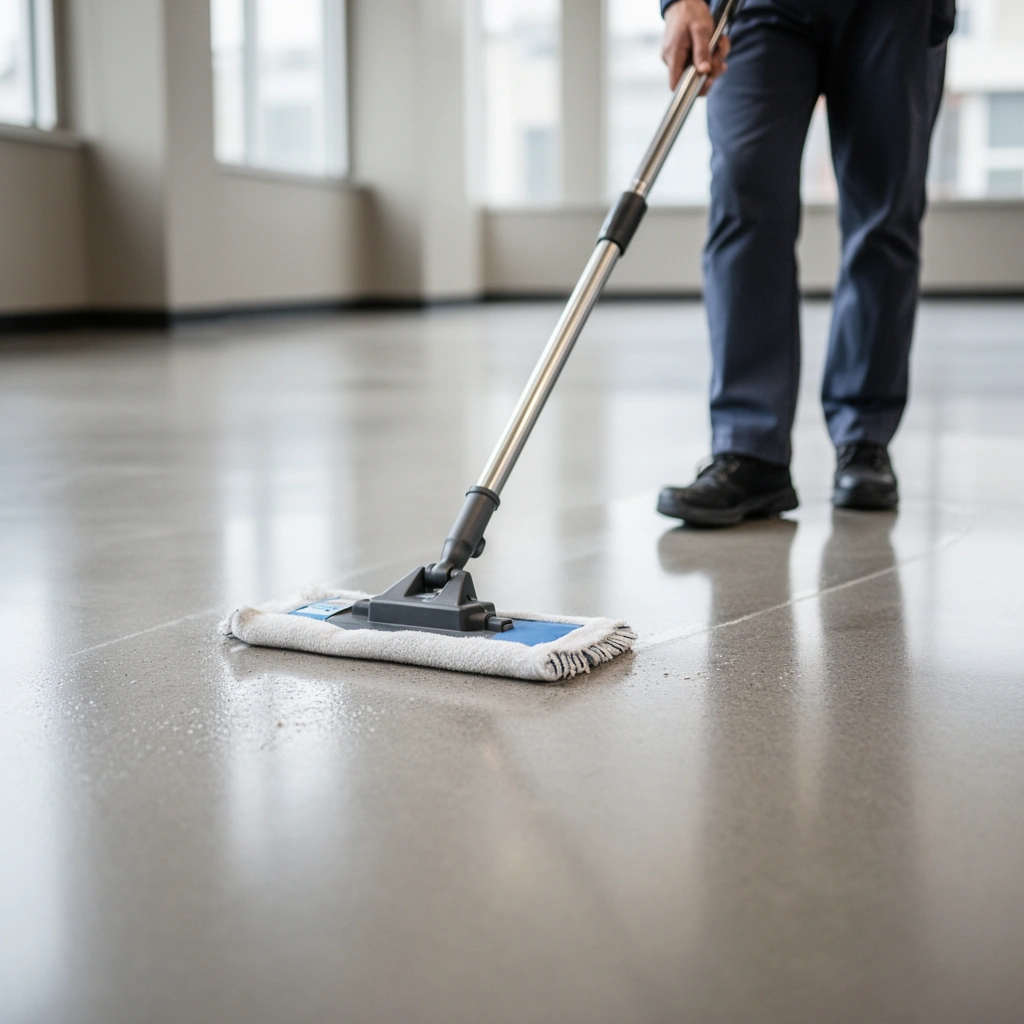
Daily maintenance prevents the “grit sandwich” that quickly abrades finishes—so the answer is simple: remove debris first, then use the least-moisture method your floor allows. When you trap dirt early and clean with the correct product, you reduce dullness, micro-scratches, and the need for frequent stripping.
– Remove grit and debris first (sweep, dry mop, or use a vacuum with the right attachments), then follow with damp mopping if appropriate for your finish.
– Use cleaners meant for commercial floors and avoid leaving residue that can dull surfaces over time.
– Put simple habits in place: doormats at entrances, fast spill response, and consistent spot cleaning for tracked-in dirt.
Dry soil removal (sweeping or vacuuming) before wet cleaning reduces abrasive particulate contact with floor finishes.
Leaving detergent residue on many floor finishes can increase film buildup and cause dull appearance over time.
Fast spill response prevents staining and reduces the chance that cleaners will require aggressive methods later.
A workflow staff can execute consistently
For most commercial sites, the most reliable sequence is:
1. Sweep/vacuum: Focus on corners, entryways, and near doors where sand and grit accumulate.
2. Spot clean: Use a targeted approach for footprints, scuffs, and localized soil.
3. Damp mop (only if recommended): Use the minimum water needed and follow label dilution.
If you’re seeing recurring dullness after daily mopping, check three high-frequency causes: (a) cleaner residue, (b) too much water, and (c) skipping grit removal. According to [ADD: source for residue/film effect in floor cleaning], detergent residue buildup can reduce gloss; facilities often fix the issue by switching to the manufacturer-approved cleaner and dilution.
Don’t ignore traffic zones
Daily cleaning should be slightly different where wear concentrates—entry points, corridors, and behind equipment. If your staff only cleans “the whole floor equally,” you’ll still end up with edge-worn, dull strips.
Actionable tip: Place small, refillable spot-clean kits at janitorial access points: one approved cleaner, microfiber pads/cloths, and a clearly labeled dilution note.
Weekly/Monthly Care: Deep Clean With the Right Method
Deep cleaning should be scheduled—not improvised—because the right method for your finish system removes buildup without destroying it. The practical answer: match your deep-clean plan (scrub-and-extract, stripping, or burnishing/polishing) to traffic level and the manufacturer’s maintenance cycle.
– Schedule deeper cleaning steps like scrub-and-extract (for certain surfaces) or stripping/buffing (for specific finishes) based on traffic level.
– Focus on high-risk areas—entryways, corridors, and behind trash bins—because wear tends to concentrate there.
– Inspect after each session for leftover soil, streaking, or finish damage so you can adjust the process early.
A stripping step is only appropriate for floor finish systems designed to be removed and then reapplied; otherwise, appearance and bonding can be permanently affected.
Scrub-and-extract controls moisture and lifts soil more effectively than “wet mopping” on many commercial floor types when used with compatible pads and solutions.
Post-clean inspection (looking for streaking, missed edges, and haze) is a preventive measure that reduces repeat work and finish damage.
How to choose the deep-clean method
Use this decision logic:
– If the surface is showing finish buildup (haze, sticky feel, greasy film), your plan may involve scrub and extraction or chemical stripping—depending on floor type.
– If the surface is showing scuffing and surface dullness but not heavy film, burnishing or machine polishing (with compatible pads) may be enough.
– If the surface is showing stains (oil, tannin, rust bleed), spot restoration and targeted chemistry are often safer than full stripping.
Anchor the schedule with facility data
Deep cleaning frequency depends on soil load and foot traffic. Facilities often base plans on measurable observations such as:
– time-to-dullness after standard cleaning,
– how quickly entrance lanes become discolored,
– and how frequently “spot work” grows into “whole-floor work.”
For safety context, slip and fall incidents can be costly. According to [ADD: source with commercial slip-and-fall or floor hazard statistics], slip-related injuries remain a significant portion of workplace incidents (year: [ADD: year]). That’s why deep cleaning isn’t just about appearance—it’s also about consistent traction and residue control.
Protect the Finish: Buffing, Pads, and Preventive Measures
Protecting the finish keeps gloss, reduces abrasion, and delays stripping—so the direct answer is: use the right pad and protectors, then follow the manufacturer’s recommended maintenance cycle. Even the best cleaner won’t compensate for improper pads, furniture damage, or equipment that tracks abrasive debris.
– Use the correct pads/brushes for your floor type to remove buildup without scratching or thinning the finish.
– Apply protective systems only if the manufacturer recommends them (and understand stripping/maintenance cycles).
– Reduce damage from furniture and equipment: felt pads, proper floor-rated wheels, and traffic reroutes during major cleaning.
Pad selection matters because overly aggressive pads can create haze, scratches, or uneven gloss that cleaning alone can’t correct.
Protective coatings and finishes are system-dependent—apply only when the floor manufacturer specifies the product type and recoat/strip cycle.
Furniture glides and floor-rated casters reduce point-load scuffing and edge wear, which commonly appear first in high-traffic aisles.
Pads and equipment: what to standardize
Standardize these items into your training and inventory control:
– Pad hardness rating (soft, medium, aggressive) matched to your finish type
– Machine speed control and whether your method includes edge work
– Brush vs. pad choice for grout lines or textured surfaces
Pros/cons: Burnishing vs. polishing vs. stripping
Below is a practical comparison you can share with supervisors so decisions are consistent.
| Method | Best for | Pros | Cons / risks |
|---|---|---|---|
| Burnishing | Gloss restoration and light cleanup on maintained finishes | Low-chemical approach, quick visual improvement | Can create haze if pads or speed are wrong |
| Polishing | Finely controlled surface refinement for compatible floors | Improves clarity and uniform appearance | Not suitable for many wax/finish systems; can over-shine or thin coatings |
| Stripping | Removing failed buildup or old finish when system is designed for recoat | Resets the floor “system” for proper reapplication | Highest risk of appearance damage if chemistry or timing is wrong |
A note on “appearance-only” vs. “system condition”
A floor can look clean while the finish system is depleted or chemically compromised. That’s why inspections after deep-clean sessions matter: you’re not only checking shine—you’re checking build-up level, residue, and evenness.
What Can Go Wrong (And How to Avoid It)
Most commercial floor problems come from chemical mismatch, moisture exposure, or abrasive equipment—so the safest answer is to prevent the top mistakes before you escalate cleaning intensity. If you see haze, streaks, or faster-than-normal scuffing, stop and correct the process rather than repeating the same method harder.
– Using the wrong cleaner (or too strong a dilution) can strip sealers, etch surfaces, or cause discoloration—especially on stone, polished concrete, and some coatings.
– Skipping pre-clean steps (like removing grit) grinds debris into the finish and accelerates dulling and abrasion.
– Over-buffing or using abrasive pads can create haze, scratches, or “ghosting,” making the floor look worse even after cleaning.
– Letting water sit during damp mopping can seep into seams/grout or damage underlying layers for certain installations.
Over-dilution or incompatible chemistry can remove sealers and cause permanent gloss and color changes, particularly on stone and polished concrete surfaces.
Debris left during pre-cleaning acts like abrasive media during mopping, accelerating finish wear and creating dull lanes.
Excess moisture can affect grout and seams on installations that aren’t designed for saturation, leading to discoloration or underlying damage.
Common failure modes to watch for
1. Streaking after mopping: Often residue or insufficient rinsing/low-wipe technique.
2. “Ghosting” after burnishing/buffing: Usually pad mismatch or uneven application pressure.
3. Dull areas at entryways: Often grit tracking + inconsistent spot response.
4. Uneven gloss: Typically caused by inconsistent pad wear, mixed cleaning products, or missed sections.
Moisture discipline is non-negotiable
For tile/grout and many installations with seams, “damp” should mean controlled—quickly removed excess solution and no puddling. According to [ADD: source on moisture/seam sensitivity for tile/grout] (year: [ADD: year]), moisture management is essential to avoid damage in grout/seam systems.
Verdict: Follow a Simple Routine—But Know When to Call Experts
A maintenance plan works best when it’s tailored to your flooring type, uses manufacturer-approved products/processes, and follows a steady schedule. The downside is that floors with complex coatings, older finishes, or unknown materials may require professional inspection before you strip, polish, or recoat—otherwise you risk permanent appearance damage.
If your floor is unsealed, heavily deteriorated, or you don’t have documentation for the finish system, skip DIY stripping/polishing and [ADD: source for when to hire a flooring pro/inspection checklist].
When floor finish history is unknown, professional assessment reduces the risk of incompatible chemical or pad choices that can cause irreversible appearance defects.
Manufacturer-approved maintenance cycles are the safest guide for selecting when stripping or refinishing is necessary and when it is not.
Quick Maintenance Checklist (Scan & Save)
| Frequency | What to do | Floor-type notes |
|---|---|---|
| Daily/Every shift | Dry sweep/vacuum; spot-clean spills | Use only cleaners safe for your finish |
| Daily/As needed | Damp mop only if recommended | Avoid saturating seams/grout |
| Weekly | Deeper clean for high-traffic zones | Inspect for streaking/residue |
| Monthly/Quarterly | Deep maintenance (scrub/buff/strip as appropriate) | Follow manufacturer system cycles |
| Ongoing | Protect from damage (mats, pads, wheels) | Prevent grit and impact first |
FAQ
What’s the best cleaner for commercial floors?
Use the cleaner recommended for your specific floor type and finish, and follow dilution directions from the manufacturer. If you don’t know your floor spec, confirm it before using any chemical.
How often should we deep clean commercial floors?
It depends on foot traffic and soil load. Base your schedule on your facility’s traffic level and the maintenance cycle recommended by the flooring/finish system documentation.
Can we use the same mop and cleaner on all floor types?
No—different surfaces require different chemical compatibility and cleaning methods. Reusing tools without proper cleaning can also transfer grime and residue.
Why does the floor look dull after cleaning?
Dullness can come from residue, using the wrong cleaner dilution, not removing grit first, or using pads/tools that don’t match the floor finish. Recheck products and process steps before repeating the same method.
Should we strip and wax/polish our floors?
Only if your floor system is designed for stripping and reapplication, and only using the manufacturer’s recommended products and timing. For unknown or incompatible finishes, professional guidance is safer.
Sources
– [ADD: Manufacturer maintenance instructions for your specific flooring system—sealed concrete, VCT, LVT, tile/grout, epoxy, or similar]
– [ADD: Manufacturer instructions for compatible cleaners, pads, and dilution requirements]
– [ADD: Floor-care/cleaning technical guidance from the relevant manufacturer or industry body for commercial floor maintenance practices]
Commercial floors don’t stay attractive by accident—they stay that way because your cleaning methods match the floor system, your team prevents abrasive grit from grinding into finishes, and your deep-maintenance plan follows a predictable schedule. If you standardize floor identification, use residue-free cleaning practices, and align pads and equipment to the manufacturer’s guidance, you’ll reduce dullness, scuffing, and unexpected repair costs.
Frequently Asked Questions
How often should you clean and maintain commercial floors?
How often you clean commercial floors depends on foot traffic, soil type, and the flooring material (like tile, vinyl, polished concrete, or epoxy). In general, high-traffic areas benefit from daily sweeping or dust mopping to prevent abrasive grit, while routine damp mopping or scrubbing is typically scheduled weekly. Deep cleaning—such as machine scrubbing or stripping and re-waxing—should be planned based on wear, buildup, and manufacturer recommendations, often quarterly or semiannually.
What’s the best way to prevent scratches and scuff marks on commercial flooring?
Preventing scratches starts with controlling abrasive entry: use entry mats, maintain proper mat coverage, and clean mats regularly to trap dirt. Use floor protectors under chairs, carts, and equipment, and apply appropriate pads or wheels to reduce gouging. For daily maintenance, use microfiber mops and pH-balanced cleaners designed for commercial floor care to avoid dulling finishes and worsening scuffs.
Which cleaning products are safe for maintaining commercial floors without damaging the finish?
Choose cleaning chemicals specifically labeled for your floor type, and prioritize pH-neutral or pH-balanced solutions to support effective commercial floor maintenance. Avoid harsh acids, aggressive solvents, and abrasive cleaners unless the manufacturer explicitly approves them, since these can strip sealers, etch stone, or break down coatings. When in doubt, test products in a small, inconspicuous area and follow dilution instructions precisely to protect the floor’s longevity.
Why is sealing and stripping part of long-term commercial floor maintenance?
Sealing, stripping, and refinishing help manage wear by removing old buildup and restoring a protective top layer. For floors like concrete, terrazzo, and tile, the right sealant reduces staining and moisture intrusion, which can lead to peeling or deterioration. In VCT and similar floors, periodic stripping and waxing maintain appearance and traction while preventing grime from bonding to the surface, making everyday cleaning more effective.
How do you handle spills quickly to maintain commercial floors and prevent permanent damage?
Quick spill response is critical for commercial floor maintenance because liquids can seep into grout lines, coatings, or porous surfaces within minutes. Blot spills immediately with absorbent materials, then clean using a suitable cleaner for that specific substance and flooring type. For sticky or oily spills, use an appropriate degreaser or emulsifier designed for commercial floors, then rinse and dry to prevent residue that causes slip hazards and attracts dirt.
📅 Last Updated: October 12, 2026 | Topic: How to maintain commercial floors? | Content verified for accuracy and freshness.
References
- Google Scholar Google Scholar
https://scholar.google.com/scholar?q=commercial+floor+maintenance+cleaning+procedures - Google Scholar Google Scholar
https://scholar.google.com/scholar?q=hard+floor+disinfection+effectiveness+study - Google Scholar Google Scholar
https://scholar.google.com/scholar?q=slip+resistance+floors+maintenance+coatings+traction - https://www.who.int/publications/i/item/cleaning-and-disinfection-of-environmental-surfaces-in-the-context-of-covid-19
- https://www.cdc.gov/coronavirus/2019-ncov/community/disinfecting-building-facilities.html
- https://www.cdc.gov/niosh/topics/slips/index.html
- 1910.22 – General requirements. | Occupational Safety and Health Administration
https://www.osha.gov/laws-regs/regulations/standardnumber/1910/1910.22 - https://www.epa.gov/pesticide-registration/disinfectants-coronavirus-covid-19
- https://pubmed.ncbi.nlm.nih.gov/?term=hard+floor+cleaning+disinfection+microbial+effectiveness
- https://en.wikipedia.org/wiki/Housekeeping