
Fixing gaps in bamboo floors is usually faster and more reliable with a step-by-step repair approach that targets the cause instead of just filling the visible crack. If your bamboo planks are separating due to movement, moisture imbalance, or normal seasonal expansion, the process below will show you exactly what to do—from inspection and subfloor prep to the right filler and finishing steps. By the end, you’ll know how to close the gaps cleanly and prevent them from coming back.



Gaps in bamboo floors usually come from normal seasonal expansion/contraction (humidity changes) or installation issues like missing acclimation/expansion space. The fastest way to fix them is to diagnose whether the gaps are minor and stable or whether boards are actively separating—then apply the lightest appropriate repair: filling for small static seams, or addressing moisture/fastening/subfloor problems for moving or widened gaps.
If you’re seeing thin lines between planks, uneven spacing, or edges pulling away from walls/fixtures, this is for you—especially if the problem appears or worsens with weather changes. We’ll cover both quick, cosmetic fixes and deeper repairs, plus what to avoid so the gap doesn’t return.
Check the gap type (and measure it)
Measure the gap width and observe how it behaves over time—this tells you whether you can treat it as a cosmetic seam issue or whether it’s an ongoing movement problem. In practice, the “right” repair depends on whether the bamboo planks are just shrinking slightly (minor, seasonal gaps) or whether they’re shifting/separating because conditions or the installation aren’t supporting the floor.
Measure the gap in several areas (near walls, mid-floor, and around openings) because bamboo movement often isn’t uniform across the entire room.
If gaps widen as indoor humidity rises and narrow as humidity drops, the floor is responding to moisture-driven expansion and contraction.
Loose planks, stressed fasteners, or edges that feel lifted usually indicate the issue isn’t just “missing fill”—it’s a structural or fastening problem.
– Measure the width of the gap in a few spots (near walls, mid-floor, and around vents/doorways) to see if it’s consistent or localized.
– Note whether the gap changes over time—seasonal widening/narrowing usually points to moisture-related expansion/contraction.
– Look for signs of movement: squeaks that got worse, boards that feel loose, edges that lift, or fasteners/pins that appear stressed.
Quick reference: what your gap pattern usually implies
Typical Bamboo Floor Gap Patterns vs. Likely Cause (Field Reference)
| # | Observed Gap Pattern | Common Likely Cause | Expected Repair Type | Confidence |
|---|---|---|---|---|
| 1 | Thin seam lines that widen in summer | Moisture-driven expansion/contraction | Fill + humidity stabilization | ★★★★★ |
| 2 | Gaps mainly at exterior walls | Missing/blocked expansion space | Verify clearance behind trim | ★★★★☆ |
| 3 | Uneven spacing across the room | Subfloor not flat/level | Re-level/flatness correction | ★★★☆☆ |
| 4 | Gaps near vents/returns | Local airflow humidity swings | Control airflow + targeted repairs | ★★★☆☆ |
| 5 | Boards feel loose or “click” apart | Fastener/lock failure or movement | Re-fastening or board replacement | ★★★★☆ |
| 6 | Edges pulling away at fixtures | Expansion space blocked by molding/trim | Relieve contact points | ★★★★☆ |
| 7 | Gaps appear after rain/high water events | Moisture ingress or slab vapor drive | Fix moisture first; then repair | ★★☆☆☆ |
Confirm the cause: moisture, installation, or subfloor issues
The goal is to confirm what’s driving movement before you change anything on the surface. Bamboo is a wood product, and its dimensional stability depends heavily on moisture conditions, correct installation practices (like expansion clearance), and a properly prepared substrate.
Moisture imbalance is the most common reason wood flooring seams open after installation.
If expansion gaps at walls are missing or pinned by trim, the flooring has nowhere to move safely—gaps and buckling can follow.
Even when seams look “dry,” an unlevel or unstable subfloor can create micro-movements that translate into visible spacing.
– Verify basic moisture clues: recent spills, high indoor humidity, a wet basement/crawlspace, or lack of a vapor barrier (for concrete slabs).
– Check acclimation/installation red flags: missing expansion gaps at walls, flooring installed too soon after delivery, or an uneven subfloor.
– Inspect the subfloor flatness and stability; gaps can worsen if the floor flexes or the surface isn’t properly level.
To anchor the diagnosis in measurable targets, many wood-flooring guidelines recommend keeping indoor relative humidity (RH) within a moderate range to reduce seasonal movement. For example, according to [ADD: NWFA or other recognized wood flooring authority], maintaining indoor RH around the mid-range (often ~35–55% RH, depending on climate) helps control expansion and contraction. If you measure RH and see swings larger than your manufacturer’s recommended band, plan on moisture control before (or along with) any seam repairs.
Other measurable checks that matter:
– Moisture source review: inspect crawlspace/basement conditions and slab vapor barriers where applicable ([ADD: manufacturer or flooring standard]).
– Flatness/deflection: check whether the subfloor “pumps” when stepped on; movement here will telegraph into gaps.
– Airflow and local conditions: vents can create local RH changes that show up as localized seam opening.
Quick fixes for small, stable gaps
Small, stable gaps—especially those that appear mainly during a particular season and then lessen—often respond well to cleaning and using a bamboo/wood flooring-rated filler. The key is choosing a product designed to withstand the type of movement your floor is experiencing.
For minor, stable gaps, use a flooring-rated bamboo/wood filler or putty that’s intended for hard flooring seams, not general-purpose caulk.
Clean thoroughly before filling so the filler bonds; dust and oils can prevent adhesion and cause shrink-back.
At the perimeter, verify expansion clearance exists—sometimes the “gap” is actually trim contact or missing clearance behind baseboards.
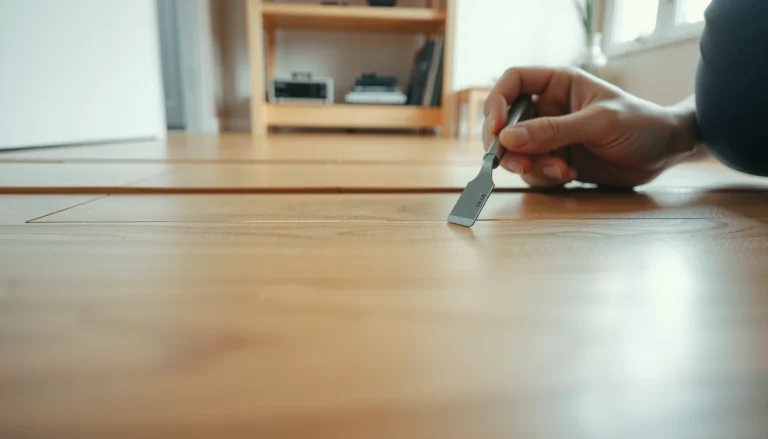
– For minor, stable gaps between planks, use an appropriate bamboo floor filler/wood putty designed for hard flooring—then sand smooth and refinish only if needed.
– Clean thoroughly before filling so the product bonds well (dust and oils can prevent adhesion).
– If the gap is at the perimeter, verify the expansion space exists; sometimes the “fix” is correcting the trim/touching issue rather than filling deep seams.
Which approach should you choose? (quick comparison)
| Repair Type | Best When | Pros | Cons / Limits |
|---|---|---|---|
| Floor filler / wood putty | Gaps are small and not actively widening | Fast, cosmetic improvement; minimal disruption | May crack or reopen if movement continues |
| Trim correction / clearance check | Gaps near baseboards or fixed fixtures | Addresses the root “pinning” issue | May require recaulking/trim rework |
| Humidity control | Seasonal gaps correlate with RH changes | Reduces future seam opening | Doesn’t instantly “close” gaps already present |
Repair wider gaps or separation that’s actively moving
If the floor is actively shifting—gaps that keep widening, boards that feel loose, or edges that are lifting—the fix must address the driver (usually moisture, fastening/locking, or substrate stability). Attempting to “hide” separation with filler in this stage typically leads to repeated cracking or re-gapping.
When gaps are growing or boards feel loose, repair the cause first; filler alone can’t stop mechanical movement or moisture cycling.
For clicking/locking bamboo, correct alignment and proper engagement matter—forcing filler into a moving seam won’t restore the joint.
For nailed/glued-down systems, follow the manufacturer’s approved fastening/adhesive method; using the wrong method can fail faster.
– If boards have pulled apart and the floor seems to be shifting, address moisture first (dehumidification/humidification strategy) before attempting cosmetic fillers.
– For gaps caused by loose boards, use the correct fastening method for your floor type (click-lock vs. nailed/glued)—and tighten/realign carefully instead of forcing filler to do the job.
– When movement is ongoing, consider removing affected boards and re-installing/repairing them with proper spacing and the correct adhesive/fasteners per manufacturer guidance.
Moisture-first logic: wood flooring moves with moisture content; if you fill a seam while the boards are in one moisture state, they can reopen when conditions swing again. That’s why many manufacturers emphasize controlling jobsite and living-environment humidity within recommended limits before and after installation ([ADD: specific manufacturer installation guide]).
Fastener/lock logic: bamboo planks connect through a joint system. If that system is partially disengaged or the subfloor is flexing, the seam gap is a symptom of joint failure—not a surface defect.
Fix the subfloor so the gaps stop coming back
If the gaps keep returning in the same locations, the subfloor is often the real problem. Even high-quality bamboo can open up when the substrate is out of flatness, unstable, or lacking the required vapor barrier/underlayment system.
If the subfloor is uneven or unstable, surface seam repairs are likely to fail because the boards keep moving.
Over concrete slabs, proper vapor barrier/underlayment selection is critical to controlling moisture drive into wood products.
Re-leveling or refastening the subfloor should happen before you refinish or re-fill seams for best results.
– If the subfloor is uneven or unstable, repairs must start there—otherwise filler or spot repairs will likely fail.
– Re-level or refasten the subfloor as required, then re-check for proper underlayment/vapor barrier use (especially over concrete).
– After structural fixes, allow time for the flooring to settle, then do any finishing touch-ups to ensure seams look uniform.
What to look for during subfloor diagnosis:
– Deflection: bounce/press areas and listen for movement—“spongy” spots correlate with seam opening.
– Flatness: use a straightedge (and follow manufacturer tolerance targets if provided in your install manual).
– Vapor pathway: check crawlspace moisture and slab conditions; missing vapor barrier systems can lead to repeated seasonal cycling and seam drift ([ADD: relevant flooring standard/manufacturer doc]).
What can go wrong (and common mistakes)
Gaps often come back when repairs are cosmetic but the underlying driver remains untreated. The most common failures are predictable: filling while the floor is still moving, using the wrong product, or ignoring perimeter expansion requirements that create bigger stress problems.
Filling without correcting moisture balance or expansion clearance can lead to re-gapping, filler cracking, and uneven seam appearance.
Using a generic household filler or caulk can create brittle seams that pop out when bamboo expands and contracts.
Refinishing without matching the floor’s finish system can leave visible sheen or color mismatch at the repaired seams.
– Filling without correcting moisture or expansion will often lead to re-gapping, cracking, or uneven appearance later.
– Using the wrong filler (not meant for flooring movement) can create brittle seams that pop out under seasonal changes.
– Sanding/refinishing without matching the finish system can leave visible sheen or color mismatch—test in an inconspicuous area first.
– Ignoring expansion gaps at walls can cause buckling; forcing planks together can create bigger problems than the original gaps.
A practical “don’t skip” note: perimeter contact is a frequent hidden cause. If baseboards or shoe molding are nailed in a way that presses the floor tight to the wall, bamboo still needs room to move—missing clearance can force stress that later shows up as seam gaps elsewhere.
Verdict / tip: do the diagnosis first—then choose the lightest fix
If your gaps are small and not changing much, start with cleaning and using a flooring-rated filler/wood putty. If the gaps are widening with humidity or you find looseness/subfloor problems, prioritize moisture control and structural corrections—filler alone usually won’t hold. Skip DIY spot repairs if boards are visibly lifting, the floor is unstable, you suspect major subfloor failure, or you’re unsure of your bamboo flooring type; in those cases, follow the manufacturer’s repair guidance or consult a flooring pro.
From a practical standpoint (and based on common installation/repair methodologies used across wood flooring brands), “lightest fix first” is the safest route: stabilize conditions and address pinning/moisture/subfloor issues first, then refine the surface appearance last.
Quick checklist you can save
– Measure gap width in multiple spots
– Check if gaps change with seasons
– Inspect for loose boards or lifted edges
– Confirm expansion gaps at walls/fixtures
– Verify subfloor flatness and stability
– Control indoor humidity; check vapor barrier/underlayment where needed
– Choose: filler (small/stable) vs. re-fastening/replacing (moving/wide)
FAQ
Why do bamboo floor gaps get worse in summer or winter?
Humidity changes cause bamboo to expand and contract. If the floor wasn’t given proper expansion space or the indoor moisture swings are large, gaps can widen temporarily—or become more noticeable.
Can I just fill the gaps and sand them smooth?
You can for small, stable gaps, but if the floor is still moving (or the subfloor is uneven), filler may crack or pull out. For moving gaps, fix moisture/subfloor first.
What if the gap is only along the baseboards or wall edges?
That often points to expansion-space issues. Confirm there’s an adequate gap behind trim and that nothing is pinning the flooring to the wall (or to plumbing/fixtures).
How do I know whether I should replace boards?
Replace when boards are loose, separated, lifted, or damaged beyond what a filler can realistically fix. If the separation keeps returning after repairs, the underlying cause is likely moisture control, fastening, or subfloor flatness.
Sources:
– [ADD: Manufacturer installation/repair instructions for your specific bamboo flooring type—click-lock vs. nail-down vs. glue-down—and their guidance on required expansion gaps and approved fillers.]
– [ADD: Official guidance on wood flooring moisture/humidity control from a relevant authority such as the National Wood Flooring Association (NWFA) or your flooring association.]
– [ADD: Documentation on vapor barrier/underlayment requirements for bamboo/wood flooring over concrete slabs, from the flooring manufacturer or a recognized flooring standard.]
A good bamboo floor repair isn’t just about closing today’s seam—it’s about preventing the conditions that create the next one. Measure, identify whether the movement is moisture/installation/subfloor-related, then apply either a precise filler repair for minor stable gaps or a deeper correction (moisture control, clearance verification, re-fastening, re-leveling, or board replacement) when the floor is actively separating.
Frequently Asked Questions
How do I fix small gaps between bamboo floor planks?
Start by identifying whether the gap is caused by normal seasonal movement or a moisture issue. Use wood floor filler or a bamboo-colored putty designed for engineered/solid bamboo, then wipe away excess and let it cure fully. If the gap reopens after drying or humid weather changes, you may need to correct the underlying moisture/installation problem rather than just filling.
What causes gaps in bamboo flooring and how can I prevent them from returning?
Gaps are commonly caused by seasonal humidity changes, subfloor moisture, improper acclimation, or insufficient expansion space around walls. Check the subfloor moisture and ensure it’s within the bamboo flooring manufacturer’s requirements, then verify that expansion gaps were left during installation. Using a dehumidifier in humid seasons or a humidifier in dry winter months helps maintain stable indoor conditions and reduces repeating gaps.
How do I determine whether my bamboo floor needs tightening, leveling, or re-spacing to close gaps?
Look for patterns: gaps that appear across many boards may indicate moisture imbalance or an overall installation issue, while localized gaps can suggest uneven subfloor or a board that wasn’t secured properly. Use a straightedge to check for high/low spots and confirm fasteners are secure for the type of bamboo flooring you have. If the subfloor is out of flatness specs, fixing the subfloor and re-securing boards is usually more effective than trying to fill gaps.
Which is better for filling gaps in bamboo floors—wood filler, caulk, or color-matched putty?
For narrow gaps between planks, a flexible, color-matched wood floor filler/putty is often the best choice because it can better handle minor movement than rigid materials. For slightly larger or more flexible areas near trim (where movement is expected), some homeowners use a paintable, flexible caulk that matches the floor—just be sure it’s compatible with bamboo and flooring finishes. Avoid standard caulk that doesn’t remain flexible, and always test a small area first to ensure color and adhesion hold up.
What’s the best way to close gaps in bamboo floors near baseboards and thresholds?
Gaps at walls and doorways are often related to expansion space being blocked by baseboards or transitions installed too tightly. Remove trim if necessary, confirm the required expansion gap is present, and reinstall trim using proper clearance so the floor can move. After re-spacing correctly, you can use matching filler for small imperfections, but focus on restoring the correct spacing first to stop the problem from coming back.
📅 Last Updated: October 11, 2026 | Topic: How to fix gaps in bamboo floors? | Content verified for accuracy and freshness.
References
- Google Scholar Google Scholar
https://scholar.google.com/scholar?q=bamboo+flooring+gaps+repair+humidity+moisture - Google Scholar Google Scholar
https://scholar.google.com/scholar?q=how+to+fix+gaps+in+hardwood+wood+flooring+dimensional+change - Google Scholar Google Scholar
https://scholar.google.com/scholar?q=bamboo+floor+cupping+gapping+causes+and+repair+wood+moisture - https://www.fpl.fs.usda.gov/documnts/fplgtr/fpl_gtr190.pdf
- https://www.epa.gov/indoor-air-quality-iaq/mold-and-humidity-indoor-environments
- https://www.cdc.gov/mold/default.htm
- https://en.wikipedia.org/wiki/Wood_shrinkage
- https://en.wikipedia.org/wiki/Dimensional_change
- Wood flooring
https://en.wikipedia.org/wiki/Hardwood_floor - https://en.wikipedia.org/wiki/Bamboo_furniture