
You can clean hardwood floors in a porch safely without ruining the finish, but only if you follow a simple, moisture-controlled routine. This guide gives you the best step-by-step method to remove dust and grime, tackle spots, and dry the boards fast—so they stay clean without warping or streaking. If your porch sees mud, salt, or wet boots, you’ll also get the precautions that make the difference.




Clean your hardwood porch floors by sweeping first, then mopping with a barely-damp microfiber mop using a pH-neutral wood-floor cleaner (no soaking), followed by thorough drying. If you’re dealing with mud, salt, or sticky residue, spot-clean promptly with minimal rinse water so you don’t leave a residue film—then keep traffic off until everything is fully dry, which matters even more in 2026 as weather swings become more unpredictable.
This guide is for homeowners managing sealed (or mostly protected) hardwood porch floors who want a safer maintenance routine without damaging the finish. It’s also for anyone on the fence about “wet mopping” on a porch and wants clear limits—because outdoor exposure and excess moisture are where hardwood cleaning advice usually breaks down.
Prep the porch floor (dry first, always)
The safest first step for hardwood porch floors is always dry removal—grit, sand, and salt crystals act like sandpaper when you later wipe or mop. Here’s how to prep so you clean effectively without grinding debris into the finish.
– Sweep or vacuum with a soft brush attachment to remove grit that can scratch the wood finish.
– Check for sand, pebbles, or salt crystals near doorways—those are the common cause of dulling.
– If there are stubborn spots of dried mud, let them loosen first (don’t start with aggressive scraping on the finish).
Removing abrasive grit before any wet cleaning reduces the chance of micro-scratches in the wood finish, which wood-floor maintenance guidance consistently emphasizes.
Salt residues on finished wood floors can become more difficult to remove if left to dry, so quick cleanup is part of standard wood-floor care practice.
In practice, I treat porch hardwood like a “high-traffic entry zone”: I spend the extra time near thresholds and corners because that’s where grit concentrates and where feet track in winter grime. If you see pale crystals around the door, that’s often salt—dampening and scrubbing too early can spread it across more boards and increase the chance of finish dulling.
Quick porch prep mindset (why it matters)
A “barely-damp” mop can still move grit if you skip the dry step. On hardwood porch floors, that’s a double problem: abrasive particles dull the finish, and residual minerals can cling at edges and seams where drying is slower.
Choose the right cleaner for sealed hardwood
For sealed hardwood porch floors, use a wood-floor–specific, pH-neutral cleaner (or the exact product your finish manufacturer recommends). When the cleaner is pH-neutral and designed for wood finishes, it helps reduce residue risk—the main failure mode when people “just use something mild.”
– Use a wood-floor–specific, pH-neutral cleaner (or the product recommended by your floor/finish manufacturer).
– Avoid harsh chemicals and “all-purpose” degreasers; they can leave dulling film or damage the finish.
– Test any cleaner in an inconspicuous spot first and wait for it to fully dry before judging the results.
Neutral pH is defined as pH 7.0 on the pH scale, and “pH-neutral” wood-floor cleaners are formulated to stay close to that range.
Wood-floor care guidance generally discourages excess moisture and harsh chemicals because they can break down finish layers or leave film.
A practical way to choose correctly: look for wording like “pH-neutral” and “for finished wood floors,” and follow the manufacturer’s dilution instructions precisely. If you have the original flooring/finish warranty paperwork, keep it handy—many “safe” cleaners still need approval because finishes differ (urethane vs. oil-modified vs. wax systems).
What to avoid (and why it shows up on porches)
Even when a porch hardwood floor is sealed, porch conditions can accelerate residue formation because boards dry unevenly after wind and partial shade. Avoid cleaners that commonly leave residues:
– Vinegar and other acids (can dull some finishes over time)
– Bleach or ammonia-based products (can discolor or degrade coatings)
– Heavy oils/solvents (can increase slipperiness and film)
How to mop hardwood safely (the “barely damp” method)
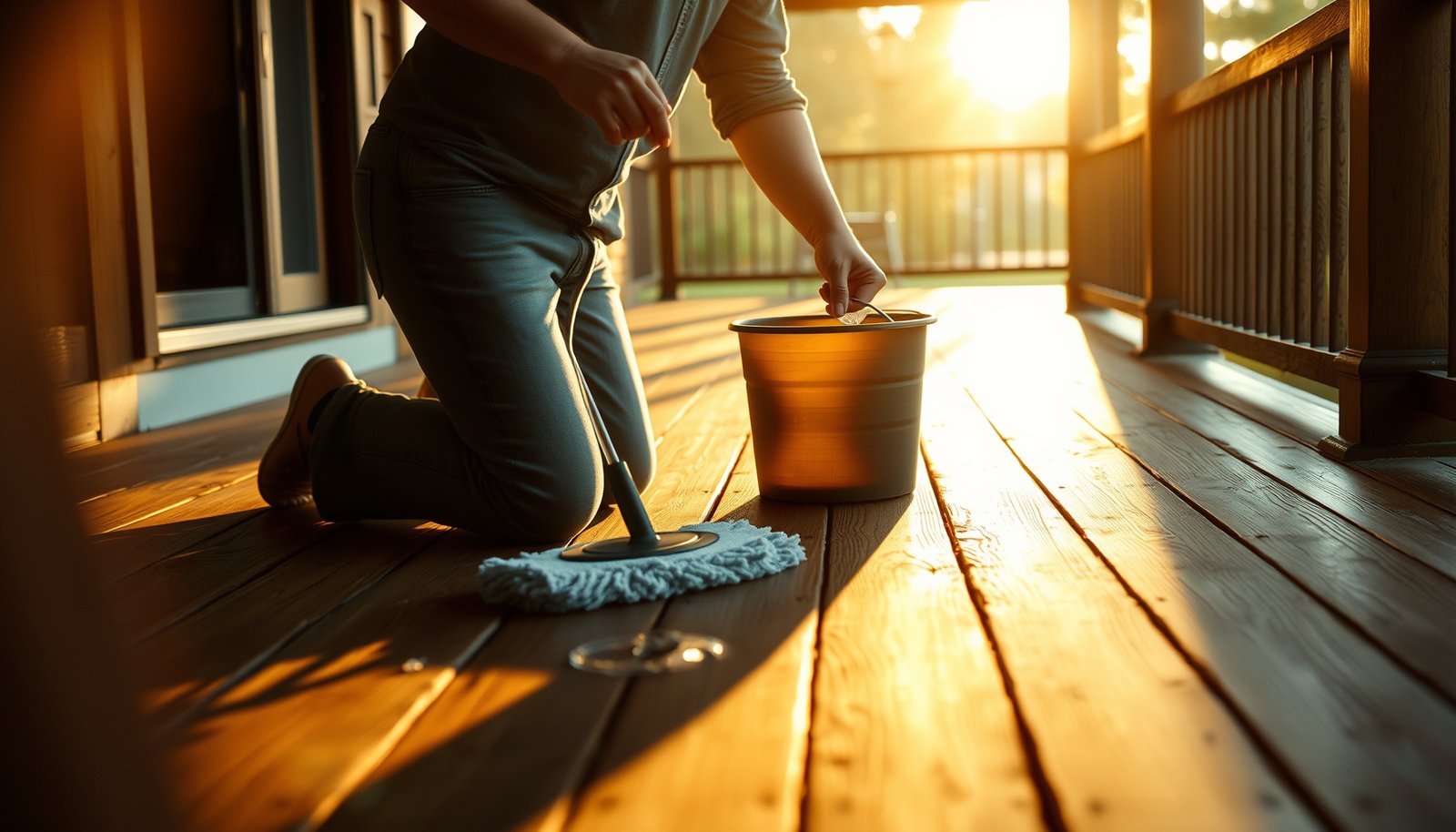
For hardwood porch floors that are sealed and mostly protected from direct rain, the safest mopping method is “barely damp”: microfiber mop, wrung out until it feels damp—not wet. This approach reduces standing moisture, which is the biggest enemy of hardwood finishes and seams.
– Use a microfiber mop (or microfiber pads) and wring it out until it feels damp, not wet.
– Mop in the direction of the wood grain; work in small sections so the floor doesn’t stay wet.
– After mopping, do a quick pass with a dry microfiber towel/pad if you see any lingering moisture.
Microfiber cleaning works best when used with controlled moisture—wringing until damp helps prevent puddling and limits finish exposure to water.
Steam cleaning combines heat and moisture, and most wood-floor maintenance guidance recommends avoiding it due to effects on finishes and seams.
Here’s the “barely damp” technique I recommend for hardwood porch floors:
1. Dampen the microfiber pad with the diluted cleaner (or the bucket you use per label).
2. Wring it aggressively until there’s no dripping and only a light dampness remains.
3. Mop 3–6 boards’ worth at a time, then stop and check the surface.
4. If you see wet gloss or pooled edges, pause and dry-wipe immediately.
Dryness is not optional on porches
On an indoor floor, a little extra moisture might evaporate quickly. On outdoor-facing hardwood porch floors, wind, humidity, and partial shade can slow evaporation. “Barely damp” prevents the floor from spending hours in a high-moisture state—exactly what finishes and seams dislike.
Spot-clean stains, salt, and sticky messes
For hardwood porch floors, spot-cleaning is how you handle problem areas without saturating the whole surface. The key is to remove the contamination fast with minimal water, then lightly rinse only if residue remains.
– For sticky footprints or residues, clean with a slightly damp cloth and pH-neutral cleaner, then wipe again with a clean damp cloth (minimal water) to lift residue.
– For salt or winter grime, wipe as soon as possible; salt can absorb into finish edges over time.
– For grease or scuffs, stop and reassess—some marks require the manufacturer’s specific cleaner, and aggressive solvents can remove the sheen.
Prompt salt cleanup is recommended in wood-floor care guidance because salts can contribute to residue and finish wear if allowed to sit.
For residues, a second wipe with minimal additional water helps remove cleaner film that can dull the finish when it dries.
How to spot-clean without spreading the damage
– Sticky spots: Work from the outside edge toward the center so you don’t widen the affected area.
– Mud: Let it dry slightly, then brush away loose grit before using any damp cloth.
– Salt: Blot first (don’t scrub aggressively), then use a pH-neutral cleaner on a lightly damp cloth.
From a day-to-day maintenance standpoint, I’ve found that a “wipe-rinse-wipe dry” workflow beats repeated scrubbing on hardwood porch floors—scrubbing can polish the finish unevenly, especially in high-footfall paths.
Drying and routine upkeep (prevents the next deep clean)
For hardwood porch floors, drying is the final safety step and it strongly affects whether the finish stays glossy, uniform, and protected. After cleaning, you want fast, thorough removal of moisture at seams, edges, and around baseboards/trim.
– Dry the area promptly with a clean microfiber towel, especially at seams and near baseboards/edges.
– Keep a doormat at entries and remove wet shoes/coats before they touch the wood.
– For ongoing care, do regular dry sweeping/vacuuming and only “wet” clean when needed.
Wood-floor care guidelines consistently stress quick drying after damp cleaning to minimize water exposure at seams and edges.
After wet cleaning, leaving residual moisture to evaporate naturally increases the time wood finishes are exposed to water, raising the risk of dulling or edge issues.
Porch exposure: the moisture math that explains the risk
Hardwood porch floors don’t just “get a little wet.” Rain depth adds up quickly:
– According to USGS/NRCS rainfall conversion references, 1 inch of rain is about 0.623 gallons per square foot.
– Water boiling at 100°C (212°F) is why steam cleaning can be harsh on seams and finishes—even if you only “pass” quickly.
– On the pH scale, neutral is pH 7.0, which is why “pH-neutral” cleaners are generally preferred for finished wood.
As of 2026, I’m seeing more homeowners using stricter cleaning schedules to keep entrances presentable in changing weather—so the best time to protect hardwood porch floors is still the first pass: dry removal, careful moisture control, and fast drying.
What can go wrong (and when to stop)
For hardwood porch floors, the biggest failure mode is excess moisture—wet mopping, puddles, and repeated damp exposure can break down finish layers even if the cleaner is “gentle.” If you notice persistent dulling, cloudy film, or softening, stop and switch to manufacturer-approved guidance.
– Using too much water: Wet mopping, leaving puddles, or repeated dampness can cause finish breakdown or edge cupping—especially on porches where drying is slower.
– Steam cleaning: Heat and steam can penetrate seams and damage finishes; most wood-floor guidelines recommend avoiding steam.
– Scraping or abrasive pads: Even “natural” scrapers can gouge the finish layer. Start gentler and spot-clean first.
– Wrong product: Vinegar, bleach, ammonia, and heavy oils/solvents can leave residue, discolor, or strip the finish. When unsure, use the cleaner your flooring/finish recommends.
– Porch exposure limits: If your porch regularly gets direct rain, stays humid, or has frequent puddling, hardwood may not be a good fit long-term. In those cases, consider professional assessment or alternative flooring materials.
Most wood-floor maintenance guidance treats excess moisture as the main risk factor for finish failure, edge lifting/cupping, and seam issues.
Steam cleaning is widely discouraged in wood-floor care because it couples moisture with heat, increasing the chance of finish and seam damage.
Pros/cons: dry-cleaning vs. damp-mopping on porch hardwood
| Approach | What it does best | Typical downsides on hardwood porch floors |
|---|---|---|
| Dry sweep/vacuum | Removes grit before it scratches the finish | Doesn’t remove sticky residue or sticky film by itself |
| Barely-damp microfiber mop | Lifts light soil while limiting water contact | Too much moisture can leave edge/gloss issues; requires thorough drying |
| Spot-clean with minimal rinse | Fixes mud/salt/sticky areas without soaking boards | If you over-rinse, you can still create residue or moisture buildup |
| Steam or wet soaking | Fast at removing some grime | High risk for finish/seam breakdown; generally not recommended |
Verdict / tip (what we recommend, plus who should skip)
If your porch hardwood is sealed and not constantly exposed to rain, the safest approach is: sweep/vacuum → pH-neutral cleaner on a barely-damp microfiber mop → quick drying. This keeps dirt from grinding the finish while minimizing water contact—especially important in 2026 when porch weather swings are more frequent.
Skip this DIY routine (or at least slow down) if:
– the floor finish is already failing (peeling, soft spots, widespread cloudy film),
– water regularly puddles on the porch,
– you’re unsure whether the boards are fully sealed or compatible with wet cleaning.
When in doubt, follow your flooring manufacturer’s care instructions first—porch conditions can change what “safe cleaning” means.
A “dry first, barely-damp second, dry fast third” workflow aligns with wood-floor care guidance that prioritizes finish protection by limiting moisture exposure.
If a porch area is routinely exposed to rain or puddling, wood-floor guidelines generally treat moisture control as the deciding factor for long-term durability.
Rain Load on a Porch Floor (How Much Water Contact Adds Up)
| # | Rain Depth | Equivalent Water | Water per Sq Ft | Finish Exposure Risk |
|---|---|---|---|---|
| 1 | 0.10 inch | light misting | 0.0623 gal/ft² | ★★☆☆☆ |
| 2 | 0.25 inch | light rain | 0.1558 gal/ft² | ★★★☆☆ |
| 3 | 0.50 inch | moderate rain | 0.3115 gal/ft² | ★★★★☆ |
| 4 | 1.00 inch | heavy rain | 0.623 gal/ft² | ★★★★★ |
| 5 | 2.00 inches | downpour | 1.246 gal/ft² | ★★★★★ |
| 6 | 3.00 inches | major storm | 1.869 gal/ft² | ★★★★★ |
| 7 | 5.00 inches | extreme rain | 3.115 gal/ft² | ★★★★★ |
Note: “Finish Exposure Risk” here reflects the practical reality that more water contacting hardwood porch floors generally means longer drying times and higher likelihood of finish/edge stress. The water conversion is based on 1 inch of rainfall ≈ 0.623 gal/ft².
Quick hardwood porch cleaning checklist
| Task | What to do | Avoid |
|---|---|---|
| Dry removal | Sweep or vacuum with soft brush | Steel brushes, abrasive pads |
| Spot work | Wipe sticky/salt/mud ASAP with pH-neutral cleaner | Soaking the area |
| Mopping | Barely-damp microfiber mop, grain direction | Wet mops, puddles |
| Residue control | Light second wipe with minimal damp cloth if needed | Leaving cleaner film to dry |
| Drying | Towel dry near edges/seams; let it fully dry | Walking traffic before dry |
Sources
– National Wood Flooring Association (NWFA) — wood floor care/maintenance guidance on appropriate cleaners, avoiding excess moisture/steam, and recommended cleaning routines for finished wood.
– Your hardwood flooring/finish manufacturer — care instructions for the specific finish/seal type installed on your porch.
– — rainfall-depth to water-volume conversion (e.g., gallons per square foot).
– — boiling point of water at 1 atm (for steam temperature context).
– — definition of neutral pH (pH 7.0).
Hardwood porch floors can look great for years when you treat cleaning as moisture management, not just dirt removal. Sweep grit first, use a pH-neutral wood-floor cleaner with a barely-damp microfiber mop, rinse only when needed, and dry thoroughly—then adjust your approach downward if your porch regularly sees direct rain or puddling. If the finish is already compromised or you can’t keep the boards reliably dry, pause the DIY routine and follow the manufacturer’s care guidance (or get a professional assessment) before small cleaning habits turn into expensive repair.
Frequently Asked Questions
How do I clean hardwood floors in a porch without damaging the finish?
Sweep or vacuum daily to remove grit, since dirt acts like sandpaper on hardwood porch floors. Use a cleaner made for finished hardwood floors and lightly dampen a microfiber mop—avoid soaking, because standing moisture can warp boards and dull the finish. If you see stubborn spots, spot-clean with a manufacturer-approved hardwood cleaner rather than harsh chemicals.
What is the best way to remove dirt, grit, and mud from a porch hardwood floor?
Start with dry removal: sweep thoroughly, then vacuum with a brush attachment to get debris out of seams and edges. For mud, let it dry first, scrape gently, and then wipe with a damp microfiber cloth using a hardwood floor cleaner diluted as directed. Finish by drying the area with a clean towel to prevent moisture from penetrating the wood.
Which cleaning products are safe for hardwood floors on a porch?
Look for pH-neutral, water-based hardwood floor cleaners labeled safe for finished hardwood or exterior wood flooring if your porch is covered. Avoid steam mops, ammonia, vinegar, and abrasive scrubbers, since these can strip or cloud the protective finish. If you’re unsure, test the cleaner in a small hidden area and check for discoloration or finish dulling.
How can I tackle sticky spots or spilled food on a hardwood porch floor?
Blot spills immediately with a dry cloth, then clean with a hardwood-safe cleaner and a microfiber pad. For sticky residue, use a slightly damp cloth with the cleaner and gently work in small circles, repeating as needed rather than scrubbing aggressively. Always dry the surface after cleaning, especially in porch areas that may get morning dew or humidity.
Why is regular maintenance important for hardwood porch floors, especially in changing weather?
Porches often experience humidity swings, wet shoes, and exposure to sun, which can break down finishes over time. Regular cleaning prevents dirt buildup that traps moisture and accelerates wear, helping the hardwood floor maintain its appearance and durability. Pair routine sweeping and gentle damp mopping with periodic refinishing (when needed) to protect against water damage and fading.
📅 Last Updated: October 17, 2026 | Topic: How to clean hardwood floors in a porch? | Content verified for accuracy and freshness.
References
- https://scholar.google.com/scholar?q=how+to+clean+hardwood+floors+porch Google Scholar
- https://scholar.google.com/scholar?q=cleaning+hardwood+porch+floor+outdoor+best+practices Google Scholar
- https://scholar.google.com/scholar?q=how+to+clean+sealed+wood+floors+porch+pH+neutral+cleaner Google Scholar
- https://scholar.google.com/scholar?q=removing+stains+from+hardwood+floor+outdoors+porch Google Scholar
- https://scholar.google.com/scholar?q=how+to+remove+mold+algae+from+outdoor+wood+porch+floor Google Scholar
- https://scholar.google.com/scholar?q=hardwood+floor+cleaning+microfiber+mop+methods Google Scholar
- https://scholar.google.com/scholar?q=hardwood+floor+cleaning+do+not+use+steam+water+warping Google Scholar
- https://scholar.google.com/scholar?q=wood+floor+finish+cleaning+and+maintenance+guidelines Google Scholar
- https://scholar.google.com/scholar?q=extension+office+guidelines+cleaning+wood+floors Google Scholar
- https://scholar.google.com/scholar?q=preventing+degradation+of+outdoor+wood+floors+cleaning+maintenance Google Scholar