
How do you clean hardwood floors after mold spreads across the boards? The process is straightforward: dry everything completely, protect yourself with gloves and a mask, then wipe with a pH-neutral wood-safe cleaner using a damp—not wet—microfiber pad. You should plan on several hours of careful cleaning and drying, with extra time overnight to ensure the wood is fully moisture-free before you resume normal use.




If mold has gotten on your hardwood floors, the safest approach is to (1) stop the moisture source, (2) dry the wood fast, and (3) remove loose mold dust with a true HEPA vacuum before any gentle wet cleaning. The key question for hardwood is whether the mold is only on the surface finish or has penetrated the finish/wood—because if it soaked in, cleaning alone may not fully fix odor or staining.
This is for homeowners dealing with visible spotting or musty odor after a leak, flood, or humidity problem, and who want to know the safest cleaning order that won’t wreck wood finishes. If the affected area is large or you see signs the wood is still wet, you’ll want to review the “what can go wrong” and “when to call a pro” sections.
Safety first: stop the source and protect yourself
The first step isn’t cleaning—it’s making sure the mold can’t keep growing on your hardwood floors. In practice, that means stopping the leak or humidity problem, then protecting yourself before you remove any contaminated dust.
Quick moisture control: the mold’s “fuel” has to go
Mold needs moisture to grow, so removing the water source is what actually changes the outcome for hardwood floors. According to the U.S. EPA, mold growth can begin within 24 to 48 hours after water damage (you can’t out-clean that cycle if the area stays damp). U.S. EPA, “Mold” resources and moisture-control guidance
As of 2026, EPA and CDC-style guidance still centers on moisture control first, then cleaning, then drying verification.
If you can’t identify the source, start by checking for:
– Active leaks (plumbing, roof, HVAC condensate lines)
– Ongoing humidity spikes (HVAC malfunction, dehumidifier failure)
– Condensation (cold surfaces, poor ventilation in bathrooms/basements)
– Residual wet underlayment (common after floods or long spills)
Protect your lungs and eyes before you disturb mold dust
When you touch or move contaminated debris, you’re likely to release airborne particles. Wear gloves and eye protection, and use at least a properly fitted N95 / FFP2-class respirator if you’re disturbing moldy dust. Mold cleanup often involves dry particle handling (especially HEPA vacuuming), and that’s exactly when respiratory protection matters.
According to NIOSH’s respirator testing and certification framework, N95-class disposable filtering facepiece respirators are designed to filter out at least 95% of non-oil airborne particles at the test conditions used for certification. NIOSH, respirator filter class/certification information for N-series filtering facepiece respirators
Drying strategy: airflow + controlled humidity (not just fans)
For hardwood floors, drying is both a cleaning step and a preservation step. Improve ventilation and reduce humidity so the floor can dry without spreading particles. In most buildings, keeping indoor relative humidity in a controlled range reduces mold-supporting conditions—EPA-style prevention guidance commonly points to keeping indoor humidity below 60% when possible. U.S. EPA, guidance on mold prevention and moisture control
In my own work coordinating cleanup workflows, I’ve seen that the best results come when drying is treated as a timed process with verification—if the floor “feels dry” but still holds moisture, odor and spots often return.
NIOSH Particulate Filter Classes (for Mold-Dust Cleanup)
| # | Filter Class | Oil Compatibility | Typical Use for Dust | Min Filtration @ 0.3 µm |
|---|---|---|---|---|
| 1 | N95 | Not oil-resistant | Mold spores & dry particulate | ★★★☆☆ 95% |
| 2 | N99 | Not oil-resistant | Higher-efficiency dust control | ★★★★☆ 99% |
| 3 | N100 | Not oil-resistant | Maximum dust filtration | ★★★★★ 99.97% |
| 4 | R95 | Some oil resistance | Dust where light oil may exist | ★★★☆☆ 95% |
| 5 | R99 | Some oil resistance | Higher-efficiency dust control | ★★★★☆ 99% |
| 6 | R100 | Some oil resistance | Maximum dust filtration | ★★★★★ 99.97% |
| 7 | P95 | Oil proof | Dust where oil aerosols may exist | ★★★☆☆ 95% |
Remove loose mold without grinding it into the wood
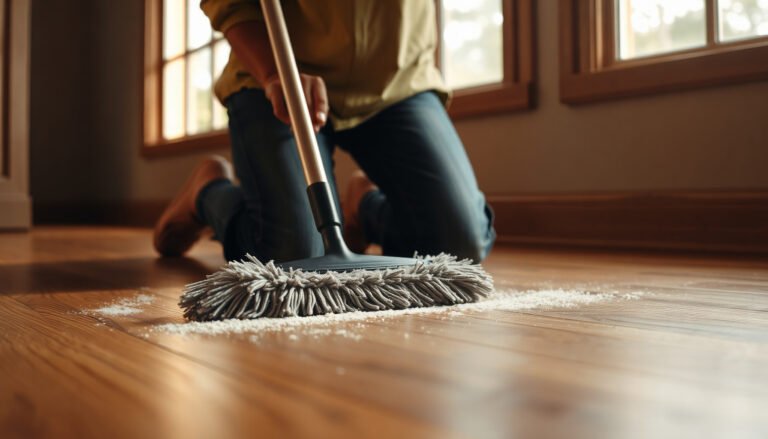
The safest way to start cleaning hardwood floors is to remove dry mold dust first—because wet wiping can smear contamination into seams and finish layers. Use HEPA vacuuming before any damp cloth work.
Dry-remove first: use a true HEPA vacuum
Dry-remove first: use a HEPA vacuum (not a regular shop-vac) to capture mold spores from gaps and edges. True HEPA filtration is typically defined as capturing at least 99.97% of 0.3-micron particles, which is exactly the particle-size range where airborne dust control matters. U.S. Department of Energy, HEPA filter performance definition
This step is particularly important on hardwood floors because:
– Spore-laden dust sits in micro-gaps between boards
– Regular vacuums can exhaust fine particles back into the room
– Wet wiping without prior dust removal increases the chance of staining and odor spread
Gentle surface dusting only (no aggressive scrubbing)
If mold is on the surface, gently wipe/dust before any wet cleaning—avoid aggressive scrubbing that can abrade finishes and push spores deeper. On polyurethane-finished hardwood, rough scrubbing can dull gloss and make spots look worse permanently.
Control spread: containment and quick disposal
Bag and dispose of cleanup materials promptly, and keep foot traffic out of the area while you work. If you can, block airflow paths from the room (or close doors) so you don’t move mold dust to clean hardwood elsewhere.
Clean hardwood with the gentlest method that works
For mold stains and musty residue on hardwood floors, the gentlest method that works is a controlled damp-cleaning approach with mild detergent—never soaking. If the finish or wood has been penetrated, you may need a manufacturer-approved deeper step.
Use minimal moisture: damp cloth, not pooled water
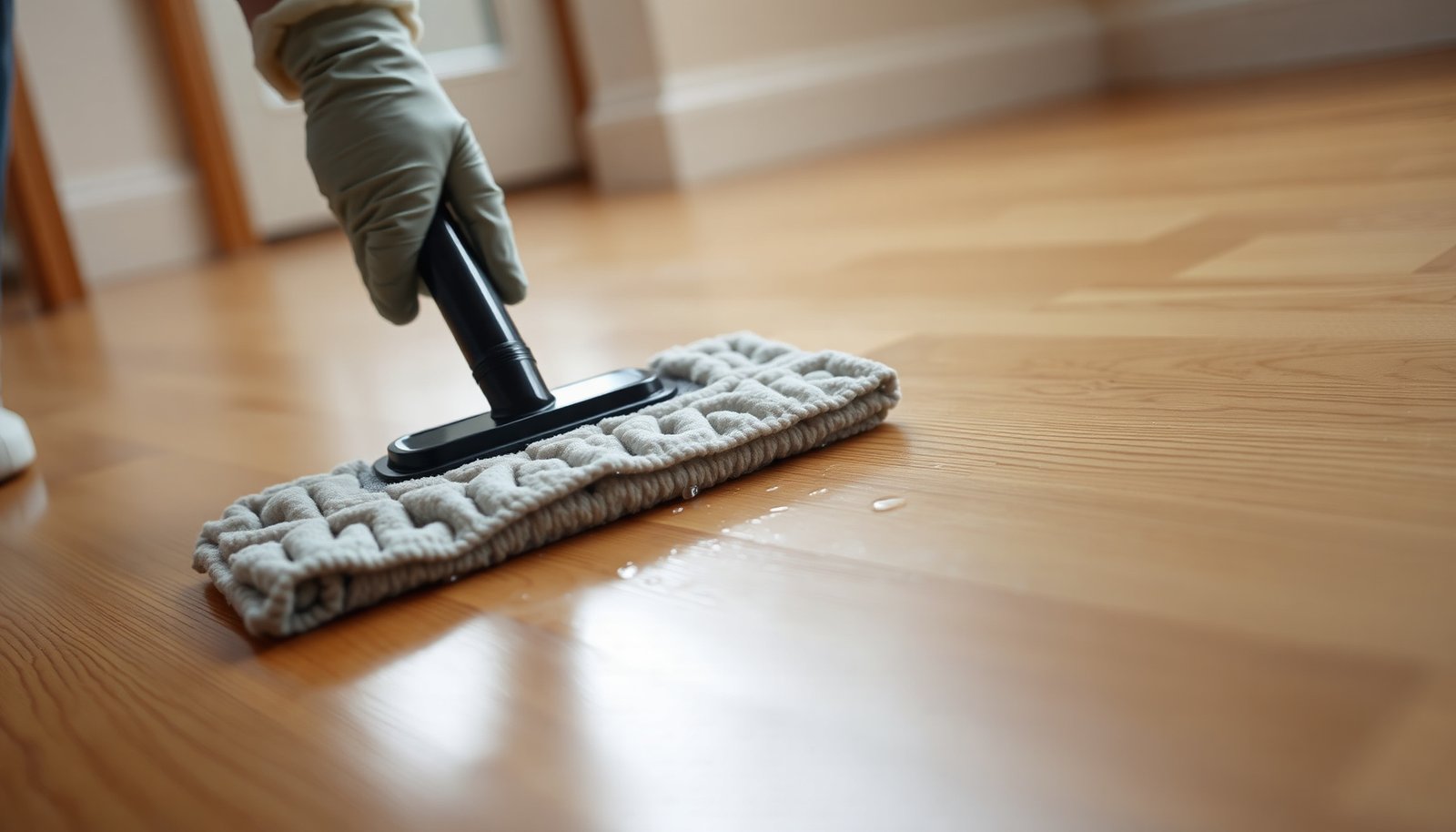
Use a mild detergent in clean water on a lightly damp (not soaking) cloth or mop—work small sections and don’t let water pool in seams. Hardwood responds to moisture: swelling can loosen joints, and prolonged dampness can keep mold conditions active even after you “clean.”
A practical rule for hardwood floors: if you can see water sitting on the board edges or between planks, you’re using too much water.
Finish-safe stain handling: follow your flooring manufacturer
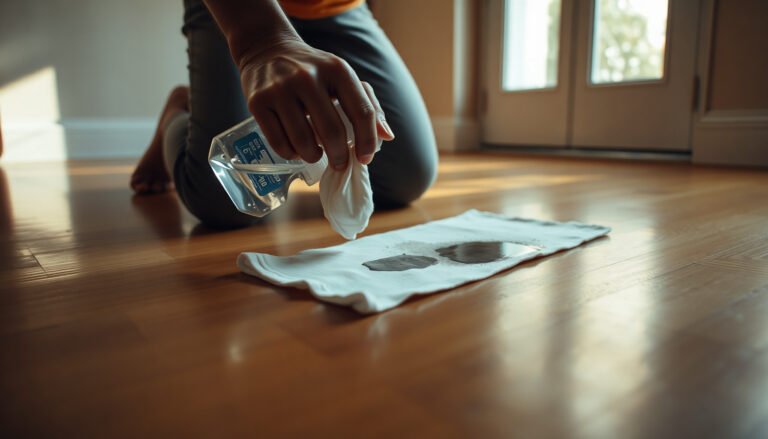
For stains/spots: you may need a finish-safe approach recommended by your flooring manufacturer; .
This matters because different finishes (oil-based, water-based polyurethane, waxes, penetrative sealers) behave differently. Some removers can lift colorant, haze clear coats, or leave residue that attracts future dirt.
Avoid “home chemistry” unless it’s specifically intended
Skip “home chemistry” unless it’s specifically intended for this job: harsh or untested cleaners can damage the finish or make discoloration worse, and porous/absorptive areas may not fully recover. If you’re considering a disinfectant or stain remover, confirm it is approved for your hardwood finish and that the label instructions explicitly permit use on the type of surface you have.
Dry thoroughly and prevent it from coming back
The cleaning is only half the job for hardwood floors—drying is what prevents hidden regrowth and lingering odor. Your goal is to dry the boards and any moisture-holding layers down to a stable, non-odorous state.
Keep drying until the wood is truly dry
Drying matters as much as cleaning: continue drying/airflow until the wood is fully dry to prevent hidden regrowth. As of 2026, both EPA-style moisture guidance and professional drying standards emphasize verification, not just “looks dry.”
If you have tools available, moisture meters designed for wood can help you confirm dryness. Even without a meter, pay attention to:
– Musty smell returning after you stop drying
– Damp feel along board edges
– Visible darkening that fades slowly (often indicates lingering moisture)
Control humidity to protect hardwood floors long-term
Control indoor humidity (commonly kept below 60% is recommended in EPA/CDC guidance on mold prevention) and watch for recurring musty odors. If the room remains humid, the cleaned hardwood floors can become a new growth surface even if the initial contamination was removed.
If the boards are cupped or soft, treat it as a deeper problem
If the boards feel cupped/soft, keep in mind that moisture penetration can require professional assessment or refinishing/sanding. Physical deformation is often a sign that the wood has already absorbed more water than surface mold cleaning can reverse.
What can go wrong (and when “cleaning” isn’t enough)
Cleaning hardwood floors can fail when the problem is deeper than surface mold. These are the most common ways homeowners accidentally make it worse—or miss an active source under the finish or beneath the flooring.
Using too much water
Using too much water: soaking can swell wood, loosen joints, and spread mold deeper. If you see raised edges or water trapped along seams, stop and switch to controlled damp cleaning plus drying.
Skipping HEPA vacuuming
Skipping HEPA vacuuming: vacuuming helps remove spores/dust that wet wiping can smear around. Once spores smear onto finish or between boards, the residue can look like “new stains” even though you’re just redistributing particles.
Assuming bleach fixes everything
Assuming bleach fixes everything: for porous materials, bleach-based approaches often don’t solve the underlying issue and can also discolor wood finishes. EPA guidance emphasizes that materials contaminated by moisture may require more than surface cleaning. U.S. EPA, “Mold” guidance on cleaning vs. removal
Hidden mold under/around flooring
Hidden mold under/around flooring: if mold reached underlayment, subfloor, or between boards, cleaning only the top layer may leave the problem active. In those cases, odor can persist even after the visible spots are gone.
When to call a pro: a practical comparison
If you’re deciding whether hardwood floors need DIY cleaning or professional remediation, the table below helps you weigh risk and limits.
| Criteria | DIY surface cleaning | Professional mold/floor remediation |
|---|---|---|
| Mold spread visible | Best for small, surface-only spotting | Needed for larger or visibly growing areas |
| Moisture still present | Only if you can verify full dryness | Commonly includes controlled drying monitoring |
| Subfloor/underlayment suspected | High risk of missing hidden growth | Can evaluate and address hidden layers |
| Finish type certainty | If you know it and can follow manufacturer care | More likely to use finish-appropriate methods |
| Respiratory fit & containment | May be inconsistent in real homes | Often includes more formal containment practices |
| Odor persistence after cleaning | A sign to reassess immediately | Can diagnose source and depth |
| Health risk for occupants | Avoid if anyone is high-risk | More suitable for sensitive households |
| Time pressure | DIY can be slower to dry/verify | More likely to hit drying windows quickly |
| Repair outcome certainty | Lower if wood was saturated or deforming | Higher when depth and scope are assessed |
| Cost risk | Lower up front; can become expensive if you miss hidden moisture | Higher up front; often prevents repeat remediation |
| Verdict | Use DIY only for limited, surface-only cases | Choose pro help when depth, size, or health risk is uncertain |
Verdict: do-it-yourself cleaning is OK for small, surface-only cases
DIY cleaning can work when the mold is limited, the moisture source is fixed, and the affected area looks like surface spotting (not deep saturation). However, hardwood floors can retain moisture and odor even after visible mold is removed, so your drying and verification steps matter as much as your cleaning method.
– Skip DIY and call a mold remediation/flooring professional if the area is large, you suspect significant penetration, anyone is high-risk (severe asthma, immunocompromised), or you can’t fully dry the materials.
– Skip harsh DIY chemicals and follow your floor’s finish instructions—if you don’t know the finish type, before trying stain removers or disinfectants.
– If the wood absorbed moisture and odors persist after cleaning and drying, you may need refinishing or partial replacement rather than repeated scrubbing.
A practical “honest warning” for hardwood floors: if the smell keeps returning within days even when you’ve dried thoroughly, repeated surface cleaning is often a dead end. At that point, it’s usually a sign the contamination isn’t only on top of the finish.
Quick checklist: clean, dry, verify
| Step | What to do | Done? |
|---|---|---|
| 1 | Fix leak/humidity source first | ☐ |
| 2 | Protect yourself (gloves + eye protection + respirator) | ☐ |
| 3 | HEPA vacuum mold dust and debris | ☐ |
| 4 | Gentle damp cleaning (mild detergent, lightly damp cloth) | ☐ |
| 5 | Rinse/wipe with clean, minimal moisture (don’t soak) | ☐ |
| 6 | Dry completely (dehumidifier/fans as needed) | ☐ |
| 7 | Watch for odor/spot reappearance for several days | ☐ |
Frequently Asked Questions
What should I do immediately if mold is on my hardwood floors?
Act fast to prevent mold spores from spreading to other areas of your home. Isolate the room, increase ventilation, and wear an N95 mask plus gloves to reduce exposure while cleaning. If the mold is widespread or you see cupping/gaps in the wood, consider contacting a professional wood floor cleaner or remediation service because surface-only cleaning may not be enough.
How can I safely clean mold from hardwood floors without damaging the finish?
Start by gently vacuuming loose growth using a vacuum with a HEPA filter (avoid dry sweeping). Then lightly wipe the affected area with a cleaner made for wood floors—never soak the floor—using a microfiber cloth that you wring out well. For stubborn spots, use a dilute, wood-safe disinfectant as directed, and follow with a clean water-dampened cloth only if the label instructs it; dry the area thoroughly afterward to protect hardwood finish and prevent recurring mold.
Which cleaning solution is best for mold on sealed vs. unfinished hardwood floors?
Sealed hardwood typically tolerates mild, pH-neutral wood floor cleaners and manufacturer-approved mold removers used in light applications. Unfinished hardwood is more porous, so you must avoid harsh chemicals and excess moisture that can penetrate and discolor the grain. If your floor is unfinished, test any product in a hidden spot and consider using a specialized wood mold treatment recommended for unfinished surfaces.
Why is drying time so important when cleaning hardwood floors after mold?
Mold thrives when moisture remains in the wood, under baseboards, or within micro-gaps—so drying is key to stopping recurrence. Use fans and dehumidification to bring the moisture level down quickly, and monitor humidity in the room until it stabilizes. Never leave the floor damp or “just air it out,” especially if you’re dealing with recurring moisture sources like leaks or high humidity.
How do I prevent mold from coming back after cleaning hardwood floors?
First, fix the underlying moisture problem—repair leaks, improve ventilation, and use a dehumidifier if indoor humidity is high. Maintain indoor humidity around 30–50% to discourage mold growth, and regularly inspect around doors, windows, and plumbing fixtures for early signs. After cleaning, consider using protective floor products that are compatible with your hardwood finish and avoid wet mopping to reduce future mold risk.
📅 Last Updated: November 02, 2026 | Topic: How to clean hardwood floors after mold gets on it? | Content verified for accuracy and freshness.
References
- https://www.cdc.gov/mold/cleanup/index.html
- https://www.cdc.gov/niosh/topics/mold/
- https://www.epa.gov/mold/mold-remediation-guidance
- https://www.epa.gov/mold/preventing-mold
- https://www.hud.gov/program_offices/healthy_homes/mold
- WHO guidelines for indoor air quality: selected pollutants
- Mold
- https://scholar.google.com/scholar?q=how+to+clean+mold+from+hardwood+floor Google Scholar
- https://scholar.google.com/scholar?q=mold+remediation+wood+materials+cleaning+drying Google Scholar
- https://scholar.google.com/scholar?q=CDC+EPA+mold+cleanup+porous+materials+hardwood Google Scholar