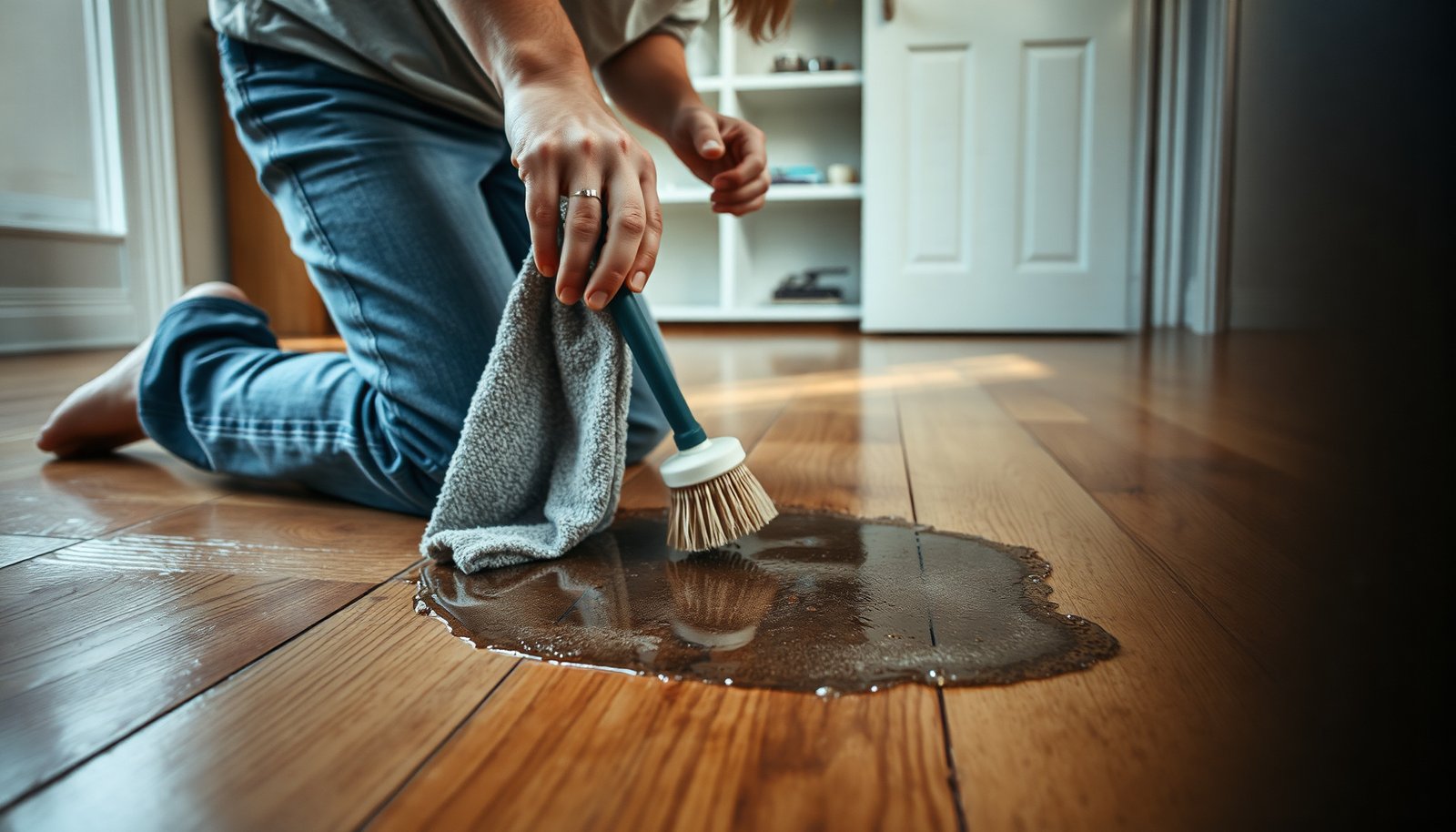

You lift a rug and see a faint ring of fuzzy dark growth where the hardwood met a damp spill. With the right protection and a careful, low-moisture cleaning routine, you can remove the surface mold without damaging the finish—usually in a few hours for small spots. You will need a HEPA vacuum, microfiber cloths, a soft brush, and a cleaner made for wood, plus a plan to stop the moisture that caused it.




Mold on hardwood usually comes off best when you stop the moisture first, then clean with mild detergent and thorough drying—not by flooding the floor. If the mold returns quickly or the affected area is large, you may need deeper remediation or help from a pro. As of 2026, this approach remains the safest way to protect both the finish and indoor air quality while you deal with mold on hardwood floors.
This guide is for homeowners dealing with visible surface mold on finished (sealed) hardwood floors after a spill, leak, or humidity problem. If the floor is unfinished or the mold has spread deep, the approach can change.
Check if it’s surface mold (or a moisture problem)
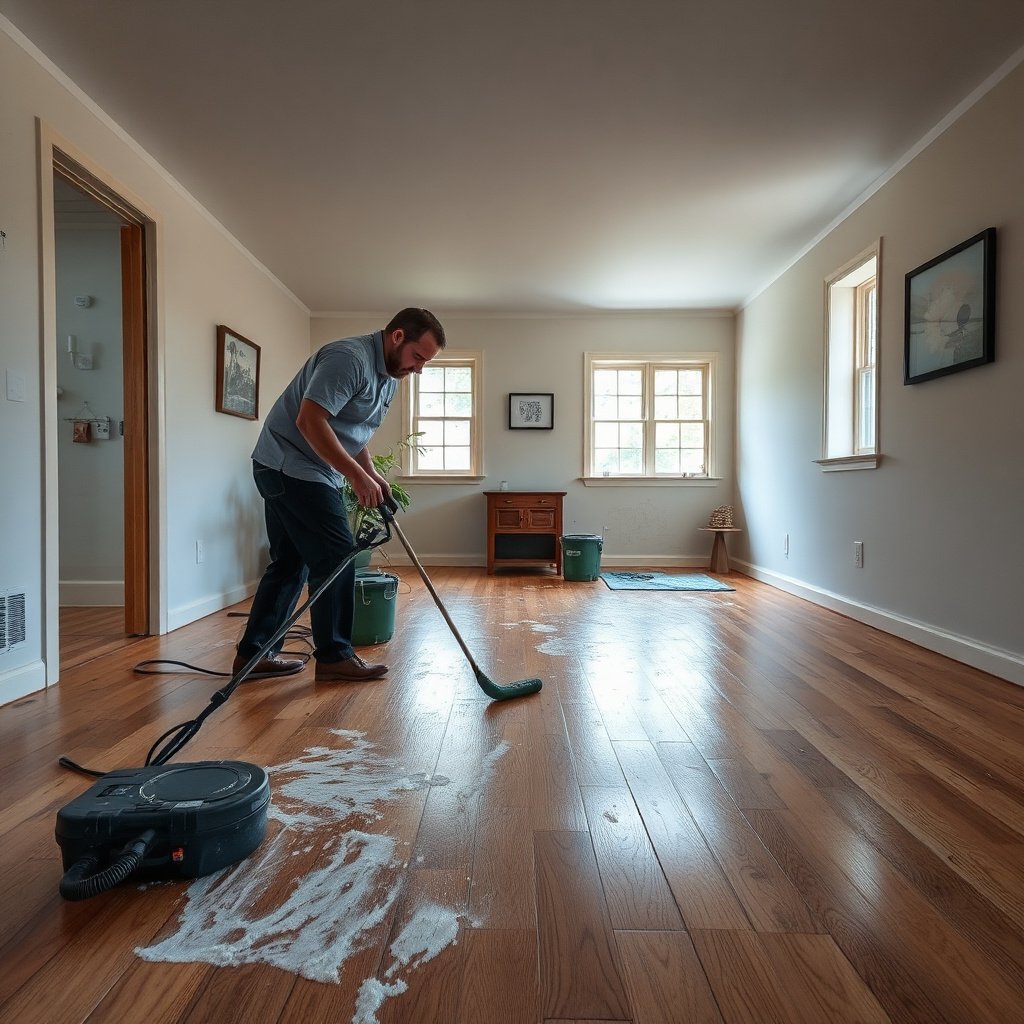
The fastest way to remove mold off hardwood floors is to confirm it’s surface growth—and, just as importantly, stop the moisture feeding it. Mold on hardwood is almost always a symptom; without fixing the damp condition, the same spots will reappear even after good cleaning.
Surface mold is typically:
– Visible black/green/gray spots on top of the finish (often around a spill edge or moisture pathway)
– Not accompanied by musty air only (though mild odor can still happen)
– Localized to where water sat or where humidity condensed
Mold that has penetrated further (or involves the subfloor) is more likely when:
– You see bubbling/soft spots, persistent odor, or widespread darkening beyond the spill path
– The area stays damp longer than a day or two
– Mold growth returns within days after cleanup, suggesting the moisture source wasn’t fully corrected
Before you touch the floor, check the likely moisture origin:
– Leaks under sinks, dishwashers, toilets, or behind appliances
– Condensation from HVAC issues, cold supply lines, or poor ventilation
– Wet crawlspaces/basements (humidity-driven rather than a single spill)
– Spills that weren’t dried promptly or that wicked into seams
A key rule of thumb from the U.S. Environmental Protection Agency (EPA) is that mold problems should be treated as moisture problems. According to EPA, mold can begin growing indoors within 24–48 hours after water damage occurs. EPA also recommends that if the mold-affected area is larger than 10 sq ft, you should consider professional remediation rather than DIY.
What to look for on sealed hardwood specifically
Finished (sealed) hardwood helps because the mold often sits on/near the surface rather than deeply into bare wood. That said, sealants can wear at edges and around seams, and water can still migrate. When cleaning mold off hardwood floors, your goal is to remove visible growth while minimizing water intrusion—especially at joints.
Prep for safe cleaning (protect yourself and the room)
The most effective mold off hardwood floors cleanup starts with containment and protective gear, because you don’t want to spread spores while wiping. You also want to reduce airborne particulates so the rest of the home doesn’t become the “work area.”
For a small, surface-level mold cleanup:
– Wear protection: eye protection plus a respirator appropriate for mold (commonly an N95 type) and gloves.
– Ventilate: open windows if weather allows and the source is localized; otherwise use fans that don’t blow air into clean rooms.
– Keep people and pets out of the work zone until cleaning and drying are complete.
If you have one, use a HEPA vacuum rather than dry sweeping. Dry sweeping can aerosolize mold particles and residue.
One concrete standard point: NIOSH-certified N95 respirators are designed to filter at least 95% of airborne particles in tests. According to NIOSH, N95 filtering facepiece respirators are required to provide at least 95% filtration efficiency for certain test particles. (Always follow the fit instructions for your model; a poor seal dramatically reduces real-world protection.)
Quick containment habits that make a big difference
– Close doors to adjacent rooms and plan airflow so dust/spores don’t travel.
– Remove washable area rugs near the affected zone (and bag them).
– Keep cleaning steps “wet wipe, then dry” rather than “dry disturb.”
Remove mold off hardwood floors (step-by-step)
The safe way to remove mold off hardwood floors is to dry first, then clean using mild detergent with controlled moisture, and finally dry thoroughly. Avoid flooding because water can move through seams and under edges—turning a surface cleanup into a deeper moisture problem.
Step 1: Dry first (stop moisture immediately)
If any water is still present, stop the source and dry the area completely before wiping. If the spill was recent, use towels to absorb, then run airflow to bring the floor back to normal dryness. Mold off hardwood floors doesn’t respond well to “cleaning through dampness”—active growth continues when the wood remains wet.
Step 2: Wipe with mild detergent (controlled, not soaking)
Mix mild detergent with water, then wipe with a microfiber cloth that’s damp (not dripping). Change cloths often so you’re not re-depositing residue elsewhere.
Why this works: mild surfactants lift surface contaminants without relying on harsh chemistry that may damage finishes or push moisture deeper into micro-gaps.
Step 3: Light rinse, then hard dry
After cleaning, do a light wipe with a lightly damp cloth (minimal water), then dry thoroughly with clean towels and continued airflow. The “hard dry” part matters as much as the detergent because mold off hardwood floors can recur if moisture lingers in the wood structure or subfloor.
For stubborn discoloration
If the mold stain won’t lift after proper cleaning, don’t assume it’s still “active mold.” Stains can remain after the organisms are removed because pigment residues and wood tannins can discolor the finish.
For stronger agents (like peroxide/bleach), use only what is consistent with your floor finish manufacturer’s instructions—some chemicals can dull or weaken coatings, and they may not solve the moisture problem.
Below is a practical comparison of common approaches for sealed hardwood when your goal is mold off hardwood floors without finish damage.
| Method | Pros | Cons |
|---|---|---|
| Mild detergent + damp microfiber | Good for surface mold on sealed finishes; controlled water; repeatable and easy to document. | May not remove deep staining even after growth removal. |
| Peroxide-based products (finish-approved) | Can help lighten persistent organic discoloration when used as directed by the finish system. | Not universal for all sealants; incorrect dwell time or concentration can dull coatings. |
| Bleach/strong oxidizers (finish-unverified) | Sometimes reduces visible color on certain surfaces. | High risk of finish damage and may not address moisture-driven recurrence. |
| Sanding/refinishing | Can remove penetrated growth and compromised finish layers. | Dust exposure; permanent alteration; only appropriate if finish system and subfloor conditions require it. |
(This comparison is about safe decision-making for sealed hardwood. Always defer to your specific floor finish manufacturer’s care instructions before using any chemical beyond mild detergent.)
Dry thoroughly to prevent it from coming back
The best predictor of whether mold off hardwood floors will return is whether the wood and any moisture reservoir beneath it fully dry. Drying turns a “cleanup” into a lasting fix.
Do this:
– Keep air moving with fans and/or a dehumidifier until the floor feels and reads as dry to normal conditions.
– Re-check within a couple of days. If you see new spots, the moisture source (or trapped moisture) is still present.
– Don’t put rugs or furniture back too soon; trapping moisture under objects is a common reason mold returns.
Moisture control is also where the broader guidance comes in: According to EPA, keeping indoor relative humidity below **60%** helps prevent mold growth in many settings. That target supports the “dry thoroughly” principle—especially in humid climates or during recurring condensation seasons.A practical drying checklist for hardwood mold cleanup
– Fans aimed to circulate air along the floor surface (not blasting directly into baseboards only)
– Dehumidifier if the room humidity is high
– Short-interval checks (for example, morning and evening) to confirm drying progress rather than assuming it “eventually will”
What can go wrong (common mistakes to avoid)
The most common reason people struggle with mold off hardwood floors is not the cleaning product—it’s the process mistakes that reintroduce moisture or spread spores. Avoid these pitfalls to keep the remediation shallow and safe.
– Over-wetting the floor: Hardwood can warp or cupping can start when water soaks into seams and edges.
– Using bleach or strong cleaners blindly: These can damage finishes and may not address the underlying moisture source.
– Missing hidden mold: Areas under baseboards, near vents, or under rugs can be where moisture lingers—surface cleaning alone may not be enough.
– Assuming discoloration = active mold: Stains can persist even after growth is removed, so re-cleaning endlessly can waste time while the moisture issue continues.
If you find signs of deeper contamination (soft subfloor, persistent odors, or rapidly recurring growth), continuing DIY usually makes things worse—both in cost and risk.
Verdict: what’s worth trying, and when to stop
The recommended DIY approach is worth trying only when you have small, visible surface mold on sealed hardwood and you can identify and fix the moisture source quickly. If the affected area is larger than 10 sq ft, the mold returns repeatedly, odors persist, you suspect subfloor contamination, or the floor is unfinished, you should stop DIY and escalate to deeper remediation or professional help.
To make that decision quickly, here’s a structured comparison.
| DIY surface-clean approach | Professional remediation |
|---|---|
| Best starting point for sealed hardwood with visible surface mold only | Best choice when moisture or microbial growth is suspected beyond the surface |
| Relies on careful moisture control + controlled wiping | Adds diagnostics and containment practices tailored to the source |
| Can reduce visible growth and surface residue | Can address porous materials, underlayment, and elevated contamination risks |
| Lower cost for small, localized problems | Higher upfront cost but reduces repeat failures |
| More dependent on accurate assessment of the moisture source | Better for recurring cases where moisture isn’t fully identified |
| Limited ability to “verify” complete remediation | Uses remediation workflows aligned with professional standards and documentation |
| May leave staining even after mold growth is removed | More likely to coordinate spot treatment vs refinishing when needed |
| Risk of spreading spores if prep/containment is weak | Lower spread risk with controlled work practices |
| Time-intensive if multiple rounds of drying/cleaning are needed | Time-efficient for larger or complex moisture events |
| Follow-up relies on your observation (no specialized verification) | Includes clearer remediation acceptance steps (based on scope and conditions) |
| Verdict: DIY is appropriate only for small, confirmed surface mold after moisture is controlled. | Verdict: Choose a pro when the area is >10 sq ft, odors persist, growth returns quickly, or you suspect underlayment/subfloor contamination. |
Tip: If you’re unsure whether your floor is sealed, check the finish type (or contact the manufacturer) before using anything beyond mild detergent. Using the wrong chemistry on an unsealed surface can worsen the problem by driving moisture and residues deeper.
Quick checklist (scan before you start)
| Step | Do this | Avoid |
|---|---|---|
| 1 | Fix leaks / stop moisture | Cleaning while the area is still wet |
| 2 | Protect yourself + ventilate | Dry sweeping dust/mold |
| 3 | HEPA vacuum lightly (if available) | Spreading residue with a broom |
| 4 | Wipe with mild detergent, damp cloth | Soaking or puddling water on seams |
| 5 | Dry completely with airflow | Putting rugs/furniture back too soon |
| 6 | Re-check for return | Ignoring recurring spots/odors |
NIOSH filter grades commonly used during mold cleanup (N/R/P series)
| # | Respirator grade | Minimum filtration efficiency | Protection rating | Best-fit context for mold off hardwood floors |
|---|---|---|---|---|
| 1 | N95 | ≥ 95% | ★☆☆☆☆ | Small, contained surface cleanup |
| 2 | R95 | ≥ 95% | ★☆☆☆☆ | Cleanup with nuisance moisture/condensation risk |
| 3 | P95 | ≥ 95% | ★☆☆☆☆ | Small DIY jobs when oil-free protection is desired |
| 4 | N99 | ≥ 99% | ★★☆☆☆ | Higher confidence for dusty wiping/HEPA vacuuming |
| 5 | R99 | ≥ 99% | ★★☆☆☆ | Small jobs where condensation is hard to prevent |
| 6 | P99 | ≥ 99% | ★★☆☆☆ | Higher filtration when debris loading is expected |
| 7 | P100 | ≥ 99.97% | ★★★☆☆ | For longer work sessions or higher dust risk |
(For respirators, prioritize correct fit and follow all safety requirements in your jurisdiction; this table reflects filtration efficiency levels, not full protection for all hazards.)
Sources
– U.S. Environmental Protection Agency (EPA) — guidance on mold remediation practices, moisture control, and when to seek professional help (including the 10 sq ft threshold in remediation guidance). EPA
– Centers for Disease Control and Prevention (CDC) — general mold health and cleanup considerations. CDC
– NIOSH (National Institute for Occupational Safety and Health) — information on respirator filtration efficiency for N/R/P series classes (e.g., N95 ≥95%, P100 ≥99.97%). NIOSH
– Floor finish manufacturer care instructions — chemical compatibility and cleaning limits for sealed hardwood finishes (specific recommendation needed here).
If you’re dealing with mold off hardwood floors in 2026, the practical takeaway is simple: stop moisture, clean with mild detergent using minimal water, then dry aggressively and re-check. When the scope is larger than 10 sq ft or the problem keeps returning, shifting from “scrub harder” to “remediate the moisture source” (or bringing in a pro) is the difference between a one-time cleanup and ongoing recurrence.
Frequently Asked Questions
What’s the safest way to remove mold from hardwood floors without damaging the finish?
First, ventilate the area and wear protective gear like gloves and a mask to avoid inhaling mold spores. Lightly dry-brush or vacuum the surface with a HEPA filter to remove loose growth, then clean with a hardwood-appropriate cleaner—avoid soaking the wood. Dry the area completely afterward and consider sanding and refinishing if the mold has penetrated or left staining that won’t lift.
How do I get black mold off hardwood floors after a water leak?
Start by identifying and fixing the source of moisture, since mold on hardwood floors will return if the area stays damp. Blot up any remaining moisture, then clean the affected spots with a cleaner safe for wood (or a diluted, low-residue mold remover) and keep the solution from pooling. Use fans and dehumidification to dry the floor thoroughly, typically within 24–48 hours, and monitor for any recurring musty smell.
Why does mold come back on hardwood even after cleaning, and how can I prevent it?
Mold returns when moisture levels remain too high, such as from ongoing leaks, damp basements, high indoor humidity, or incomplete drying after cleaning. After removing mold, reduce humidity with a dehumidifier and ensure good airflow under and around the flooring. If mold frequently reappears in the same spot, you may need to check for subfloor damage or trapped moisture beneath the hardwood.
Which cleaning solution is best for mold on sealed vs. unfinished hardwood floors?
For sealed hardwood floors, use a mild wood-safe cleaner or a diluted mold cleaner that won’t strip the finish, and apply it with a damp cloth rather than pouring directly onto the boards. For unfinished hardwood, you must be more cautious because mold can penetrate deeper into the pores; you may need more thorough surface cleaning and, in some cases, sanding to remove embedded growth. In both cases, avoid harsh chemicals and excess water—spot test first and dry completely.
How do I remove mold staining from hardwood floors and know when to refinish?
After cleaning mold, the remaining discoloration may require deeper surface treatment, such as gentle sanding or a targeted wood-safe stain remover, especially if the mold caused dark spots. If the moldy areas feel rough, spongy, or the stain persists after proper cleaning and drying, refinish hardwood flooring may be necessary to fully eliminate mold residues and restore the surface. Always ensure the wood is fully dry and cured before sanding or applying any finish to prevent recontamination.
📅 Last Updated: November 02, 2026 | Topic: How to get mold off hardwood floors? | Content verified for accuracy and freshness.
References
- https://www.cdc.gov/mold/default.htm
- Mold | US EPA
- A Brief Guide to Mold, Moisture and Your Home | US EPA
- Mold Remediation in Schools and Commercial Buildings Guide: Chapter 1 | US EPA
- https://www.osha.gov/health-topics/mold
- https://www.hud.gov/program_offices/healthy_homes/mold
- https://pubmed.ncbi.nlm.nih.gov/?term=mold+remediation
- https://scholar.google.com/scholar?q=mold+removal+hardwood+floors Google Scholar
- https://scholar.google.com/scholar?q=how+to+clean+mold+from+wood+floor+HEPA+vacuum+porous+materials Google Scholar
- https://scholar.google.com/scholar?q=mold+remediation+porous+surfaces+wood+floor+guidelines Google Scholar