
Choosing hardwood floors for a hallway is all about handling daily foot traffic, grit, and moisture without losing style. If you want the best-performing option, prioritize solid or engineered hardwood with a wear layer rated for heavy use and a matte or wire-brushed finish that hides scuffs. This guide answers which wood type, plank width, and finish to pick so your hallway floor looks sharp and lasts.




Choose hallway hardwood floors that balance durability, finish protection, and safe traction. For most homes, a harder wood species plus a tough, sealed finish (often polyurethane) will hold up better to daily foot traffic and frequent cleaning. In this guide, you’ll learn what to prioritize—then we’ll walk through practical choices so you don’t end up with cupping, scuffs, or slipping.
If you’re replacing floors in a hallway (high traffic, usually lots of dirt tracked in, and limited room to “hide” damage), this is for you—especially if you’re deciding between species, plank width, thickness, and finish type.
Start with hallway traffic: durability and finish first
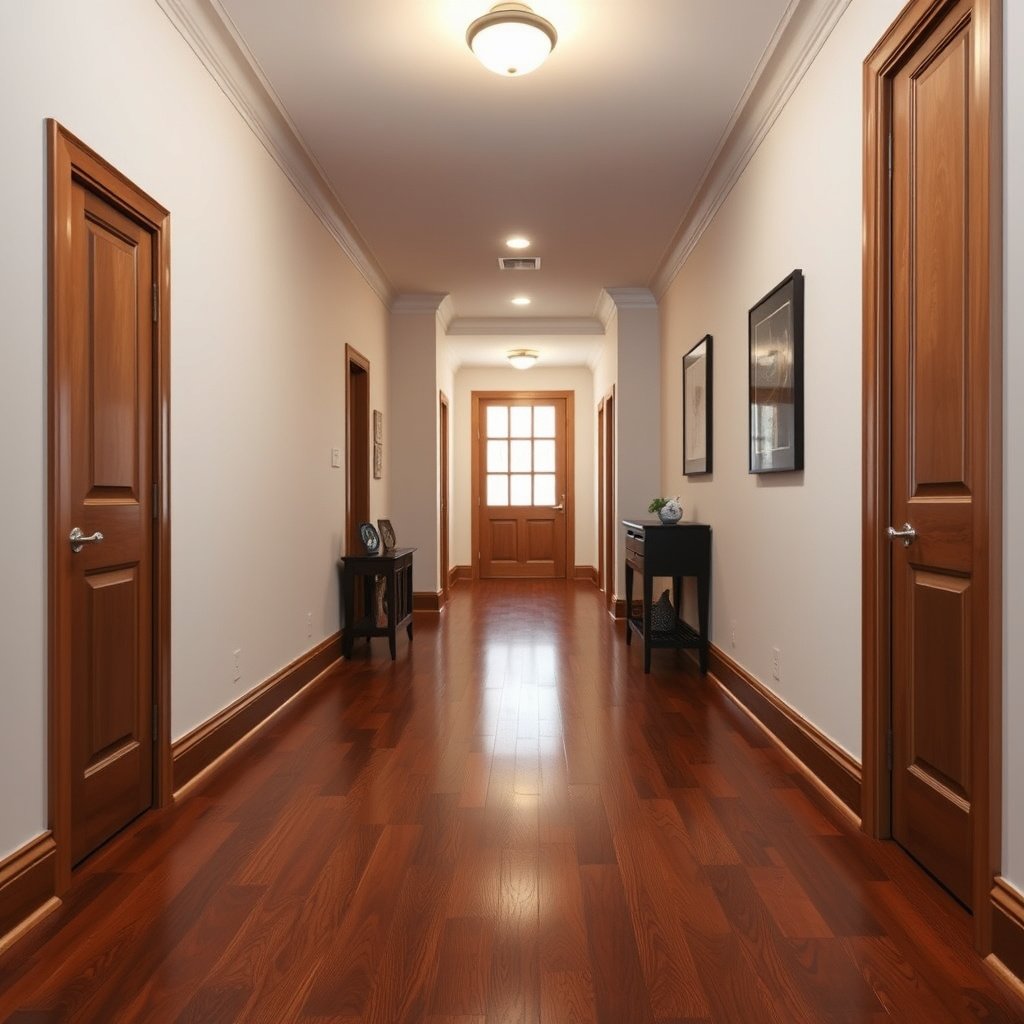
In a hallway, the finish system matters as much as the wood because scuffs and tracked grit are constant. Start by selecting a tough, well-cured sealed finish, then match the species to your tolerance for dents and color change.
Hallway hardwood floors are the first interior surface visitors hit—and they typically see concentrated wear near the entry end. That wear isn’t just scratches; it’s also grit abrasion from shoe traffic and the “sandpaper” effect when dry dirt sits on the coating. In my experience advising homeowners on hallway projects, the biggest difference maker is whether the finish is designed for floors and whether it was allowed to cure fully before heavy use.
According to the National Wood Flooring Association (NWFA), consistent indoor conditions (especially relative humidity) reduce wood movement that contributes to cupping and gapping. NWFA guidance on environmental conditions for wood flooring
According to ASTM methods used for hardness testing (commonly cited as “Janka hardness”), harder wood generally resists denting and surface wear better than softer species when impacted by foot traffic. ASTM hardness test methods
– Hallways take constant wear from shoes, vacuuming, and scrubbing—so prioritize a long-wearing surface finish before you obsess over color.
– Look for a finish designed for floors that can handle scuffs and frequent cleaning (the right coating and proper curing matter as much as the product).
What to prioritize in the finish (beyond “it’s polyurethane”)
Not all polyurethane behavior in hallway hardwood floors is identical. The practical differences usually come down to (1) sheen level, (2) how the product is applied and cured, and (3) whether your cleaning routine matches the coating chemistry. A higher-gloss finish can show scuffs sooner; a satin or matte finish often hides them better while still providing a sealed surface for grit.
Also, curing is not the same as drying. Many finish systems may feel “dry” earlier but continue to build properties over time. If a hallway is in a main circulation route, delaying furniture movement and heavy traffic until the finish is fully cured can prevent early finish failures like soft wear spots or premature dulling.
Finish approach comparison (quick parseable view):
| Finish style | Best for hallway hardwood floors when… | Watch-outs |
|---|---|---|
| Oil-based polyurethane | You want a very tough, sealed surface that tolerates abrasion and routine dry/wipe cleaning. | Often more odor during application; sheen and yellowing can matter for lighter woods. |
| Water-based polyurethane | You want clearer color and generally faster turnaround for some installation schedules. | Still requires correct surface prep and full cure before heavy traffic; some systems are sensitive to certain cleaners. |
| Hardwax oil / penetrating oil | You prioritize repairability and a different look/feel (less “film” on top). | Hallway grit can still wear the surface faster unless the system is maintained exactly. |
Pick the right hardwood species for everyday wear
In hallway hardwood floors, the safer default is a harder species—because it’s more resistant to dents and abrasion from shoe grit. Then you choose the finish that seals the surface so daily cleaning doesn’t strip protection.
Hardwood species selection is where many hallway mistakes start: homeowners pick a beautiful, softer wood for the bedroom-level look, then notice faster dulling and visible dents once the hallway becomes the main traffic corridor. Hardness also influences how quickly the floor shows “micro-damage” even when it’s not structurally failing.
According to common Janka hardness datasets used in flooring specifications, harder woods (e.g., hickory) typically test at higher force values than softer woods (e.g., walnut). ASTM-referenced Janka hardness test reporting (datasets used in flooring specs)
According to NWFA installation guidance, wood flooring performance depends on both species characteristics and environmental control—not species alone. NWFA wood floor installation guidance
– Choose a harder species when possible, because it generally resists dents and surface damage better than softer options.
– Match the wood’s natural characteristics to your expectations: some species show scratches or color shifts more noticeably over time.
Hardwood Species Commonly Used for Flooring (Janka Hardness & Hallway Wear Rating)
| # | Hardwood species | Janka hardness (lbf) | Typical hallway wear behavior | Scratch/dent resistance |
|---|---|---|---|---|
| 1 | Hickory (Carya spp.) | 1,825 | Very resistant to dents from foot traffic; scuffs still happen but less “dentiness.” | ★★★★★ |
| 2 | Hard Maple (Acer saccharum) | 1,450 | Good impact resistance; can show surface wear depending on finish sheen. | ★★★★☆ |
| 3 | White Oak (Quercus alba) | 1,360 | Durable for active homes; grain variation can affect how scratches read visually. | ★★★★☆ |
| 4 | Ash (Fraxinus americana) | 1,320 | Solid everyday durability; can be visually “busy,” which sometimes helps hide fine scratches. | ★★★☆☆ |
| 5 | Red Oak (Quercus rubra) | 1,290 | Durable but more likely than hickory/maple to show wear patterns if finishes are too soft. | ★★★☆☆ |
| 6 | Beech (Fagus grandifolia) | 1,300 | Comparable to red oak in wear; finish selection still strongly affects hallway scuff resistance. | ★★★☆☆ |
| 7 | Walnut (Juglans nigra) | 1,010 | More prone to visible dents than harder species; can be great visually if protected carefully. | ★★☆☆☆ |
Note: Janka hardness numbers are widely reported in flooring-spec references; confirm your exact species and test methodology in the manufacturer’s spec sheet for your selected product.
Consider plank width, thickness, and how boards will move
In hallway hardwood floors, wider planks and thinner constructions can make seasonal movement more visible—even when the installation is “correct.” Your best bet is to choose dimensions and construction that match your home’s humidity stability.
Wood movement is the hidden variable behind many hallway problems. When you compare plank widths, remember that the longer the board, the more noticeable any expansion/contraction can become at the surface. That visibility can show up as slight gapping at seams, or as stress if the installation constraints (like room for expansion) aren’t followed.
According to NWFA installation guidance, maintaining consistent indoor humidity helps limit dimensional change in wood flooring and reduces the likelihood of cupping or gapping. NWFA wood floor environmental guidance
According to manufacturer installation instructions, correct underlayment/subfloor preparation and acclimation are critical because installation defects can cause squeaks and early performance issues even with premium planks. Typical manufacturer installation/spec instructions
– Narrow vs. wide planks can change the look of a hallway and also how movement (seasonal expansion/contraction) shows up.
– Confirm thickness and construction details that affect stability; better-performing options tend to cope with normal indoor humidity swings more predictably.
Thickness and construction: what “stable” really means
“Thickness” alone doesn’t guarantee stability. What matters most is the product construction (solid vs engineered), core design (for engineered), and whether the installer followed the manufacturer’s specific method for fastening/underlayment. In hallway hardwood floors, instability can appear as squeaks, unevenness, or finish micro-failures where movement is concentrated.
If you’re choosing plank width, think about your hallway geometry. Long, straight hallways can visually amplify subtle seam changes. In those cases, homeowners often prefer either narrower planks or engineered construction designed for more predictable dimensional behavior across typical indoor humidity swings.
Plan for moisture and temperature changes in hallways
Hallway hardwood floors hold up best when you treat the hallway like a “pressure point” between different rooms. Your goal is predictable indoor moisture and temperature so the wood and the finish don’t fight the environment.
Many hallways sit between spaces with different thermostat cycles: the living room heats more, the bedroom might be cooler, and the entry end could face drafts. Those conditions can push the hallway wood to move more than the rest of the home. When movement is paired with abrasive grit (common near entries), the finish can wear unevenly.
According to NWFA guidance, wood flooring performance depends on controlling indoor relative humidity—commonly targeted in the mid-range—to minimize excessive seasonal movement. NWFA wood floor humidity guidance
According to ASTM and industry testing practices, wood’s dimensional change responds to moisture content, which is why consistent indoor conditions reduce cupping and gapping risk. ASTM wood property/testing references
– Hallways often sit between rooms with different heating/cooling habits—so wood movement can be more noticeable if conditions vary.
– Use the right floor-protection routine (mats/entry rugs, gentle cleaning, and consistent indoor conditions) to reduce gaps, cupping, or finish problems.
A practical protection routine for hallway hardwood floors
Start at the entry end. Use a correctly sized entry mat to capture grit and moisture; then place a runner where you can (especially if your household is prone to dragging damp shoes). For cleaning, prioritize dry methods first: vacuuming with a soft brush and spot-cleaning as needed before you ever use a damp mop.
As of 2026, manufacturers continue emphasizing finish compatibility and careful moisture control in their care instructions. Always follow the finish system’s recommended cleaners—many “all-purpose” products are designed for unsealed or differently sealed surfaces, not for urethane film finishes.
What can go wrong (and how to avoid it)
Most hallway hardwood floor failures come from mismatches: softer wood paired with a less durable finish, or poor installation conditions that defeat even a premium product. You can avoid many problems by planning around subfloor readiness and finish-care compatibility.
The “entry end” is where you’ll see the truth first. If you choose a softer species or a finish that isn’t rated for heavy residential traffic, you may notice dents, dulling, or faster wear patterns sooner than expected. Also, hallway issues are often installation-related: an uneven subfloor can telegraph through, causing squeaks and finish stress concentrations.
According to NWFA installation guidance, subfloor flatness and correct moisture/environmental conditions are key determinants of long-term wood floor performance. NWFA installation guidelines (subfloor/environment sections)
According to typical finish manufacturer care instructions, using incompatible cleaners can reduce finish life or change sheen by removing oils/additives or damaging the coating surface. Finish manufacturer care/cleaner compatibility documentation
– Choosing a beautiful but softer species or a less durable finish can lead to dents, dulling, or faster wear—especially near the entry end of the hallway.
– Ignoring subfloor condition and installation details can cause problems that no “premium” plank can fully fix (e.g., squeaks, unevenness, or early finish failure).
– Picking a finish type that doesn’t fit your cleaning habits (or using harsh cleaners) can shorten the floor’s lifespan—use products that are compatible with the finish.
Common failure modes to watch for during planning
Pros vs cons to keep you realistic:
– Harder species + sealed finish
– ✅ Better dent/scuff resistance for hallway hardwood floors
– ✅ More forgiving of routine cleaning (when you use approved methods)
– ❌ Can be more expensive and may show texture/grain strongly
– Softer species for the look
– ✅ Softer wood can be more forgiving underfoot and visually warm
– ❌ More likely to show dents and wear patterns sooner in hallways
– Penetrating/oil systems
– ✅ Some homeowners prefer easier spot maintenance
– ❌ Requires strict maintenance to prevent uneven wear in high-traffic hallways
Verdict: the best approach (and who should skip this)
For most homeowners, the best path to long-lasting hallway hardwood floors in 2026 is durability-first: choose a harder species and pair it with a tough, sealed finish, then verify installation stability needs. This reduces scuffs, helps prevent early finish wear, and supports safer traction in daily traffic.
Here’s the honest tradeoff: the most protective choices aren’t always the cheapest or the easiest to “undo” if you later change your cleaning habits. Also, if your hallway faces major uncontrolled moisture issues (like recurring leaks or chronic high humidity), no floor selection can fully compensate. In those cases, you may need to address the moisture source first—then choose flooring once conditions are stable.
According to NWFA guidance, controlling indoor humidity and following installation requirements reduces the likelihood of movement-related problems such as gapping or cupping. NWFA installation/environment guidance
According to finish system care instructions, using manufacturer-approved cleaners and respecting cure times is essential for maintaining floor finish performance. Manufacturer finish care documentation
For most homeowners, the safest path is: choose a durable hardwood species, pair it with a tough sealed finish, and buy based on installation/stability requirements—not just appearance. Skip this “balance durability first” approach if you’re planning frequent wet mopping, have major ongoing moisture issues, or can’t control indoor humidity—those situations can overwhelm even good flooring choices. If you’re unsure, confirm compatibility with your specific finish plan and subfloor conditions before committing.
Quick hallway hardwood checklist
When you shop, keep it focused: durability + finish protection + moisture stability + safe cleaning compatibility. If you can answer every item below before ordering, you’ll avoid most hallway-specific surprises.
According to NWFA guidance, pre-planning for environmental control and subfloor readiness is a major factor in long-term wood floor success. NWFA installation guidelines
According to finish manufacturer instructions, finish performance depends on correct prep, application, and curing before heavy foot traffic. Manufacturer installation/curing instructions
– Durability: harder species + protective, sealed finish
– Traffic zones: extra focus near the entry end (scuffs and tracked grit)
– Wood behavior: plank width/thickness for predictable movement
– Moisture control: consistent indoor humidity; avoid harsh cleaners
– Installation readiness: check subfloor flatness and compatibility with the flooring type
Sources
A hallway is unforgiving by design: grit is tracked in, foot traffic never really stops, and any mismatch between species, finish, and environmental control shows up faster. If you choose a harder wood species, use a tough sealed finish designed for floors, and follow the manufacturer’s installation and care instructions, your hallway hardwood floors should stay sharp, safe, and durable for years—especially in active households in 2026.
Frequently Asked Questions
What hardwood floor color is best for a hallway?
For most hallways, lighter hardwood colors (oak, maple, or light walnut) help brighten the space and make it feel larger, especially if the hallway has limited natural light. If you want a warmer or more dramatic look, medium tones like white oak with a natural stain are a popular balance that hides everyday scuffs better than very light finishes. Dark floors can look elegant, but they may show dust and traffic-lane scratches more easily, so choose a durable, scratch-resistant finish.
How do I choose the right hardwood thickness and plank width for a hallway?
Look for hardwood that’s commonly used for floors with regular foot traffic—typically 3/4-inch solid hardwood for a traditional, sturdy feel, or engineered hardwood if you need more installation flexibility. For plank width, narrower planks (about 2 to 3 inches) often hide gaps and uneven subfloor movement better, while wider planks can create a modern look but may emphasize subfloor imperfections. In high-traffic hallways, prioritize stability and a finish designed for abrasion resistance.
Which wood species is most durable for hallway use?
Species with higher hardness ratings tend to resist dents and wear better in hallways, where dirt, grit, and furniture movement are common. Oak (especially white oak) is a go-to due to its durability and timeless grain pattern, while hickory is known for exceptional toughness and character. If you’re balancing aesthetics and performance, consider how the grain pattern and stain absorption will look in a hallway with consistent lighting.
Best finish type for hardwood floors in a hallway?
For hallway floors, the best finish is one that offers strong scratch and moisture resistance, since hallways experience frequent cleaning, tracked-in debris, and occasional spills. Opt for factory-finished polyurethane or aluminum-oxide enhanced finishes because they generally provide better wear layers than many site-finished options. Also consider a matte or satin sheen to reduce the visibility of scuffs and fingerprints compared to high-gloss hardwood floors.
Why is acclimation and subfloor preparation important when choosing hardwood flooring for a hallway?
Even the best hardwood floors for hallways can fail prematurely if the subfloor is uneven or if the wood isn’t acclimated to your home’s temperature and humidity. Hallways are often long and narrow, which can reveal minor subfloor dips or high spots through gaps or squeaks after installation. Choose a hardwood installation method that matches your subfloor condition—especially if you’re considering engineered hardwood for better dimensional stability in varying indoor conditions.
📅 Last Updated: October 16, 2026 | Topic: How to choose hardwood floors for a hallway? | Content verified for accuracy and freshness.