


Dried hard-water spots on hardwood floors can make even well-cared-for planks look dull and streaked, and that can be genuinely frustrating. With the right cleaning method, you can dissolve the mineral residue and restore a clean, even appearance without stripping the wood finish. You’ll need a soft microfiber cloth, a gentle pH-neutral cleaner, and a vinegar-water solution, and most repairs take less than an hour of careful work.




Dried hard-water deposits can usually be removed by softening them with a diluted vinegar (or citric-acid) wipe, then lifting the residue with a soft cloth. Afterward, do a light rinse-wipe and dry quickly to prevent new spotting or finish haze. Keep the moisture minimal—soaking hardwood can cause swelling and long-lasting damage.
If you’re seeing white/gray crusty spots, chalky streaks, or “spotting” on a sealed or finished hardwood floor, this is for you. It’s especially useful when regular sweeping and damp mopping won’t budge the marks. If your floor is recently refinished, water-sensitive, or you’re unsure what finish it has, test first in an inconspicuous area.
Gather supplies & check your finish
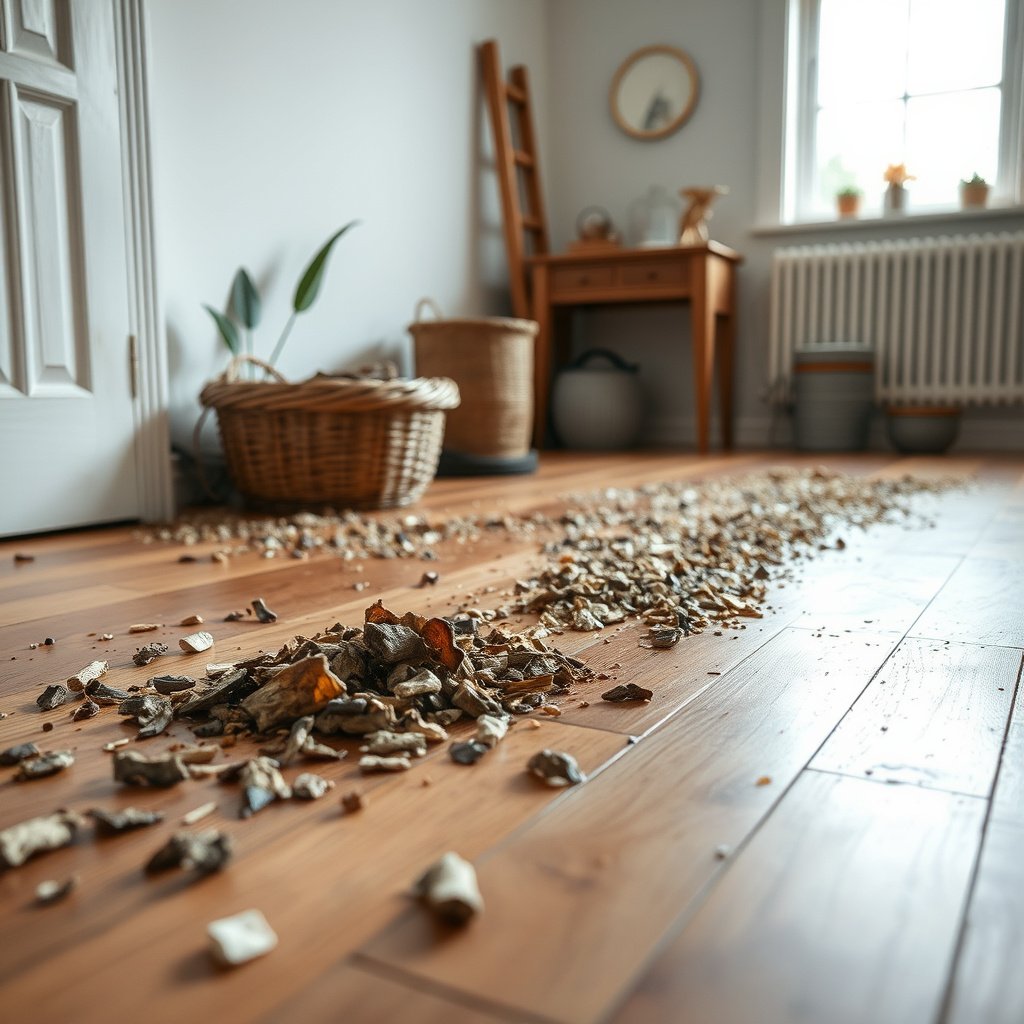
You’ll get the safest results by using soft, finish-friendly tools and confirming whether your hardwood is sealed or finish-exposed before using any acid on dried hard-water deposits. This prevents finish haze, discoloration, and edge damage—especially on older floors.
– Use soft microfiber cloths, a non-scratch pad (optional), and a bucket/spray bottle—avoid steel wool or scrub brushes.
– Identify whether the floor is sealed (polyurethane/urethane-finished) versus unfinished/oiled/waxed, because “strong” cleaners can dull or strip some finishes.
– Plan to clean in thin passes: you want “damp,” not wet—no puddles or soaking.
Soften and lift dried hard-water deposits
You can usually remove dried hard-water deposits by dissolving the mineral crust with a mild acid wipe, then lifting what’s left with gentle cloth pressure. From a chemistry standpoint, many deposits are carbonates, and weak acids like acetic acid (vinegar) can dissolve calcium carbonate by converting it into water-soluble salts.
– Mix a mild acid solution: diluted white vinegar (typical household vinegar is ~5% acetic acid, but confirm your bottle strength) or diluted citric-acid cleaner.
– Lay the cloth over the deposits and let it sit briefly to soften crusty buildup, then wipe away.
– Reapply as needed—don’t keep scrubbing once the deposit is gone (rubbing can leave haze).
Quick method (common starting point)
– Saturate a cloth lightly with the diluted vinegar/citric mix (or apply as a thin, damp cloth layer).
– Wait a few minutes, then wipe. If residue remains, repeat one more time before switching approaches.
Minerals Behind Hard-Water Spotting & Expected Response to Mild Acid
| # | Mineral commonly found in spots | Typical chemical form | Often looks like | Reactivity to diluted vinegar/citric acid |
|---|---|---|---|---|
| 1 | Calcite | CaCO₃ | White crust | ★★★★★ |
| 2 | Aragonite | CaCO₃ | Chalky film | ★★★★★ |
| 3 | Dolomite | CaMg(CO₃)₂ | White-gray crust | ★★★★☆ |
| 4 | Gypsum | CaSO₄·2H₂O | Dry, powdery spots | ★★★☆☆ |
| 5 | Barite | BaSO₄ | Hard, stubborn haze | ★★☆☆☆ |
| 6 | Quartz/silica | SiO₂ | Rough “etched” marks | ★☆☆☆☆ |
| 7 | Iron oxides (rust minerals) | Fe-oxides | Gray-brown spotting | ★★☆☆☆ |
*Note:* The star scale above reflects typical expected behavior of common mineral deposits with diluted acetic/citric acid wipes at room conditions, not guaranteed results on every floor finish. In practice, the fastest fix is still the softening-and-lifting approach—used briefly and followed by a dry-out phase.
Under the hood, vinegar works because it contains acetic acid, a weak acid that donates hydrogen ions. According to NIST, acetic acid has a pKa of 4.76 (25 °C), which means it’s strong enough to react with many carbonate deposits without being as aggressive as strong industrial acids (NIST Chemistry WebBook: acetic acid pKa). For citric acid, NIST reports pKa values of 3.13, 4.76, and 6.40, which helps it act effectively across a range of mild conditions (NIST Chemistry WebBook: citric acid pKa). Also, vinegar strength is not arbitrary: U.S. regulation defines vinegar as containing at least 4% acetic acid by volume for “vinegar” products (21 CFR 5.22 (U.S. FDA)).
Clean residue safely for sealed vs unfinished hardwood
You’ll avoid the most common damage by cleaning dried hard-water deposits differently depending on whether the floor is sealed or unfinished. Sealed hardwood generally tolerates brief, diluted acid use—while unfinished/oiled/waxed floors are more vulnerable to dulling, staining, or finish lift.

– Sealed hardwood: After lifting the deposits, wipe with a clean, lightly damp cloth (water only) to remove any leftover acid residue; dry immediately.
– Unfinished/oiled/waxed hardwood: Go slower—use the mildest solution that works and test first. If you see dulling or blotchiness, stop and switch to the finish-appropriate care method (often the safest route is a manufacturer-approved cleaner).
– If the spots look like surface haze rather than crust, use gentle wiping—heavy abrasion can permanently dull the finish.
For clarity, here’s a simple decision snapshot (this helps when you’re staring at a floor and trying to decide whether to “keep going” or stop):
- Sealed hardwood (polyurethane/urethane-finished)
- If dried hard-water deposits are mineral-crusty, diluted vinegar or citric-acid wipes are typically effective. Follow with a quick water-only rinse-wipe and immediate drying to reduce finish haze.
- Unfinished, oiled, or waxed hardwood
- Acid exposure can change the color/shine or pull oils out of the surface. Use the gentlest approach, test in a hidden spot, and stop if you see changes—then move to the finish-maker’s recommended cleaner.
From my own maintenance experience, the “no puddles” rule matters more than people expect: even on sealed floors, leaving an acid-wet cloth running under foot traffic quickly leads to patchy drying patterns that look like new spotting.
Neutralize, rinse-wipe, and dry to prevent new spotting
You prevent recurrence by removing remaining cleaner (neutralization-by-wipe) and drying fast. Dried hard-water deposits form where water lingers; similarly, finish haze often appears when solution residue dries on the surface.
– Do a light “rinse-wipe” with water (just enough to remove cleaner), then buff dry with a clean microfiber towel.
– Improve drying: run a fan and keep foot traffic off until fully dry.
– For recurrence control, wipe up spills quickly and consider a humidifier/dehumidifier strategy if your environment swings a lot—hard-water deposits often reappear where water sits.
If you’re working in 2026 on a floor with frequent kitchen splashes, a practical preventive step is to keep a microfiber “dry buff” towel by the entry to that room. The faster you remove residual moisture after the acid step, the less likely you’ll create additional mineral residue patterns.
What can go wrong (and how to avoid it)
You can usually avoid setbacks by controlling moisture, staying within diluted acid limits, and not over-scrubbing once the dried hard-water deposits are lifted. The wrong approach often doesn’t just fail—it can leave a permanent finish dull spot.
– Flooding/soaking: Excess moisture can cause swelling at seams or edge-raise, especially on older floors—use damp cloths, not wet mops.
– Wrong chemical strength: Strong acids can dull finishes, while harsh cleaners (bleach/ammonia) can cause discoloration—start mild and test.
– Scratching or haze: Abrasive pads or aggressive scrubbing can leave permanent dull spots, even if the deposit comes off.
Also note: if the “deposit” is actually etched damage or deep staining (not just mineral crust), repeated acid wiping can make the surface look worse by increasing haze. If the area stops responding after your second softening cycle, pause and reassess.
Verdict + quick checklist
This method is a reliable DIY starting point for many sealed hardwood floors: soften with diluted vinegar/citric acid, lift gently, then rinse-wipe and dry. The downside is that some finishes (or older, sensitive coatings) can haze or dull—so testing matters. Skip DIY acid-cleaning on unfinished/oiled floors if you can’t confirm finish compatibility, or if your test spot shows dulling or finish change.
Quick checklist (scan/save):
| Step | Do | Don’t |
|---|---|---|
| Test first | Try in a hidden spot | Start on the whole room |
| Soften | Use diluted vinegar/citric on a damp cloth | Pour liquid onto the floor |
| Lift | Wipe gently with microfiber | Scrub hard while residue remains |
| Rinse-wipe | Wipe with clean, lightly damp cloth | Leave cleaner sitting |
| Dry | Buff dry immediately | Let it air-dry wet |
Frequently Asked Questions
What’s the safest way to remove dried hard-water deposits from hardwood floors?
Start by softening the mineral buildup with a damp, warm microfiber cloth rather than scrubbing dry deposits aggressively. Use a cleaner specifically formulated for hardwood or a diluted vinegar solution only if your floor finish is compatible (test in an inconspicuous area first). After loosening the deposits, wipe with a clean damp cloth to remove residue, then dry thoroughly to prevent water damage.
How do you clean hard-water stains on hardwood floors without damaging the finish?
Avoid abrasive pads, steel wool, or harsh chemicals that can dull or strip the polyurethane or varnish. Dried hard-water spots often require gentle, repeated applications: apply a hardwood-safe solution (or vinegar diluted with water), let it sit briefly, then wipe and rinse with a damp cloth. Finish by drying immediately and buffing lightly with a dry microfiber towel.
How can I remove white calcium buildup (hard water marks) that’s already dried on wood?
Hard water deposits can become crusty, so use a softening approach first—place a damp cloth over the spot and keep it warm for several minutes. For persistent spots, reapply a diluted vinegar or mineral-deposit remover that’s safe for sealed hardwood, then wipe as the residue breaks down. Always remove any remaining solution with plain water on a well-wrung cloth and dry completely.
Which cleaning solution works best for dried hard-water deposits on sealed hardwood floors?
In many cases, a diluted white vinegar solution (mixed with water) is effective at dissolving calcium and lime, but it must be tested first. If the buildup is heavy, a commercial calcium/lime remover labeled safe for sealed floors can work faster—just follow the label instructions and keep contact time short. Regardless of the product, finish with a clean damp wipe and thorough drying to protect the hardwood floor finish.
Why do hard-water stains keep coming back on hardwood floors, and how can I prevent them?
Hard-water minerals left behind from mopping, spills, or steam cleaning can gradually build up as dried rings and haze. Prevent recurrence by using clean, distilled water for damp mopping, wiping up spills promptly, and avoiding oversaturation of the wood. Using a hardwood floor cleaner that won’t leave mineral residue and maintaining a protective finish can significantly reduce future hard-water marks.
📅 Last Updated: October 31, 2026 | Topic: How to clean dried hard-water deposits from hardwood floors? | Content verified for accuracy and freshness.
References
- Hard water
- Limescale
- Hardness of Water | U.S. Geological Survey
- Checking your browser – reCAPTCHA
- Checking your browser – reCAPTCHA
- https://www.britannica.com/science/hard-water
- Home | National Wood Flooring Association | NWFA
- https://scholar.google.com/scholar?q=how+to+remove+hard+water+stains+from+hardwood+floors Google Scholar
- https://scholar.google.com/scholar?q=hard+water+scale+removal+calcium+carbonate+vinegar+wood+finish Google Scholar
- https://scholar.google.com/scholar?q=hardwood+floor+care+mineral+deposits+pH+neutral+cleaner Google Scholar
[…] it with minimal effort—usually within about an hour for a small area. Gather distilled water, a soft microfiber cloth, and a pH-neutral wood cleaner or mineral-deposit remover, then follow the process for a […]
[…] water to soften any new mineral residue. Then mix equal parts white vinegar and water (or use a vinegar-water solution) and wipe with a microfiber cloth, testing a small hidden spot first. For stubborn spots, let the […]