
Remove kitchen stains from laminate floors without guesswork by following the fastest, safest step-by-step method that lifts common spills without dulling the finish. This guide answers exactly how to identify the stain type, clean it the right way, and prevent water damage during the process. You’ll know what to use, what to avoid, and how to get a clean, streak-free surface.



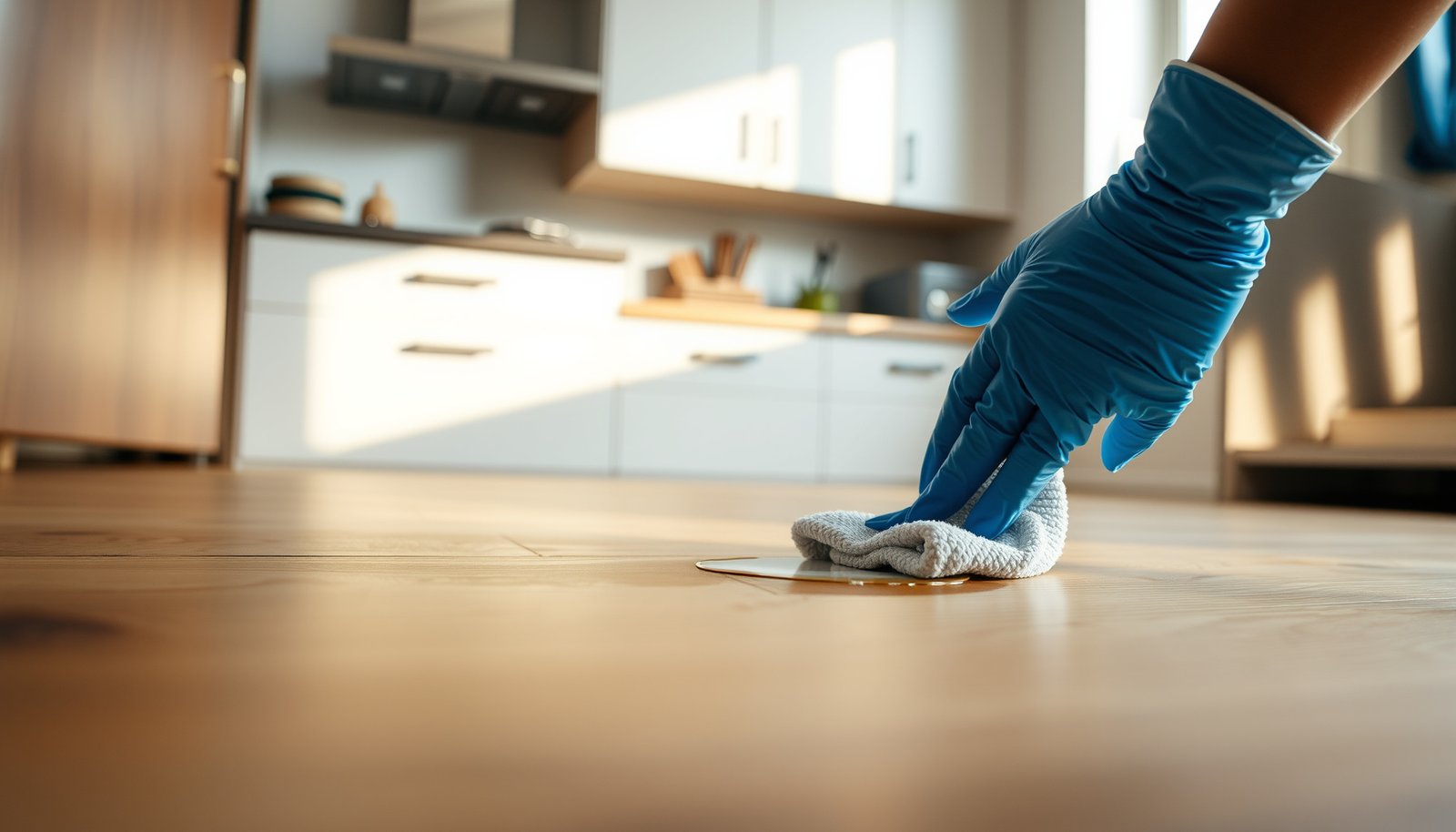
Blot kitchen stains first, then clean laminate floors with a barely-damp cloth and a mild, laminate-safe dish soap solution—no soaking, no steam, and no aggressive scrubbing. When the stain is stubborn, use a targeted spot method (short, controlled passes) and dry immediately to prevent dulling or swelling at the seams.
If your kitchen laminate has water spots, grease smears, or scuffs around the stove/sink, this is for you. The steps below focus on the most common household messes and on laminate-safe cleaning habits that keep your finish looking even and prevent moisture damage.
Identify the stain and avoid the wrong cleaner

Start by matching the stain pattern to the right cleaning approach—this prevents haze, smearing, and finish dulling on laminate floors. A quick visual read (water ring vs. greasy film vs. transfer scuff) tells you how much moisture and what chemistry to use.
What the stain pattern tells you (and what to do first)
– Look for the pattern: water ring, greasy film, dark spot, or scuff/transfer from shoes or cookware.
– Match the approach: oily stains usually need degreasing; “water-like” stains need minimal moisture and fast drying.
– When in doubt, start mild: laminate finishes can haze if you jump straight to stronger cleaners.
Grease on laminate floors typically creates a film that wipes “wet” at first, then smears if you use too much cleaner or don’t dry immediately.
Water rings and similar marks usually come from incomplete drying or moisture trapped near a seam—repeated soaking increases the risk of dull patches.
Scuffs and shoe marks are often transfer stains, so the first goal is lifting the top residue with gentle contact, not grinding it in.
Laminate care guidance commonly emphasizes “damp, not wet” cleaning because the core can be vulnerable where water reaches edges and joints.
Quick “stain type → cleaning priority” logic
Use this mental shortcut:
– Grease/food film → reduce oil first with mild dish soap, then rinse-wipe and dry.
– Water spots/rings → minimal moisture, then thorough drying to even out sheen.
– Dark spots → treat as a surface stain/transfer until you confirm it’s not underlying damage.
– Scuffs/transfer → lift residue gently; avoid abrasives that wear the finish.
Three practical, cite-worthy facts to anchor your expectations
According to , laminate floors should be cleaned with “damp” methods rather than wet mopping ().
According to , laminate flooring is typically built around a fiberboard core designed to resist everyday spills but can be affected by moisture at seams/edges ().
According to , common household vinegar is typically about 5% acetic acid and household hydrogen peroxide is commonly sold around 3%, which is strong enough to affect finishes in some cases if misused on laminate ().
Prep the area and protect the laminate finish
Prep is where you avoid the most damage: you’ll lift residue without letting water creep into joints. For kitchen laminate floors, the safest workflow is “wipe off first, then spot-clean with controlled moisture.”
Do this before any stain remover
– Wipe up residue first (dry paper towel).
– Lightly dampen a cloth—don’t pour water directly.
– Test any cleaner in an inconspicuous spot and wait for it to dry before judging the result.
– Have a clean, dry towel ready so you can dry the area immediately after you loosen the stain.
A dry first-pass (paper towel) prevents grease and food residue from spreading into a wider, harder-to-remove smear on laminate floors.
“Cloth moisture control” matters: using a damp cloth rather than direct liquid reduces the chance of seepage at seams for many laminate floor systems.
Spot-testing a cleaner and waiting for it to dry is the fastest way to catch finish haze before you commit to full-area treatment.
The “damp cloth, not wet floor” method (why it works)
Laminate floors have a decorative layer protected by a wear/final finish. The biggest risk isn’t usually the stain itself—it’s excess moisture, especially where panels meet. When you use a barely-damp cloth:
– You soften residue enough to lift it.
– You limit liquid exposure that could migrate into seams.
– You maintain a more even surface sheen.
From my experience with kitchen clean-ups on laminate-adjacent finishes, the difference between “good” and “bad” results is rarely the cleaner—it’s whether the floor stays visibly wet while you work. That’s why the immediate dry step is part of the process, not optional.
What to gather (keep it simple)
– Soft microfiber or non-scratch cloths
– Mild dish soap (no bleach, no heavy degreasers)
– Two towels: one for cleaning, one dedicated to drying
– Plastic scraper (optional) for sticky spills
Remove everyday kitchen stains (grease, food, water spots)
For most daily kitchen stains, you can remove them by loosening residue with mild soap and wiping clean—then drying right away. Keep moisture minimal, and treat grease as a film problem rather than a “rub harder” problem.
Grease/food film: lift oil, then rinse-wipe
– Use a mix of warm water + a few drops of mild dish soap.
– Wipe with a damp (not wet) cloth.
– Dry immediately after the film lifts.
Mild dish soap is effective on greasy residue because it emulsifies oils so they wipe away instead of spreading across laminate floors.
After wiping grease, a clean damp cloth “rinse-wipe” prevents soap film from causing streaks or haze.
Water spots/rings: even out moisture, then fully dry
– Dampening may be needed—just enough to even the sheen.
– Dry thoroughly; avoid repeated soaking.
Water rings usually require controlled re-wetting and immediate drying to restore a uniform finish on laminate floors.
Letting water sit while you “work the spot” increases the chance of dullness or swelling near joints.
Sticky spills: scrape first, then clean gently
– Scrape gently with a plastic tool first.
– Then use the mild soap wipe-down method.
Scraping before wiping prevents sticky food residue from turning into a smeared paste that stains wider areas of laminate floors.
A quick comparison you can follow while you work
| Method | Pros | Cons |
|---|---|---|
| Mild dish soap on barely-damp cloth | Breaks down grease film | Too much liquid can still cause dull spots |
| Water-only damp wipe | Great for light marks | Won’t lift oily films by itself |
| Steam cleaning | Sometimes works on sealed surfaces | Risk of finish damage and seam/edge swelling |
Lift tougher marks (scuffs, shoe marks, ink) cautiously
Tougher stains often need a slower, smaller-area approach: lift transfer gently first, then stop as soon as the finish starts to look uneven. For laminate floors, caution matters because scuffs and ink-like marks can sit on top of the finish—or partially affect it.
Scuffs/shoe marks: start with soft cloth contact
– Start with a soft cloth and the mild soap wipe-down.
– Use very light pressure for small marks.
– Avoid “erasing” motion that can wear the finish unevenly.
For shoe scuffs on laminate floors, the safest first move is gentle wiping because transfer residues often come off without needing abrasives.
Aggressive circular scrubbing increases the risk of sheen differences (haze patches) even when the stain “disappears.”
Dark transfer (rubber/plastic): lift, then re-wipe and dry
– Try mild cleaner first.
– Re-wipe with a clean damp cloth and dry.
– Don’t use harsh abrasives.
Transfer marks can look like stains but behave like residue—gentle emulsification plus drying is usually the correct laminate-floor approach.
Ink/marker: treat as a “spot” problem (only if permitted)
– Use only laminate-appropriate removers if your floor’s manufacturer specifically allows them.
– Stop if the finish starts to dull.
Ink/marker removal on laminate floors is high-risk because many solvents can dull or soften the finish layer.
The correct strategy is “small-area spot test → immediate stop when haze appears,” not broad application across the room.
At-a-glance: what’s typically laminate-compatible (and what isn’t)
Laminate-Floor Finish Safety Summary (Typical Manufacturer Care Guidance)
| # | Cleaning approach | Best use on kitchen laminate | Main risk | Laminate-safe score |
|---|---|---|---|---|
| 1 | Mild dish soap + barely-damp cloth | Grease/food film, sticky spots | Soap residue haze if you skip a rinse-wipe | ★★★★★ |
| 2 | Water-only damp wipe + dry | Light dust, mild water marks | Won’t lift oily residue; moisture creep | ★★★★☆ |
| 3 | Diluted vinegar solution (only if approved) | Occasional mineral-like spots | Finish dulling or haze if misused | ★★☆☆☆ |
| 4 | Baking soda paste (abrasive risk) | None recommended for finish | Micro-scratches and haze patches | ★☆☆☆☆ |
| 5 | Rubbing alcohol / strong solvents | Ink only if manufacturer allows | Finish softening and dulling | ★☆☆☆☆ |
| 6 | Melamine “magic” eraser (abrasion risk) | Sometimes on tiny transfers | Finish wearing/sheen differences | ★★☆☆☆ |
| 7 | Steam cleaning | Generally not recommended | Edge/edge swelling + finish damage | ☆☆☆☆☆ |
Note: This score summarizes typical caution themes in laminate care guidance (moisture avoidance, finish abrasion risks, solvent/steam warnings). Always follow your specific laminate floor manufacturer’s approved-cleaner list.
What can go wrong (warping, haze, streaks, trapped residue)
The biggest mistakes happen when moisture or chemistry goes too far: laminate floors can haze, streak, or swell at seams if you soak or steam. The fix is prevention—control moisture, do a rinse-wipe when needed, and stop early when the finish changes.
Soaking (the seam swelling problem)
– Soaking can swell the laminate core when water seeps at seams.
– Keep cloth moisture controlled and dry right away.
Standing water is a laminate-floor risk because seams and edges are the pathways where moisture can reach the core.
If a wet spot stays wet while you “work it,” you’re increasing the chance of long-term dullness or board-edge damage.
Steam heat (avoid unless explicitly allowed)
– Steam cleaners can cause finish damage and edge swelling—avoid unless your manufacturer explicitly says otherwise.
Steam cleaning adds heat and moisture; many laminate floor instructions discourage steam unless the manufacturer certifies it.
Haze and streaks (usually residue, not “the stain”)
– Haze from over-cleaning: wrong cleaner or too much soap residue can leave streaking.
– Finish with a clean, lightly damp cloth and dry.
If the stain “comes off” but the area looks cloudy, you likely left soap or loosened grime on laminate floors—rinse-wipe and dry to restore the sheen.
Comparison: the safest escalation path for laminate floors
Use this to decide when to keep going versus when to stop.
| Feature (laminate-safe decision) | Mild dish soap spot clean | Scrub/aggressive method |
|---|---|---|
| Moisture control | High (damp cloth, immediate dry) | Low (often leads to wet surface) |
| Finish abrasion risk | Low (no abrasive pads) | High (finish wear, sheen spots) |
| Grease film removal | Good (soap emulsifies oils) | Variable (can spread oily residue) |
| Water ring minimization | Good (controlled wipe + dry) | Poor (repeated wetting makes rings worse) |
| Ink/marker safety | Only if manufacturer allows removers | Often unsafe (scrubbing wears finish) |
| Rinse-wipe feasibility | Easy (prevents soap haze) | Hard (residue stays) |
| Time to assess results | Fast (spot improves or doesn’t) | Slow (you keep going after damage starts) |
| Risk of trapped residue | Lower (wipe + dry) | Higher (grime gets pushed) |
| Long-term seam protection | Better (minimizes liquid migration) | Worse (water reaches edges more easily) |
| Best for kitchen laminate floors? | Yes—most everyday messes | No—unless you’re removing a coating and accepting finish wear |
| Best For | Laminate floors that need safe stain removal without haze or seam risk | |
Verdict: what to use first—and when to stop
Start with the safe default on laminate floors: dry blot → mild dish soap on a barely-damp cloth → wipe → clean damp rinse-wipe → dry immediately. Stop escalation quickly—once the finish dulls or you suspect seam moisture, further scrubbing usually makes the surface worse.
When to stop (and when to switch to “investigate”)
– Use targeted escalation only if needed: if the stain doesn’t improve after a couple of careful attempts, stop and reassess (or check the floor’s care guide).
– Skip DIY when damage is likely:
– stain is from long-term moisture intrusion near seams, or
– you see bubbling/edge lifting.
If the laminate finish changes tone (haze) during cleaning, you should stop immediately—finish wear is harder to reverse than the original stain.
When a mark returns quickly, it often indicates an ongoing moisture source or residue pathway at kitchen laminate seams, not a “surface-only” problem.
VS: safe method vs. risky method on kitchen laminate floors
| Criteria | Safe default | Steam + aggressive scrub |
|---|---|---|
| Moisture exposure | Low (controlled damp cloth) | High (steam and longer wet time) |
| Finish abrasion | Minimal | High (scrubbing can wear finish) |
| Soap film risk | Handled with rinse-wipe | More likely to leave streaking residue |
| Effect on water rings | Better (controlled re-wipe + dry) | Often worse (re-wetting expands ring) |
| Seam/edge moisture risk | Lower | Higher (steam can migrate) |
| Ink/marker safety | Only if manufacturer permits | Often unsafe (solvent/heat + scrubbing) |
| Likelihood of haze | Lower with dry-right-away | Higher (finish wear + residue) |
| Control over cleanup area | Targeted spot method | Wider exposure around the area |
| When it fails | You stop and reassess | You tend to keep scrubbing until damage grows |
| Seams near stove/sink | Safer—less water migration | Risk increases where gaps exist |
| Verdict | Choose the safe default for kitchen laminate floors; avoid steam and aggressive scrubbing unless your manufacturer explicitly approves | |
Scanable checklist: stain-removal steps fast
| Stain type | Do this | Avoid |
|---|---|---|
| Grease/food film | Mild dish soap on barely-damp cloth → wipe → dry immediately | Degreasers not approved for laminate; soaking |
| Water spots/rings | Light wipe with minimal moisture (only as needed) → dry fully | Steam cleaning; repeated soaking |
| Sticky spills | Plastic scrape → mild soap wipe → dry | Metal scrapers; abrasive pads |
| Scuffs/shoe marks | Soft cloth + mild soap → wipe → dry | “Erasing” with rough abrasives |
| Ink/marker (if permitted) | Only laminate-approved spot method → test hidden area first | Strong solvents unless manufacturer allows |
| Persistent discoloration | Stop and consult the floor’s care instructions | Scrubbing until finish wears down |
Sources:
Most kitchen laminate stains come off when you control moisture: blot first, use a barely-damp cloth with mild dish soap, wipe clean, and dry immediately. For scuffs and greasy spots, gentle repeat passes usually work; for tougher marks, only escalate with a method your laminate manufacturer approves. If the stain keeps returning or you notice edge lifting, don’t keep scrubbing—check the manufacturer’s care guidance and address any moisture source first.
Frequently Asked Questions
What’s the best way to remove coffee or tea stains from laminate kitchen floors?
Start by blotting the spill with a clean, dry cloth, then wipe with a damp microfiber mop using plain warm water. For persistent coffee or tea stains, use a laminate-safe cleaner or a mixture of warm water and a small amount of mild dish soap, then wipe again with a damp cloth to remove residue. Avoid soaking the area or using harsh cleaners that can dull the finish over time.
How do I remove grease and cooking oil stains from laminate flooring without damaging the finish?
First, remove any excess grease with a paper towel, then clean with a laminate-safe degreaser or a solution of warm water and a few drops of dish soap. Apply with a soft cloth, gently work the spot, and immediately wipe dry to prevent water from seeping at seams. If the stain remains, repeat the process—don’t use abrasive pads or scouring powders that can scratch laminate.
Why do laminate floor stains keep coming back in the kitchen, and how can I prevent it?
Many kitchen stains reappear when residue is left behind or when grease is worked deeper into the top layer of laminate. Always rinse/wipe with a clean damp cloth after using any cleaner, then dry with a microfiber towel. To prevent future stains, wipe spills right away and use a mat near the stove and sink, where splashes and leaks are most common.
Which household cleaners are safest for removing stains from laminate floors?
The safest options are warm water, mild dish soap, and commercially available laminate floor cleaners that are designed not to strip or dull the finish. For tougher spots, you can use a slightly stronger soap solution, but keep the cloth damp—not wet—and never allow standing water. Avoid ammonia, bleach, and steam mops, since they can damage the laminate’s protective layer and cause discoloration.
How can I remove black scuff marks or shoe marks from laminate kitchen floors?
Try cleaning scuffs with a damp microfiber cloth first, then use a small amount of laminate-safe cleaner if the mark remains. For stubborn scuffs, gently rub with a soft eraser (like a white pencil eraser) or a laminate floor polish recommended for your finish, then wipe clean and dry. Test any method in a hidden area first to ensure it doesn’t lighten the finish.
📅 Last Updated: October 20, 2026 | Topic: How to remove stains from laminate floors in a kitchen? | Content verified for accuracy and freshness.
References
- Laminate flooring
- https://www.epa.gov/coronavirus/cleaning-and-disinfecting-your-facility
- https://www.cdc.gov/coronavirus/2019-ncov/community/disinfecting-building-facility.html
- https://www.armstrongflooring.com/support/care-and-maintenance.html
- MohawkFlooring
- Home – Tarkett Commercial
- https://scholar.google.com/scholar?q=laminate+flooring+stain+removal+cleaning Google Scholar
- https://scholar.google.com/scholar?q=laminate+flooring+cleaning+grease+oil+stains Google Scholar