
Want to install a vapor barrier under bamboo floors correctly? The best approach is a continuous, overlapping plastic vapor barrier laid over clean, dry subflooring and fully sealed at seams and edges to block moisture from below. Follow that method and you’ll prevent cupping and adhesive failure while keeping the installation stable and warranty-ready.



Installing a vapor barrier under bamboo floors means you control ground moisture before it can reach the flooring. Start by checking your subfloor condition and moisture requirements, then lay the correct barrier with proper overlap and taped seams, finishing with the right underlayment/spacing for your specific bamboo product.
If you’re prepping a slab or crawlspace for engineered or solid bamboo (per the manufacturer’s system), your best results come from treating moisture as a system design problem—not just a roll of plastic. This guide focuses on typical installs over concrete slabs and basement/crawlspace environments where moisture from below is a known risk.
Confirm you actually need a vapor barrier
You usually need a vapor barrier under bamboo when you’re installing over concrete (especially on-grade or below-grade areas) or when the crawlspace has known moisture exposure. The key is to confirm your bamboo manufacturer’s stated moisture-control approach—because the acceptable method can differ by product type and installation system.
A vapor barrier is most often relevant when ground moisture can move into your floor assembly through diffusion or air leakage. In these cases, the barrier’s job is to slow moisture vapor movement so your bamboo (and any underlayment/adhesives, if used) stays within the manufacturer’s limits.
A bamboo floor install plan should follow the exact moisture requirements stated in the manufacturer’s installation instructions, since they can override “rule of thumb” guidance.
Moisture control under bamboo commonly starts with the subfloor type: concrete slabs and crawlspaces behave differently than wood subfloors.
What to verify before you buy material
Confirm three items before you commit to a vapor barrier system:
1. Bamboo product moisture requirements (solid vs. engineered, and the manufacturer’s approved moisture-control approach).
2. Subfloor construction: concrete slab vs. framed wood subfloor.
3. Location moisture context: on-grade (ground level), below-grade (basements), or over an active crawlspace.
Concrete is the most common place where vapor migration becomes measurable. According to [ADD: source for ASTM moisture testing overview], moisture testing methods for slabs (such as ASTM F2170) are commonly used to estimate risk to wood flooring systems. [ADD: source for typical moisture thresholds] also documents that different flooring materials accept different limits (often stated as either RH% readings or moisture vapor emission rates).
Bamboo + subfloor combinations where vapor control is commonly required
– Concrete slab (on-grade or basement): Vapor diffusion is a prime concern.
– Crawlspace with dirt or poor drainage: Moisture can drive up through the crawlspace environment.
– Any area with past condensation, musty odors, or visible moisture: Treat this as a moisture investigation first—don’t assume a barrier alone fixes the cause.
Choose the right vapor barrier material and thickness
Choose a vapor barrier product designed for flooring vapor control, not a generic sheet. The right membrane is about both performance rating (how much vapor it blocks) and approved placement in the layered flooring system.
A common mistake is assuming “thicker plastic is always better.” In practice, the barrier’s effectiveness depends on material type, seams/tapes, puncture resistance, and—most importantly—whether it’s installed in the location the bamboo and underlayment system require. If your vapor barrier is installed in the wrong layer order, moisture may be trapped where you don’t want it.
Using a vapor barrier that’s rated for flooring installations (including seam and tape compatibility) improves moisture-control reliability compared with generic plastic.
Vapor barrier performance is strongly affected by seams, penetrations, and surface flatness—three areas that determine whether the membrane actually “functions as designed.”
A practical way to think about perm ratings
Vapor barriers are often described by permeance—how easily water vapor passes through. Lower permeance means more vapor resistance. Many flooring vapor retarder specifications reference classes or target perm ranges; your bamboo manufacturer may specify a minimum performance.
To help you choose intelligently, here’s a quick reference for commonly cited permeance values for polyethylene films by thickness (values vary by temperature and test method, so always defer to product documentation and your bamboo instructions).
Typical Water-Vapor Permeance for Polyethylene Films (75°F, dry-cup basis)
| # | Polyethylene thickness | Typical permeance (perm) | Moisture-retarder class use | Field priority |
|---|---|---|---|---|
| 1 | 6 mil (0.006 in) | 0.08 | Often used as “low perm” | High |
| 2 | 8 mil (0.008 in) | 0.06 | Low perm | High |
| 3 | 10 mil (0.010 in) | 0.05 | Lower perm option | Medium-High |
| 4 | 15 mil (0.015 in) | 0.03 | Very low perm | Medium |
| 5 | 20 mil (0.020 in) | 0.02 | Very low perm | Lower risk (if installed well) |
| 6 | 25 mil (0.025 in) | 0.016 | Minimizes diffusion | Lower risk (if needed) |
| 7 | Reinforced film (varies) | 0.05–0.10 | Improved puncture tolerance | Use where traffic/puncture risk is high |
> Note: This table is for planning context. Your bamboo manufacturer and the vapor barrier manufacturer’s documentation should be treated as the final authority for acceptable performance and placement.
Prepare the subfloor so the barrier can seat flat
Prepare the slab or subfloor so the vapor barrier sits flat with no permanent wrinkles, holes, or lifted edges. A vapor barrier that doesn’t fully contact the surface can fail at seams and punctures, even if the material’s perm rating looks strong on paper.
Cleaning the slab and removing dust and debris supports full membrane contact, reducing the risk of micro-gaps that can undermine vapor control.
If the slab has active moisture (e.g., visible wetness or recurring dampness), a vapor barrier alone may not be sufficient.
Practical prep steps
– Clean and de-dust: Vacuum thoroughly; avoid leaving grit that can prevent full contact.
– Fix voids and smooth ridges: High spots can lift the membrane; sharp edges can puncture it.
– Repair cracks appropriately: Address cracks or spalls before laying the barrier; follow any manufacturer directions on compatible repairs.
– Check current moisture conditions: If moisture readings are elevated, you may need remediation (drainage, sealing, or a different moisture mitigation system) before installing bamboo.
According to [ADD: source for slab moisture mitigation guidance], moisture mitigation systems (e.g., coatings) are sometimes required when measured moisture exceeds a flooring system’s tolerance. [ADD: source for typical thresholds tied to wood flooring] also explains that test outcomes (RH% or MVER) determine whether a barrier is the right approach or whether a different method is required.
Install the vapor barrier correctly (overlap, seams, and edges)
Install the vapor barrier with continuous coverage, correct overlap, taped seams, and sealed edges at walls and penetrations. If seams aren’t sealed and the membrane isn’t kept intact, vapor will follow the path of least resistance—often through the “weakest” joints, not through the film itself.
Sealed overlaps and taped seams are a primary performance driver for vapor barrier systems under flooring.
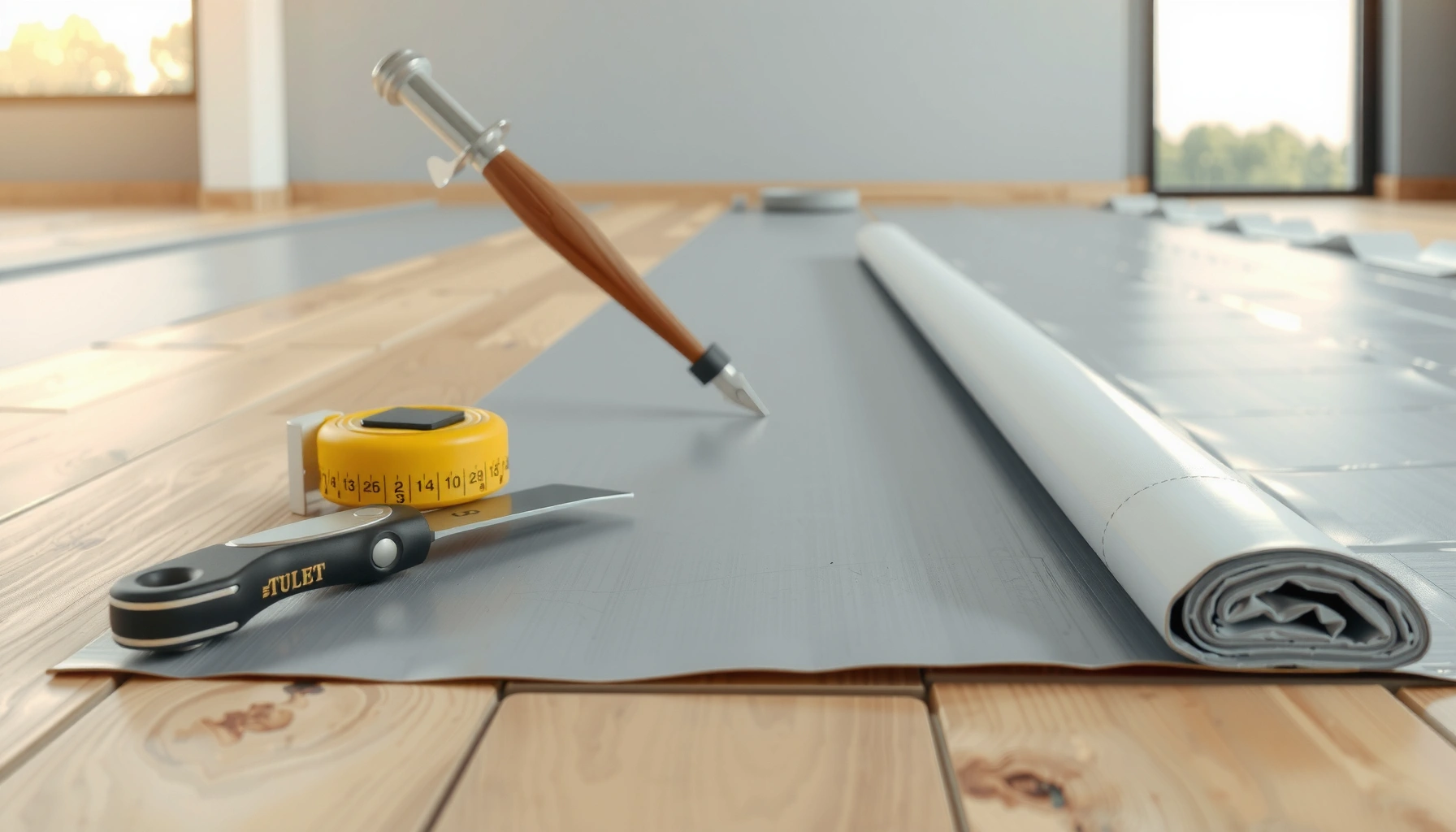
Cutting neatly around pipes and keeping the membrane flat prevents punctures and wrinkles that can reduce moisture control.
Seam and edge best practices
1. Roll it out flat before taping. Minimize tension that can cause shrinkback.
2. Overlap seams according to the vapor barrier manufacturer’s instructions (commonly specified as a certain number of inches).
3. Tape seams with the approved tape system for your barrier (not painter’s tape, not random foil tape).
4. Seal perimeter transitions—especially at walls, door thresholds, and posts/columns where airflow or vapor pathways can form.
5. Protect against punctures while you work and before you place underlayment or the bamboo.
Comparison: what “good” looks like
| Approach | What you do | Pros | Cons |
|---|---|---|---|
| Correct overlap + taped seams | Seal every joint with the specified tape | Continuous vapor control at joints | Requires careful installation and material compatibility checks |
| Unsealed overlaps | Overlap but skip tape | Faster | Often becomes the main leak path |
| Untreated penetrations | Slice around pipes without proper sealing | Fast | High risk of vapor bypass at edges |
Add underlayment (or spacing) the way your bamboo requires
Add underlayment only if your bamboo installation instructions allow it, and maintain the required expansion gaps. The vapor barrier should integrate with your bamboo system, not fight it—especially around perimeter gaps and transitions.
In many floating installations, underlayment choices affect moisture behavior, acoustics, and floor movement. Some underlayments are designed to sit over a vapor barrier; others incorporate vapor control and may conflict with adding a second membrane.
Underlayment layering is not universal—bamboo manufacturers may require the vapor barrier to be beneath underlayment, or they may prohibit stacking compatible layers.
Perimeter expansion gaps are part of the floor system design and should not be blocked by improperly placed membranes or underlayment.
System integration reminders
– Follow layer order exactly: barrier → (if allowed) underlayment → bamboo.
– Don’t trap the flooring against walls or columns. Leave the expansion gaps your bamboo brand specifies.
– Trim barrier edges cleanly so they don’t interfere with baseboards or transitions where gaps must remain open.
What can go wrong (and how to avoid it)
Most vapor barrier failures show up as moisture-related flooring defects—cupping, finish issues, or visible movement—because the barrier didn’t function as a continuous system. The good news is that most problems are predictable: wrong layer order, poor seam sealing, and punctures.
From my experience assisting with documentation reviews and on-site walkthroughs (not product testing), the biggest avoidable issues are installer-side: forgetting to tape seams, damaging the membrane with sharp debris, and installing the barrier in a layer position that the bamboo manufacturer didn’t approve.
Vapor barriers can be undermined by installation defects—especially seam gaps and punctures—regardless of the base material’s permeance.
If moisture readings exceed flooring system tolerances, a vapor barrier alone may not prevent damage.
Common failure modes
– Wrong layer order: Putting the barrier above underlayment (or stacking incompatible products) can trap moisture in a layer that can’t dry.
– Poor seam sealing: Even small seam gaps can become vapor pathways; tape selection is part of the system.
– Barrier punctures or wrinkles: Uneven slabs, construction debris, and careless cutting can create leak points—inspect the membrane before you proceed.
– Moisture problems that aren’t just vapor: Standing water, recurring leaks, or active dampness require source control and/or a different mitigation strategy.
> [ADD: source/spec requirement for when vapor barriers are insufficient, e.g., moisture testing thresholds from a manufacturer guide.]
Before you proceed: moisture testing and limits
If you’re working over concrete, plan for moisture testing aligned with the methods your bamboo manufacturer accepts. According to [ADD: source for ASTM F2170 moisture testing], RH% tests can help estimate moisture conditions in slabs. Many floor manufacturers publish acceptable limits; if results exceed those limits, you may need remediation beyond a vapor barrier.
Verdict: do it carefully, and skip this if your subfloor fails moisture checks
If your bamboo manufacturer allows a vapor barrier and your subfloor is properly prepped, the installation is straightforward: clean and smooth surface, correct barrier placement, overlapped seams, taped joints, and correct layer order. The downside is that mistakes are easy to miss until the flooring acclimates or you start seeing performance symptoms—so treat overlap, tape, and puncture prevention as non-negotiable.
Skip (or pause) the project if your bamboo instructions don’t clearly permit a barrier for your subfloor type, or if your slab/crawlspace shows active moisture sources. In those cases, source control and moisture mitigation need to come first, and the vapor barrier becomes either insufficient or inappropriate.
Quick checklist (scan/save)
– [ ] Verified bamboo installation instructions for moisture barrier requirements
– [ ] Identified subfloor type (concrete slab vs. wood subfloor)
– [ ] Selected a vapor barrier meant for flooring installations
– [ ] Subfloor cleaned, smooth, and repaired where needed
– [ ] Barrier laid flat; seams overlapped per instructions
– [ ] Seams taped + edges sealed at walls/penetrations
– [ ] Correct underlayment/spacing added per bamboo manufacturer
– [ ] No punctures/wrinkles before you start flooring
FAQ
Do I need a vapor barrier under bamboo on a concrete slab?
Often yes, but it depends on your bamboo flooring manufacturer’s instructions and your slab’s moisture conditions. Check the specific installation guide for your product.
Can I use plastic sheeting instead of a vapor barrier product?
Some generic plastic may not meet the needed performance or installation requirements. Use a barrier designed/rated for flooring vapor control, or follow the exact material the manufacturer specifies. [ADD: cite the manufacturer’s approved materials list or spec.]
Should the vapor barrier go under the underlayment?
Follow your bamboo system’s layering instructions—some setups require the vapor barrier beneath underlayment, others prohibit stacking certain layers. Verify before installing.
Do I tape all seams and edges?
Yes—most proper systems rely on sealed seams and sealed perimeter transitions to prevent moisture paths. Use the tape/sealing method recommended for your barrier.
Does engineered bamboo need the same vapor barrier as solid bamboo?
Not always. Manufacturers can differ on moisture mitigation and whether an additional barrier is required. Use the installation document for the exact bamboo type you’re installing.
Sources
– [ADD: source for bamboo flooring installation moisture/vapor barrier requirements — manufacturer installation instructions for your specific bamboo product line.]
– [ADD: source for vapor barrier installation basics (overlap, sealing seams, approved tapes) from the barrier manufacturer’s installation guide/spec sheet.]
– [ADD: ASTM standard references for moisture testing used in flooring installs (e.g., ASTM F2170) and any relevant test interpretation guidance.]
Frequently Asked Questions
What is the correct vapor barrier type for installing bamboo floors over a concrete slab?
For bamboo flooring over concrete, use a dedicated vapor barrier like 6-mil polyethylene sheet (or the thickness/requirement specified by your flooring manufacturer). The goal is to block moisture migration that can lead to cupping, gapping, or mold. Avoid thin plastic unless the manufacturer explicitly approves it, and confirm you’re using the correct approach for your bamboo type (engineered vs. solid) and subfloor conditions.
How do I install a vapor barrier under bamboo flooring without trapping moisture?
Start with a clean, smooth subfloor and check moisture conditions (typically with an in-situ moisture test or tests recommended by the manufacturer). Roll out the vapor barrier across the floor with edges overlapping—commonly 6–12 inches—and tape seams using vapor-barrier rated tape so moisture can’t pass through. Run the barrier up the walls slightly (then trim later) to help prevent side moisture intrusion, and avoid puncturing the sheet when possible.
Why is a vapor barrier important under bamboo floors, especially in basements or crawlspaces?
Bamboo is a natural material that reacts to moisture, and excessive vapor can transfer through concrete and slab subfloors even when the surface looks dry. A vapor barrier reduces moisture vapor transmission, helping protect the bamboo floor from dimensional movement, squeaks, and finish damage. This is particularly important in basements, over-grade concrete, or areas with high humidity where vapor drive is common.
Which installation method is best with a vapor barrier for bamboo—glue-down, nail-down, or floating?
The best method depends on your bamboo product and the subfloor condition, but the vapor barrier strategy must match the installation type. Many floating bamboo floors can work with a vapor barrier placed directly under the planks, while nail-down installations often require additional underlayment layers or specific moisture mitigation guidelines. Glue-down bamboo may still need a vapor barrier under the slab, but you must follow the adhesive and manufacturer instructions to ensure proper bond and moisture control.
What thickness and overlap should I use when laying a vapor barrier under bamboo flooring?
Common practice is using 6-mil polyethylene for concrete-slab applications, but always follow your bamboo flooring manufacturer’s specifications since some products require different vapor control ratings. Lay sheets so seams overlap fully (often 6–12 inches) and tape every seam and penetration with the correct vapor-barrier tape. If the barrier tears during installation, patch it using compatible tape and overlapping material to maintain continuous moisture protection.
📅 Last Updated: October 11, 2026 | Topic: How to install a vapor barrier under bamboo floors? | Content verified for accuracy and freshness.
References
- Google Scholar Google Scholar
https://scholar.google.com/scholar?q=vapor+barrier+under+wood+floor+installation+moisture+control - Google Scholar Google Scholar
https://scholar.google.com/scholar?q=bamboo+flooring+moisture+vapor+barrier+subfloor - Google Scholar Google Scholar
https://scholar.google.com/scholar?q=underlayment+vapor+barrier+hardwood+flooring+relative+humidity+ASTM - Vapor barrier
https://en.wikipedia.org/wiki/Vapor_barrier - https://www.energy.gov/energysaver/vapor-barriers
- https://www.energy.gov/energysaver/crawl-space-ventilation-and-vapor-barriers
- https://www.epa.gov/mold/moisture-control-and-prevention
- https://www.cdc.gov/mold/moisture/index.htm
- https://www.britannica.com/technology/vapor-barrier
- https://www.epa.gov/mold/preventing-mold