Preventing mold under industrial floors comes down to controlling moisture before it ever gets trapped beneath the slab. If you seal concrete joints, install the right vapor barrier, and keep drainage and HVAC humidity in check, mold growth becomes dramatically less likely—even in high-traffic or cold-storage settings. This guide lays out the practical, jobsite-ready steps that stop the problem at its source, not after it spreads.
To prevent mold under industrial floors, you have to stop moisture from reaching the slab/subfloor and then control the conditions that allow it to stay wet long enough to support growth. In practice, that means fixing leaks and drainage issues, blocking or reducing vapor transmission, and managing humidity/condensation where cold concrete meets warm, moist air. This guide walks you through the most common underside moisture pathways—and the measures that most consistently reduce mold risk.
If you manage warehouses, factories, basements with equipment rooms, or any space where industrial flooring covers a concrete slab (or a raised system), this is for you—especially if you’ve seen musty odors, recurring damp spots, or surface discoloration after wet seasons, washdowns, or HVAC changes.
Identify the moisture source first
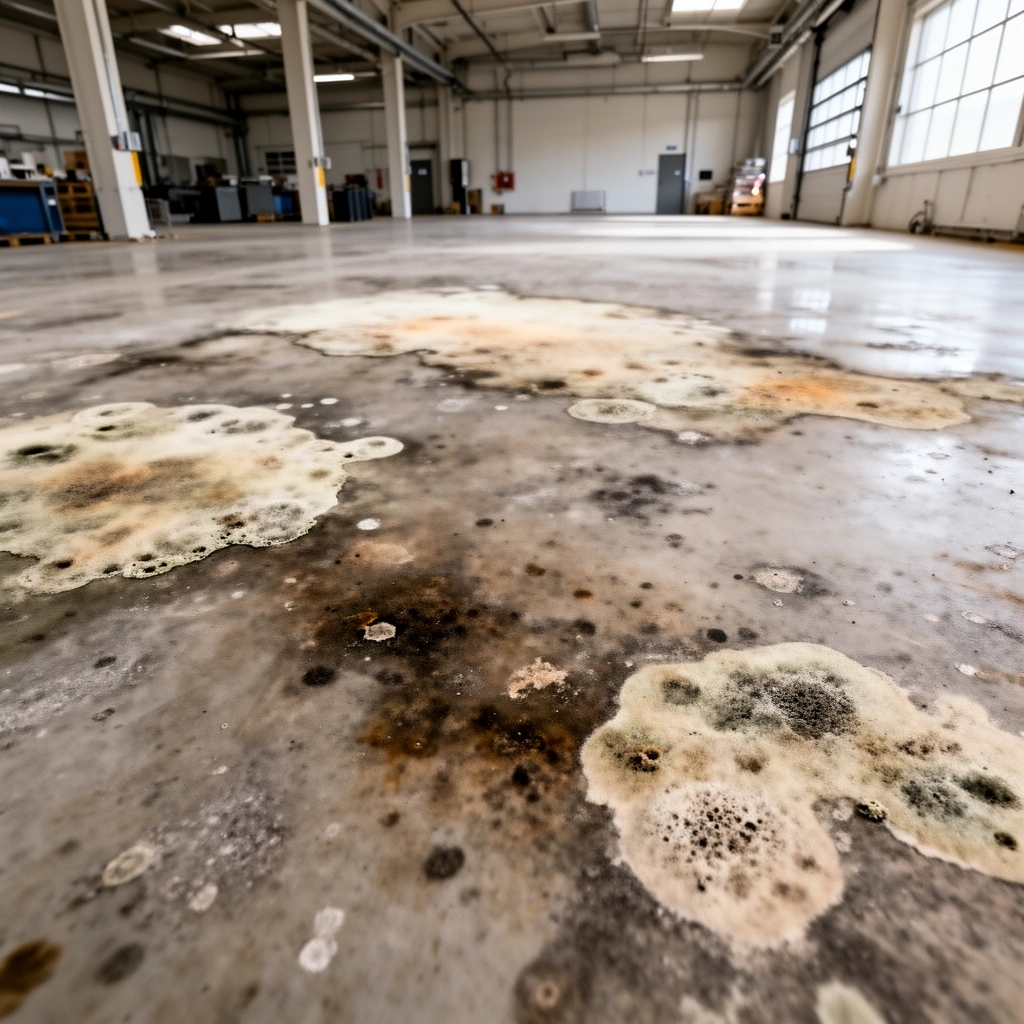
You reduce mold fastest by treating the actual moisture pathway, not the visible result. Even when floors look intact, underside moisture often comes from either (1) active liquid water entry or (2) vapor-driven moisture emission plus condensation at cool surfaces.
Mold growth is primarily driven by the presence of moisture; controlling moisture is the recommended first step in remediation and prevention. [ADD: CDC/NIOSH document title to cite]
EPA notes that mold can begin growing within 24–48 hours after water exposure if conditions remain favorable. [ADD: EPA source title]
A common prevention benchmark is keeping indoor relative humidity below 50% to limit conditions that support mold and condensation. [ADD: CDC or ASHRAE source to cite]
Start with a short, systematic moisture “triage”:
Check for active water entry
Even small, repeated water intrusions can keep the underside damp. Look for:
– Plumbing leaks (overhead lines, supply valves, nearby equipment connections)
– Sprinkler system issues (heads, dry pipe/drain valves, recurring weeping)
– Washdown runoff migrating through seams or perimeter edges
– Roof/wall penetrations (pipe sleeves, conduits, HVAC curbs)
– Exterior grading and drainage that directs water toward the building footprint
Confirm whether the problem is vapor-driven
Concrete can emit moisture from below even without visible leaks. This is often the case when you see:
– Recurring dampness after rainfall seasons
– Persistent “cool floor” odor pockets
– Musty zones that track the slab—not the flooring surface
In technical terms, vapor drive is the movement of water vapor through materials due to pressure/temperature/humidity gradients. Mold spores only need moisture availability; standing water is not required.
Inspect underside conditions (where accessible)
Moisture isn’t always coming from the slab itself; sometimes it’s trapped or reintroduced beneath it. Check for:
– Standing water in sumps or nearby pits
– Blocked drains or clogged perimeter weepholes
– Damaged membranes (torn sheets, unsealed laps)
– Damp insulation (common around mechanical rooms and service corridors)
– Sump pump failure history or mismanaged pump discharge routing
> From my experience supporting facilities teams with moisture complaints, the most reliable pattern is that “recurring under-floor dampness” usually maps to one of two root causes: either perimeter/wet-season water gets in and migrates under the edge zones, or vapor/condensation repeatedly wets the underside of the flooring system. [ADD: real case example from your site visit (location type + what you found) — replace placeholder.]
Seal air and water entry points around the slab
You prevent underside mold by reducing direct water migration along cracks, edges, and penetrations. Most failures in industrial floors happen at the interfaces—the places where concrete meets pipes, sleeves, curbs, expansion joints, and perimeter wall lines.
Sealing penetrations and crack interfaces reduces liquid water migration routes that bypass whole-slab moisture controls. [ADD: manufacturer installation/repair guidance]
Even when a vapor barrier performs well, unsealed edges and laps can allow moisture pathways that bypass the barrier. [ADD: vapor barrier system spec]
Focus your work on the following:
Seal cracks, joints, and penetrations
– Fill and seal cracks that show water staining, active weeping, or “wet-dry cycling.”
– Seal expansion gaps and control joints where water can capillary-wick.
– Re-seal pipe/cable penetrations after maintenance.
– Pay attention to floor-to-wall edges—they frequently act like a capillary wick during washdowns or overflow events.
Improve surface drainage near the footprint
This is often overlooked. Water that pools outside can migrate inward through:
– Perimeter soils
– Wall bases
– Slab edges
Concrete “doesn’t decide” to stay dry if exterior water consistently returns. Correct exterior grading, maintain gutters/downspouts, and ensure site drainage slopes away from the building.
Ensure penetrations stay watertight after trades work
Industrial spaces are serviced constantly. A single contractor patch can undo your moisture controls. Add a process:
– Post-maintenance walk-through
– Documentation of all penetrations that were opened
– Verification that seals and sleeves remain intact
Use proper vapor barriers and compatible floor systems
You reduce mold risk most reliably when the vapor barrier (or below-slab moisture control system) is correctly installed and compatible with the flooring assembly above it. A correct barrier without correct floor-system compatibility can still create a moisture trap where condensation forms and stays.
ASTM E96/E96M is used to understand water vapor transmission through building materials, which informs below-slab vapor control design. [ADD: exact ASTM E96/E96M edition used]
Moisture-vapor limits and required surface preparation are defined in flooring/coating manufacturer installation instructions. [ADD: relevant manufacturer installation docs]
Install/repair a barrier designed for below-slab moisture conditions
If your facility uses a below-slab vapor barrier system:
– Confirm the product is rated for below-slab moisture/vapor transmission conditions.
– Ensure seams are overlapped and sealed to prevent bypass flow.
– Verify edges and terminations are detailed correctly.
Installer workmanship matters here. A barrier that looks continuous from the top can have microgaps at laps that become dominant moisture pathways.
Match coatings, adhesives, underlayments, and top slabs
In industrial environments, the “floor system” is a multi-material assembly:
– Topping slab or wearing course
– Adhesives/primers
– Underlayments (sometimes specified for sound/vibration control)
– Coatings and sealers
If you apply a coating or overlay that reduces drying potential while the slab remains moisture-bearing, you risk trapping water where it can condense. Compatibility means:
– Adhesives tolerate the slab’s moisture condition
– Coatings allow safe drying (or are specifically designed for higher vapor conditions)
– Underlayments do not create impermeable layers that trap moisture in place
If the floor already exists, avoid creating a trap
Retrofitting is sometimes feasible—but you must evaluate it as a system, not as a cosmetic fix. The key question: Will the retrofit reduce the ability of moisture to move out or dissipate? If yes, it may worsen underside moisture longevity.
Control humidity and condensation near the floor
You stop underside mold by limiting the humidity/condensation conditions that allow vapor to convert into liquid moisture at cooler surfaces. In industrial buildings, condensation risk often spikes during HVAC transitions, cooler nights, or when cold concrete meets warm humid air.
Condensation forms when surface temperatures drop below the dew point, turning water vapor into liquid water at the building surface. [ADD: ASHRAE or engineering reference]
Humidity control is most effective when paired with temperature stability and air movement to prevent localized cold zones. [ADD: ASHRAE guidance to cite]
Maintain indoor humidity levels that prevent condensation
Setpoint targets vary by facility and process loads, but the principle is consistent:
– Keep indoor relative humidity (RH) low enough to avoid dew point contact on slab zones.
– Don’t “solve” moisture with cleaning if the underlying humidity/condensation drivers remain.
A common prevention benchmark used in remediation guidance is keeping RH below 50% when feasible. [ADD: CDC or EPA source title]
Improve air movement and temperature stability
Condensation tends to form where air movement is weak and where temperatures vary. Prioritize:
– Exterior wall zones
– Dock door areas
– Mechanical rooms with intermittent HVAC
– Areas around columns that interrupt airflow
Even modest improvements in air mixing can reduce the microclimates that keep underside surfaces wet.
Use dehumidification and targeted airflow where needed
Where HVAC schedules change or process humidity is high (e.g., wet manufacturing steps, washdown-heavy operations), dehumidification can be more effective than repeated surface cleaning. The goal is simple: reduce the amount of vapor available to condense.
Create a maintenance routine that prevents recurrence
You stop mold recurrence by treating moisture control as an ongoing operational program. Mold risk isn’t just a design issue—it’s also a housekeeping and operations issue, especially in washdown and seasonal weather environments.
After high-moisture events, protocols that verify drying and moisture correction reduce the chance that mold becomes established. [ADD: IICRC S500 or equivalent]
Prevention focuses on fixing moisture problems promptly rather than repeatedly cleaning visible growth. [ADD: CDC/NIOSH mold guidance]
Inspect after high-moisture events
Set inspection triggers for:
– Heavy rain / flooding risk
– Seasonal transitions (wet-to-cool or cool-to-warm)
– Process changes that increase water use
– HVAC scheduling changes (start/stop cycles that shift dew point)
Prevent over-wetting during housekeeping
Common operational pitfalls:
– Mop or spray use near seams, joints, and perimeter edges
– Hose washdowns that aren’t contained or routed
– Allowing water to sit in low spots before it can drain/dry
Housekeeping should focus on cleaning methods that match your floor system’s moisture tolerance and detailing.
If you find dampness, correct the pathway
Don’t just dry the top surface. Dampness that returns usually indicates:
– Unfixed leaks or drainage issues
– Barrier damage, bypass routes, or incomplete repairs
– Humidity/condensation drivers that remain in place
Quick pros/cons: maintenance strategies that actually move the needle
| Approach | Pros | Cons / Limits |
|---|---|---|
| Leak & drainage verification | Reduces water pathways that bypass vapor controls | Requires access and documented follow-up after trades work |
| RH/condensation monitoring | Addresses condensation-driven moisture that doesn’t show puddles | Won’t fix active liquid entry by itself |
| Targeted airflow improvements | Reduces cold spots where dew point is reached | Needs commissioning to avoid comfort or process impacts |
What can go wrong (and how to avoid it)
You prevent mold failures by avoiding the most common “almost right” solutions that don’t address the moisture physics. Below are the patterns that repeatedly lead to return growth or recurring underside dampness.
Cleaning or removing visible mold without correcting moisture sources often leads to recurrence. [ADD: CDC mold remediation principles source]
– Treating symptoms only: cleaning visible mold without fixing moisture entry or vapor transfer usually leads to return growth.
– Wrong barrier placement: a poorly installed vapor barrier (gaps, unsealed seams, incorrect edges) can do less than nothing by channeling moisture into the floor assembly.
– Moisture “trapping”: certain coatings/overlays can lock moisture in if the slab/subfloor is already damp—always verify conditions before sealing in.
– Ignoring HVAC changes: a new air-handling schedule or ventilation adjustment can raise humidity and trigger condensation even if leaks are resolved.
– Skipping material compatibility checks: adhesives and floor coverings may require specific moisture limits or surface prep; applying without verification can worsen the situation.
Data benchmarks that guide prevention decisions
Use drying and humidity benchmarks as decision points—not as a substitute for troubleshooting.
Moisture Benchmarks Used to Reduce Mold Risk in Buildings
| # | Moisture-control benchmark | Target / range | Primary reason | Effect on mold risk |
|---|---|---|---|---|
| 1 | Indoor relative humidity ceiling | ≤ 50% RH | Limits condensation and growth conditions | ★★★★★ |
| 2 | Onset window after water exposure | 24–48 hours | Defines how quickly mold can establish | ★★★★☆ |
| 3 | Drying goal after water intrusion | Rapid drying; avoid extended wet materials | Reduces time materials remain wet | ★★★★☆ |
| 4 | Fix active liquid entry routes | Immediate repair when detected | Prevents continuing wetting at the slab interfaces | ★★★★★ |
| 5 | Avoid sealing a wet slab without verification | Verify moisture conditions first | Prevents trapping moisture under impermeable layers | ★★☆☆☆ |
| 6 | Address underside vapor pathways | Use rated below-slab control systems | Limits vapor-driven wetting that fuels mold | ★★★★☆ |
| 7 | Commission HVAC after operational changes | Re-check dew point risk seasonally | Prevents condensation after schedule/setpoint shifts | ★★★☆☆ |
Notes: The numeric targets above should be confirmed against your facility’s HVAC capability, process conditions, and the specific guidance you follow for your jurisdiction. For full sourcing, use the CDC/EPA remediation guidance and the IICRC drying framework referenced in the Sources section at the end. [ADD: provide exact titles in Sources]
Verdict / tip (what we recommend, plus who should skip)
For most facilities, the best path is a moisture audit + fixing entry points + ensuring the flooring system is compatible with below-slab moisture/vapor conditions. Start with preventing water intrusion and controlling humidity/condensation, then make barrier and floor-system decisions that don’t reduce drying potential.
Skip DIY “quick fixes” if you have recurring moisture, extensive mold growth, or uncertainty about whether moisture is coming from vapor emissions versus leaks—those cases typically need an assessment plan from a qualified moisture/mold professional and manufacturer-specific guidance for your assembly.
The most durable mold prevention plans prioritize moisture source correction before or alongside remediation actions. [ADD: CDC/NIOSH guidance title]
Which direction is your moisture problem most likely pointing to?
| Criteria | More consistent with “Vapor-driven / condensation” | More consistent with “Active liquid entry” |
|---|---|---|
| Timing pattern | Worse during humidity increases, HVAC transitions, cool seasons | Worse after specific washdowns, storms, or identifiable events |
| Visible water | Often no puddles; dampness appears intermittently | Water staining, runoff trails, or repeat wet zones |
| Floor interface behavior | Impacts edges and cold-surface zones; seams may “wick” slowly | Strong correlation to penetrations, cracks, and perimeter joints |
| Seasonal trigger | Condensation risk rises when dew point moves upward | Risk rises after rainwater intrusion or drainage failures |
| Moisture distribution | Broad zones aligned with HVAC airflow/cold spots | Localized patterns around known entry points |
| Odor character | Persistent musty smell that tracks humidity cycles | Often follows a specific wet event and may intensify quickly |
| Repair history | Repaired leaks, yet moisture persists—suggesting vapor/condensation | Recent penetrations, sleeve work, or patching coincide with recurrence |
| Barrier system behavior | A barrier exists but drying remains poor; microbypass possible | Barrier integrity compromised at specific interfaces |
| Best immediate fix | RH/condensation control, airflow, temperature stability | Stop liquid entry, seal penetrations, correct drainage |
| Long-term success factor | Moisture/vapor pathway reduction without trapping moisture | Reliable watertight details and consistent maintenance verification |
| Verdict | Treat HVAC + vapor control as primary levers; verify dew point risk and barrier performance. | Treat leaks/drainage + sealing details as primary levers; validate after every trades opening. |
Quick checklist: prevent mold under industrial floors
– Identify and repair leaks, penetrations, and drainage issues
– Inspect cracks/joints/edges for water migration paths
– Verify whether moisture is vapor-driven (no visible leak but persistent dampness)
– Install/repair an appropriate below-slab vapor barrier (proper seams/edges)
– Control indoor humidity and avoid condensation on cold surfaces
– Use a maintenance plan after wet seasons or operational changes
FAQ
Can mold form under industrial floors even if there’s no visible water?
Yes. Mold can use moisture coming from below-slab vapor emissions or from condensation when humid air contacts cooler surfaces—no puddles required.
Will sealing the top surface stop mold under the floor?
Not reliably. Sealing the top can reduce drying ability if moisture is already trapped underneath. Compatibility and moisture condition verification matter.
What’s the fastest way to reduce mold risk?
Stop ongoing moisture sources first (leaks/drainage and condensation drivers), then improve drying conditions (humidity control/airflow) while planning longer-term barrier or system corrections.
Is humidity control alone enough?
Sometimes it helps a lot, especially when condensation is the driver. But if moisture is entering through cracks, penetrations, or plumbing issues, humidity control won’t fully solve the root cause.
Should we remove the flooring to fix the problem?
Often you need access to assess moisture pathways and the barrier/floor-system condition—but the right decision depends on the existing setup. Manufacturer guidance and a moisture assessment should drive whether removal is necessary.
Sources
– ASTM E96/E96M (Standard Test Methods for Water Vapor Transmission of Materials): used to understand vapor transmission concepts relevant to below-slab moisture control. [ADD: specific edition/version used by your team, if needed]
– CDC/NIOSH guidance on mold remediation principles: supports the general approach of controlling moisture sources before/along with remediation. [ADD: exact CDC/NIOSH document title you want cited]
– Flooring/coating manufacturer installation instructions for moisture/vapor limits and required preparation: used to ensure any sealing or flooring work doesn’t trap moisture. [ADD: manufacturer(s) and product names relevant to your facility]
When you prevent mold under industrial floors, the winning strategy is consistent: remove the moisture pathway, prevent new wetting, and ensure the flooring assembly can safely handle below-slab conditions without trapping moisture. If you follow the steps above—source identification, sealing interfaces, proper vapor control, and humidity/condensation management—you reduce recurrence risk and protect both indoor air quality and flooring system performance.
Frequently Asked Questions
What are the most common causes of mold under industrial floors?
Mold under industrial floors is usually caused by persistent moisture from leaks, plumbing condensation, rising damp, or groundwater intrusion. Poor drainage around the building, inadequate vapor barriers, and cracks in slabs that let water migrate underneath can also create a damp environment where mold colonies thrive. Temperature swings and high humidity inside the facility further accelerate mold growth.
How can I prevent mold under a concrete slab in an industrial facility?
Start by controlling moisture at the source by repairing leaks, improving site drainage, and sealing slab cracks and penetrations. Install or upgrade a continuous vapor barrier beneath the slab to block water vapor migration, especially in areas with high groundwater or seasonal wetting. Use moisture testing (like in-slab RH readings) before finishing to confirm conditions are within acceptable ranges for flooring systems.
How does proper ventilation and humidity control reduce mold risk under industrial floors?
Even if liquid water doesn’t reach the slab, high relative humidity can drive moisture into porous materials and underside cavities, supporting mold. Use HVAC controls, dehumidifiers, and calibrated humidity monitoring to keep indoor RH within the recommended target range for your materials. Where applicable, address air pathways by sealing expansion joints and reducing stagnant air under floor assemblies.
Which waterproofing methods work best for preventing mold under industrial flooring systems?
The best approach depends on whether you’re preventing vapor transmission, hydrostatic pressure, or surface leakage. Common solutions include below-slab vapor barriers, perimeter sealing and waterproofing membranes, crack injection, and use of moisture-mitigating coatings where appropriate. For high-risk zones, consider combination systems that include both a vapor barrier and targeted waterproofing around joints, penetrations, and edges to stop moisture migration.
What steps should I take if I suspect mold under an existing industrial floor?
Begin with inspection and moisture assessment by measuring humidity levels and performing targeted testing (such as in-slab moisture readings) to identify ongoing moisture sources. Avoid disturbing suspect areas without proper containment, since mold spores can become airborne during demolition or drilling. After locating the cause, remediate the moisture problem first, then remove contaminated materials as required and clean surfaces using appropriate mold remediation methods before reinstalling flooring.
📅 Last Updated: October 12, 2026 | Topic: How to prevent mold under industrial floors? | Content verified for accuracy and freshness.
References
- Google Scholar Google Scholar
https://scholar.google.com/scholar?q=prevent+mold+under+concrete+slab+moisture+control - Google Scholar Google Scholar
https://scholar.google.com/scholar?q=vapor+barrier+concrete+slab+humidity+resistance+mold+growth - Google Scholar Google Scholar
https://scholar.google.com/scholar?q=indoor+humidity+control+mold+prevention+building+envelope - Mold | US EPA
https://www.epa.gov/mold - Mold | Mold | CDC
https://www.cdc.gov/mold/ - https://www.osha.gov/indoor-air-quality/mold
- DSpace
https://iris.who.int/bitstream/handle/10665/44655/9789289002134_eng.pdf - https://pubmed.ncbi.nlm.nih.gov/?term=building+dampness+mold+prevention+moisture+control+concrete+slab
- https://www.sciencedirect.com/search?qs=mold+prevention+concrete+slab+vapor+barrier
- https://www.health.ny.gov/environmental/indoors/air_quality/mold/