
If you’re choosing outdoor floors, the best option depends on how you handle water and wear: for most homeowners, porcelain pavers win for durability and drainage stability. This guide tells you exactly how to select the right materials, build reliable drainage, and avoid the common failures—cracking, shifting, and surface buildup—that ruin outdoor surfaces. By the end, you’ll know what to buy for your climate, exposure, and intended use.




The best outdoor floor is the one that matches your climate and moves water away safely—material choice alone won’t solve pooling, algae, or slippery surfaces. Start by confirming the flooring is truly rated for outdoor use, then verify drainage design (slope/joints/sub-base) and slip resistance before you commit.
If you’re planning a patio, deck, walkway, balcony, or pool surround—and you want to avoid cracking, fading, mold growth, and slick wet spots—this guide helps you make the right decisions in the right order.
Match the floor to your outdoor conditions
Choosing outdoor floors starts with climate fit: freeze-thaw, heat, UV exposure, and humidity determine whether a surface stays stable for years. Your “best look” won’t matter if the material can’t tolerate your temperature swings or stays wet too long.
– Consider freeze-thaw cycles, high heat, heavy rain, and direct sun exposure when choosing outdoor materials.
– Think about moisture sources (ground water, sprinklers, nearby plants) and whether the surface will be continuously wet or only occasionally damp.
– Verify the product is specifically rated for outdoor use (UV-stable and water-resistant, not just “waterproof”).
ANSI A137.1 specifies slip resistance performance testing for tile, including wet DCOF requirements used for safer outdoor wet-area tile selection.
ISO 13006 defines porcelain tile as having very low water absorption (≤ 0.5%), which directly affects stain resistance and water behavior outdoors.
In the U.S., the International Residential Code requires grading to slope away from foundations so water drains away from the home (6 inches within the first 10 feet).
Porcelain tile and some pavers handle moisture better than many interior-only materials, but even “water-resistant” products can fail if the system is wrong. When you evaluate a product, check whether the manufacturer explicitly lists outdoor use, including UV stability and freeze-thaw suitability. “Waterproof” alone often refers to waterproof backing or core construction, not the full assembly (surface + setting method + joints + sub-base).
We also recommend thinking in “wet duration,” not just “wet vs dry.” If a walkway receives runoff during storms or sits near sprinklers, choose materials and layouts designed for repeated wetting. If your space only gets occasional dampness, you may have more options—still, drainage and traction specs remain non-negotiable.
Quick material fit examples
– Freeze-thaw zones: prioritize systems with correct sub-base drainage and expansion/joint detailing; rigid surfaces without movement joints are prone to cracking.
– Hot, sunny climates: confirm UV ratings and heat tolerance (some sealers, coatings, and resins can degrade faster in intense sun).
– Coastal/humid climates: favor materials with proven exterior performance and cleaning plans that prevent biofilm buildup.
Prioritize drainage and surface slope
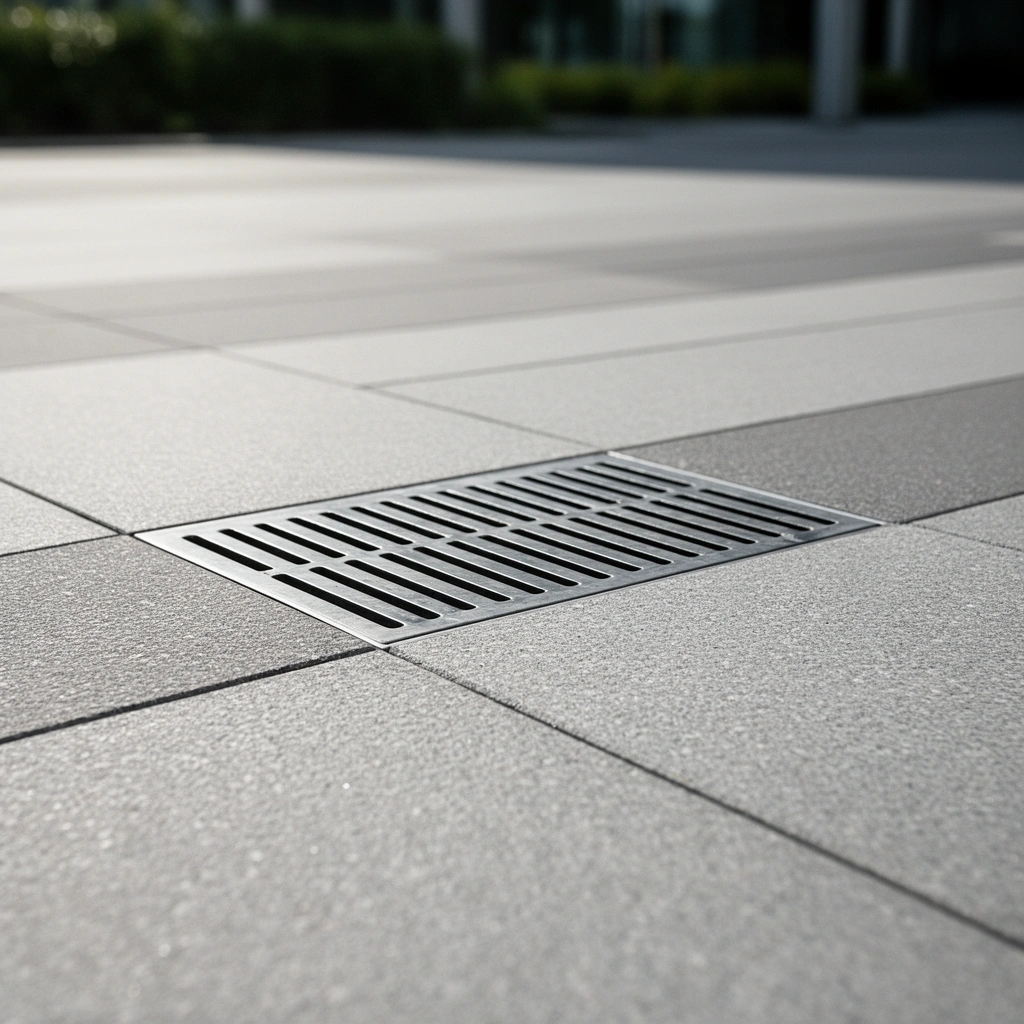
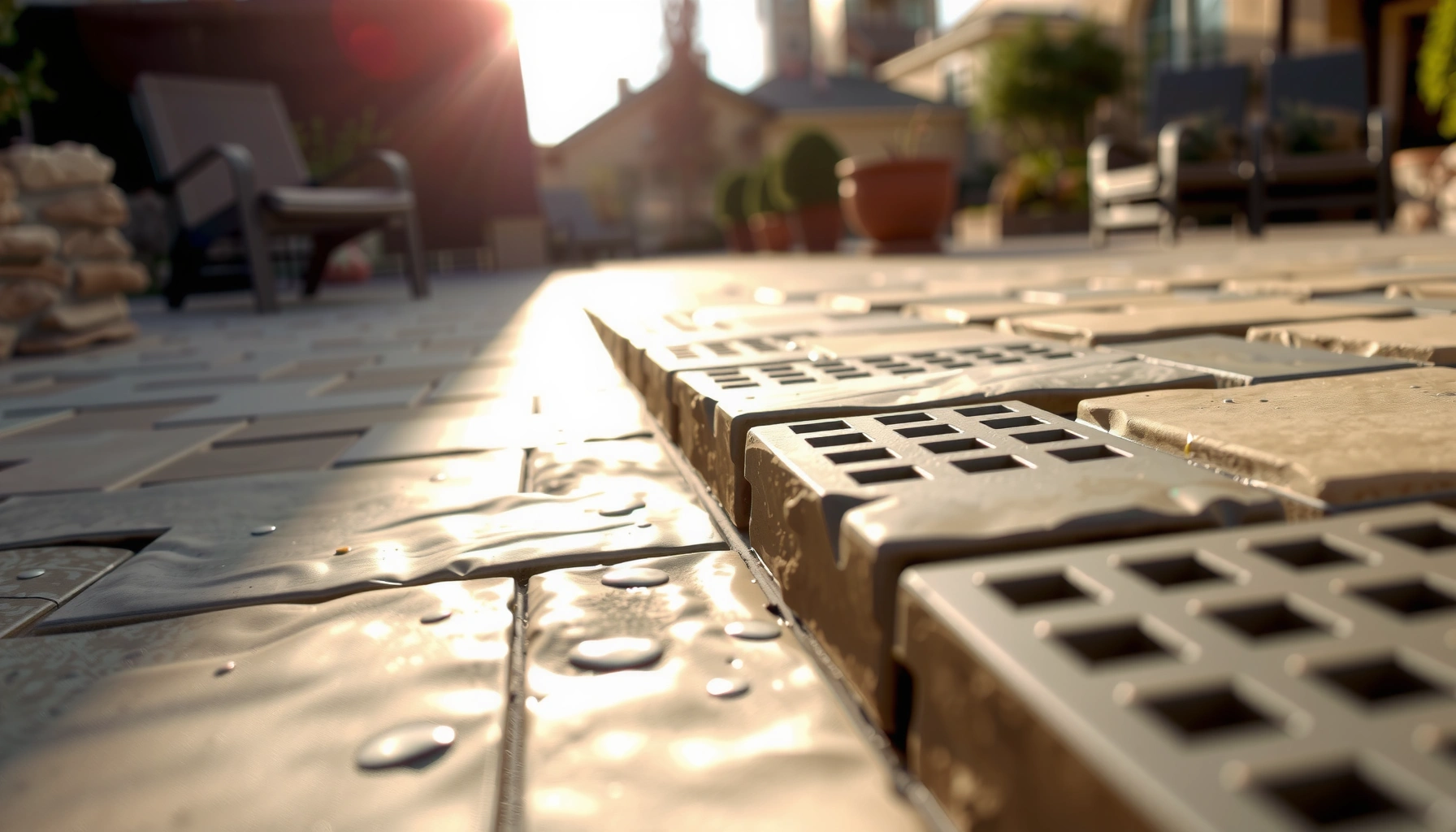
The surest way to protect outdoor flooring is to prevent standing water before it reaches the surface. If water pools, you’ll see faster staining, joint degradation, algae growth, frost damage, and uneven wear—regardless of how “durable” the top layer claims to be.
– Choose a system that lets water drain away (gaps, permeable layers, proper sub-base, or a designed drainage path).
– Plan the layout so water doesn’t pool—especially near doors, stairs, and edges.
– If you’re installing over an existing slab, confirm whether you’ll need leveling/priming steps to prevent uneven wear or trapped moisture.
The International Residential Code (IRC) requires soil grading to slope away from the foundation—commonly 6 inches over the first 10 feet—to keep water from pooling near structures.
Tile and stone exterior failures are frequently assembly-related: if water can’t escape through joints and substrate layers, moisture accumulation drives long-term deterioration.
ADA guidance for accessible routes uses slope limits to manage water flow and safe footing; verify your local code for exterior walking surfaces.
Drainage is a system, not a single detail. Water must have a path to follow—from the surface into joints (if the design uses them), through a permeable layer, or into a controlled drainage channel. A good slope also reduces the “drying time,” which matters for slip risk because wet algae/biofilm forms fastest when surfaces remain damp.
What to validate before you buy
– Surface slope to daylight or drains: confirm the plan avoids low spots.
– Permeable vs non-permeable layers: paver assemblies often rely on aggregate interlock and drainage through the base; tile-over-concrete assemblies rely heavily on moisture management at the substrate and edges.
– Edge and transition detailing: doors, thresholds, and step edges are where water commonly migrates underneath systems.
If you’re installing over an existing slab, ask your flooring instructions about moisture behavior and whether leveling/priming is required. Trapped moisture is a frequent cause of uneven performance—especially with exterior tile systems where the bond line and movement joints are critical.
Focus on slip resistance and safety
Safer outdoor floors are designed for traction while wet, not just for how they look when dry. In wet areas—pool surrounds, grill zones, and rinsed patios—choose finishes and products that explicitly meet outdoor slip-performance guidance.
– For wet areas (near pools, kitchens, or frequently rinsed patios), look for traction-oriented finishes rather than shiny “low-friction” looks.
– If anyone in your household is prone to slipping or you expect shoes to come on/off often, treat slip resistance as a must-have requirement.
– Avoid finishes that become slick when wet unless the manufacturer clearly states outdoor slip performance.
ANSI A137.1 sets wet DCOF performance criteria used to identify tile suitable for wet areas (commonly DCOF ≥ 0.42 for specified interior/exterior applications).
Exterior traction requirements differ by use location; pool decks and frequent-rinse areas typically need more conservative slip-performance assumptions than dry patios.
Glossy coatings can increase reflectivity but can also reduce wet traction—always confirm the manufacturer’s outdoor and wet-safety testing.
A key mindset shift: slip resistance is not a universal trait. It depends on surface texture, finish chemistry, water film behavior, and how quickly biofilm forms. Even within the “same” tile category, matte textures and honed finishes can differ meaningfully in wet traction.
In my experience advising on outdoor projects, the most avoidable safety problems come from choosing an attractive finish that looks fine on a dry showroom slab but isn’t specified for wet exterior use. Once installed, you can often clean better than you can “re-engineer” traction—so the safer move is to verify slip-performance claims up front.
Pros/cons: traction strategy by area
| Outdoor area | What tends to work | What to avoid |
|---|---|---|
| Pool surround | Texture-first finishes designed/tested for wet areas | Highly polished or “decorative slick” surfaces without outdoor wet specs |
| Grill and rinse zone | Slip-oriented finishes + easy-clean maintenance plan | Smooth coatings that rely on “freshly dry” conditions |
| Low-use balcony | Still verify outdoor rating, but less stringent slip needs may apply | Interior-only products and coatings not meant for UV + rain cycles |
Compare common outdoor flooring options (and tradeoffs)
The best outdoor flooring option depends on your tolerance for maintenance and your need for moisture-safe drainage. Here’s a practical comparison that helps you weigh durability, installation complexity, and water behavior.
– Concrete and stamped concrete: durable and customizable, but finish condition and cracking risk depend heavily on prep, expansion joints, and climate.
– Outdoor tiles (ceramic/porcelain) and pavers: good design flexibility, but grout/setting method and joint design matter for water movement and longevity.
– Decking (wood or composite): comfortable underfoot, but maintenance and moisture behavior vary by material; composites still need proper airflow and installation details.
– Rubber/foam or synthetic surfaces: can be great for cushioning, but confirm UV and outdoor ratings and whether you’re okay with cleaning requirements.
Concrete durability outdoors depends heavily on cracking control (sub-base support, curing, and expansion/joint placement), not just compressive strength.
Porcelain’s low water absorption (≤ 0.5% per ISO 13006) helps reduce water uptake that contributes to staining and freeze-thaw stress.
Paver longevity depends on base thickness/compaction and joint design—water management failures often start below the surface.
Material tradeoffs that matter in real use
– Foot traffic: rigid surfaces can feel colder/harder; joints can also be traction and maintenance points.
– Pets and sharp claws: joint edges, grout, and coatings determine scratch resistance and cleanability.
– Pool area: slip performance and biofilm resistance matter as much as water resistance.
– Grills and standing grease: surface chemistry and sealing/cleaning compatibility matter.
Comparison quick-view
Outdoor Flooring Systems: Water & Slip Suitability (Engineering Benchmarks)
| # | System (Outdoor Use) | Moisture Resistance Benchmark | Wet Slip Basis | Durability Fit (1–10) |
|---|---|---|---|---|
| 1 | Porcelain outdoor tile (rated) | ≤ 0.5% absorption (ISO 13006) | ANSI A137.1 wet DCOF criteria | 9 |
| 2 | Concrete (reinforced + joints) | Depends on curing & crack control | Surface broom/texture choice | 8 |
| 3 | Concrete pavers (over compacted base) | Permeable drainage through joints/base | Texture-specific traction grading | 8 |
| 4 | Natural stone (exterior-rated) | Varies by stone type; absorption matters | Finish/texture determines wet traction | 7 |
| 5 | Wood decking (proper airflow) | Performs with drainage & ventilation | Texture + cleaning prevent slip risk | 5 |
| 6 | Composite decking (exterior-rated) | Good moisture behavior; airflow still required | Manufacturer traction/finish specs | 7 |
| 7 | Rubber/synthetic surfacing | UV & water resistance vary by formulation | Outdoor slip testing & cleaning plan | 4 |
Note: Durability fit (1–10) is a decision-support indicator based on the listed benchmarks and common failure modes, not a lab test result for every product. For exact claims, always use the manufacturer’s installation and performance sheets.
Plan the base, spacing, and installation details
The most expensive outdoor failures usually start under the surface. A correctly specified base, proper layering, and movement-compatible installation details often matter more than the brand of the top layer.
– A lot of “floor failure” starts under the surface: sub-base compaction, leveling, and correct layering determine long-term stability.
– Follow manufacturer guidance for spacing (expansion gaps, panel seams, or joint widths) so materials can move with temperature and moisture.
– If you’re using tiles or pavers, pay attention to the setting bed, grout/mortar choice, and edge finishing to keep water from migrating underneath.
Tile exterior assemblies are sensitive to substrate flatness and correct mortar/setting methods; poor base conditions can translate into cracking, debonding, and edge failures.
Rigid outdoor surfaces need movement accommodation (expansion joints and controlled cracking joints) to manage thermal expansion and prevent random cracking.
Paver longevity is strongly influenced by base compaction and drainage aggregate design; water entrapment under pavers accelerates settlement.
Here’s how to think about it practically:
1. Base preparation: compacted sub-base reduces settlement and prevents “lippage” or rocking planks.
2. Flatness & leveling: exterior floors tolerate less “wobble” than you’d expect once you add water, freeze-thaw, and foot pressure.
3. Spacing and joints: expansion gaps aren’t cosmetic—they’re how the system stays intact as it moves.
Tiles and pavers: where water gets in
– Setting beds and mortar choice affect bond strength and moisture behavior.
– Grout/joint design affects whether water can escape or stays trapped near edges.
– Perimeter edge finishing prevents water migration under the assembly during storms.
Decking: ventilation and airflow are part of the structure
Wood and composite both need airflow to avoid moisture entrapment. Even if a decking board is water-tolerant, an incorrectly installed substructure can trap moisture underneath—creating staining, odor, or early deterioration.
What can go wrong (and how to avoid it)
Outdoor floors typically fail because water management, movement control, or slip safety is compromised. Most problems are predictable—pooling water, mismatch of climate and material, and incorrect installation details show up quickly or seasonally.
– Pooling water: leads to staining, algae, frost damage, and early wear—solve with proper drainage and slope.
– Wrong material for climate: heat can soften/warp some materials; freeze-thaw can crack rigid ones—confirm outdoor and weather ratings.
– Overlooking slip behavior: a floor that looks safe when dry may become hazardous when wet—check outdoor traction specs.
– Neglecting maintenance: even “low-maintenance” floors can require sealing, cleaning, or periodic joint care depending on the material.
Wet slip risk often increases with biofilm buildup; preventing persistent dampness reduces algae and improves traction maintenance.
Freeze-thaw damage is more likely when water can infiltrate and remain trapped within the assembly layers during cold cycles.
Standing water near thresholds increases the chance of moisture migration behind edge details, leading to substrate damage.
Common scenario checks:
– Near doors: if water runs toward the home instead of away, you’ll see edge deterioration and faster wear.
– Under furniture or grills: shaded areas dry slowly and can accumulate slip risk.
– DIY “close enough” grading: even small low spots can become the collection points for runoff.
Maintenance isn’t optional—just varied. Some surfaces require periodic sealing or re-coating; others demand joint care or specific cleaners to avoid surface haze and traction loss.
Verdict / tip: choose durability + drainage first
The best outdoor floor is the one that fits your climate and your water conditions—so start by confirming outdoor ratings, slip resistance, and drainage design, then match aesthetics. If you can’t maintain or re-coat surfaces as recommended, avoid materials that rely on routine sealing or specialized upkeep, and don’t skip grading/sub-base correction if your space needs true slope work.
Downsides to plan for:
– More durable options often cost more upfront and may require stricter installation tolerances.
– High-traction finishes can be less “glass-like” than glossy looks, especially in pool zones.
– Some systems are repairable, others are replacement-heavy when sub-base failures occur.
If your project can’t meet drainage and slope requirements (or you can’t verify slip performance for wet areas), you should consider redesigning the system rather than hoping the surface coating will solve it.
Quick checklist (scan/save)
– Outdoor-rated material (UV and weather resistant per manufacturer specs)
– Slip resistance for wet conditions (verify wet-area testing/specs)
– Drainage plan (no pooling; appropriate slope/joints/sub-base)
– Compatible base/sub-base prep method
– Expansion gaps/spacing per manufacturer instructions
– Maintenance expectations you can realistically keep
– Edge detailing to prevent water migration
FAQ
What’s the best outdoor floor for wet areas?
Look for flooring explicitly rated for outdoor wet use and verify wet slip performance requirements. Just as important, design for quick drainage—pool surrounds and frequently rinsed patios fail faster when water lingers.
Do outdoor floors need sealing?
Some materials and finishes require sealing to resist staining and water penetration, while others use formulations designed to reduce maintenance. Always follow the manufacturer’s care instructions for your exact product.
Can I install outdoor flooring over an existing slab?
Often yes, but it depends on slab condition, moisture behavior, and whether the flooring instructions allow direct installation or require specific leveling/priming. Confirm the assembly requirements before proceeding.
What’s more durable: tiles or pavers?
Both can be durable if installed with the correct sub-base, setting bed (for tile), and joint design. Durability usually comes down to water management, movement control, and exterior-rated materials—not the category name.
How do I prevent cracking or shifting?
Preventing cracking and shifting starts with sub-base compaction, correct thickness/layering, movement joints where required, and correct spacing. For rigid materials, follow exterior installation specs closely and don’t reduce joint allowances “for appearance.”
Sources
– ISO 13006 — porcelain tile classification and water absorption requirements (used for porcelain moisture behavior discussions).
– ANSI A137.1 — tile standards including wet slip testing frameworks and performance criteria used to inform wet-area tile selection.
– International Residential Code (IRC) R401.3 — requirements for site grading/slope to direct water away from the foundation.
– [ADD: source for your region’s exterior drainage/slope guidance (local amendment to IRC/IBC)]
– [ADD: manufacturer installation instructions/spec sheets for the specific outdoor flooring types you plan to use—tile, pavers, composite decking—so you can cite UV and slip/traction claims accurately]
– [ADD: manufacturer maintenance/care guides for sealing/cleaning requirements for each chosen material]
Frequently Asked Questions
What factors should I consider when choosing outdoor floors?
Start by matching the outdoor floor material to your climate and conditions like rain, freeze-thaw cycles, and direct sun exposure. You’ll also want to consider slip resistance, durability, and how much maintenance you’re willing to do. Finally, check installation requirements—some outdoor flooring options need proper sub-bases, drainage, or sealing to perform well long-term.
How do I choose outdoor flooring that won’t get slippery when wet?
Look for outdoor floor surfaces with a high slip-resistance rating and textured or patterned finishes rather than smooth, glossy surfaces. For areas prone to water—like patios, pool decks, or entryways—choose materials designed for exterior use and drainage. It’s also wise to consider footwear and algae resistance, since mildew and moss can reduce traction over time.
Which outdoor floor materials are best for freeze-thaw climates?
In freeze-thaw regions, choose outdoor floors that resist cracking and water absorption, such as properly installed concrete with the right mix and joints, porcelain pavers rated for exterior use, or natural stone designed for outdoor temperature swings. Avoid materials that can retain water or are prone to chipping without a suitable base and drainage. Proper sub-base preparation and sealing (when recommended by the manufacturer) are key to preventing damage.
Why is proper sub-base and drainage important for outdoor flooring?
Even the best outdoor floor can fail if water collects underneath or the base isn’t stable. A well-prepared sub-base helps with leveling, reduces shifting, and supports long-term durability, while drainage prevents freeze damage, pooling, and grout or joint deterioration. For patios and pavers, follow recommended base thickness and use the correct bedding layer and edging systems.
Best outdoor floors for low maintenance: what should I choose?
For low-maintenance outdoor flooring, consider porcelain or ceramic pavers made for exterior use, interlocking deck tiles designed for outdoor conditions, or sealed composite decking where appropriate. These options typically require less upkeep than natural stone or unsealed wood, and they resist staining when installed correctly. Still, plan on basic cleaning and periodic inspections of joints, fasteners, and drainage to keep your outdoor floor looking its best.
📅 Last Updated: October 12, 2026 | Topic: How to choose outdoor floors? | Content verified for accuracy and freshness.
References
- Google Scholar Google Scholar
https://scholar.google.com/scholar?q=how+to+choose+outdoor+flooring+materials+durability+water+drainage - Google Scholar Google Scholar
https://scholar.google.com/scholar?q=outdoor+flooring+slip+resistance+guidelines+deck+patio+pavers - Google Scholar Google Scholar
https://scholar.google.com/scholar?q=outdoor+floor+covering+selection+considerations+freeze+thaw+maintenance - Deck (building)
https://en.wikipedia.org/wiki/Decking - Paver
https://en.wikipedia.org/wiki/Paver - Redirecting…
https://www.ada.gov/2010ADAstandards_index.htm - https://extension.umn.edu/structures/decks-and-porches
- https://www.epa.gov/pressure-treated-wood
- https://www.epa.gov/lead/renovating-repairing-and-painting-children-and-housing-commonly-asked-questions-0
- https://www.fs.usda.gov/visit/forestry-topics/woods-and-forests/using-wood-outdoors