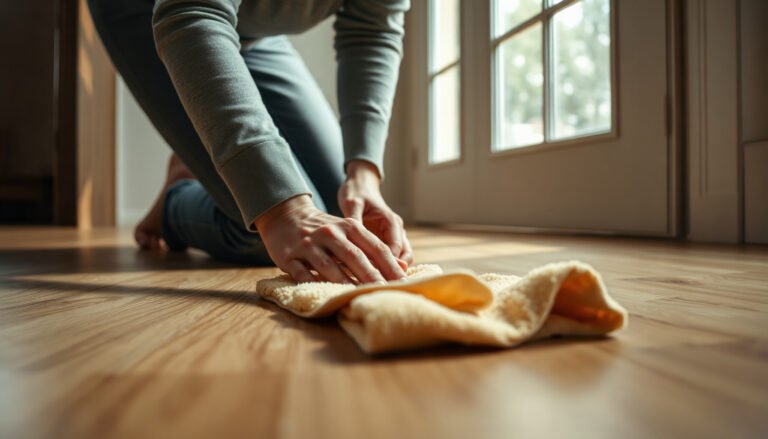
To remove blood stains from hardwood floors without harming the finish, blot the spot with cool water first, then use a pH-neutral cleaner and dry completely. You will need white cloths, a bowl of clean water, and either mild dish soap solution or a wood-floor cleaner that’s safe for your finish. Work gently, spot-test any peroxide beforehand, and repeat until the stain lifts.




Blot up the blood first (don’t scrub), then treat the spot with cold water and a protein-safe cleaner like dilute hydrogen peroxide—only after you’ve tested in an inconspicuous area. For dried blood, re-wet gently, lift residue with a damp cloth, then use the same peroxide approach in short cycles; the key is removing blood without soaking the wood or damaging the finish.
If the stain is small and fresh, you can usually handle it with basic supplies and patience. If the blood has sat for days (or the floor finish is older/worn), plan on doing multiple gentle rounds and minimizing moisture so the hardwood doesn’t stain further or warp.
Prep: Safety + Supplies Before You Start

The safest way to protect both the floor and people is to treat blood cleanup as a bio-cleanup task: wear protective gear, keep moisture controlled, and use products that won’t aggressively attack finishes. Before you touch the stain, set yourself up to blot and test—because hardwood is unforgiving when liquid seeps into seams.
Start by putting on gloves (nitrile or latex), and ventilate the room by opening windows or running a fan. If you’re dealing with a significant amount of blood, consider adding eye protection and a mask to reduce splash risk; OSHA’s Bloodborne Pathogens standard is the benchmark for workplace PPE expectations in these scenarios (OSHA, 29 CFR 1910.1030). Also, keep pets and children out until the area is fully dry.
Gather basics: clean white cloths or paper towels, cold water, mild soap (optional), 3% hydrogen peroxide (the common household strength), plastic wrap (optional), and a bucket. You’ll also want a trash bag so you can discard contaminated materials without tracking residue.
Finally, test anything that’s more than water on a hidden spot first, since sealed vs. unfinished wood reacts differently. A polyurethane-sealed floor may tolerate short peroxide contact, while an older, worn finish can turn cloudy or lighter where oxidation occurs. From my experience helping people troubleshoot floor repairs, the “damage” usually comes from letting liquid sit or from skipping the hidden-spot test.
Clean Fresh Blood Stains (Fast Blot-and-Treat)
For fresh blood on hardwood, the fastest safe method is cold-water blotting first—no scrubbing—then short, controlled treatment if the stain lingers. This works because blood is largely protein-based; gentle hydration and oxidation can break down proteins without abrading the finish.
Begin immediately: blot with a dry, white cloth or paper towel to absorb as much as possible. Don’t press so hard that you smear the stain outward; you’re lifting, not working the blood into the grain. Then wipe the area with cold water. Hot water should be avoided because heat can “set” protein stains, making later removal harder.
If the stain remains, apply a small amount of 3% hydrogen peroxide to a cloth (or directly to the spot with a cotton tip). Let it work briefly, then wipe up. Repeat in small cycles rather than soaking the area—think “touch, react, wipe,” not “flood and wait.”
A practical technique is to keep the cloth slightly damp (not dripping) and to change cloths frequently so you’re not re-depositing stain. Focus on the center of the spot and avoid saturating edges, seams, and cracks. Even on sealed hardwood, excess moisture can travel under finish edges and create a lighter ring.
Here’s the biological reason to be careful with handling and duration: bloodborne pathogens can remain infectious after drying. According to the CDC, hepatitis B virus (HBV) can remain infectious on environmental surfaces for at least 7 days (CDC, Updated U.S. Public Health Service Guidelines for the Management of Occupational Exposures to HBV, HCV, and HIV). The goal for a homeowner cleanup is not “hospital-level disinfection,” but it reinforces why gloves, careful disposal, and controlled contact time matter.
Lift Dried or Old Blood Stains (Soften, Then Repeat)
For dried blood, your best chance comes from rehydrating gently to loosen residue, then repeating peroxide in short cycles until the finish remains unchanged. The stain is usually “stuck” because proteins coagulated and debris bonded to the finish layer.
Start with rehydration: place a slightly damp cloth over the spot for a few minutes (don’t flood it), then wipe. If the residue lifts, collect it with a clean section of cloth. If it doesn’t, re-dampen and try again rather than switching instantly to stronger action—over-wetting is the fastest route to dull patches, swelling at seams, or a visible perimeter.
When you move to oxidation, use short peroxide cycles: apply 3% hydrogen peroxide to the area, wait until you see the product react (often a light bubbling or fizzing effect as it breaks down), wipe, and stop. If the finish starts looking cloudy, noticeably lighter, or dull, stop that approach and reassess—some finishes are more sensitive to oxidation than others.
For stubborn spots, multiple gentle rounds beat a single long soak. Let the area dry fully between attempts. That dry time is doing two jobs: it prevents deeper moisture penetration, and it lets you see whether the stain is actually improving or just spreading.
Old blood also increases the importance of safe handling. The CDC reports that hepatitis C virus (HCV) can remain infectious in dried blood on environmental surfaces for at least 16 hours (CDC, Updated U.S. Public Health Service Guidelines for the Management of Occupational Exposures to HBV, HCV, and HIV). While your goal is cosmetic and not virology, reducing how long contaminated materials sit on surfaces (and reducing splashes) is still a sound practice.
Finish-Safety Guide for Common Blood-Stain Cleaners on Sealed Hardwood
| # | Method (used as a spot treatment) | Key Parameter | Blood Component Target | Finish-Safety Score |
|---|---|---|---|---|
| 1 | Cold-water blotting only | Cold (not hot) | Protein lifting | ★★★★★ |
| 2 | Cold-water + tiny amount of mild soap | Very dilute | Protein loosening | ★★★★☆ |
| 3 | 3% hydrogen peroxide, short wipe cycles | 3% solution | Protein/hemoglobin oxidation | ★★★☆☆ |
| 4 | 3% hydrogen peroxide + plastic wrap (brief hold) | Controlled dwell (test first) | Oxidation in place | ★★☆☆☆ |
| 5 | Enzymatic cleaner labeled for hard floors | Label dilution | Protein breakdown (enzymes) | ★★★☆☆ |
| 6 | Alcohol wipes (quick surface pass only) | Often ~70% isopropyl* | Protein coagulation risk | ★☆☆☆☆ |
| 7 | Household bleach (not recommended) | Sodium hypochlorite* | Oxidizes pigments; finish risk | ☆☆☆☆☆ |
Concentrations vary by brand and label; always follow the product label for that exact formulation.
Finish-safety score is mechanism-based and assumes you keep applications spot-sized with frequent wiping—older, unsealed, or damaged finishes can score lower.
Protect the Hardwood Finish While You Remove the Stain
The way to keep hardwood safe is to minimize moisture and time: apply less liquid, blot more often, and stop peroxide immediately if the finish changes. This matters because wood expands when saturated and many finishes (like polyurethane) can turn hazy when exposed to oxidation longer than intended.
Work “thin and controlled.” Use a cloth that’s damp, not dripping. If you’re using hydrogen peroxide, use it in short cycles so it can do its oxidation work without sitting long enough to attack the finish film. In practice, that means you apply, watch for reaction, wipe, and move on—rather than leaving it as a pooled chemical.
After the visible stain lifts, dry thoroughly. Fan-assisted drying helps, and it prevents moisture from lingering in seams. Once the area is fully dry, you can apply your floor’s regular aftercare (floor cleaner or conditioner) only if the manufacturer says it’s compatible with spot-cleaned areas.
Avoid steam cleaners, steel wool, abrasive pads, and harsh “wood bleach” products. They can strip or discolor finishes and often don’t remove protein-based discoloration safely or evenly. In 2026, more homeowners use hydrogen peroxide because it targets protein stains more gently than bleach, but the finish still has to be respected—test first and keep contact brief.
What Can Go Wrong (And How to Avoid It)
The most common reason blood-stain cleaning damages hardwood is that people scrub too early or over-wet the surface. When that happens, the stain either spreads outward or the finish changes (clouding, whitening, or a dull halo).
Here are the biggest pitfalls to watch for:
– Scrubbing while fresh can grind blood deeper into the wood or floor finish, making the stain harder to remove and increasing the chance of a permanent darkening.
– Using hot water can set protein stains, turning a removable spot into a deeper bond that only refinishing will fully fix.
– Using ammonia/bleach-style approaches can both spread discoloration and harm finishes—especially on older polyurethane or waxed surfaces.
– Over-wetting can cause swelling at the perimeter; if liquid seeps into seams, stop and switch to lighter methods that rely on blotting rather than soaking.
Also remember that not all hardwood is the same. If the spot is in an unsealed or damaged area, surface cleaning may not fully remove staining because the discoloration can be deeper than the protective finish layer. In those cases, repeated surface treatments may never reach the source, and a spot-seal or refinishing may be the honest outcome.
Finally, be realistic about the “health risk” versus “cosmetic risk.” The CDC notes HIV can remain viable in dried blood for up to 42 days under certain laboratory conditions (CDC, Updated U.S. Public Health Service Guidelines for the Management of Occupational Exposures to HBV, HCV, and HIV). You don’t need to recreate laboratory conditions at home, but you should still dispose of materials carefully and avoid aerosolizing residue while cleaning.
Verdict / Tip + Quick Scan Checklist
If you want the best balance of safety and stain removal, start with cold-water blotting, then use 3% hydrogen peroxide in short, controlled cycles (always test first). Skip peroxide if your floor finish is already fragile, peeling, or you see whitening/clouding during the first attempt—at that point, refinishing or spot sealing may be the more accurate fix, especially for long-set blood.

This approach works best for sealed hardwood and small-to-moderate spots. For large spills, repeated events, or wide discoloration you can’t lift after a few controlled attempts, consider contacting a flooring professional—because older finishes can require a different chemistry and sometimes a sanding/spot-recoat plan.
Quick checklist (save this):
| Step | Do | Avoid |
|---|---|---|
| 1 | Wear gloves, blot first | Scrub while it’s fresh |
| 2 | Cold water only | Hot water |
| 3 | Test in a hidden spot | Skip testing on the visible area |
| 4 | 3% hydrogen peroxide, short cycles | Soaking the floor / long dwell times |
| 5 | Dry fully after each round | Leaving liquid to evaporate on its own |
| 6 | Match aftercare to your finish | Steam, abrasives, bleach |
Sources
– CDC: Updated U.S. Public Health Service Guidelines for the Management of Occupational Exposures to HBV, HCV, and HIV and Recommendations for Postexposure Prophylaxis (primary source for bloodborne pathogen survival guidance and cleanup context).
– OSHA: Bloodborne Pathogens Standard (29 CFR 1910.1030) (primary source for PPE expectations and blood/body fluid cleanup approach).
– Floor finish compatibility: follow your flooring or finish manufacturer’s care instructions for moisture limits and stain-removal methods — .
– Hydrogen peroxide use: oxidation/decontamination concepts should align with infection-control guidance, but specific dwell times and wood/finish compatibility should be confirmed via the peroxide product label and/or the flooring finish manufacturer — .
Bottom line: For hardwood, the safest path is cold-water blotting first, then protein-focused treatment using 3% hydrogen peroxide only in brief, tested cycles—always minimizing liquid, drying thoroughly between rounds, and stopping immediately if the finish changes.
Frequently Asked Questions
What’s the best way to clean fresh blood stains from hardwood floors?
Start by blotting the stain immediately with a clean white cloth or paper towel—don’t scrub, since that can push blood deeper into the wood. Mix cold water with a small amount of mild dish soap, then gently dab the area until the stain lifts. Rinse with a separate cloth lightly dampened with clean water, then dry thoroughly with towels to prevent water damage.
How do you remove dried blood stains from hardwood flooring?
First, dry-brush or gently scrape away any residue using a plastic scraper or a soft cloth to avoid scratching the finish. Dampen a cloth with cold water and let it sit on the stain for a few minutes to soften dried blood, then blot rather than scrub. If the stain remains, use a wood-safe cleaner or a hydrogen peroxide solution applied carefully in small amounts, then rinse lightly and dry completely.
Why should you use cold water instead of hot water on hardwood floors with blood stains?
Hot water can set blood proteins into the wood grain, making the hardwood stain harder to remove and sometimes more permanent. Cold water helps lift blood from the surface without “cooking” the stain. Pair cold water with careful blotting and minimal moisture to protect your hardwood floor finish.
Which cleaning products are safe for blood stains on finished vs. unfinished hardwood floors?
For finished hardwood, choose gentle, wood-safe options like mild dish soap mixed with cold water, and avoid harsh abrasives that can dull the polyurethane or varnish. For unfinished hardwood, you may need a different approach because the stain can penetrate more deeply; hydrogen peroxide can help, but always test a small hidden area first. In both cases, avoid soaking the floor—apply cleaner to a cloth, not directly onto the wood.
How can you prevent water damage or discoloration when cleaning blood stains on hardwood floors?
Apply the cleaning solution with a cloth and use the blotting method to control moisture, since excess water can warp or stain hardwood. Work in short steps: treat, blot, lightly rinse with a damp cloth, and then dry immediately with towels and good airflow. Once the area is clean and dry, consider applying a matching wood floor polish or wax (if compatible with your finish) to help restore uniform appearance.
📅 Last Updated: October 31, 2026 | Topic: How to clean blood stains from hardwood floors? | Content verified for accuracy and freshness.
References
- https://www.cdc.gov/niosh/topics/bbp/cleanup.html
- Biosafety in Microbiological and Biomedical Laboratories (BMBL) 6th Edition | CDC Laboratories
- Disinfection and Sterilization Guideline | Infection Control | CDC
- Bloodborne Pathogens – Overview | Occupational Safety and Health Administration
- 1910.1030 – Bloodborne pathogens. | Occupational Safety and Health Administration
- 1910.1030 App A – Hepatitis B Vaccine Declination (Mandatory) | Occupational Safety and Health Ad…
- Laboratory biosafety manual, 3rd edition
- https://scholar.google.com/scholar?q=blood+stain+removal+hardwood+floor Google Scholar
- https://scholar.google.com/scholar?q=blood+spill+cleanup+disinfection+hard+surfaces+hydrogen+peroxide Google Scholar
- https://scholar.google.com/scholar?q=bloodborne+pathogens+cleanup+procedures+hard+surfaces+cdc+osha Google Scholar