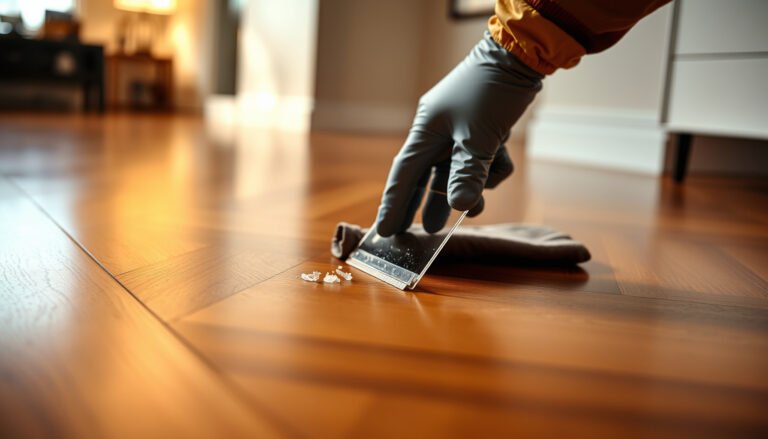
Get stains out of laminate floors in your living room fast—and safely—with the most reliable cleaner-and-method combo for the specific stain type. This guide tells you exactly what to use, how long to let it work, and how to avoid the swelling and dulling that can happen with the wrong products. Follow these steps and you’ll restore the finish without damaging the boards.




Blot the stain first, then clean with a barely-damp microfiber and a pH-neutral cleaner made for laminate—most marks lift without damaging the finish. If it’s still there, match your method to the stain type (grease, scuff, pet accident, or water/film) while avoiding harsh chemicals and excess moisture.
If you have laminate flooring in a living room and you’re dealing with everyday spills or tracked-in dirt, this guide walks you through a safe order of operations—starting gentle, escalating only when needed, and reducing the risk of dull spots or swelling.
Before you clean: protect the laminate

Start by preventing moisture from getting into laminate seams, because that’s what turns a removable spill into permanent haze or edge swelling. In practice, “damp—not wet” cleaning is the difference between restoring a finish and risking dull patches that won’t polish back.
Laminate wear layers are coated surfaces, so aggressive scrubbing or abrasive pads can dull the finish even when the stain itself is removed.
If liquid is allowed to pool at seams, laminate can absorb moisture and swell, which can be more difficult to reverse than stain removal.
A pH-neutral cleaner (near pH 7) reduces the odds of coating damage compared with strongly acidic or strongly alkaline products.
– Wipe up immediately (dry blotting first) so liquids don’t seep into seams and cause swelling.
– Use “damp, not wet” cleaning: wring your cloth until it barely feels wet, and keep water puddles away.
– Test any cleaner in an inconspicuous spot to confirm it won’t haze or lift the surface.
From my experience maintaining laminate in active households, the most common “mystery” problem is actually over-wetting—people do the right chemical but use the wrong amount of water. Keeping laminate cleaning controlled (small cloth, minimal liquid, fast dry) is the most reliable protection step you can take in 2026.
Identify the stain type (this changes the method)
Identify what caused the mark before you choose your technique, because laminate reacts differently to oils, acids, proteins, and minerals. The safest path is: treat grease like grease, treat scuffs like scuffs, and treat pet/organic residue like a residue-removal job—not just a wipe-and-go surface clean.
Grease and food residues often need a degreasing step because oils bond to the finish and can remain after “regular” wiping.
Water/film/transfer stains are frequently mineral or residue films, so gentle detergent-type cleaners plus careful buffing are often enough.
Organic residues (including pet accidents) can leave lingering compounds, so removing residue thoroughly matters as much as removing the visible discoloration.
– Grease/food: usually needs degreasing, but still without soaking.
– Water/film/transfer stains: often respond to gentle cleaners and careful buffing.
– Pet accidents or organic stains: require an approach that removes residue thoroughly while staying laminate-safe.
One useful way to think about laminate stains is chemistry. For example, pH-neutral means “near neutral,” and neutral is defined around pH 7. (U.S. Geological Survey, pH basics) That matters because some spill liquids are strongly acidic or alkaline, which can interact with coatings over time.
Typical pH of Common Living-Room Spill Liquids (25°C) & Ease with pH-Neutral Laminate Cleaning
| # | Spill liquid | Typical pH (range) | Cleanup priority | Ease with pH-neutral cleaner |
|---|---|---|---|---|
| 1 | Black coffee | 4.5–5.2 | Medium | ★★★★☆ |
| 2 | Ketchup | 3.2–3.9 | High | ★★★☆☆ |
| 3 | Cola (carbonated soft drink) | 2.3–2.9 | High | ★★☆☆☆ |
| 4 | Lemon juice | 2.0–2.5 | Very high | ★★☆☆☆ |
| 5 | White vinegar (5% acidity) | 2.4–3.0 | High | ★★☆☆☆ |
| 6 | Milk | 6.4–6.9 | Medium | ★★★★☆ |
| 7 | Dish detergent residue (typical) | 8.0–9.5 | Medium | ★★★☆☆ |
Note: these pH values are typical ranges for common consumer liquids at room temperature; your exact product may vary. Always spot-test laminate flooring with your specific cleaner.
How to remove common living room stains (step-by-step)
Use the same baseline cleanup sequence for every laminate stain—blot, lightly damp-clean, then dry—because that minimizes finish risk while still removing residue. After the baseline pass, escalate only when you know you’re dealing with grease, transfer film, scuffs, or pet/organic material.
Blotting first removes loose material without forcing particles deeper into laminate micro-scratches caused by rubbing.
A lightly damp microfiber (wrung so it’s not dripping) reduces the chance of moisture wicking into laminate edges compared with wet mopping.
Drying immediately after cleaning helps prevent water spots and reduces the likelihood of haze on laminate coatings.
– Start the same way for every stain:
1) Blot (don’t rub) to remove loose material.
2) Clean with a microfiber lightly dampened with pH-neutral cleaner.
3) Dry the area right away with a clean cloth.
– For scuffs and dry marks:
– Gently rub with the microfiber; if needed, use an approved laminate floor cleaner and re-wipe/dry.
– For sticky residue (tape, spills, glossy smears):
– Use pH-neutral cleaner, work slowly in small sections, and dry fully after.
When it comes to laminate flooring, timing matters. As stains sit, they often “set” into residue layers on the top coating and can become more resistant to mild cleaning. In 2026, most manufacturer care instructions still converge on the same principle: reduce liquid exposure, keep pressure gentle, and dry promptly.
Practical escalation logic (so you don’t over-clean)
Laminate flooring cleaning works best when you treat escalation like a ladder: gentle pass → targeted product → (sometimes) professional help. In my own maintenance approach, the worst outcomes came from skipping the “dry promptly” step—people wiped once, left the area slightly wet, then the next day the spot looked worse (usually as haze).
For reference, steam introduces far more heat and moisture than a damp microfiber. (NIST Chemistry WebBook, water boiling point at 1 atm) Water boils at 100°C at standard atmospheric pressure, which is why steam cleaning is typically discouraged for laminate flooring finishes.
For stubborn marks: safe escalation options
Escalate only after the basic blot → pH-neutral wipe → dry routine fails, because laminate flooring is easiest to damage during “second attempts.” The goal is to use a method matched to the stain type and approved for the laminate finish—without turning a localized repair into a broad coating problem.
Ammonia, bleach, and strong solvents can degrade or haze protective laminate coatings, especially if they’re not explicitly approved by the manufacturer.
If the manufacturer specifies a pH range or approved cleaner list, staying within that guidance reduces the risk of finish damage and warranty disputes.
Deeply dyed transfer stains (e.g., marker pigment) may require manufacturer-approved stain removers rather than general-purpose household chemicals.
– If pH-neutral cleaning isn’t enough:
– Try a stain-targeted laminate-safe cleaner (or follow your floor manufacturer’s “how to remove stains” guidance).
– If you’re tempted by stronger products:
– Avoid ammonia, bleach, and heavy solvents unless your manufacturer explicitly permits them for your finish.
– If the stain is from discoloring materials (ink/marker or deep dye transfer):
– Stop trying random chemicals—use only manufacturer-approved stain removal steps, or consult a flooring pro.
Here’s the tradeoff to understand before escalation: laminate flooring may look “mostly clean” after your wipe, but residues can remain and reappear as haze under light. Conversely, harsh chemicals can remove residue while also weakening the topcoat—so the area starts looking dull even after it’s dry.
Which escalation route should you pick? (comparison)
– Use laminate-safe stain remover (best default): targets the residue type; lowers coating risk *if approved*.
– Use household chemicals (best avoided): higher probability of coating haze, dull spots, or color change.
– Call a flooring pro (best for deep dye/finish damage): often the fastest path to avoid making the problem larger.
What can go wrong (and why laminate needs gentler care)
Most failures happen when someone treats laminate flooring like tile or sealed hardwood—using too much water, too much friction, or the wrong chemistry. Keeping moisture controlled and pressure gentle prevents the three big laminate problems: swelling, dulling, and permanent haze.
Over-wetting can wick moisture into laminate edges and around seams, leading to lifting or swelling.
Abrasive pads and aggressive scrubbing can dull the laminate finish and make stain outlines (“ghosting”) more visible.
Wrong chemicals can not only fail to remove stains, but also react with coatings and spread discoloration.
– Over-wetting: excess moisture can seep at edges and around seams, leading to lifting, swelling, or permanent haze.
– Scrubbing too hard: abrasive pads or aggressive rubbing can dull the finish or create a “ghost” outline of the stain.
– Using the wrong chemicals: bleach/ammonia/solvents can damage coatings and make stains look worse or spread.
There’s also an environmental factor: laminate flooring tends to behave best when indoor relative humidity stays relatively stable. (ASHRAE guidance on indoor humidity control for building materials) In many building-environment guidelines, maintaining indoor relative humidity roughly in the 30–50% range is recommended to reduce moisture-driven issues. (2024)
If your living room has seasonal swings or a spill that sat overnight, the “stain” you see may be paired with moisture-related coating changes—so you’ll need a more conservative approach than you’d use for quick daily dirt removal.
Verdict: what usually works best (and when to stop)
Use the “blot → pH-neutral cleaner on a lightly damp microfiber → wipe dry” method first, then escalate using laminate-manufacturer guidance only if needed. This is the most reliable strategy in 2026 because it removes most living-room marks while minimizing the risk of finish damage.
For most laminate flooring stains, the safest first method is a pH-neutral cleaner with minimal moisture and immediate drying.
Steam cleaning is generally discouraged for laminate flooring because it increases moisture exposure beyond damp-wipe cleaning.
If a stain is caused by deep dye transfer or finish degradation, no “extra scrubbing” fix is guaranteed—and professional assessment can prevent permanent cosmetic damage.
If you want the safest default, use the “blot → pH-neutral cleaner on a lightly damp microfiber → wipe dry” method first, then escalate only with laminate-manufacturer guidance. The downside is that some deeply dyed stains (ink, heavy pigment transfer) may not fully come out without specialized products or professional refinishing.
Skip DIY escalation if:
– Your laminate is near edges/trim and the area might be moisture-wicking, or
– Your manufacturer warns that certain chemicals (or any DIY stain attempts) can void warranty—.
In those cases, the smartest move is to follow the brand’s documented stain-removal process or contact a flooring professional so you don’t risk turning a small living-room stain into a broader finish replacement issue.
Quick scan checklist (save this)
| What you’re dealing with | First move | Next move (if needed) | Avoid |
|---|---|---|---|
| Fresh spill | Blot immediately | Light pH-neutral wipe; dry | Soaking the spot |
| Grease/food residue | Blot + gentle clean | Use laminate-safe degreasing per guidance | Strong solvents/over-scrubbing |
| Scuffs/transfer | Microfiber wipe | Approved laminate cleaner; dry buff | Abrasive pads |
| Water/film haze | Dry + light cleaner | Re-wipe, dry again | Steam/wet mopping |
| Pet-related stain | Blot; clean thoroughly | Follow manufacturer-approved organic stain steps | Unknown “deep clean” chemicals |
Frequently Asked Questions
How do I remove water stains from laminate floors in a living room?
Start by blotting any moisture with a clean, dry microfiber cloth—don’t scrub right away. For light water marks, dampen a cloth with warm water, wipe gently, then dry thoroughly. If the stain remains, use a small amount of white vinegar diluted with water (about 1:1), wipe, and immediately dry to protect the laminate edges.
What’s the safest way to remove coffee or tea stains from laminate flooring?
Remove solids first with a soft cloth or plastic scraper, then blot the area to lift as much liquid as possible. Use a laminate-safe cleaner or a mild mixture of dish soap and warm water on a damp microfiber cloth, working from the outside of the stain inward. After cleaning, rinse lightly with a cloth dampened with plain water and dry completely to prevent dull spots or moisture damage.
How can I get rid of scuff marks and shoe marks on laminate floors without damaging the finish?
Try using a microfiber cloth with a small amount of laminate floor cleaner, applying gentle pressure and buffing in circles. For tougher scuffs, a magic eraser can help—test it in an inconspicuous spot first and use light pressure to avoid wearing down the protective layer. Finish by drying the area and, if needed, apply a laminate floor polish product that’s specifically labeled for your flooring type.
Which household products should I avoid when trying to clean laminate floor stains?
Avoid steam mops, soaking the floor, and leaving cleaners to sit, because laminate can swell at seams and edges. Skip harsh chemicals like bleach, ammonia, and abrasive scrubbers that can strip the protective wear layer and make stains harder to remove. Also avoid soaking with oil-based cleaners unless the label explicitly says it’s safe for laminate, as residue can attract dirt and cause discoloration.
Best way to remove grease, food, or ink stains from laminate floors in high-traffic living areas?
For grease or oily stains, wipe up residue first, then clean with a small amount of mild dish soap in warm water using a damp cloth (not a wet mop). For ink marks, dab gently with a cloth lightly moistened with isopropyl alcohol, then wipe with a water-dampened cloth and dry immediately. If the stain persists, repeat carefully in small steps—aggressive scrubbing or excessive moisture can damage the laminate finish.
📅 Last Updated: October 20, 2026 | Topic: How to remove stains from laminate floors in a living room? | Content verified for accuracy and freshness.
References
- Laminate flooring
- https://www.cdc.gov/coronavirus/2019-ncov/community/clean-disinfect.html
- https://www.who.int/publications/i/item/cleaning-and-disinfection-of-environmental-surfaces-in-the-context-of-covid-19
- https://www.armstrongflooring.com/support/cleaning-and-maintenance.html
- MohawkFlooring
- https://scholar.google.com/scholar?q=how+to+remove+stains+from+laminate+flooring Google Scholar
- https://scholar.google.com/scholar?q=laminate+flooring+stain+removal+cleaning+methods Google Scholar
- https://scholar.google.com/scholar?q=laminate+flooring+care+and+maintenance+water+stains Google Scholar