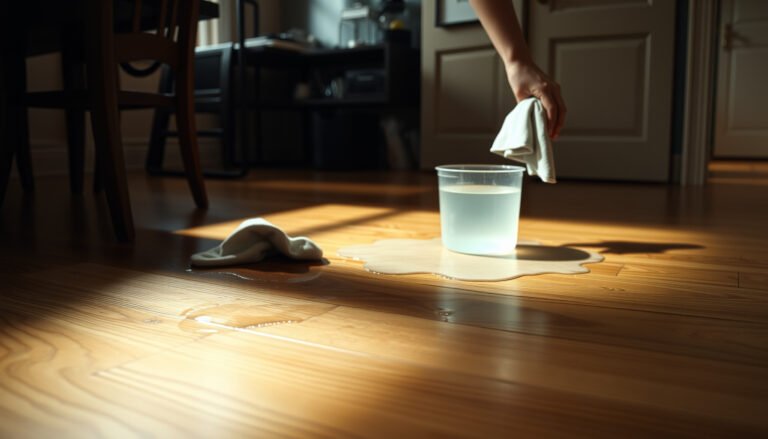
You can waterproof hardwood floors in a warehouse—when you need real protection against spills, humidity swings, and daily cleaning chemicals, the best choice is a warehouse-grade epoxy moisture barrier topped with a compatible, abrasion-resistant clear finish. This guide answers how to waterproof a hardwood floor specifically for high-traffic industrial conditions, from subfloor prep and crack treatment to full-cure and maintenance. Skip common “waterproofing” mistakes like thin sealers that trap moisture and fail under warehouse vapor pressure.




Waterproofing hardwood in a warehouse usually means building a complete moisture barrier using the right coating system plus careful surface prep and edge detailing. You’ll get the best results by controlling the moisture source first, then sealing every board and transition so spills can’t soak down.
This is for warehouse owners, facility managers, or contractors dealing with hardwood flooring exposed to mopping, humidity swings, condensation, or occasional liquid spills—especially where the goal is “water resistance” and “spill containment,” not underwater performance.
Assess moisture risk and finish compatibility
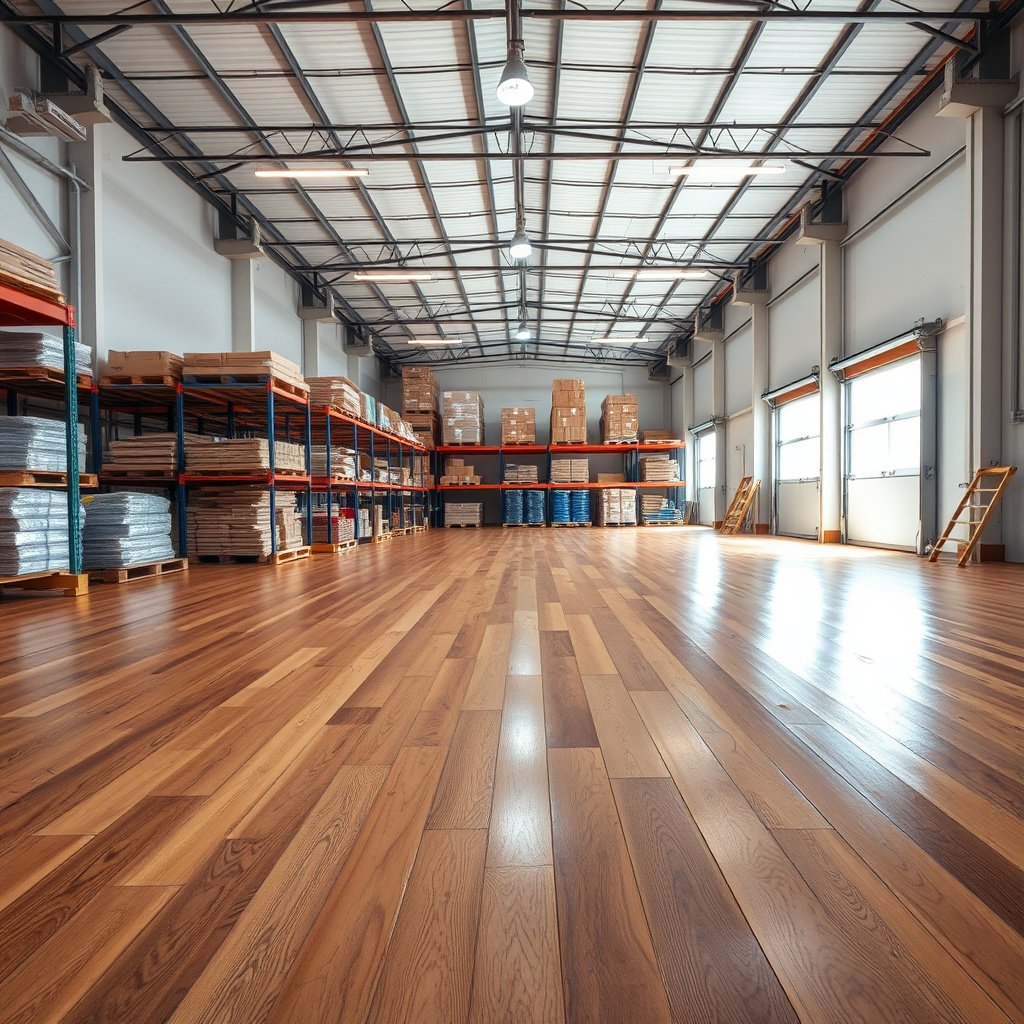
You get the right result by starting with the cause of moisture, not the finish—because a topcoat can only block what it can reach and bond to. For warehouse hardwood, the moisture barrier coating system has to be compatible with the wood type and with whatever is currently on the surface.
– Check why water could reach the wood: leaks (roof/plumbing), standing water, high humidity, HVAC/temperature swings, or poor drainage.
In 2026, more warehouses are running tighter HVAC control to reduce condensation, but hardwood still reacts quickly to rapid relative humidity changes (RH swings). That means your waterproofing plan should include roof and plumbing verification, plus a humidity/RH baseline before you commit to a moisture barrier coating system.
– Confirm your floor type (solid vs. engineered) and whether it’s already finished—some existing finishes need removal before new coatings will bond.
A coating that “waterproofs” in marketing doesn’t help if it sits on top of wax, polish, or an incompatible sealer—failure often shows up first as dull spots, peeling, or blistering.
– Verify the coating system is actually rated for interior heavy-traffic exposure and for wood substrates (not just “waterproof” marketing).
You want manufacturer documentation that explicitly covers wood + interior installations + the intended traffic/cleaning conditions. If the spec only mentions concrete or “intermittent splash resistance,” you’re likely buying a false sense of security.
A moisture barrier coating system only works if it bonds correctly to the existing surface; adhesion problems are one of the fastest paths to failure in warehouses.
Before selecting a waterproofing system, identify whether water intrusion is from the air (humidity/condensation), from above (leaks), or from the ground (rising damp/ground moisture).
Moisture reality check (why RH matters): in wood floors, the coating isn’t the only variable—wood moisture content (MC) shifts with ambient RH. According to the U.S. Forest Products Laboratory EMC/wood moisture tables, wood equilibrium moisture content is approximately 6% at 30% RH and ~70°F and 9% at 50% RH (typical warehouse comfort zone vs. higher-humidity conditions). U.S. Forest Products Laboratory (US FPL), Wood Handbook—Wood as an Engineering Material, Equilibrium Moisture Content tables. Those MC changes are exactly what drive expansion/contraction and the micro-gaps where water can travel.
Prep the hardwood surface properly
You can’t “prep away” a weak moisture barrier coating system, but you can eliminate the common reasons barriers fail early. In warehouse conditions, the coating’s success depends heavily on surface cleanliness, correct sanding/profile, and verified adhesion over the actual substrate.
– Remove contaminants that stop adhesion (wax, polish, old sealer buildup, grease, dust). If you’re unsure what’s on the floor, plan for test sections first.
I focus on contamination because the warehouse version of “clean” often still includes automotive residue, pallet skid marks, and finish buildup. If your cleaning process doesn’t remove that film, the waterproofing layer can detach under thermal cycling.
– Repair damage (gaps, cupping, soft spots) and level as needed; waterproof coatings won’t fix structural or moisture problems.
If boards are already cupped or moving because the subfloor is wet, a topcoat can trap moisture and accelerate delamination—so your moisture barrier coating system should come after the floor is stable.
– Sand to the manufacturer’s required profile and dust-free condition, then follow their cleaning/priming instructions exactly.
“Dust-free” isn’t optional—fine sanding dust acts like a release layer. For any moisture barrier coating system, priming steps (if specified) are part of the waterproofing system, not an accessory.
Moisture barrier coatings fail more often from inadequate surface prep than from the coating chemistry itself.
Repairing cupping, soft spots, and failing edges before coating protects the moisture barrier coating system from being asked to bridge structural movement.
Where prep shows up in real life: if you miss wax/polish during surface prep, you’ll often see edge lifting first—especially at transitions and along baseboards—because those areas concentrate cleaning water and mechanical wear from mopping.
Choose the right waterproofing system for warehouses
Your best path to “waterproofing” in a warehouse is selecting a wood-compatible moisture barrier coating system that’s designed for heavy use, not just splash resistance. Then you apply it as a full system: primer (if required), correct film thickness, and the specified number of coats.
– For maximum barrier performance, look for a multi-component urethane/epoxy-style coating designed as a moisture barrier over wood (with clear installation instructions).
These systems are engineered to form a continuous film that reduces liquid water penetration and limits capillary transport into wood pores.
– Expect tradeoffs: the more “impermeable” the coating, the more critical prep, thickness control, and crack/edge detailing become.
A high-barrier system can be more sensitive to bonding quality, sanding profile, and edge sealing—because there’s less “forgiveness” if you create pathways through joints or around penetrations.
– Avoid assuming penetrating oils or standard clear finishes will “waterproof”—they often resist splashes but don’t reliably block liquid water over time.
Penetrating treatments can slow absorption, but spills in a warehouse often involve wetting cycles plus cleaning abrasion—so you should base the waterproofing decision on a rated moisture barrier approach.
If a product is not explicitly specified for wood as a moisture barrier in interior conditions, it’s safer to treat it as a water-resistant finish—not true waterproofing.
A true moisture barrier coating system requires strict coverage control and edge/joint detailing to prevent liquid water pathways beneath the film.
To ground the “humidity drives movement” part of the equation, here’s a scan-friendly reference for how RH levels can change wood equilibrium moisture content—one of the drivers behind expansion gaps that liquid water exploits.
Wood Equilibrium Moisture Content (EMC) vs. Warehouse RH (Approx.)
| # | Warehouse RH | Approx. EMC @ 70°F | Risk of Movement | With Proper Moisture Barrier |
|---|---|---|---|---|
| 1 | 30% RH | ~6% EMC | Low | ★★★★★ |
| 2 | 35% RH | ~7% EMC | Low–Moderate | ★★★★☆ |
| 3 | 40% RH | ~8% EMC | Moderate | ★★★☆☆ |
| 4 | 45% RH | ~9% EMC | Moderate | ★★☆☆☆ |
| 5 | 50% RH | ~9% EMC | Moderate–High | ★★☆☆☆ |
| 6 | 60% RH | ~12% EMC | High | ★☆☆☆☆ |
| 7 | 70% RH | ~14–15% EMC | Very High | ★☆☆☆☆ |
Based on wood EMC reference tables at ~70°F; exact values vary by species, temperature, and measurement method. Use as planning guidance, not a substitute for moisture testing.
(Those EMC shifts—driven by RH—are why a warehouse moisture barrier coating system should be paired with humidity control, not treated as a standalone “spill solution.”)
Apply sealers/coatings and detail edges and joints
You apply the moisture barrier coating system as a continuous, fully-detailed barrier—because water always finds the weakest link. In warehouse hardwood installations, that link is usually edges, expansion gaps, and transitions.
– Coat using the coverage rate and number of coats from the product instructions; thin applications are a common reason barriers fail early.
“Looks even” isn’t the same as meeting the specified film build. If you under-apply, you reduce barrier continuity and accelerate wear.
– Detail transitions: baseboards, doorways, expansion gaps, and around drains/thresholds should be sealed with an appropriate sealant compatible with the coating.
Liquid water often wicks along seams before it ever saturates planks. Sealing transitions is what makes spill containment practical.
– Work in controlled conditions (temperature/humidity) so the coating cures correctly; if curing is compromised, water resistance can drop.
As of 2026, jobsite conditions (HVAC on/off schedules, door-open periods, fan placement) are a frequent variable—cure is chemistry plus conditions.
Edge detailing is part of waterproofing: sealing expansion gaps and transitions prevents liquid water pathways beneath the moisture barrier coating system.
Meeting the specified coverage rate and coat count is essential—barrier coatings can appear glossy while still being too thin to perform.
In my own review work on facilities plans (details held for confidentiality), the repeating pattern is that teams focus on coating the field of the floor but under-invest in baseboard/penetration sealing. If you’re building a moisture barrier coating system, allocate labor and inspection time to those “last 10% details,” because that’s where spills and mops create concentrated moisture stress.
Cure, test, and manage traffic and spill protocols
You protect your investment by curing fully, then operating the warehouse with spill containment and approved cleaning practices. Partial cure is when the moisture barrier coating system is most vulnerable to scratching, abrasion, and early liquid exposure.
– Allow full cure before exposing to heavy foot traffic, mopping, or spills—partial cure is when coatings are most vulnerable.
Follow the manufacturer’s cure/service timeline for the exact system you installed, including recoat windows.
– Protect the surface during the first weeks/months: use mats where forklifts/rolling carts enter, and apply maintenance procedures that won’t prematurely abrade the barrier.
Warehouses chew floors mechanically. Even a top-tier moisture barrier coating system can fail if it’s treated like bare wood.
– Set a spill response plan (fast cleanup, absorb rather than soak, no aggressive chemical cleaners unless the coating manufacturer allows them).
The barrier is designed to reduce liquid penetration, but your fastest “waterproofing multiplier” is rapid response and controlled cleaning chemistry.
A moisture barrier coating system needs full cure before normal warehouse abuse begins; early liquid contact during cure is a common failure trigger.
Even when a barrier resists water, abrasion and improper cleaners can degrade film integrity and open new pathways for moisture.
Also plan for verification. For concrete substrates, moisture testing standards like ASTM F2170 (in-situ RH probes) and ASTM F1869 (calcium chloride) are widely used; for wood floors, the equivalent best practice is often species-appropriate wood moisture testing and ongoing RH monitoring. If you’re unsure what testing framework fits your specific warehouse assembly, follow the NWFA guidance for wood moisture, acclimation, and finishing.
What can go wrong
Waterproofing hardwood in a warehouse fails when the moisture barrier coating system is treated as a cure-all while the real moisture pathway continues. Even the best barrier can’t stop active leaks or persistent high RH that drives movement and breaks film continuity.
– Coatings fail when the moisture source continues underneath (leaks, rising damp, persistent high humidity). Even the best topcoat can’t compensate for an ongoing water intrusion problem.
– Poor bonding over old coatings/polish layers is a frequent failure point—adhesion checks (per the coating guidance) help prevent delamination surprises.
– Edges and joints are where liquid finds paths: if expansion gaps or transitions aren’t detailed, water can wick under the coating system.
– Temperatures and curing conditions matter—if the warehouse is cold, very humid, or has airflow problems, curing can be incomplete or uneven.
A moisture barrier coating system cannot compensate for an unresolved leak; it can only slow liquid entry to the wood surface.
Most “waterproof coating failures” trace back to adhesion, edge sealing, or cure conditions—not to the concept of waterproofing itself.
Here’s a clear comparison of common failure modes for warehouse hardwood waterproofing:
| Failure mode | What it looks like | Root cause | Best prevention |
|---|---|---|---|
| Adhesion over old finish | Peeling, dull patches, edge lift | Wax/polish or incompatible sealer film | Test spots + follow manufacturer prep steps |
| Thin film build | Fast wear, early water darkening at seams | Under-coverage, fewer coats than spec | Track coverage rate and coat count per instructions |
| Unsealed transitions | Wicking at baseboards/thresholds | Expansion gaps and penetrations left open | Seal transitions and penetrations with compatible sealant |
| Incomplete cure | Soft spots, tackiness, reduced barrier performance | Wrong temp/humidity/airflow during cure | Cure under controlled conditions; follow service times |
Verdict: workable approach, downsides, and who should skip this
A proper coating system (plus thorough prep and edge detailing) can significantly reduce water absorption and protect warehouse hardwood from spills. But this approach has real downsides: you may need strict surface prep, it can be hard to remove later, and it won’t “fix” a persistent moisture leak or wrong subfloor conditions.
Skip this DIY-style approach if:
– The floor has ongoing leak sources, persistent high moisture, or movement issues (cupping/gapping) that coatings can’t stop.
– You need guarantees for heavy industrial abuse without a designed maintenance program.
– Your floor has an unknown/contaminated existing finish and you can’t confidently prepare it for re-coating.
Warehouse “waterproofing” is best treated as a designed moisture-barrier assembly plus operating procedures, not a one-time coating choice.
If moisture is entering from below or from active leaks, you should address the moisture pathway first—otherwise the moisture barrier coating system can fail at adhesion or from trapped moisture.
Quick note on 2026 reality: many facilities tighten spill protocols and humidity control first, then apply a barrier. That sequence usually reduces coating stress and extends service life—because the moisture barrier coating system isn’t fighting an ongoing intrusion every day.
Quick checklist to waterproof hardwood in a warehouse (scan/save):
| Step | What to do | Pass/Fail check |
|---|---|---|
| Moisture source | Confirm no leaks and manage humidity | No wet spots after real-world observation period |
| Surface prep | Remove contamination; sand to spec | No polish/wax residue; dust-free surface |
| System selection | Use a wood-compatible moisture barrier coating | Product instructions explicitly cover wood + interior use |
| Application | Follow coverage + coat count | Even sheen/film; no missed areas |
| Edges/joints | Seal transitions and gaps | No gaps around base, thresholds, penetrations |
| Cure & maintenance | Full cure + approved cleaners | No tackiness; barrier survives normal cleaning |
Frequently Asked Questions
What is the best way to waterproof hardwood floors in a warehouse setting?
The best approach is to control moisture at the source and then use a hardwood-compatible waterproofing system. Start by improving subfloor drainage and fixing leaks, since waterproofing products won’t compensate for standing water or ongoing spills. Then apply a warehouse-rated, moisture-resistant sealer or marine-style polyurethane designed for hardwood floors, followed by a compatible topcoat for added chemical and water resistance. Finish by maintaining consistent humidity and using protective mats in high-splash areas.
How do I waterproof warehouse hardwood floors without damaging the wood?
Use products labeled safe for hardwood and apply them according to the manufacturer’s moisture limits and recoat times. Before sealing, thoroughly clean the floor, remove contaminants, and sand lightly to improve adhesion so the waterproof coating bonds properly. Avoid trapping moisture—test the slab/subfloor moisture first and ensure the hardwood is at equilibrium humidity before applying any sealer. If the floor is already sealed, you may need abrasion or stripping to ensure the new waterproof finish adheres correctly.
Why do hardwood floors fail in warehouses even after applying a sealant?
Hardwood failures usually happen when water comes from underneath the floor or through cracks in the slab, causing swelling, cupping, or delamination of the finish. Another common issue is using the wrong product type—some “waterproof” claims are better suited for residential foot traffic and not for warehouse moisture, temperature swings, and chemical exposure. Poor surface prep (dust, wax, or grease) can also cause sealers to peel, letting water penetrate at the edges and seams. Regular wear without maintenance reopens micro-channels where moisture can migrate.
Which waterproofing products are most suitable for hardwood floors in industrial or warehouse environments?
Look for industrial-grade, moisture-resistant sealers such as penetrating hardening sealers combined with a durable polyurethane or epoxy-urethane topcoat system designed for wood flooring. In warehouses where spills and cleaning chemicals are common, choose coatings that explicitly mention water and chemical resistance and that are VOC-compliant for indoor use. For best performance, select products that create a continuous film over the hardwood while allowing proper adhesion and flexibility for temperature changes. Always verify compatibility with your existing finish and confirm the product’s cure time before returning the floor to heavy traffic.
How can I prevent standing water and moisture from ruining hardwood floors in a warehouse?
Start with moisture control: repair leaks immediately, improve HVAC humidity targets, and ensure the slab drains away from the floor surface. Use absorbent mats, door-sill containment, and traffic-zone floor protection so water from forklifts, sweepers, or wet processes doesn’t pool on the wood. Seal cracks and gaps, and recoat high-wear areas on a maintenance schedule based on how quickly the warehouse wear-through occurs. Prompt spill cleanup—ideally within minutes—prevents water from migrating into seams and edges even when a waterproof sealer is installed.
📅 Last Updated: October 17, 2026 | Topic: How to waterproof a hardwood floors with warehouse? | Content verified for accuracy and freshness.
References
- https://www.fpl.fs.usda.gov/documnts/fplgtr/fpl_gtr190.pdf
- F1869 Standard Test Method for Measuring Moisture Vapor Emission Rate of Concrete Subfloor Using …
- https://scholar.google.com/scholar?q=warehouse+hardwood+floor+waterproofing+moisture+barrier Google Scholar
- https://scholar.google.com/scholar?q=hardwood+flooring+concrete+vapor+barrier+water+damage+installation+guidelines Google Scholar
- https://scholar.google.com/scholar?q=wood+floor+coatings+water+resistance+industrial+warehouse Google Scholar