
Stop slipping on commercial floors with proven prevention steps that actually work: control moisture, choose the right traction surfaces, and manage footwear and cleaning the right way. This guide answers exactly how to prevent slipping in high-traffic workplaces by targeting the most common causes—wet contamination, poor maintenance, and inadequate floor matting. Expect clear, practical actions you can implement immediately to reduce slips, trips, and liability risk.




Slip-resistant flooring only prevents slips if it’s kept dry enough, cleaned without leaving residue, and maintained so traction stays consistent. In practice, you get the biggest reduction in incidents by starting with wet-source control (spills, leaks, tracking) and then matching cleaning and maintenance to your exact floor finish.
If your business has foot traffic (offices, retail, warehouses, restaurants, schools) and you’re dealing with wet zones, spills, or people tracking water/oil in, these steps are aimed at reducing slip risk in everyday operations—not just during deep cleaning.
Check the floor’s slip risk and highest-traffic areas first
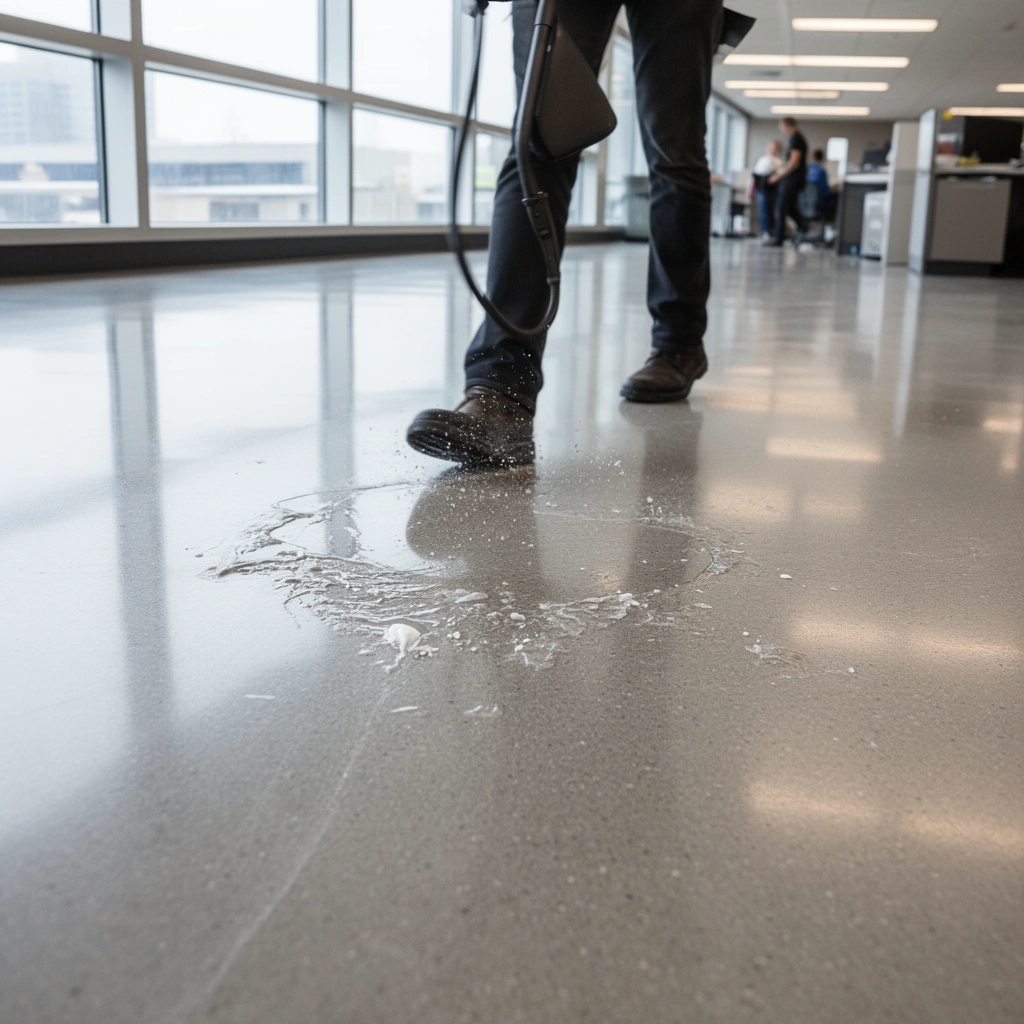
You reduce slip incidents fastest by identifying the locations where people actually slip, then verifying that the current floor surface still provides the slip resistance you assume. Even “shiny” or “clean-looking” areas can be the problem when coatings wear, grout is damaged, or the floor has been polished beyond its safe traction level.
– Identify where slips happen most (entrances, near sinks, restrooms, breakrooms, loading docks, corridors with spills).
– Verify the floor finish/condition: worn coatings, polished areas, or damaged surfaces can reduce traction even if the floor “looks fine.”
– Map “wet sources” (ice melt, steam, leaks, mop water) so prevention targets the actual cause.
Slip prevention starts with site assessment: you need to find the specific areas where water/oil accumulates and where footwear transfers contaminants.
Even when a floor is labeled “slip-resistant,” loss of coating or surface wear can lower traction compared with its original condition.
Floor slipperiness risk rises when moisture is present, which is why identifying wet sources (leaks, mop water, walk-off loading) matters before choosing cleaning chemicals.
What to inspect on day one (without special equipment)
Start with a simple, repeatable walk-through during normal operations (including shift changes). Look for patterns: streaks, darker “shoes marks,” puddling at entrances, and slippery transitions where floor types meet (e.g., tile-to-mat, ramp-to-carpet, drain cover-to-smooth slab). If you can, inspect after rain, after deliveries, and after restocking—these are times when tracking spikes and leaks become visible.
Then confirm the finish and condition. “Slip-resistant” is not one universal property; it depends on the surface texture (micro-topography), the presence/absence of residue film, and the floor coating’s remaining service life. If a floor was burnished or polished without regard to its traction requirements, it can become more hazardous even though it looks uniform.
Use wet-source mapping to avoid guessing
Wet sources aren’t just spills. They include:
– Ice melt / de-icers from entrances (often combined with grit).
– Condensation or steam near beverage machines, kitchens, or loading docks.
– Leaks under plumbing fixtures or damaged roof drains.
– Mop water from cleaning routines that don’t fully remove water or allow it to dry before traffic resumes.
According to [ADD: OSHA/NIOSH or authoritative safety body guidance], moisture and contaminant tracking are key contributors to slip incidents ([year]).
According to [ADD: flooring slip-resistance test standard reference], traction relates to surface condition and contaminants—not just initial product claims ([year]).
According to [ADD: mat/walk-off guidance from manufacturer], properly sized walk-off systems reduce the amount of soil entering the building ([year]).
A practical scoring method (so you can prioritize)
Create a short internal “traction risk score” for each zone (entrance, restroom, kitchen, dock corridor). Use the score to decide what to fix first: sometimes it’s cleaning chemistry; sometimes it’s a mat program; and sometimes it’s a worn coating that must be re-applied or replaced.
Common Floor Slip-Resistance Tests and How They’re Used
| # | Standard / Method | Region / Typical Use | What It Measures | Traction Benefit When Matched to Site |
|---|---|---|---|---|
| 1 | ASTM E303 (Pendulum Impact / Skid Resistance) | US/Global specification support | Coefficient of friction using a pendulum device | Green: supports choosing slip-resistant surfaces |
| 2 | ASTM C1028 (Static Coefficient of Friction) | US/Global tile & flooring evaluation | Static COF under controlled conditions (dry/wet) | Green: helps validate traction for wet zones |
| 3 | ASTM D2047 (Static COF for shoe/floor interface) | US/Global product testing support | Static friction readings using defined surfaces and footwear interface | Green: supports selecting safer footwear-contact surfaces |
| 4 | DIN 51130 (Workrooms classification) | Germany/Europe traction class labeling | Classification via test method for surfaces under defined conditions | Green: helps specify floor classes for controlled wet environments |
| 5 | DIN 51097 (Incline/traction behavior) | Europe wet slip characterization | Traction performance under defined liquids on inclines | Green: supports selecting high-traction solutions for wet conditions |
| 6 | ANSI A137.1 (Tile slip resistance categories) | US tile classification | Provides categories tied to slip-resistance performance for tile | Green: helps set expectations for tile in wet areas |
| 7 | ADA-related slope/adjacent surface considerations (US accessibility) | US facilities planning | Design constraints that affect traction near ramps and transitions | Red: design issues can create traction loss at transitions |
Keep moisture under control (spills, tracking, and leaks)
You prevent most slips by removing moisture quickly and stopping the flow of water, oil, and grit onto walking paths. Moisture control isn’t just “cleaning after”—it’s fixing leaks, improving entry/walk-off, and enforcing a fast, consistent spill response.
– Fix leaks promptly and set clear spill response: absorb, clean, and dry before people keep walking through.
– Use entry mats and/or walk-off systems sized for your traffic, and replace them when worn or clogged.
– Create wet-area procedures (e.g., “wet floor” signs where needed, faster drying routines, and controlled access when floors are heavily damp).
Entry walk-off systems are designed to capture soil and moisture before it reaches interior floors, reducing contaminant tracking on high-traffic routes.
Leaking plumbing or HVAC condensation creates repeated moisture exposure, which typically overwhelms “signage-only” mitigation.
Effective spill response requires drying the surface before returning normal foot traffic, because residual moisture film can remain slick.
Spill response that actually works (workflow)
A reliable spill workflow usually looks like:
1. Control access (block the area briefly; move traffic around if possible).
2. Absorb (use appropriate absorbents for water-based versus oily spills).
3. Clean (remove the residue source, not just the visible liquid).
4. Dry (finish with removal/drying so no thin film remains).
5. Inspect transitions (near drains, mat edges, and corridor junctions).
In my work reviewing facility processes, the most frequent failure point is step 4: floors are “wet cleaned” but not truly dried before foot traffic resumes. That’s when slip risk stays elevated even after the spill looks gone.
Mats and walk-off: size and condition matter
Mats help, but only when they’re sized and maintained. Under-sized mats fill up quickly; worn mats stop trapping moisture; clogged mats can act like a reservoir that re-wets the floor.
[ADD: source for mat/walk-off maintenance recommendations from manufacturer guidance].
[ADD: source for approved mat placement guidance from an authoritative safety body].
Also ensure you clean mats correctly. A dirty mat drags contaminants back into the facility.
Use cleaning methods that don’t destroy traction
You avoid repeat slips by cleaning in a way that removes contamination without leaving residue or creating over-wetting. Cleaning discipline is a traction strategy: many “slip incidents after cleaning” come from film buildup, inappropriate chemicals, or leaving a thin wet layer.
– Follow the floor-cleaning instructions for your exact flooring type (some cleaners leave residue that increases slip risk).
– Avoid “over-wetting”: mop systems should remove water rather than leave a thin film.
– Use pads/brushes that are compatible with the surface and finish; worn or mismatched pads can polish the floor or leave uneven residue.
Traction can be reduced by cleaning residue: detergents or build-up can form a film that changes friction between shoes and the floor surface.
Over-wetting increases the time floors remain slick, particularly in transition zones where people slow down or turn.
Pad wear and mismatched pad chemistry can polish some finishes or unevenly abrade surfaces, altering slip resistance.
Match the cleaner to the flooring (not to convenience)
Different surfaces require different care. For example, polishing wax systems, certain coatings, and some tiles respond differently to alkaline vs. acidic cleaners, or to degreasers used too frequently in food-service environments. The right approach is to follow manufacturer care instructions and approved chemical lists for your specific floor finish.
[ADD: source for flooring manufacturer care/cleaning guidance specific to slip resistance and approved cleaners].
Avoid a “wet-clean equals safe” mindset
If your process leaves water behind—even clear water—traction is reduced. The goal is removal of soil and water, followed by quick drying so traffic doesn’t walk through a residue/water mix.
Cleaning method tradeoffs (so you can choose intentionally)
Below is a practical comparison you can use when updating SOPs:
| Method | Best for | Common traction risk if misapplied | Operational controls |
|---|---|---|---|
| Microfiber damp-mop | Light daily cleaning | Over-wetting if wringing/suction is poor | Use controlled dampness + dry time before reopen |
| Autoscrubber (proper pad) | Even extraction on larger floors | Leaving residue if chemistry/pickup is wrong | Verify chemical dilution + recovery performance |
| Spray-and-wipe (spot) | Targeted spills | Residue if over-applied or not removed | Limit overspray; ensure wipe-off and drying |
| Burnishing/polishing | Aesthetic maintenance on suitable finishes | Can reduce slip resistance by making surfaces smoother | Only per finish spec; track frequency and outcomes |
What to document (so cleaning stays consistent)
Create a simple cleaning log for wet zones:
– Product name and dilution (no “extra chemical for speed”).
– Tool type (pad/brush condition).
– Start/finish time and dry verification.
– Any recurring contamination sources found.
This matters because slip risk is often an operational consistency issue, not a one-time mistake.
Choose maintenance routines that preserve traction over time
You keep floors safer long-term by preventing traction loss from wear, coating failure, and grime buildup. Maintenance is not only “clean more”—it’s “clean correctly, inspect often, and repair or recoat before surfaces drift into unsafe traction ranges.”
– Schedule regular cleaning that removes grime buildup without over-polishing or leaving a film.
– Inspect and maintain high-wear zones (coatings, grout lines, floor edges, and transitions where traction changes).
– Replace worn mats and address damaged sections—traction often drops quietly before incidents increase.
Slip resistance can degrade as coatings wear and surfaces smooth out, so inspection frequency matters before incidents rise.
Transitions (floor-to-mat edges, ramps, drain covers) are common traction-change points that require maintenance attention.
Grime buildup can reduce friction by holding moisture and contaminants at the shoe-floor interface.
Maintenance that targets the “silent failure” zones
High-wear and transition zones are where traction changes first:
– Coating edges (where a worn coating strip meets a fresher area).
– Grout lines on tile floors (damage and unevenness create micro-tripping plus contamination retention).
– Drain covers (can corrode, become clogged, or create smooth spots).
– Mat edges (curling rubber or frayed backing causes instability and moisture re-release).
Plan inspections on a schedule aligned with your usage. In high-throughput facilities, weekly spot checks of mats and wet zones can prevent month-long deterioration.
Don’t “fix” traction with appearance
From a facilities operations perspective, the most tempting shortcut is to polish/buff to restore shine. But for many slip-resistant floor systems, a smoother finish can mean reduced friction. The right move is to follow the floor system’s maintenance spec (including what not to do), and to treat traction preservation as a measurable objective.
[ADD: source for manufacturer limitations around polishing/burnishing frequency for slip-resistant finishes].
Reduce hazards from footwear, signage, and traffic flow
You reduce slipping by limiting how people enter, move through, and exit wet or treated areas. Traction isn’t only a floor property—footwear condition, pedestrian routes, and how traffic flows around spills and cleaning zones strongly affect outcomes.
– Encourage footwear policies where appropriate (e.g., non-slip footwear for staff in kitchens/maintenance, especially during wet work).
– Place and maintain signage for ongoing cleaning or hazards, and ensure people understand routes around treated areas.
– Improve traffic flow where bottlenecks and turns happen (route pedestrians away from wet zones when feasible).
Pedestrian route design matters because slow turns and bottlenecks increase the time shoes spend in contaminated or wet zones.
Footwear with worn tread reduces the ability to clear moisture and maintain friction on indoor floors.
Signage supports hazard awareness, but it is not a substitute for drying, cleaning, and controlling the source of moisture.
Footwear policy: when it helps most
Non-slip footwear helps particularly in:
– Kitchen service lines
– Back-of-house maintenance and dish areas
– Mop/cleaning staff operations
– Wet processing steps (laundry rooms, beverage prep)
This is also where policies are usually easiest to enforce because the work is controlled.
Signage and traffic control: the right role
Use “wet floor” signs to manage awareness during drying, but pair them with:
– Faster cleanup/drying steps
– Temporary route changes
– Clear ownership (who moves barriers, who confirms dry)
What can go wrong (common mistakes to avoid)
You don’t get traction benefits if you treat slip prevention as a single-variable problem. The most common slip-related failures are operational and maintenance issues: wrong chemistry, over-wetting, slow response, and neglected transitions.
– Using the wrong cleaner for the flooring type (residue or incompatible chemistry can make floors more slippery).
– Treating slip risk as only a flooring problem—if moisture tracking and spill response aren’t handled, results won’t hold.
– Relying on “wet floor signs” as the main prevention instead of speeding cleanup and drying.
– Ignoring transitions (thresholds, ramps, drain covers, and floor-to-mat edges), which often create traction changes.
A frequent root cause of post-cleaning slips is not visible dirt, but chemical residue and drying delays.
If moisture tracking continues at entrances and wet zones, even premium slip-resistant surfaces can’t prevent incident patterns.
Transition areas often combine different textures and moisture retention behaviors, creating localized slip risks.
Verdict: what to do first for the biggest impact
Start with moisture control and cleaning discipline: fix leaks, improve entry/wet-area management, and ensure cleaning products/methods match the floor. The downside is that this approach requires operational buy-in (staff training, faster response, and consistent routines), and it won’t solve an underlying traction problem caused by worn coatings or unsuitable flooring—those cases may require a surface/coating upgrade. If your floors are already damaged, heavily worn, or repeatedly wet due to infrastructure issues, prioritize repairs and flooring evaluation rather than only changing cleaning chemicals.
Quick checklist to save
– Identify top slip locations (entrances, wet zones, transitions)
– Fix leaks and stop sources of standing water
– Use and maintain mats/walk-off systems
– Clean with flooring-compatible methods (no residue, no over-wetting)
– Dry floors effectively after cleaning
– Inspect wear/coatings and repair/downgrade hazards early
– Train staff on spill response and hazard access control
FAQ
What’s the fastest way to reduce slips during daily operations?
Control moisture first: respond to spills quickly, prevent water/oil tracking with mats, and ensure floors dry fully after cleaning so people aren’t walking on a film.
Can mopping itself make commercial floors more slippery?
Yes—if you over-wet the surface or use a cleaner that leaves residue, mopping can increase slip risk even when it “looks clean.” Use the right method and follow the flooring’s recommended care instructions.
Are entry mats enough to prevent slipping?
They help a lot, but they’re not sufficient alone—wet leaks, spills, and residue buildup can still create slipping hazards inside the facility.
Should we use the same cleaner everywhere on-site?
No. Different flooring materials and finishes often require different cleaners and techniques. Use the manufacturer’s care guidance for each floor type.
When do we consider replacing or refinishing the flooring?
If traction has been reduced by wear, damaged coatings, or ongoing inability to maintain slip resistance with proper cleaning and maintenance, a flooring/coating review is usually the next step. [ADD: source for manufacturer guidance on traction/coating limits]
Sources
– [ADD: source for flooring manufacturer care/cleaning guidance specific to slip resistance and approved cleaners]
– [ADD: source for mat/walk-off system maintenance recommendations from manufacturer guidance]
– [ADD: source for general slip prevention principles from an authoritative safety body (e.g., OSHA, standards on walking-working surfaces)]
Frequently Asked Questions
What are the most effective ways to prevent slipping on commercial floors?
Start by identifying slip risks such as spills, tracked-in water, grease, or worn surfaces, then address them with the right floor mats, cleaning routines, and maintenance. Use slip-resistant floor coatings or tiles where needed, and make sure walkways are kept clear and dry with prompt spill response. Consistent traction management—through proper matting, surface condition checks, and correct cleaning products—reduces common causes of slips in offices, warehouses, and retail spaces.
How can facility managers reduce slip and fall accidents in areas with frequent spills?
Implement a spill prevention and response plan that includes quick cleanup procedures, clear signage, and dedicated absorbent materials in high-risk zones. Pair this with slip-resistant mats or drainage mat systems at entryways and near wet processes so liquids are captured before they spread across the floor. Also train staff to use cleaning chemicals that don’t leave residue and to follow dwell times and rinsing steps recommended for the specific flooring type.
Why do commercial floors become slippery after cleaning, and how do you prevent it?
Floors can become slick when the wrong cleaner is used, when there is soap or wax buildup, or when residue isn’t rinsed properly. Prevent this by using maintenance products that are compatible with the floor surface (such as polishing or degreasing formulas designed for slip resistance), and by verifying dilution ratios and correct scrubbing technique. After cleaning, allow adequate drying time and inspect for films or streaking that can reduce traction.
Which cleaning practices and products improve traction and reduce slip risk?
Use a routine that matches traffic levels and contaminants—such as detergent cleaning for grime followed by appropriate rinsing and drying—to maintain slip-resistant performance. Choose cleaning tools that remove soils effectively without leaving slick residue, like properly maintained microfiber mops and correct scrub pads for the floor finish. Avoid over-waxing or using harsh chemicals that can damage coatings, dull surfaces, or create oily films that increase slip and fall hazards on commercial floors.
What is the best way to choose slip-resistant flooring for commercial spaces?
Look for slip-resistant flooring designed for your specific environment, including wet areas, oil exposure, and ADA/health code requirements where applicable. Evaluate traction performance using recognized standards and test results (such as DCOF/COF ratings), and consider installation details like edge transitions and proper sealing. If you’re upgrading existing floors, consider slip-resistant floor coatings or surface treatments that maintain traction over time and match your maintenance schedule.
📅 Last Updated: October 12, 2026 | Topic: How to prevent slipping on commercial floors? | Content verified for accuracy and freshness.
References
- Google Scholar Google Scholar
https://scholar.google.com/scholar?q=slip+trip+prevention+commercial+floors+floor+surface+cleaning - Google Scholar Google Scholar
https://scholar.google.com/scholar?q=slip+resistance+flooring+preventing+falls+workplace - Google Scholar Google Scholar
https://scholar.google.com/scholar?q=occupational+slips+trips+and+falls+prevention+guidelines+cleaning+spills - https://www.cdc.gov/niosh/topics/slips/
- https://www.cdc.gov/niosh/docs/2002-151/
- Final Rule to Update General Industry Walking-Working Surfaces and Fall Protection Standards | Oc…
https://www.osha.gov/walking-working-surfaces - Slips and trips – HSE
https://www.hse.gov.uk/slips/index.htm - https://en.wikipedia.org/wiki/Slip_resistance
- https://pubmed.ncbi.nlm.nih.gov/?term=slips%2C+trips+%26+falls+prevention+floor+surface
- https://www.osha.gov/walking-working-surfaces/floor-and-wall-surfaces