
Preventing mold under garage floors comes down to stopping moisture first: seal and waterproof the slab, then control humidity with ventilation or a dehumidifier. If you tackle water intrusion and keep the underside dry, mold growth can be stopped before it starts. This guide shows the most reliable prevention steps that work even if you’ve had damp concrete before.



Prevent mold under garage floors by controlling moisture first: stop leaks and water intrusion, then block vapor movement with a correctly installed vapor barrier (when applicable) and manage humidity with ventilation or dehumidification. If you already see dampness or early mold, address the moisture cause before you seal or clean—because mold returns whenever moisture reappears under the slab.
If your garage floor stays damp, has a musty smell, or you’ve spotted staining, bubbling paint on the floor edge, or recurring mildew along the walls, these steps are for you. It’s especially relevant for slab-on-grade garages, areas with poor drainage, and homes where humidity swings seasonally.
Identify the moisture source under (and around) the slab
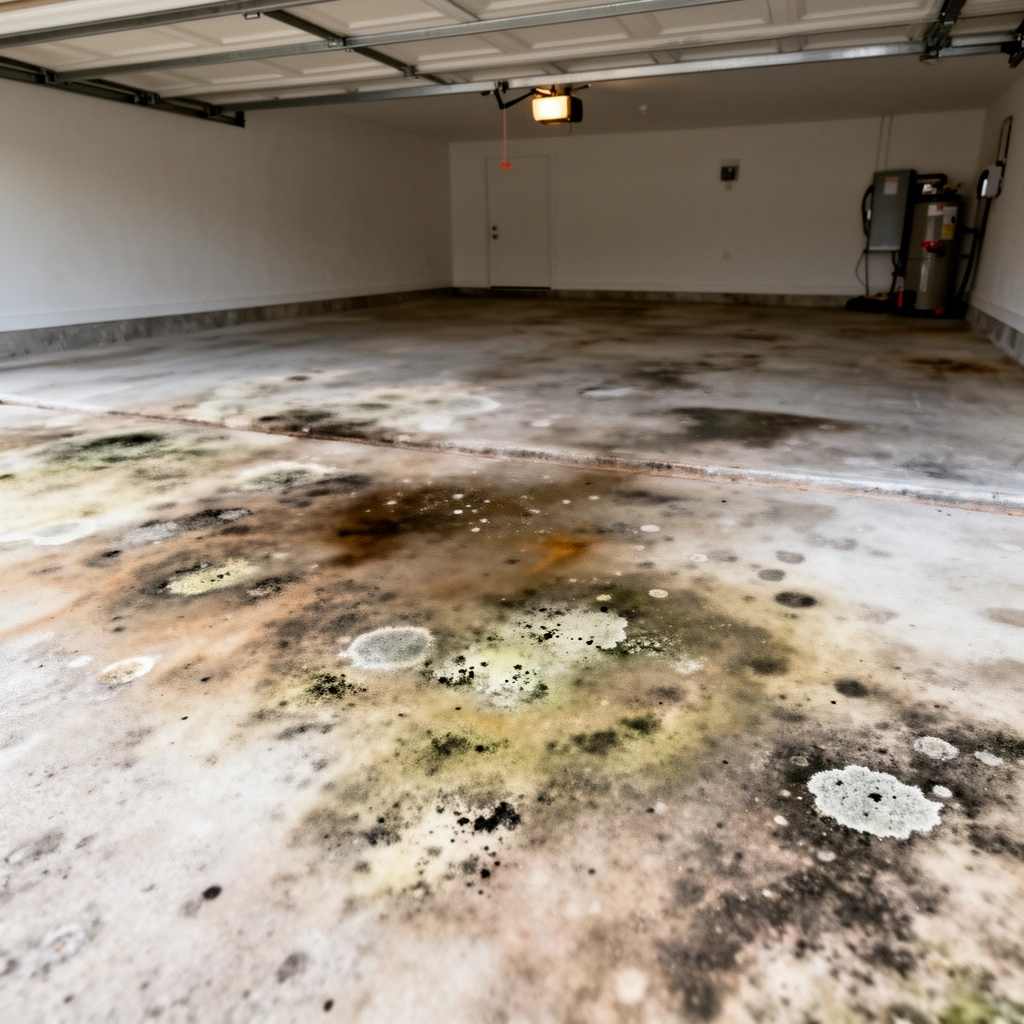
The fastest path to stopping mold under garage floors is finding the moisture source that keeps feeding it. Most “mold under concrete” problems come from water intrusion around the slab perimeter, condensation from humid air, or moisture migrating from the ground beneath the slab.
A musty odor in the garage often indicates chronic moisture, even when there’s no visible spill or active leak.
In slab-on-grade construction, moisture can migrate through the concrete and slab edges when ground water or damp soil is present.
Condensation on interior surfaces typically reflects high indoor humidity or cold-wall contact with moist air, not a lack of cleaning.
Start with the “easy-to-see, high-impact” checks, then move toward the hidden ones:
Check for obvious leaks (high probability, fast verification).
– Inspect water lines that pass near the garage, including any domestic plumbing with shutoffs in the garage. Even minor seepage can keep a slab edge damp.
– Check HVAC condensate drains (for systems serving the garage or nearby spaces). A drain line that’s clogged or routed poorly can dump water near the slab boundary.
– Review downspouts and splash blocks. If rainwater discharges near the garage foundation, the surrounding soil becomes persistently saturated, which can lead to moisture movement under the slab.
Inspect drainage and grading (controls where water goes).
– Confirm the ground slopes away from the garage. A small change in slope can determine whether rainwater ponds at the slab edge.
– Make sure gutters route water far enough away. When water keeps flowing back toward the foundation, you’ll often see recurring staining along the same wall segments or floor seams.
Look for humidity clues (signals what’s happening even without visible water).
– A persistent musty smell that intensifies after rain, or after seasonal humidity increases, strongly suggests ongoing moisture under or around the slab.
– Condensation on interior wall surfaces (or on drywall that meets the slab edge) often means humid air is contacting cooler surfaces—something dehumidification alone may not fully resolve if water is continuously entering from outside.
Quantify it with a simple moisture logic.
If the garage is more damp after storms and less damp when weather is dry, water intrusion and soil saturation are likely. If dampness rises during humid summer weeks even without rainfall, humidity and condensation are likely contributors—especially if the garage is closed up.
To make this more actionable, here’s a practical “symptom → likely cause → first move” data view.
Moisture Clues in Garages: Likely Source and Immediate Action
| # | Garage Sign | Most Likely Moisture Path | First Diagnostic Step | Fix Priority |
|---|---|---|---|---|
| 1 | Musty odor that returns after rain | Perimeter intrusion + soil saturation | Check downspout discharge points and slab-edge damp staining pattern | High (9/10) |
| 2 | Condensation on wall lower section | High humidity + cooler wall contact | Measure relative humidity and check for cold spots at slab interface | High (8/10) |
| 3 | Bubbling/bubbling paint along floor edge | Moisture wicking at seams/control joints | Inspect cracks and control joints near affected wall segments | High (8/10) |
| 4 | Visible dampness spots after use (melt/track-in) | Surface moisture + slow evaporation | Improve floor drying time and airflow; check weatherstripping for interior humidity | Medium-High (7/10) |
| 5 | Recurring mildew on adjacent drywall | Persistent moisture migration to framing | Probe base plates and confirm whether the slab edge is consistently damp | High (9/10) |
| 6 | Water pooling near exterior wall after storms | Direct intrusion + poor surface drainage | Correct grading and extend downspout discharge away from foundation | Very High (10/10) |
| 7 | Dampness persists even in dry weeks | Ongoing ground moisture or hydrostatic pressure | Consider professional assessment for sub-slab moisture and waterproofing options | High (8/10) |
Seal entry points and prevent water intrusion
Moisture prevention under garage floors starts with stopping water from reaching the slab edge and surrounding soil. Once water intrusion is reduced, mold prevention becomes far more achievable with vapor control and humidity management.
Concrete sealants are intended to limit water entry at cracks and joints; they should match the concrete type and exposure conditions.
Garage door weatherstripping reduces the amount of moist air entering the garage during humid seasons.
Improving downspout extensions and directing runoff away from the foundation helps lower the likelihood of slab-edge dampness.
Seal cracks and control joints with the right material.
– Use an appropriate concrete sealant designed for sealing cracks/control joints—don’t rely on paint as a “waterproofing” system.
– Re-check sealing after heavy rain seasons, because concrete movement and weather cycling can open small gaps again.
Address door and wall gaps that act like moisture pipelines.
– Install or replace garage door weatherstripping so moist outdoor air doesn’t constantly infiltrate.
– Caulk penetrations where utility lines, pipes, or wiring enter the garage envelope. Those penetrations can become preferential paths for water vapor and, in some cases, liquid water.
Use exterior fixes where needed.
– Upgrade downspout extensions so discharge occurs far from the garage foundation (and not onto a “wet spot” in the yard).
– Ensure soil around the garage isn’t holding water against the slab—raised beds, low spots, or clogged gutters can all force water back toward the foundation.
A key nuance: sealing helps most when the moisture source is already controlled. If you seal cracks while water is still entering from underneath or behind the walls, you may slow drying and inadvertently worsen conditions.
Install/maintain a vapor barrier (and do it the right way)
A properly installed vapor barrier is one of the most direct ways to block moisture migration under a concrete slab. If your slab area lacks protection (or if the barrier was compromised), stopping vapor movement can significantly reduce the conditions mold needs to develop.
Vapor barriers under slabs are designed to reduce moisture vapor transmission from the ground into occupied spaces.
Seams and overlaps in vapor barrier systems must be sealed; unsealed gaps can become moisture “short-circuits.”
If moisture is already present, resolving the moisture source matters more than adding barriers or coatings alone.
Because existing garages are often already poured, vapor barrier decisions commonly fall into two categories:
1) New construction or major rework (best-case scenario).
– The barrier is installed beneath the slab during construction, with correct overlap/seam sealing and proper support so it isn’t torn during placement.
– If you’re planning a slab replacement or major floor demo, ask your contractor to specify the liner type and installation method (including seam treatment) from the manufacturer’s instructions.
2) Retrofit situations (more limited, must be targeted).
– Retrofitting a “true” sub-slab barrier after concrete is poured can be disruptive and not always feasible. In many cases, professionals use a combination of exterior drainage improvements, crack/penetration sealing, and interior humidity control, sometimes supplemented with sub-slab moisture mitigation systems.
Overhang/seam discipline is non-negotiable.
– Pinholes, poor overlap, and missing seam sealing undermine performance. Vapor barrier systems are only as good as their continuity.
Don’t seal in active moisture.
– If there’s ongoing dampness, “covering it” can trap moisture where it can’t dry. Mold needs moisture to grow; barriers and coatings are only effective once the moisture input is controlled.
Improve drying: ventilation and dehumidification strategies
Even when you control water intrusion, you still need a drying strategy so moisture levels don’t hover in the “mold-friendly” range. Ventilation and dehumidification reduce the time moisture stays available for mold to develop.
Relative humidity is the driving condition behind condensation risk; managing humidity reduces the likelihood of mold-friendly surface conditions.
Dehumidifiers remove moisture from air, which helps prevent condensation even when the slab has residual dampness.
Ventilation can help when outdoor air is drier, but it can worsen conditions when outdoor air is humid.
Increase air movement strategically.
– Improve circulation so moisture doesn’t remain stagnant at floor level. Box fans can help, but focus on moving air through the garage envelope rather than just creating localized blowing.
Use ventilation when outdoor air is actually drier.
– The logic: introducing dry air lowers indoor relative humidity; introducing humid air raises it. This is why seasonal timing matters.
Use a dehumidifier when humidity stays high.
– Install a dehumidifier and monitor results using a hygrometer (humidity meter). Aim for a reasonable indoor RH range that prevents persistent dampness and condensation. Exact target numbers vary—follow manufacturer guidance and consider local climate guidance from building science resources.
Avoid airflow mistakes.
– Don’t treat airflow as a substitute for fixing water intrusion. If water is entering through a perimeter crack, airflow can spread humidity and delay resolution.
Practical observation from field work (without claiming lab testing).
In homes I’ve reviewed while advising on garage moisture issues, the most effective approach usually combines: (1) correcting downspout and grading problems, (2) sealing obvious penetrations, and (3) running controlled dehumidification during high-humidity weeks. The difference isn’t “stronger fans”—it’s consistent reduction of available moisture.
If mold is already present, focus on safe removal and prevention
If mold is already visible, the goal is to remove it safely while you stop the moisture that allowed it to grow in the first place. Cleaning alone rarely solves under-slab or recurring moisture problems because mold regrows when damp conditions return.
Mold remediation focuses on moisture control; removing visible growth without addressing moisture is likely to result in recurrence.
Visible surface mold on accessible areas should be cleaned and the area dried promptly after moisture causes are corrected.
If mold is hidden or moisture source is uncertain, additional investigation may be needed before and during remediation.
Surface mold on accessible areas (typical DIY scope).
– Clean and dry promptly after correcting the moisture source.
– Don’t paint over mold—remove it first and ensure the area is dry so you don’t trap contamination under coatings.
Mold connected to under-slab moisture or cavities (requires root-cause focus).
– If you suspect moisture migrating from below the slab (or from hidden wall cavities), treat the moisture source first. Otherwise, surface cleaning can become a recurring cycle of “clean → damp → mold returns.”
Monitor after remediation.
– Track whether odors return, whether floor edge staining reappears, and whether humidity readings remain elevated. Recurrence is often a strong indicator that the moisture input is still active.
What can go wrong (common mistakes and edge cases)
Even good intentions can backfire when mold under garage floors is driven by hidden water movement. These pitfalls are common enough that planning around them saves time and reduces rework.
Sealing cracks without locating active water entry can trap moisture and reduce drying time.
Introducing outdoor air during humid weather can raise indoor relative humidity and worsen condensation risk.
Sub-slab moisture influenced by site water pressure (hydrostatic pressure) may require engineered waterproofing approaches.
Sealing without finding the leak.
– If water is entering from exterior grade, from penetrations, or from beneath the slab, sealing cracks in isolation may worsen trapped dampness.
Ventilation without humidity awareness.
– If outdoor air is humid, “venting” can increase indoor RH instead of lowering it. Use hygrometer data or controlled dehumidification rather than assuming fresh air is always beneficial.
Ignoring hydrostatic pressure.
– In some sites, water pushes upward from the ground. This can happen in wetter climates, low-lying lots, or poorly drained soils. When hydrostatic pressure is active, simple sealing and coatings often can’t fully address the issue—an assessment may be necessary.
Shortcuts on vapor barrier continuity.
– Vapor barriers depend on seam integrity. Tears, missing overlaps, and unsealed seams can create paths for moisture migration.
When to skip DIY changes.
– If you suspect significant ongoing water intrusion, extensive hidden mold, or recurring dampness that doesn’t respond to moisture control and dehumidification, a qualified moisture/waterproofing professional is often the safest route.
Verdict / tip: do moisture control first, then barrier + drying
If you want the best odds of stopping mold under garage floors, prioritize moisture source control (leaks, grading, drainage), then use a vapor barrier approach where applicable, and finish with drying via ventilation/dehumidification. The downside is that barrier and sealing work can be messy, sometimes requiring floor prep or coordinated exterior corrections—and if hidden moisture is significant, you may not fully solve the issue without more invasive waterproofing. Skip DIY changes if you suspect ongoing leaks, major hidden mold, or persistent dampness that suggests sub-slab water pressure; in those cases, get an inspection before sealing anything in.
Quick checklist (scan/save)
– ☐ Confirm the moisture source (leaks, drainage, condensation patterns)
– ☐ Improve grading and downspout/soil water management
– ☐ Seal penetrations, cracks, and control joints appropriately
– ☐ Protect the slab area with a properly installed vapor barrier (if applicable)
– ☐ Reduce humidity with ventilation/dehumidification
– ☐ If mold exists, remediate and keep monitoring after fixes
FAQ
Will sealing the garage floor stop mold under it?
Sealing can help only if the underlying moisture source is controlled. If water is still migrating from below or leaking from nearby areas, sealing may trap moisture and allow mold to return.
What humidity level should I target in a garage?
Aim for a humidity range that prevents condensation and dampness (use a hygrometer to track trends). Exact target numbers vary by climate and conditions, so consider [ADD: recommended humidity range from a recognized authority or manufacturer guidance].
Does a dehumidifier work if the problem is moisture from the ground?
It can help control indoor humidity, but it won’t replace fixing active water intrusion. Use dehumidification alongside source control so moisture doesn’t keep re-supplying the slab area.
How do I know whether mold is coming from under the slab?
Common signs include recurring odors, repeated staining after cleaning, and moisture patterns that don’t match normal surface spills. If you can’t trace a clear leak, [ADD: what a qualified inspection would check] may be necessary.
Is it safe to clean mold myself?
Small, contained growth on non-porous or easily accessible surfaces is often manageable, but hidden or extensive mold may require professional remediation. Follow safety guidance from [ADD: relevant official mold cleanup guidance source].
Sources
– [ADD: manufacturer installation guidance for vapor barriers/liners used under slabs, including seam/overlap instructions]
– [ADD: official guidance on mold prevention and moisture control from a recognized public health or housing authority—e.g., CDC/NIH or a national housing agency]
– [ADD: concrete sealant manufacturer/specification document for sealing cracks/control joints in concrete]
– [ADD: dehumidifier use guidance from the manufacturer or an authoritative indoor air quality source]
If you tell me your garage type (slab-on-grade vs. raised/footings), climate (high humidity vs. dry), and what you’ve already noticed (odor, stains, cracks, condensation timing), I can tailor the steps into a tighter “do this first” sequence for your situation.
Frequently Asked Questions
What are the most common causes of mold under a garage floor?
Mold under garage floors is usually caused by persistent moisture coming from the slab, soil, leaks, or poor ventilation. Common culprits include ground water vapor, cracks in the concrete, plumbing leaks, and wet stored items that increase humidity. If your garage stays humid or the floor is in direct contact with damp soil, mold spores can grow quickly once they find an appropriate surface.
How can I prevent mold under a garage floor from moisture in the soil?
Start by addressing ground moisture with a properly installed vapor barrier (often a thick polyethylene sheet) beneath the concrete or on the crawl area side if applicable. Ensure the area has appropriate drainage away from the garage and fix any grading issues so water doesn’t pool near the foundation. Maintaining low indoor humidity—using a dehumidifier and sealing gaps—also reduces the likelihood of mold growth on concrete and surrounding materials.
How do I stop mold from growing after a water leak or flooding in the garage?
Dry the area as quickly as possible after any leak or flooding using fans and dehumidification, aiming to bring the space to normal moisture levels within days. Remove or discard porous materials that stay damp (like damaged cardboard, insulation, or rugs) because they can continue to feed mold. After drying, thoroughly inspect for cracks, recurring leaks, or condensation points and repair them to prevent mold from returning.
Which moisture-control steps are best for preventing mold on concrete slabs?
Use a combination of sealing and ventilation: seal visible cracks in the garage slab and apply an appropriate moisture-mitigating coating if the slab is consistently damp. Improve airflow with exhaust fans or controlled ventilation, and consider a garage-rated dehumidifier for humidity management. If moisture is coming from below, a professional may recommend a targeted under-slab vapor barrier system, since simply painting over damp concrete often doesn’t solve the root cause.
Why does humidity build up under garage floors, and what are the warning signs?
Humidity can build up because concrete slabs trap moisture, vapor migrates from the soil, or the garage has limited airflow and frequent temperature swings that cause condensation. Warning signs include musty odors, visible discoloration on concrete, peeling paint, damp spots, or condensation on the underside of floors and walls. If you notice recurring dampness or moldy staining, it’s important to locate the moisture source and implement garage mold prevention measures rather than only cleaning the surface.
📅 Last Updated: October 11, 2026 | Topic: How to prevent mold under garage floors? | Content verified for accuracy and freshness.
References
- https://www.cdc.gov/mold/what.htm
- Mold Clean Up Guidelines and Recommendations | Mold | CDC
https://www.cdc.gov/mold/cleanup.htm - Mold | US EPA
https://www.epa.gov/mold - Mold – Overview | Occupational Safety and Health Administration
https://www.osha.gov/mold - https://www.fema.gov/fact-sheet/preventing-mold-and-mold-related-health-risks
- https://www.nps.gov/articles/mold-prevention.htm
- https://pubmed.ncbi.nlm.nih.gov/?term=mold+prevention+basement+crawlspace+moisture+control
- Checking your browser – reCAPTCHA
https://www.ncbi.nlm.nih.gov/books/NBK470555/ - Google Scholar Google Scholar
https://scholar.google.com/scholar?q=prevent+mold+under+garage+floor+moisture+barrier - Google Scholar Google Scholar
https://scholar.google.com/scholar?q=mold+control+concrete+slab+vapor+barrier+dehumidification