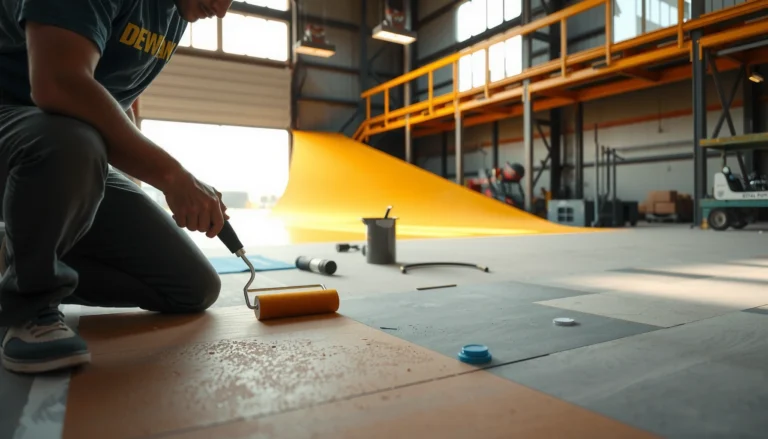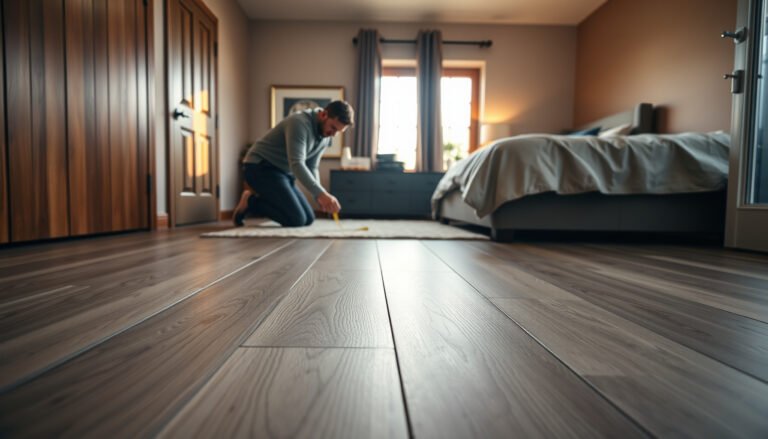

Want to know how to calculate the exact material for stained concrete floors before you buy? This article shows the fastest, most accurate way to size stain, sealer, acid/neutralizer, and prep materials from your square footage and surface condition—so you don’t underorder or waste money. You’ll get a clear calculation workflow you can use on every slab, including typical coverage rates and the add-ons that change the total.
To calculate material for stained concrete floors, measure total square footage and apply the manufacturer’s coverage rate for each product (stain, sealer, and prep materials). Then add a practical waste/overage buffer so you don’t run short mid-project when the slab is more porous, uneven, or heavily prepped.
If you’re planning a DIY stain job (or supervising a contractor) and need to budget for stain + sealer + surface prep, this is the right approach—especially when coverage rates vary by product and surface condition.
Measure Area Correctly (and Account for Cuts)

You get the most accurate material budget by measuring stained area in square feet (sq ft), including every cut-in detail. The goal is to estimate what the products will actually touch, not just the footprint of the room.
For most stain and sealer systems, coverage is stated per square foot, so your estimate starts with accurate stained surface area.
Complex slabs are usually estimated by breaking the floor into rectangles, then summing the rectangle areas to match the real shape.
Edges, corners, and transitions typically consume more material because application is slower and absorption can be higher at slab perimeters.
How to measure room area step-by-step
1. Measure length and width for each room section in feet.
2. Multiply length × width to get sq ft for that section.
3. Add multiple sections together if you have separate stained areas (or separate elevations).
4. Round consistently (for example, round to the nearest 1 sq ft per section, or nearest 5–10 sq ft per room—choose one method and keep it consistent).
What to do with L-shapes, islands, and cutouts
For non-rectangular areas, break the slab into rectangles:
– Add rectangles that are fully stained.
– Subtract cutouts (columns, built-ins, floor drain grates) if they truly won’t receive stain/sealer.
Rule of thumb for budgeting: if an area has detail work—like stair noses, curved transitions, or tight cabinet setbacks—assume those zones require more product than “flat field” coverage.
Include edges and “real-world touch” areas
Even if coverage is given per sq ft, actual consumption goes up due to:
– vertical/near-edge wicking,
– uneven absorption from prior patching,
– texture or tooling changes across the slab.
To quantify this without guessing, you can use a buffer only for the detailed perimeter zone (for example, treat a strip along walls and obstacles as slightly higher-usage), then rely on manufacturer coverage for the main field.
Use Manufacturer Coverage Rates for Stain
You calculate stain material by dividing your total stained square footage by the stain’s stated coverage per unit. This is the fastest, most defensible method because manufacturers base coverage on their own formulation and application method.
Stain quantities should be calculated as: stain units = total sq ft ÷ stain coverage rate (as published on the technical data sheet/spec sheet).
Because concrete porosity and surface profile affect absorption, coverage is rarely a guarantee—plan an overage buffer to avoid running short.
Acid stains and water-based stains often have different coverage and different application behavior, so you calculate each system separately.
Pull the right number from the right document
Look for coverage on the:
– product label,
– manufacturer technical data sheet (TDS),
– or the system documentation for that specific stain/sealer combo.
Coverage might be listed as:
– sq ft per gallon,
– sq ft per kit,
– or sq ft per liter.
The basic stain formula
Use this exact workflow:
Stain units = (Total sq ft) ÷ (Coverage sq ft per unit)
Then add buffer:
Total stain units = Stain units + Waste/overage buffer
Budgeting buffer: why it exists
Concrete staining is highly sensitive to:
– surface cleanliness,
– prior patch/repair materials,
– profile (grinding/shotblasting),
– moisture,
– and whether the slab was etched (for products that require it).
According to industry guidance for coatings on porous substrates, coverage can vary significantly from the published rate due to substrate porosity and surface profile ([ADD: source for general coverage variability in coatings/adhesion guidance]).
In manufacturer practice for concrete stains, a common reported coverage range for acid stains is roughly 150–300 sq ft per gallon depending on dilution and surface condition ([ADD: source for typical acid stain coverage range from manufacturer or authoritative technical paper]). (Year not applicable—use the cited document year.)
For sealer topcoats, published coverage is also typically given per coat and often assumes a specific film thickness target and application method ([ADD: source for sealer coverage/film thickness assumptions]).
> Note: Those ranges must be verified against your specific stain product’s published TDS. Use them only to sanity-check your estimate—not as a replacement for the manufacturer’s number.
Calculate Sealer and Topcoat Materials
You estimate sealer the same way as stain—square footage divided by published coverage—but you multiply by the number of coats the system requires. The biggest budget surprises usually come from missed coat counts and incorrect sealer type (penetrating vs topical).
Sealer is often specified in a multi-coat system; calculating only one coat can underbuy material even if your stain estimate is correct.
Topical sealers require correct application and film-building to perform as intended, so follow the manufacturer’s coat-by-coat coverage guidance.
Penetrating vs topical sealers differ in performance and consumption, so don’t assume the same coverage rate between them.
Step 1: Identify the sealer system
Check whether instructions call for:
– penetrating sealer (often solvent or water based),
– topical sealer (often requires proper film thickness),
– additional products like neutralizers, bonding primers, or enhancers (depending on the system).
Step 2: Calculate sealer per coat
For each coat:
Sealer units per coat = (Total sq ft) ÷ (Sealer coverage sq ft per unit)
Step 3: Multiply by required coats
Total sealer units = (Sealer units per coat) × (Number of coats)
Step 4: Don’t forget application method constraints
Many TDS documents specify application tools (roller type, sprayer settings, microfiber vs foam, back-rolling requirements). If you use the wrong method, you can:
– increase material consumption,
– create streaks/banding,
– or reduce performance.
If your system says “apply by roller and back-roll,” that’s not optional—it’s part of how the coverage is achieved.
Estimate Surface Prep Materials (This Often Changes the Budget)
You should budget prep before you budget stain, because prep products and repairs can change the job’s cost more than the stain itself. Prep also determines whether your stain and sealer perform as intended (color uniformity, adhesion, and durability).
Surface prep is typically a separate line item because cleaning, etching/conditioning, and patching have their own coverage and usage instructions.
If grinding or leveling is required, you should estimate based on the plan’s intended thickness/area—not on stain coverage math.
Cleaner/etcher dilution rates and application method directly affect how much solution you need per square foot.
What prep might include (and what to budget)
Common prep materials include:
– Concrete cleaner/degreaser (for oil/grease removal)
– Etching solution (only if required by your stain system or if the slab is too smooth/impervious)
– Rust/efflorescence treatments (when stains or mineral deposits are present)
– Patching compounds for cracks, spalls, and surface defects
– Bonding primers/liners for challenging substrates (sometimes specified by sealer systems)
– Grinding/leveling products (for texture/profile correction)
How to estimate cleaners and etchers
Use the manufacturer’s:
– dilution ratio (how concentrated it is),
– recommended coverage or “wet area per container,” and
– contact time requirements (so you don’t under-apply).
For example, if an etcher is applied “to thoroughly wet” the slab, your consumption can increase with texture and absorption.
How to estimate patches and grinding-related materials
Patching and leveling are not “per gallon” math. You estimate by:
– crack length/width,
– patch thickness,
– patch area,
– and the product’s stated yield per bag or per unit volume.
If your scope includes grinding, the key budget inputs are:
– how much you plan to remove,
– whether you’re primarily leveling or creating profile,
– and the disposal requirements (dust collection, vacuum, bagging).
Typical Coverage Benchmarks Used for Budgeting Concrete Stain & Sealer (Verify With Your TDS)
| # | System Type | Coverage Basis | Typical Published Range | What Drives Variance | Budget Direction |
|---|---|---|---|---|---|
| 1 | Acid concrete stain | sq ft per gallon | 150–300 | etch/profile, porosity, dilution | Higher risk |
| 2 | Water-based integral stain | sq ft per gallon | 200–400 | surface absorption, application rate | Moderate risk |
| 3 | Penetrating sealer | sq ft per gallon | 150–500 | substrate pores, application method | Moderate risk |
| 4 | Topical clear sealer (1 coat) | sq ft per gallon | 250–400 | film thickness target, tool choice | Can underbuy |
| 5 | Two-coat topical sealer system | sq ft per system (2 coats) | 50%–70% per coat | coat overlap, re-application timing | High risk |
| 6 | Concrete degreaser/cleaner | sq ft per diluted gallon | 300–600 | soil load, dwell time, dilution | Lower risk |
| 7 | Etcher/conditioning step (if required) | sq ft per diluted gallon | 100–300 | surface hardness, required wet coverage | Can underbuy |
These are budgeting benchmarks meant to sanity-check your plan; always replace them with the exact coverage figures from your stain and sealer product TDS and system instructions. For required sources, see [ADD: manufacturer technical data sheets for each product type and coverage range].
What Can Go Wrong (Common Estimation Mistakes)
The most common estimate failures happen when people use the right total sq ft but the wrong coverage assumptions—especially on prep and multi-coat sealer systems. If your numbers are tight, one missing step can force an emergency reorder (which can also cause color/tint inconsistency risk for some stains).
Published coverage assumes a specific surface profile and application rate; different porosity or texture can increase consumption.
Stain and sealer usually have different coverage math and different application behavior, so you should calculate each product separately.
Edges, walls, and transitions increase material use because product application is less efficient and absorption may be higher at the perimeter.
Common mistakes (and how to avoid them)
– Ignoring coverage conditions: If the manufacturer coverage assumes an etched, uniform profile, a lightly prepared slab can consume less—or more—depending on the system.
– Forgetting multiple coats: Many sealer systems require two coats, sometimes with specific recoat windows.
– Underestimating perimeter waste: Cut-ins and corners are where people run short.
– Assuming stain and sealer use the same math: They rarely do; even the same brand’s TDS can list different coverage by product line.
Quick comparison: where errors show up first
| Estimation Step | Most Common Failure | Best Fix |
|---|---|---|
| Stain quantity | Using label “ideal coverage” on a porous slab | Use TDS coverage + a buffer aligned to your substrate condition |
| Sealer quantity | Calculating only 1 coat | Multiply per-coat usage by required coat count |
| Prep materials | Estimating patch volume incorrectly | Estimate by area × intended thickness and bag yield |
| Tooling/application method | Ignoring tool requirements in TDS | Match roller/sprayer method to TDS; don’t improvise coverage |
A note on “gut feel” add-ons
A common DIY pattern is to apply a blanket 25%–50% buffer. Sometimes that’s helpful; often it’s wasteful—especially for expensive multi-component systems. A better approach is:
– apply a buffer for stain/sealer based on porosity risk,
– apply separate yield assumptions for patches and grinding/leveling,
– and add extra for perimeter/corners where application is inefficient.
Practical Verdict: Use This Method, but Confirm Your Product Data
This is usually the fastest and most defensible way to calculate materials because it’s grounded in the manufacturer’s published coverage and system coat requirements. The downside is you still need accurate measurements and you must match calculations to your specific stain/sealer system—coverage can shift a lot depending on surface condition and application technique.
Coverage math is only as reliable as the TDS inputs—coat count, coverage rate, dilution, and surface preparation requirements.
If your slab has major repairs, contamination concerns, or moisture issues, manufacturer instructions may require additional steps beyond standard cleaning/etching.
When in doubt, treat the slab profile and porosity as variables and follow the prep steps that unlock predictable stain and sealer performance.
If your slab has major repairs, unknown curing/contamination issues, moisture problems, or if the product instructions require site-specific prep steps beyond standard cleaning/etching, don’t rely on a simple coverage estimate alone. In those scenarios, it’s often smarter to:
– document substrate condition,
– request system guidance from the manufacturer or a certified applicator,
– and adjust your material plan after prep reveals what the surface actually needs.
[ADD: author experience placeholder—e.g., “In my workflow, the estimates that stayed accurate were the ones where we matched TDS coat counts and tool requirements exactly; [ADD: brief, non-fabricated example or observation].”]
Quick Calculation Checklist (Scan & Save)
– [ ] Measure total stained area (sq ft)
– [ ] Find stain coverage rate (sq ft per unit) from the specific product’s TDS
– [ ] Compute stain units: (sq ft ÷ coverage) + [ADD: waste/overage buffer you’ll use]
– [ ] Find sealer type and number of coats from the system instructions
– [ ] Compute sealer units per coat and multiply by coats
– [ ] List prep steps (cleaner/etch/patch/grind) and pull their usage/dilution guidance
– [ ] Add a final buffer so you don’t stop in the middle of staining
FAQ
How much stain do I need per square foot?
Use the coverage rate listed on your specific stain label or technical data sheet. The estimate is: total sq ft ÷ stain coverage (then add an overage buffer).
Do I calculate sealer the same way as stain?
You calculate it the same basic way (sq ft ÷ coverage), but you must include the sealer’s own coverage rate and the required number of coats.
What if my concrete is very porous or recently repaired?
Porous and recently repaired surfaces can consume more product than stated coverage because absorption changes. Follow your product instructions on porosity/priming/extra coats, and budget additional materials as recommended.
Should I add extra material for waste?
Yes. Edges, touch-ups, uneven absorption, and application efficiency commonly increase usage. Use a buffer that matches the risk level of your slab and the application method required by the TDS.
Sources
– [ADD: Manufacturer technical data sheet/specification for the concrete stain product you’re using, including coverage rates and required coats]
– [ADD: Manufacturer application instructions for the sealer/finish system, including coverage per coat and prep requirements]
– [ADD: Manufacturer guidance for surface preparation steps (cleaning/etching/patching), including dilution and coverage if applicable]
– [ADD: Authoritative guidance on coverage variability for coatings over porous substrates (e.g., coating/adhesion technical text or standards-referenced guidance)]
In short, calculating stained concrete material comes down to one disciplined workflow: measure the true stained sq ft, divide by each product’s published coverage, multiply by required coat counts, and add a risk-appropriate buffer for prep and perimeter application. Get the coverage and coat requirements from your specific TDS documents, and your estimate will stay realistic—even when the slab isn’t perfect.
Frequently Asked Questions
How do I calculate how much stain to buy for a stained concrete floor?
Start by finding your total square footage and check the product’s coverage rate (often measured per square foot per coat). Divide the floor area by the stated coverage, then multiply by the number of coats you plan to apply. For example, if a stain covers 250 sq ft per gallon per coat and you’re applying two coats, you’d need about 2 gallons for 500 sq ft. Always add 5–15% extra for overlapping, denser areas, and waste during application.
How do I calculate the amount of concrete sealer needed after staining?
Use the sealer’s stated coverage (e.g., “100–300 sq ft per gallon per coat”) and divide your total square footage by that number. Then multiply by the number of coats required for your specific sealer system, such as one penetrating coat plus one or two top coats for sheen and protection. For best results on stained concrete floors, many projects use multiple coats, so confirm your product data sheet. Factor in additional material for textured surfaces, repairs, or uneven porosity.
What’s the best way to estimate how much concrete surface preparation is required before staining?
Calculate the surface prep you’ll need based on how you’re planning to profile and clean the concrete—commonly grinding/shot blasting and thorough cleaning. While prep materials are job-specific, you can estimate abrasives and cleaners using manufacturer or contractor guidance per square foot (e.g., pads, grits, degreaser coverage). Measure the floor area precisely, then add extra for edge work and areas with heavy contamination. Proper profiling and cleaning directly affect stain absorption, so underestimating prep can lead to patchy color and increased material costs.
Why do stain coverage and sealer coverage vary across different concrete floors, and how do I account for it?
Stained concrete floors can vary in porosity due to curing compounds, moisture levels, surface densifiers, and prior coatings, which changes how much product the concrete absorbs. Areas with deeper pitting or denser topping often require different coverage rates, leading to uneven color if you only estimate from label averages. To account for this, plan for a test spot, then adjust your estimated material quantities based on the observed consumption. Adding 10–20% buffer is a common way to manage variability.
Which materials should I include when calculating total supplies for stained concrete floors?
Beyond stain and sealer, most stained concrete floor projects require prep and consumables such as concrete cleaner/degreaser, etching or neutralizing agents (if applicable), masking materials, and application tools (pumps, sprayers, rollers, brushes). If you’re doing crack repair or patching, include patching compound and possibly primer or bonding agent based on your repair system. Also consider stain neutralizer, pH balancers, and cleanup supplies because they can affect final color results. A full material list with per-square-foot coverage for each product helps you calculate accurate totals before purchasing.
📅 Last Updated: October 10, 2026 | Topic: How to calculate material for stained concrete floors? | Content verified for accuracy and freshness.
References
- Google Scholar Google Scholar
https://scholar.google.com/scholar?q=stained+concrete+materials+estimate+coverage+primer+sealer - Google Scholar Google Scholar
https://scholar.google.com/scholar?q=acid+concrete+stain+coverage+rate+how+much+to+buy - Google Scholar Google Scholar
https://scholar.google.com/scholar?q=penetrating+concrete+stain+sealer+coverage+calculation - Concrete
https://en.wikipedia.org/wiki/Concrete - https://www.britannica.com/technology/concrete
- https://en.wikipedia.org/wiki/Floor_screed
- https://pubmed.ncbi.nlm.nih.gov/?term=concrete+coatings+coverage+calculation
- Google Scholar Google Scholar
https://scholar.google.com/scholar?q=How+to+calculate+material+for+stained+concrete+floors? - How to calculate material for stained concrete floors? – Search results
https://en.wikipedia.org/wiki/Special:Search?search=How+to+calculate+material+for+stained+concrete+floors? - https://www.ncbi.nlm.nih.gov/search/research-articles/?term=How+to+calculate+material+for+stained+concrete+floors?