
Find out how to clean granite floors step by step with safe, streak-free results you can trust. This guide lays out the best cleaning method—what to use, what to avoid, and how to protect the stone finish—so your floors stay polished without damage. You’ll leave with a clear, repeatable routine for daily care and deeper cleanings.




Clean granite floors by mopping with warm water and a pH-neutral cleaner, then drying thoroughly to prevent streaks and mineral spots. Stay away from acidic or abrasive products (like vinegar, lemon, descalers, and scouring powders) because they can dull granite or break down an existing sealer. The result is a stone floor that looks polished and stays cleaner between deeper cleans—without risking haze or etching.
If your granite has a honed or polished finish, or it’s sealed (common in kitchens, foyers, and bathrooms), the cleaning method should still follow the same “gentle + pH-neutral + dry” principle. This guide is for homeowners and property managers who want safe, practical steps without turning granite into a hazy or etched surface.
Gather the right supplies (and skip the harmful stuff)

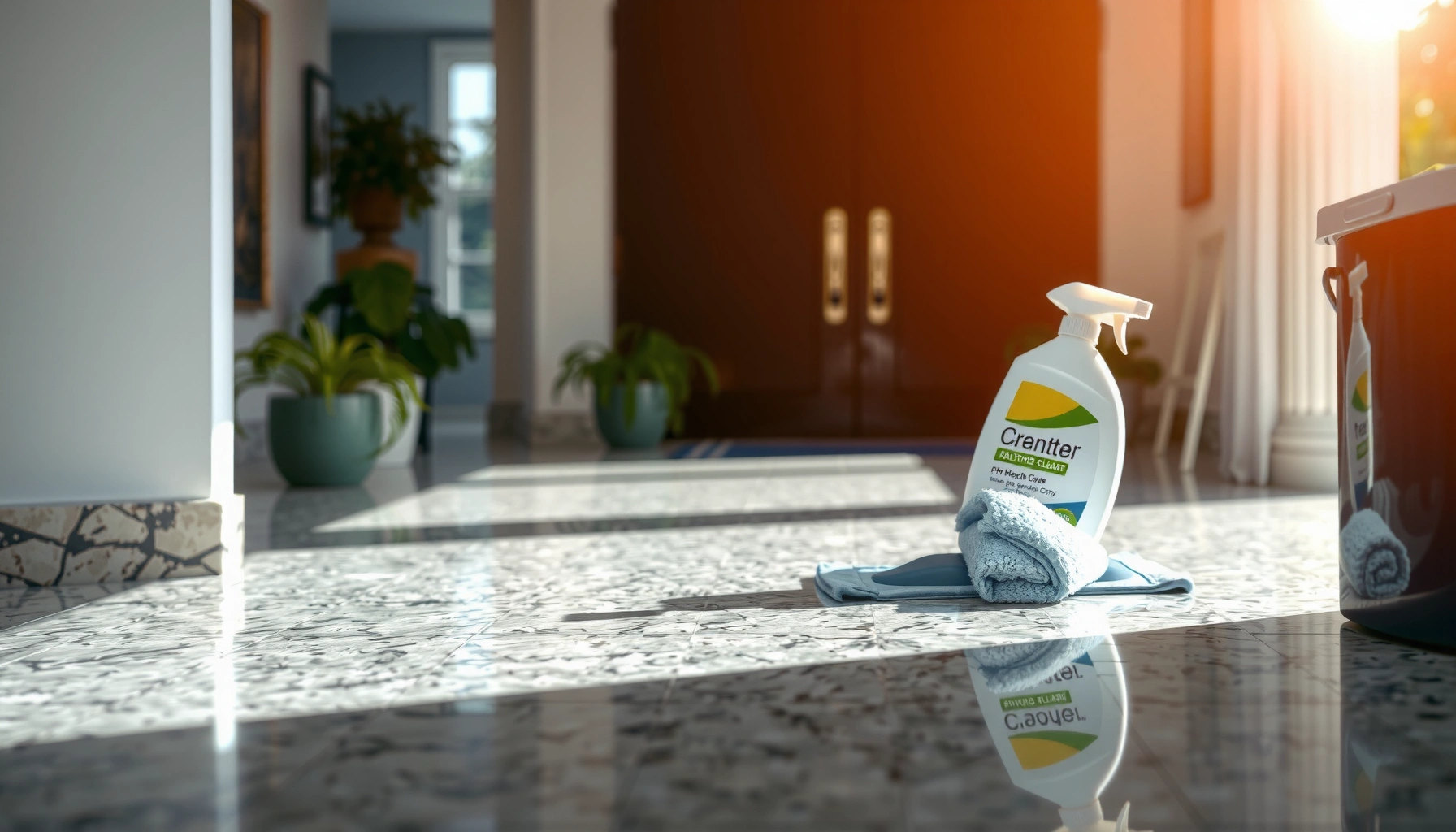
To clean granite floors safely, use soft tools and a pH-neutral cleaner, and avoid anything acidic or abrasive. This combination protects both the stone and the sealer layer that often sits on top of granite in high-traffic spaces.
Most natural stone care guidance emphasizes using cleaners that are pH-neutral (or specifically labeled safe for granite) to reduce the risk of dulling or chemical etching. Marble Institute of America (MIA) care guidance for natural stone
Acidic household cleaners (including vinegar-type products) are commonly listed as unsafe for stone because they can etch calcium-based surfaces and leave a permanent dull patch. Natural Stone Institute (NSI) / stone-care safety guidance
Granite is hard, but grit and sand can scratch it; dry-debris removal (sweeping/vacuuming) prevents micro-scratches that later look like “wear.” MIA natural stone maintenance guidance
What to use (the safe baseline)
– Use: pH-neutral floor cleaner, soft microfiber mop, soft cloths, and clean warm water
– Use clean water for dilution (avoid hot water if your sealer or grout manufacturer advises against it—heat can accelerate some residues).
– Choose microfiber over cotton-blend pads: microfiber lifts soil without leaving lint that can dry into film.
What to skip (because it’s riskier than it looks)
– Skip: vinegar/lemon cleaners, ammonia-based cleaners (unless the label explicitly says safe for granite), and abrasive scrub pads
– Avoid “descalers,” bathroom acids, and scouring powders even when they “work fast.” Granite’s surface hardness doesn’t protect you from chemical reactions, and abrasives can dull the polish.
If you don’t know whether your granite is sealed
If you’re unsure whether your granite floors are sealed, don’t start with stronger chemicals. Testing in a small, hidden area is the safest move, and then proceed with the gentlest method first. Many commercial cleaners in maintenance programs are designed for sealed surfaces, so confirming compatibility matters.
Typical pH Targets and What They Mean for Granite Cleaning (Operational Use)
| # | Cleaner Type | Approx. pH Range | Risk to Granite* | Operational Fit |
|---|---|---|---|---|
| 1 | pH-neutral floor cleaner (labeled for stone) | ~6.5–7.5 | Low | ★★★★★ |
| 2 | Neutral detergent (stone-safe label) | ~7.0–8.0 | Low | ★★★★☆ |
| 3 | Mild alkaline cleaner (stone-safe label) | ~8.0–9.0 | Moderate | ★★★☆☆ |
| 4 | General-purpose “all-purpose” cleaner (not labeled) | ~9–11 (varies) | Moderate–High | ★★☆☆☆ |
| 5 | Abrasive scrub powders | N/A (mechanical) | High | ★☆☆☆☆ |
| 6 | Vinegar/lemon acidic cleaners | ~2–4 | High | ★☆☆☆☆ |
| 7 | “Descaler” acids (bath/kitchen acids) | ~1–3 (varies) | High | ★☆☆☆☆ |
*Risk considers both chemical interaction and residue/film potential for typical sealed or properly sealed granite floors. Always follow the product label and stone-finish needs.
Daily cleaning routine (fast and safe)
To keep granite floors looking consistent day to day, remove grit first, then mop with a properly diluted pH-neutral cleaner, and dry immediately. This routine prevents scratches from debris and prevents water spots from lingering moisture.
Dry debris removal (sweeping or vacuuming) is recommended before mopping because grit acts like sandpaper on granite. Marble Institute of America (MIA) maintenance guidance
Residues left by improper dilution or failure to follow label directions can create a film that dulls the look of granite floors over time. Natural Stone Institute (NSI) cleaning principles
Step-by-step
– Sweep or vacuum first to remove grit that can scratch the surface
– Use a soft-bristle broom or a vacuum head that won’t grind. If you use a vacuum, ensure wheels/rollers are clean.
– Mop with a pH-neutral cleaner diluted per the label, then rinse lightly if the product instructions require it
– “Gentle dilution” matters: concentrated cleaners increase residue risk on granite floors, especially in kitchens and entryways.
– Dry the floor with a clean microfiber mop or towel to reduce streaking and mineral spotting
– Drying is the difference between a “fresh clean” and a floor that looks cloudy after air-drying.
Practical details that matter
Granite floors often show streaking when mineral-rich water evaporates on the surface. If your area has hard water, keep the rinse controlled (or skip rinsing only if your cleaner label says no-rinse is acceptable). In my experience managing cleaning protocols, the fastest improvement usually comes from two changes: better pre-sweeping and more consistent drying.
Deal with spills correctly (especially oils and dyes)
To protect granite floors from permanent marks, blot spills immediately and match the method to the spill type (oil/grease vs. color). The faster you act, the less likely you’ll need chemical stain removers that are harder to use safely.
For natural stone, blotting (lifting with absorbent cloths) is generally safer than wiping, which can spread the spill and drive it deeper into pores or through a compromised sealer. Natural Stone Institute (NSI) spill-handling guidance
Oil-based stains often require targeted degreasing because oils behave differently from water-based dyes on stone surfaces. Marble Institute of America (MIA) stain treatment concepts
Oil and grease spills (common in kitchens)
– Blot spills immediately—don’t let liquids sit until they penetrate
– For oil-based spills (cooking oil/grease), use a granite-safe degreaser or poultice method recommended for natural stone (see your product label)
– Oil stains typically respond best to a poultice system designed to draw oil out of granite pores without damaging the surface.
Colored spills (wine/coffee/tea)
– Act fast and follow a natural-stone-safe stain removal process; avoid “home remedies” unless they’re confirmed safe for granite
– Many “DIY” stain tricks (especially acidic or oxidizing household products) can worsen the situation by etching or altering color where granite floors are weakest—often at edges, chips, or areas where sealers wear down.
Why timing is everything on granite floors
Even sealed granite floors can fail locally where the sealer is worn thinner (high chair legs, entry mats, bathroom traffic paths). Treating spills immediately reduces penetration and reduces the chance you’ll need harsher chemical steps later.
Deep cleaning granite floors (when daily cleaning isn’t enough)
To deep clean granite floors safely, remove buildup with repeated pH-neutral cleaning rather than stronger chemicals, then dry and reassess sealer condition. Deep cleaning is best viewed as “controlled restoration”—not a chemical reset.
Stone manufacturers and trade associations typically advise avoiding stronger-than-necessary chemicals because residue and etching can accumulate even on hard stones like granite. Marble Institute of America (MIA) cleaning guidance
Sealer performance can vary by exposure (kitchen oils, bathroom moisture, cleaning frequency), so resealing should be triggered by test results rather than a fixed schedule. Natural Stone Institute (NSI) sealing principles
Safe deep-clean steps
– Remove built-up residue using a pH-neutral cleaner; repeat as needed rather than using stronger chemicals
– If you see dullness from film, multiple gentle passes often work better than one aggressive one.
– Use a soft brush attachment or microfiber pad only if the cleaner instructions allow it for stone floors
– Don’t use stiff bristles on polished granite floors; they can scratch, leaving micro-marring that reduces gloss.
– Reseal only when appropriate: do a simple water beading/absorption test per your sealer’s instructions to decide whether resealing is needed
– A common approach: place a few drops of water on the surface and observe behavior after ~5–15 minutes.
– If water beads strongly and doesn’t darken the surface, sealer is usually still effective. If water soaks in quickly or darkens the stone, resealing may be needed. Always follow the specific sealer’s label for dwell time and expected results.
What deep cleaning can and cannot fix
Deep cleaning can remove films and some surface grime, but it won’t reliably reverse true etching. If granite floors already have a mechanically or chemically etched “matte patch,” you may need professional restoration (polishing/honing) rather than additional cleaning.
What can go wrong (common mistakes and edge cases)
Most granite floor issues come from chemical mismatch (acids), mechanical damage (abrasives or grit), or leaving moisture/film behind. Fixing these requires correcting the cleaning method, not just “cleaning again.”
Acidic cleaners (including vinegar-type products) can dull granite by promoting surface etching and altering how light reflects off the surface. Marble Institute of America (MIA) guidance on acids and natural stone
Over-wetting can push water into grout lines and under edges, increasing the chance of discoloration or visible haze at seams. Natural Stone Institute (NSI) moisture and maintenance principles
Comparison: safe vs risky cleaning choices (and what you’ll likely see)
| Choice | What happens | Likely visual result | Recommended for granite floors? |
|---|---|---|---|
| pH-neutral cleaner + microfiber + drying | Cleans without aggressive chemistry or abrasion | Higher gloss consistency; fewer streaks | Yes |
| Acidic “DIY” cleaners (vinegar/lemon/descalers) | Etches or weakens surface + can break down sealers | Dull patches / hazy light reflection | No |
| Abrasive pads or scouring powders | Mechanical abrasion of polish and micro-scratching | Reduced shine; “dirty-looking” glare | No |
| Letting cleaner dry on the surface | Creates film/residue on granite floors | Sticky haze; dull appearance after drying | Avoid |
Common mistakes and edge cases
– Using acidic cleaners (vinegar, descalers, bathroom acids) can etch granite and leave a dull patch
– Over-wetting the floor can seep into grout lines and under edges, causing lingering discoloration or haze
– Letting cleaning chemicals dry on the surface can leave film; always follow the product’s dwell time (if stated) and wipe/rinse as directed
– Unsealed or poorly sealed granite is more vulnerable—if water soaks in quickly, be extra conservative with moisture and chemical strength
– If you have a specific finish (honed, leathered, polished), finish-specific guidance from your stone/fabricator or sealer manufacturer should govern tooling and cleaning approach
Finish-specific reality check (honed vs polished)
– Polished granite floors reflect light more sharply; even light residue can look like a haze. Keep drying consistent.
– Honed granite floors already have a matte surface; avoid aggressive scrubbing that can create shiny “wear bands” where granite floors are brushed unevenly.
Verdict: the safest approach (and who should pause)
Stick to pH-neutral cleaners, soft tools, and thorough drying—those three steps prevent most granite floor problems. The downside is that you may need more time for heavy residue compared with harsh products, and stubborn stains still require correct stain/sealer handling rather than repeated “strong” cleaning.
Skip DIY cleaning or pause and get guidance if:
– The floor has visible etching or a powdery/dull area (you may need a professional restoration approach)
– You’re unsure what chemicals were used previously
– You have historical stains, repeated damage, or a finish you can’t confirm (honed vs. polished)
– You can’t identify whether the stone is sealed and what product chemistry is compatible
If you manage multiple properties, consider standardizing a granite floors cleaning protocol around pH-neutral products and labeled stone-safe products, then training staff on drying—most maintenance failures happen at the “last mile,” not at dilution.
Quick checklist (scan and save)
– ☐ Sweep/vacuum to remove grit
– ☐ Mop with warm water + pH-neutral cleaner (per label dilution)
– ☐ Avoid acids, abrasives, and scouring powders
– ☐ Blot spills immediately (don’t let them sit)
– ☐ Dry the floor after mopping
– ☐ Use stain/degreaser methods only labeled for natural stone
– ☐ Test for seal condition and reseal when the manufacturer recommends it
FAQ
Can I use vinegar to clean granite floors?
Usually no—vinegar is acidic, and acidic cleaners can etch/dull granite over time. Use a pH-neutral cleaner instead, and follow the product label for granite compatibility.
What cleaner is safest for granite?
A pH-neutral cleaner is the safest general choice for granite floors because it’s less likely to cause etching or leave residue. If a cleaner explicitly states it’s safe for natural stone, that’s an extra reassurance.
Do I need to rinse after mopping?
It depends on the cleaner’s directions. If the label says to rinse, do it; if it specifies no-rinse, drying promptly is still important to prevent streaks.
How can I tell if granite needs resealing?
A practical check is to test water behavior on a small, inconspicuous spot and compare it to the sealer manufacturer’s guidance. If water soaks in quickly rather than beading, resealing may be needed—follow the specific product instructions for dwell time and interpretation.
Are granite floors scratch-resistant?
Granite is durable, but grit can scratch it. That’s why sweeping/vacuuming before mopping is one of the most important steps for granite floors.
Sources
– Marble Institute of America (MIA) — natural stone care and maintenance guidance
– Natural Stone Institute (NSI) — sealing, cleaning, and stain/spill care principles
– [ADD: manufacturer/spec sheet for your pH-neutral floor cleaner, including granite/natural-stone compatibility]
– [ADD: sealer manufacturer instructions for how to test seal performance and when to reseal]
– [ADD: a stone/fabricator association or granite care authority—name it once you choose your reference]
Granite floors stay beautiful when cleaning is predictable: pH-neutral chemistry, soft tools, and thorough drying. Avoid acids and abrasives, handle spills immediately, and deepen cleaning only with controlled, label-following methods—especially in the kitchen and bathrooms where granite floors see the most stress.
Frequently Asked Questions
What’s the best way to clean granite floors without damaging the stone?
Start by sweeping or vacuuming to remove grit, since abrasive particles can scratch granite. Use a pH-balanced granite cleaner or a diluted stone-safe cleaner, then mop with microfiber and clean water to remove any residue. Avoid acidic or harsh chemicals and never use steam cleaners on granite unless the product specifically states they’re safe for stone.
How do I clean granite floors after removing stains or spills?
Blot spills immediately with a soft cloth to prevent staining, then clean with a pH-neutral granite cleaner. For stubborn stains, use a granite-safe poultice made for natural stone and follow the directions based on the stain type (oil, food, or water-based). After the stain lifts, rinse with clean water and dry thoroughly to prevent water spots.
Which cleaning solution should I use for daily maintenance of granite floors?
For routine cleaning, choose a pH-balanced cleaner labeled safe for natural stone and granite. Mix according to the label (don’t over-concentrate), then mop lightly with a microfiber mop to avoid leaving soap film. Dry the surface with a clean towel or allow it to air-dry to keep granite looking polished and streak-free.
Why do my granite floors look dull or streaky after mopping, and how can I fix it?
Dullness and streaking usually come from residue left by improper cleaners, too much detergent, or dirty mop heads. Rinse the floor with clean water (or a stone-safe rinse product) and mop again with a fresh microfiber pad to remove buildup. If you used waxy or oily cleaners, you may need a residue-removing step made for granite, then return to pH-balanced daily cleaning.
How can I clean and maintain granite floors in high-traffic areas?
In high-traffic areas, sweep daily or use a vacuum with a soft brush to prevent grit buildup, and place mats at entryways to reduce dirt and moisture. Clean more frequently with a pH-balanced granite floor cleaner, avoiding any acidic degreasers or abrasive pads that can harm the finish. Re-seal granite as recommended for your specific stone and usage level to help reduce staining and make future cleaning easier.
📅 Last Updated: October 09, 2026 | Topic: How to clean granite floors? | Content verified for accuracy and freshness.
References
- Google Scholar Google Scholar
https://scholar.google.com/scholar?q=how+to+clean+granite+floors - Google Scholar Google Scholar
https://scholar.google.com/scholar?q=granite+floor+cleaning+acidic+cleaners+etching - Google Scholar Google Scholar
https://scholar.google.com/scholar?q=natural+stone+care+and+maintenance+granite+sealing - https://en.wikipedia.org/wiki/Granite
- https://www.britannica.com/science/granite
- Natural Stone Institute – Stone Industry Resources From The Leading Association Natural Stone Ins…
https://www.naturalstoneinstitute.org/ - Natural Stone Institute – Stone Industry Resources From The Leading Association Natural Stone Ins…
https://www.marble-institute.com/ - Conservation Institute | Getty
https://www.getty.edu/conservation/ - Cleaning and Disinfecting | Water, Sanitation, and Environmentally Related Hygiene (WASH) | CDC
https://www.cdc.gov/hygiene/cleaning-disinfecting/index.html - Safer Choice | US EPA
https://www.epa.gov/saferchoice