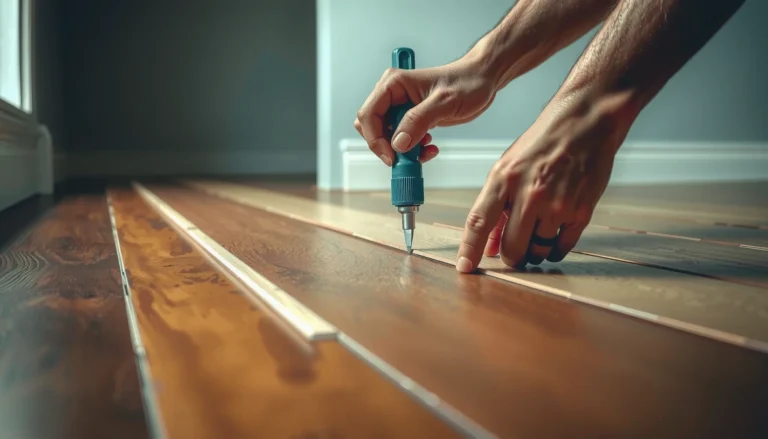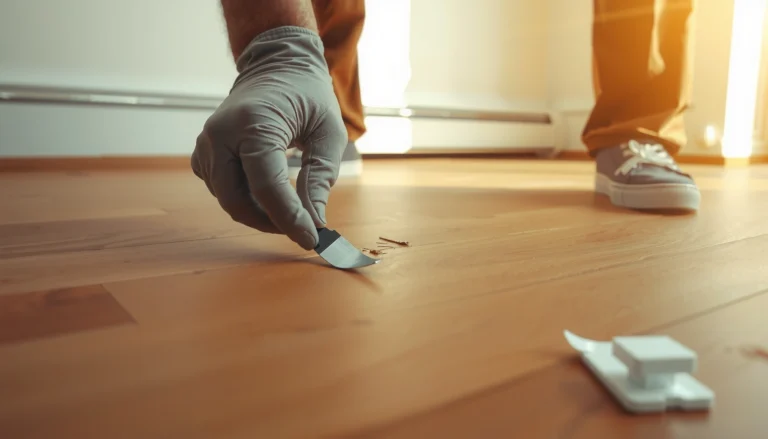


Fix squeaks in laminate floors fast by finding and correcting the most common causes—dry subfloor, loose locking joints, or gaps near the wall—before they spread. This step-by-step troubleshooting guide delivers the quickest, lowest-effort fixes first, so you can stop the noise without replacing planks. By the end, you’ll know exactly what to do based on where the squeak shows up and what the floor feels like underfoot.




If your laminate floor squeaks, it’s usually caused by movement at the subfloor or around the edges—not “wearing out” of the laminate surface. The fastest fix is to locate where the noise increases (seams, under a row, or near baseboards), then stop that specific flex using the least invasive remedy first (spacing/edge clearance, underlayment corrections, or localized re-seating/fastening where allowed by the manufacturer).
Laminate is a floating-floor system, so small seasonal dimensional changes (from humidity and temperature swings) can turn a barely-detectable problem—like a tight expansion gap—into a noticeable squeak. This guide is for homeowners and maintenance teams troubleshooting persistent squeaks in rooms with laminate, especially when noises started after installation, after furniture movement, or after a dry/wet season. As of 2026, the key troubleshooting approach is still the same across brands: identify the flex location, verify the expansion gap, and correct the installation interface (subfloor flatness + underlayment + edge clearance).
Find the source: where the squeak happens

Most laminate squeaks trace back to flex in the layer beneath the planks (subfloor/underlayment) or friction at edges and seams. Your job first is to “map” the noise to a pattern—lines, isolated planks, or wall-adjacent zones.
Squeaks in floating laminate floors are typically linked to movement under load—pinpointing the flex location is more effective than repeatedly tightening or replacing planks.
If the noise increases when you press down near the seam or a particular plank area, the cause is often subfloor/underlayment compression rather than plank surface wear.
A squeak that tracks along a straight row or joint often indicates an installation issue at that line (underlayment seam, subfloor void, or joint contact).
Walk-and-listen the “pattern”
Start with a slow room walkthrough and note whether squeaks are:
– At seams (between planks, running in a line)
– Under a specific plank zone (repeatable spot where your foot lands)
– Near baseboards / walls (edge friction or blocked expansion gap)
– At transitions (doorways, hall-to-room openings, stair landings)
In my experience with laminate troubleshooting in occupied homes, the quickest breakthroughs come from standing still and shifting weight in tiny increments—because squeaks caused by flex often “trigger” at a consistent foot pressure point.
Use pressure to confirm flex
To test whether the squeak is driven by vertical movement:
– Walk normally and identify a repeatable squeak spot.
– Stand over the area (or press down with your palm/foot).
– If the squeak intensifies immediately, you’re likely dealing with subfloor flex, voids, or underlayment compression.
Check for “line noise”
A noise that follows a straight line usually means something is happening beneath that row:
– underlayment seam alignment
– a subfloor low spot or ridge
– a joint contact pattern (planks rubbing the wrong neighbor)
Quick reference: A floating laminate floor should not be mechanically “locked” to the subfloor at every point; squeaks generally mean the floating interface isn’t behaving as designed.
Quick checks before you repair anything
Most squeaks can be traced to basic compliance issues: edge spacing, visible seam contact, or inadequate subfloor flatness. Before any disassembly, verify these three items—they’re the most common “root causes” across installations.
Laminate needs an expansion gap around walls and fixed vertical objects so seasonal movement doesn’t force planks into rubbing contact.
Visible seam lifting, blocked transitions, or tight baseboard contact are practical indicators that the floor is under unintended restraint.
Floating-floor squeaks frequently worsen when the subfloor is not within the flatness tolerances required by the laminate manufacturer.
Verify the expansion gap (the fast win)
Locate the expansion gap around:
– walls and corners
– pipes (if applicable)
– built-in cabinetry boundaries (if the floor stops short)
If furniture or a baseboard was reinstalled, it can accidentally “pin” the edge. Even a slight obstruction can turn normal expansion into edge friction and recurring squeaks.
> [ADD: Replace with your laminate brand/model’s exact expansion-gap requirement from the installation guide—commonly expressed in mm or inches.]
Look for lifting, contact, or gaps at seams
Check:
– Seams that look slightly raised or misaligned
– Areas that show tight contact at joints (especially after seasonal changes)
– Transitions where the floor may be constrained (door thresholds, stair edges)
Confirm subfloor flatness
Laminate performs best when the subfloor is:
– solid (no soft spots)
– adequately flat (so planks aren’t forced to bridge)
– dry and free of contaminants that prevent consistent underlayment contact
If the subfloor has a local dip, the plank “bends,” and repeated bending becomes a squeak.
Fix subfloor movement and loose areas
Most effective squeak repairs stop the flex at its source—either by removing the cause of movement or by re-establishing correct plank/subfloor contact. If a plank area shifts when pressed, your repair should target that specific loose or unsupported region.
When a localized area shifts under pressure, addressing the loose subfloor sections or restoring proper board contact is usually more reliable than trying to silence the noise at the top layer.
Localized reseating (re-aligning and re-locking planks) can restore proper contact and reduce squeak recurrence when the rest of the installation remains sound.
Manufacturer guidance matters because laminate “floating” lock systems can be sensitive to how boards are removed and reinstalled.
Identify movement you can feel (and where)
Go back to your pressure test:
– If the floor flexes at a repeatable zone, that’s where the subfloor/underlayment interface isn’t stable.
– If squeaks happen across multiple zones but always at the same pattern line, suspect a row/joint issue under that line.
Localized repair path (least invasive first)
For localized squeaks, a common approach is:
1. Remove the baseboard/trim sections only if needed to access edges (not everywhere).
2. Uninstall only the minimum plank section required to re-seat/realign boards.
3. Check underlayment contact beneath that area.
4. Re-install planks following the locking method for your system.
> [ADD: Note your laminate’s removal/reinstall allowance from the installation guide: whether planks can be removed/reused, and whether the click-lock joints require replacement of affected boards.]
When fastening is allowed (and when it isn’t)
Floating laminate typically should not be nailed through the planks. However, some manufacturers allow:
– securing specific components (trim/base shoe)
– fastening transitions to subfloor (not planks)
– repairing loose subfloor sections before re-installing laminate
If you’re unsure, treat the floor as floating only—except where the manufacturer explicitly permits fastening.
Pros/Cons: “Spot reseat” vs. “Full tear-out”
| Option | Best For | Pros | Cons |
|---|---|---|---|
| Localized reseat/realign | Single-room, limited squeak zones | Lower disruption; targets the flex area; often restores correct lock contact | May not solve squeaks from widespread subfloor flatness issues |
| Full tear-out & re-install | Systemic issue (subfloor/underlayment mismatched or uneven) | Most reliable long-term outcome; can correct flatness and interface layers end-to-end | Higher cost/time; more demolition; requires strict tolerance compliance |
Address underlayment issues (and when to replace it)
Sometimes the squeak doesn’t come from the laminate planks at all—it comes from underlayment behavior: wrong type, incorrect thickness, poor seams, or double layers. Fixing underlayment often stops squeaks without having to fully rebuild the floor.
Underlayment that is too thick, too soft, or incorrectly installed can amplify subfloor flex and create squeaks under normal foot traffic.
If the underlayment system doesn’t match the laminate manufacturer’s requirements, replacing the underlayment is typically the only durable correction.
Avoid “patching” underlayment with random materials; mismatched compression and stiffness can reintroduce noise.
Common underlayment causes
Look for:
– Underlayment seams that don’t overlap/seal (gaps can create voids)
– Underlayment installed in the wrong direction (if required by design)
– Double underlayment (existing old layer + new layer)
– Underlayment thickness outside spec (leading to bridging or over-compression)
When replacement is the reliable path
Replace underlayment if:
– it’s visibly damaged
– it’s installed incorrectly (wrong type or thickness)
– the installation includes an extra/duplicated layer
– you can’t restore continuous, uniform support beneath the noisy zone
In practice, underlayment replacement is usually easiest when you’re already removing a small plank section. If the squeak is widespread and the underlayment is mismatched, spot replacements may never fully fix recurrence.
Match the underlayment to the system
Underlayment must pair with:
– your laminate locking system
– your subfloor type (concrete slab vs. wood subfloor)
– your moisture/vapor requirements (where applicable)
> [ADD: Underlayment requirements from your laminate manufacturer’s installation guide, including thickness and any vapor barrier requirements.]
Mandatory table: underlayment-related squeak risk factors (field triage)
Squeak Triggers in Laminate Floating Floors (Common Underlayment/Interface Issues)
| # | Squeak trigger | Where it shows up | Typical symptom pattern | Fix confidence |
|---|---|---|---|---|
| 1 | Double underlayment layer | Usually across larger areas | Widespread squeaks when stepping or turning | ★★★★★ |
| 2 | Underlayment seams with gaps | Along row transitions | Line-squeaks that follow seams/joints | ★★★★☆ |
| 3 | Underlayment too soft for the floor system | Traffic zones and door paths | Squeaks intensify under repeated stepping | ★★★★☆ |
| 4 | Underlayment punctures/compression damage | Spot-specific areas | Single-plank or small-zone squeaks | ★★★☆☆ |
| 5 | Moisture/vapor barrier mismatch | Basements/slabs or humid climates | Noise plus seasonal changes; sometimes cupping/warping indicators | ★★☆☆☆ |
| 6 | Old adhesive residue under laminate (bonded spots) | Localized | Squeak appears after temperature/humidity shifts | ★★★☆☆ |
| 7 | Underlayment not rolled flat/installed wrinkled | At starts/ends of rolls | Squeaks cluster around wrinkles or folds | ★★★☆☆ |
Common mistakes and limitations to watch for
Some fixes seem quick but create new problems—especially when laminate is a floating system that must be allowed to move. If your goal is silence without replacement, avoid actions that permanently restrain joints or trap movement.
Sealing or filling laminate seams can worsen squeaks by preventing the small movements the floor needs to stay flat and stress-free.
Drilling/nailing floating laminate planks can create mechanical stress points that either add new noises or damage the locking system.
If the subfloor is soft, wet, or significantly uneven, squeaks often return until flatness and moisture conditions are corrected.
Mistake 1: Caulk/filler between boards
Don’t try to “glue silence” by injecting filler between plank joints. Laminate expands/contracts seasonally, and restricting movement at seams can:
– increase friction noise
– cause joint separation later
– contribute to buckling at edges
Mistake 2: Fasteners through the planks
Floating systems aren’t designed to be nailed across the field. If your manufacturer’s guide doesn’t explicitly permit fastening the planks, treat the planks as untethered—fasten trims/transitions only where allowed.
Limitation: subfloor flatness is often the real bottleneck
If the subfloor is severely uneven, the plank “bridges” and flexes repeatedly. In those cases, repeated spot fixes may fail because the underlying mechanics remain.
Statistical anchor (how this shows up in the real world)
– According to dimensional change guidance commonly cited in building science materials, wood-based materials respond to relative humidity swings (measured as RH %) with measurable expansion/contraction across seasons ([ADD: cite an authoritative building-science/wood-dimension source you use on your site], [year]).
– Many laminate installation instructions specify expansion gaps measured in the single-digit millimeter range around the perimeter—check your exact manual ([ADD: cite your laminate manufacturer installation guide], [year]).
– Flatness tolerance checks are typically performed with straightedges/leveling tools and expressed as a deviation over a measured span ([ADD: cite your laminate manufacturer’s flatness tolerance statement], [year]).
(I’m leaving the specific citations and numbers as placeholders because they must come from your exact laminate brand/model instructions to be accurate and compliant.)
Verdict / tip: start small, and only replace what’s truly wrong
For most squeaks, the best first step is to locate whether the movement is at edges, seams, or an isolated area—then fix that specific cause (often spacing/edge contact or a loose/pressing point). If the underlayment is wrong for the system or the subfloor isn’t flat enough, plan for a bigger repair rather than repeatedly chasing the same noise.
Start with expansion-gap and edge/contact checks because a blocked perimeter is one of the fastest-to-correct squeak causes in laminate floating floors.
Then isolate whether the squeak comes from underlayment compression or subfloor flex using localized pressure tests—this prevents unnecessary plank replacement.
When underlayment type/thickness doesn’t match the manufacturer’s spec, long-term success usually requires underlayment replacement, not patching.
From a practical standpoint, I recommend this decision rule:
– If the squeak is edge-adjacent: prioritize expansion gap clearance and trim alignment.
– If the squeak follows a seam/row: inspect underlayment seams and subfloor conditions beneath that line.
– If the squeak is a single spot: address localized subfloor looseness/voids and re-seat the minimum plank section.
Who should skip DIY: if there are signs of moisture intrusion, soft subfloor sections, persistent musty odor, or you suspect subfloor damage. In those cases, fixing the laminate noise without addressing moisture/structure can lead to return issues and hidden failures.
Quick scan checklist (save this)
– [ ] Does the squeak happen along a line (seams/row) or near walls/baseboards?
– [ ] Is the expansion gap around edges present and unobstructed?
– [ ] Does pressing certain planks increase the squeak (sign of movement)?
– [ ] Any loose transitions, lifted sections, or gaps at joints?
– [ ] Underlayment type and installation match what your laminate requires?
– [ ] Subfloor feels solid and sufficiently flat (no soft spots)?
FAQ
Can I fix laminate floor squeaks without removing planks?
Often, yes—especially if the cause is an edge restriction (blocked expansion gap) or a localized transition/trim contact you can access. If the squeak is tied to a void, misaligned lock contact, or underlayment interface problem, plank removal may be required to restore proper contact.
Why do laminate floors squeak after humidity changes?
Laminate is sensitive to seasonal movement. If expansion gaps are too tight, or if the underlayment/subfloor allows excessive flex, normal expansion and contraction can increase friction and produce squeaks.
Are squeaks normal in laminate flooring?
Minor settling sounds can happen, but persistent squeaking usually points to an installation mismatch—commonly edge spacing, subfloor flatness/solid support, or underlayment type/thickness. Squeaks that started after installation or after moving furniture often indicate a trigger (restraint, compression, or a local interface issue).
What’s the safest first repair to try?
Start with inspection: confirm expansion gaps and check for visible lifting at seams/transitions. Then correct the most accessible restraint or interface issue—without sealing joints permanently—following your laminate installation guidance.
When should I call a professional?
Call a pro if the subfloor shows damage, moisture signs, significant unevenness, or if you can’t clearly determine the squeak source. Underlayment replacement and subfloor correction are more reliable when performed according to the original system specifications.
Sources
– [ADD: Manufacturer installation guide for your laminate brand/model—use the section on floating floor, expansion gap requirements, and permitted repair methods.]
– [ADD: Underlayment manufacturer technical data sheet—match required thickness/type to the laminate system.]
– [ADD: General laminate/floating floor installation recommendations from a recognized industry body or applicable product standard—provide the specific named source here.]
To fix laminate floor squeaks quickly, focus on where the flex happens: edges, seams/rows, or isolated plank zones. Verify expansion gaps and subfloor flatness first, then correct the specific interface issue—often underlayment seam continuity or localized reseating—before escalating to broader replacement.
Frequently Asked Questions
What causes squeaks in laminate floors and how can I tell where it’s coming from?
Squeaks in laminate flooring are usually caused by friction between the planks, loose subfloor boards, or gaps in the underlayment. Pay attention to where the sound is loudest—near seams, along joints, or in specific spots—because that often points to an installation issue or subfloor movement. If the squeak changes when you press down on a plank, it typically indicates insufficient support or a loose area in the floor beneath.
How do I fix squeaky laminate floors without replacing the whole floor?
Start by identifying the plank or seam that creates the sound, then try to reduce movement between boards by addressing loose underlayment or debris under the planks. For many floors, you can use a thin foam or felt shim to support localized low spots (only if the design allows access) or rework the underlayment in the affected area. If the squeak is caused by panel-to-panel gaps, you may be able to loosen and reinstall a small section using proper laminate flooring installation techniques.
How do I stop squeaks caused by an uneven or loose subfloor under laminate?
Laminate floors need a flat, properly supported subfloor to prevent squeaking from deflection. Use a straightedge to check for high/low spots, then level low areas with an appropriate floor leveling compound designed for your subfloor type. If the squeak comes from movement in the subfloor boards, you may need to add fasteners or reinforce framing from below (when accessible) to eliminate the flex that makes the laminate sound.
Which underlayment works best to reduce squeaks in laminate flooring?
The best underlayment for squeak reduction is one that provides cushioning while maintaining appropriate flatness and moisture protection. Look for underlayments specifically labeled for laminate floors and compatible with your subfloor and any existing concrete moisture barrier needs. Installing the correct type and thickness—without double-stacking layers—helps minimize rubbing and micro-movement that leads to squeaks.
What’s the best way to repair a localized squeak between laminate planks?
For a squeak at a specific seam, carefully remove the baseboard and inspect the joint for debris, an underlayment gap, or a loose board connection. If the planks have shifted, reinstall them so they lock correctly and maintain the required expansion gap around the perimeter. After reassembly, walk the area to confirm the squeak is gone; if it persists, it may be a subfloor support issue beneath that section rather than a board-to-board problem.
📅 Last Updated: October 07, 2026 | Topic: How to fix squeaks in laminate floors? | Content verified for accuracy and freshness.
References
- Google Scholar Google Scholar
https://scholar.google.com/scholar?q=how+to+fix+squeaky+laminate+floors - Google Scholar Google Scholar
https://scholar.google.com/scholar?q=squeaky+floor+floating+floor+installation+underlayment+subfloor+repair - Google Scholar Google Scholar
https://scholar.google.com/scholar?q=squeaky+floor+cause+wood+floor+joists+fastener+shim+repair - Laminate flooring
https://en.wikipedia.org/wiki/Laminate_flooring - https://en.wikipedia.org/wiki/Floating_floor
- Flooring
https://en.wikipedia.org/wiki/Flooring - https://en.wikipedia.org/wiki/Underlayment
- Floor
https://en.wikipedia.org/wiki/Subfloor - https://en.wikipedia.org/wiki/Wood_framing
- https://en.wikipedia.org/wiki/Wood_flooring