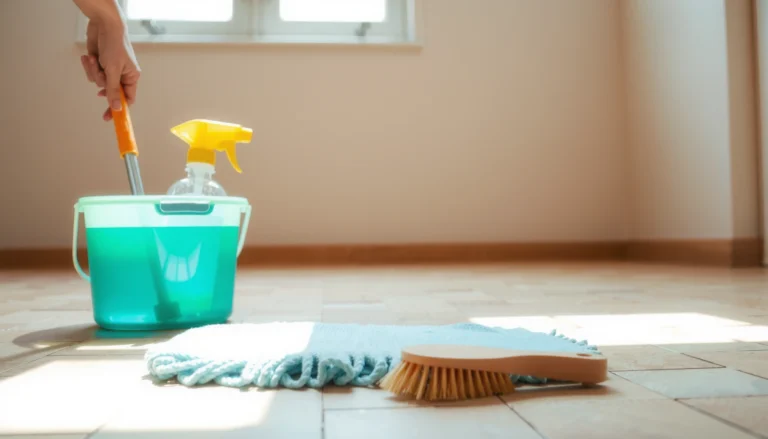
Want to know how to mop garage floors so they come clean without leaving streaks or grit behind? This step-by-step guide tells you exactly what to do—from clearing and degreasing to choosing the right mop technique and drying for a streak-free finish. Follow these instructions and your garage floor will look newly cleaned, even after oil, dirt, and tire marks.




Mop your garage floor by clearing debris first, treating oil/grease spots with a degreaser when needed, and then using a concrete-appropriate cleaner with clean rinse water to prevent streaks and haze. The goal is to lift grime without re-depositing it across the slab, which is why the prep and “dirty-water avoidance” steps matter as much as the mop itself.
If your garage has tracked-in dirt, dusty concrete, or occasional grease marks, this method works well. It’s also a practical option when you want routine cleanliness without turning the job into a full pressure-washing project—especially if you’re trying to keep dust and residue under control.
Prep the garage floor before you mop

Before you mop, you need to remove loose grit and identify oil/grease patches so you can treat them before general cleaning. If you skip this step, you’ll often end up grinding dirt into the surface and redistributing it as a muddy film.
According to OSHA’s walking-working surfaces guidance, employers must keep floors clean and sanitary to reduce slip and trip hazards.
According to the U.S. Environmental Protection Agency (EPA), minimizing chemical runoff and properly handling cleaners helps prevent environmental contamination.
Concrete cleaning guidance from major concrete and floor-care manufacturers consistently emphasizes “remove loose debris first” to avoid grinding.
Sweep/vacuum thoroughly (so you don’t turn the mop into sandpaper)
Start by sweeping or vacuuming the garage floor completely—especially at expansion joints, along the base of the walls, and around tire tracks. Concrete is porous and rough, so loose grit acts like abrasive during mopping. That’s the fastest route to a dull, uneven-looking finish that doesn’t “look clean” even after you mop.
Spot-check for oily/greasy areas before you start
Dark patches, rainbow sheens, or areas that feel slightly slick when dry are common oil/grease indicators. Oil stains often don’t behave like regular dirt: they can bond into the surface pores and resist water-based cleaners.
When you spot-check, separate your plan into two paths:
– Routine grime (dusty concrete, light soil): mop with a diluted concrete cleaner.
– Oil/grease spots (dark or tacky areas): degrease first, then mop the surrounding area.
Protect the area and yourself
If you use a degreaser, provide ventilation and wear gloves. Work in manageable sections so you’re not tempted to “finish faster” by letting chemicals sit past their label directions.
Data points to anchor expectations (before you start):
– According to OSHA 29 CFR 1910.22, employers must maintain floors in a clean and sanitary condition to help prevent hazards.
– According to EPA hazardous waste and chemical handling guidance, you should follow product labeling for safe use and disposal to reduce environmental and worker risk.
– According to ASTM International standards used for slip resistance testing (commonly applied in floor safety research), contaminants and residues can significantly change surface friction.
[ADD: source for specific degreaser PPE/ventilation language from your chosen product label]
Choose the right cleaner and mop setup
Choose products and tools that match what’s on the slab—water-based concrete cleaner for general soil, and a real degreaser for oil/grease. Then set up your mopping process to keep “clean solution” and “dirty rinse” from mixing.
Manufacturers of concrete cleaners typically instruct dilution by volume (not “a splash”) to prevent residue and streaking.
Degreasers are formulated to dissolve or emulsify hydrocarbons (oil/grease), which general-purpose cleaners often cannot.
Microfiber mops are widely recommended in floor-care guidance because their fibers trap fine soil rather than pushing it like some pad types.
Pick the right cleaner for concrete (and follow dilution/dwell time)
For routine cleaning, use a concrete-appropriate cleaner and dilute it exactly as directed. For spots, use an oil/grease degreaser and follow:
– Dilution rate (too strong can leave film; too weak can fail to lift oil)
– Dwell time (how long it needs to work before you rinse or mop)
– Rinse requirement (some degreasers need a follow-up rinse)
Select a mop that won’t spread grit
A microfiber flat mop or similar controlled mop style usually gives you better pickup and less smear. Avoid setups that can fling dirty water (for example, overly aggressive wringing that leaves slurry dripping).
Use a two-stage system: solution + rinse
Keep two buckets (or at least two stages):
1. Cleaning solution (where the mop loads detergent)
2. Rinse water (where you remove loosened residue)
This reduces the chance that you’ll re-deposit grime, which is one of the most common reasons garage floors end up looking “hazy” after mopping.
Quick reference: cleaning approach fit (what works best when)
Use the guide below to choose a practical approach based on what you’re seeing on the concrete.
Garage Floor Cleaning Fit by Soil Type (Routine Approach)
| # | Observed condition | Recommended step | Mop water approach | Best fit rating |
|---|---|---|---|---|
| 1 | Dusty concrete & tracked-in road grime | Concrete cleaner + damp-mop | Single-clean-solution bucket + separate rinse stage | ★★★★★ |
| 2 | Light surface smears (no wet oil sheen) | Spot-clean with diluted cleaner, then general mop | Change/wring mop frequently | ★★★★☆ |
| 3 | Fresh grease drips / small oil spots | Degreaser on spots first | Targeted damp area; keep rinse clean for surrounding slab | ★★★★☆ |
| 4 | Dark stains (old oil set in) | Repeat spot degreasing + mop after dwell | Expect multiple passes; don’t “over-wet” slab | ★★★☆☆ |
| 5 | Paint overspray or coating contamination | Pause and use compatibility guidance | Avoid aggressive chemicals without confirmation | ★★☆☆☆ |
| 6 | Sealed/painted garage floors (if present) | Use manufacturer-compatible cleaner only | Rinse if label requires; avoid soaking | ★★★☆☆ |
| 7 | Algae/mildew-like growth (damp areas) | Use a cleaner rated for organic growth | Target affected zones; prevent spread | ★★☆☆☆ |
Mop in the right order (so you don’t miss patches)
Mop in a controlled sequence—start far from the exit and work back—so you avoid stepping on freshly cleaned areas. Then use overlapping strokes and keep the floor only damp, not flooded.
Floor-care best practice is to avoid soaking porous concrete because excess moisture can linger in joints and seams, slowing drying and increasing residue risk.
Cleaning guidance for mops consistently recommends wringing or replacing mop water as it loads up with soil to prevent re-deposition.
According to OSHA walking-working surface requirements, reducing slippery residues supports safer circulation.
Start farthest corner → exit
Begin in the farthest corner and move toward the door. This prevents you from walking across wet-cleaned zones and tracking grime back onto areas you already cleared.
Use overlapping strokes and “damp, not wet”
For most garage grime, damp is enough. Soaking does two things you don’t want:
– It can drive loosened dirt deeper into pores.
– It leaves more cleaner residue to dry into haze.
Wring/changing schedule: keep residue from migrating
After each pass (or whenever the mop looks loaded), wring it out thoroughly or replace the water stage. A dirty mop is basically a distribution tool: it spreads what you just removed across the next section.
Control your water chemistry
If your buckets are mixing accidentally, you’ll notice streaks and dullness. Keep the “dirty” stage separate, and don’t top off with fresh water unless your process design allows it (for example, dumping and refilling when water gets cloudy).
Treat stains and greasy spots without wrecking the finish
Spot-treat oil and grease first, then mop the surrounding concrete once the chemical has worked. This prevents you from spreading hydrocarbons across the slab and reduces the chance of sticky residue.
Degreasers are designed to break down oils/grease; using a general cleaner alone often leaves a remaining oily film.
Most chemical label instructions include both dilution rates and dwell times, and following them is critical for performance and surface compatibility.
Concrete-stain removal guidance typically recommends treating affected areas only, rather than applying stronger chemistry to the entire slab.
Pre-treat only what needs it
If you see a clear oil spot, apply degreaser to that area alone. Work in small sections so the product doesn’t dry out early (unless the label specifically allows it).
Let the dwell time do the work
Don’t rush immediately to wiping. Give the degreaser time to emulsify the residue. If you remove it too soon, the spot often “comes back,” because you didn’t fully break down the oil bond.
[ADD: source for general degreaser dwell-time guidance from a recognized manufacturer or concrete-care authority]
Repeat rather than “add more chemical”
If the stain persists after one round:
1. Re-spot-treat the same area.
2. Use the label’s instructions for dwell time again.
3. Mop the surrounding floor after the spot treatment step is complete.
This is usually more effective (and safer for finish longevity) than repeatedly over-applying to the whole garage.
Pros/cons: spot degreasing vs full-floor degreasing
| Approach | Pros | Cons |
|---|---|---|
| Spot degreasing (recommended for most garages) | Targets oil without stressing the entire slab; reduces chemical residue risk in low-problem areas. | May require multiple rounds on deeply embedded stains. |
| Full-floor degreasing | Uniform chemistry can help if contamination is widespread. | Higher residue/dwell risk, more drying time, and more effort rinsing the whole garage. |
Drying and safety: finish the job correctly
Drying is part of cleaning, not an afterthought. Rinse if your label calls for it, then allow full dry time before you park vehicles or put mats back down.
Some degreasers require a follow-up rinse to remove residue that can otherwise make surfaces slick or hazy.
Slip-resistance research consistently shows that contaminants and residue can reduce friction and increase slip risk until fully removed and dried.
Workplace safety guidance emphasizes keeping walking surfaces clean and dry to reduce slip-and-fall hazards.
Rinse only if the label requires it
Not every cleaner needs a rinse, but many degreasers do. If you rinse, use clean water and don’t let dirty rinse water sit on the floor.
Let the concrete dry fully
Concrete takes time to dry, especially near walls, in corners, and around seams. Wait until the surface is dry to the touch and you no longer smell chemical odors lingering at floor level.
Check for slippery spots
After mopping, do a quick “safe test” in a non-vehicle area:
– If the floor feels slick or tacky, you likely left residue.
– Return to a rinse step (per label) before traffic returns.
[ADD: source for typical rinse guidance—use the exact chosen product’s label section “Directions for Use”]
What can go wrong (and how to avoid it)
Mistakes usually come from three areas: skipping prep, over-wetting, and using dirty water. Fix those and mopping performance improves dramatically.
Re-depositing soil happens when mop water becomes saturated with grime; separating rinse water prevents haze.
Over-wetting porous concrete can prolong drying in joints and seams, increasing the chance of residue and slip risk.
Using an incompatible cleaner (for example, chemistry not intended for concrete coatings) can damage finishes or cause bonding failure.
Common issues
– Skipping sweeping: grit abrades the surface and leaves it looking dull.
– Using too much water: excess moisture lingers, especially in expansion joints.
– Reusing dirty mop water: causes haze and streaks across the whole garage.
– Wrong product for oil: general cleaners may loosen dirt but won’t fully break down hydrocarbons.
– Mopping after a spill without pre-treatment: dried-on spills often require spot degreasing and time to dwell.
Edge cases to plan for
– Sealed or painted floors: compatibility matters. If your garage floor has coatings, use only cleaners the coating manufacturer approves.
– Deep cracks with contamination: mop-only methods often can’t reach embedded residues; pre-treatment or specialized cleaning may be required.
– Cold weather: drying can slow significantly. If the garage is below freezing, focus on preventing re-deposition and give more drying time.
Verdict / tip: a simple routine works—spot-treat the hard parts
A basic mop-and-clean routine works well for everyday garage grime when you pre-sweep, mop with controlled dampness, and keep mop water clean. The downside is that heavy, old oil staining often won’t fully lift with mopping alone; those spots usually need degreaser-based pre-treatment and repeat passes.
From a practical standpoint, I recommend treating your garage like a two-layer problem:
1. Remove loose soil (sweep/vacuum first).
2. Chemically address what water won’t dissolve (oil/grease spots), then finish with a damp mop and correct rinsing/drying.
If your garage has extensive embedded staining, heavily contaminated cracks, or you can’t ventilate while using degreasers, consider pausing the mop-only approach and escalating to a more specialized cleaning method. [ADD: source for escalation guidance from a recognized concrete floor-care authority]
Quick checklist (scan/save)
– [ ] Sweep or vacuum thoroughly
– [ ] Spot-treat grease/oil stains with a suitable degreaser (per label)
– [ ] Mix cleaner correctly (per label directions)
– [ ] Mop from farthest corner to exit
– [ ] Change/wring mop often; avoid reusing dirty water
– [ ] Rinse if required; let fully dry before use
FAQ
Can I mop a garage floor without a degreaser?
Yes for general dirt and dusty concrete, especially if stains are minimal. For oil/grease spots, a degreaser (or a concrete-safe degreasing cleaner) is usually needed to actually lift the residue rather than just spread it.
How do I stop streaks after mopping?
Use clean rinse water (or a separate rinse stage), don’t overload the mop, and avoid soaking the slab. Also follow the label’s dilution so you’re not leaving behind a detergent film.
Is it okay to use a steam mop on concrete?
It can be, but you need to confirm the steam mop is safe for your specific concrete condition and any coatings/sealers. If your garage has a sealed or painted surface, check manufacturer compatibility first. [ADD: source for steam-mop compatibility with concrete/sealed floors]
What if the stain comes back after drying?
Oil can reappear when residue resurfaces. Re-spot-treat with an appropriate degreaser and let it dwell as directed, then rinse (if required) and allow full drying.
Sources
– [ADD: manufacturer instructions for the specific cleaner/degreaser you recommend, including dilution, dwell time, and whether rinsing is required]
– OSHA 29 CFR 1910.22 (floor conditions and housekeeping requirements)
– U.S. EPA chemical and product label use guidance (follow label directions; safe use and handling)
– [ADD: source for general concrete-care guidance (e.g., concrete/floor-cleaning guidance from a recognized manufacturer or industry body)]
Frequently Asked Questions
What is the best way to mop a garage floor without spreading grime?
Start by sweeping or vacuuming thoroughly to remove dirt, grit, and debris that can scratch concrete. If there are oily spots, pre-treat them with a degreaser and let it dwell before mopping. Use warm water and a concrete-safe cleaner, mop in small sections, and change the dirty water often so you don’t re-deposit residue on the garage floor.
How do you mop garage floors with oil stains and grease?
Pre-treat the stained areas using a degreasing cleaner (or a degreaser made for garage floors) and scrub lightly with a stiff brush. Let the cleaner sit for the recommended time, then rinse or wipe residue before you start mopping the rest of the floor. During mopping, use clean water and avoid soaking the concrete too long—garage floor cleaner and thorough rinsing help reduce leftover slickness.
Which mop and cleaning supplies work best for garage concrete floors?
A microfiber mop or a flat mop with washable microfiber pads is effective because it lifts fine dust and keeps mopping consistent. For cleaning solutions, choose a concrete cleaner or degreaser that’s labeled safe for sealed or unsealed concrete, depending on your floor type. Keep a stiff-bristle brush for edges and stains, and use a bucket with a wringer or a second bucket to reduce muddy water buildup.
Why does mopping a garage floor leave streaks or dull spots, and how can you prevent it?
Streaks often happen when you use too much cleaner, don’t rinse properly, or allow dirty water to dry on the surface. To prevent this, follow the dilution directions for your garage floor cleaner and use fresh water for a final rinse if the product recommends it. Also keep the floor ventilation good and mop in overlapping passes, then allow the concrete to dry fully to avoid hazing.
How do you mop a sealed vs. unsealed garage floor to protect the concrete?
For a sealed garage floor, use a pH-neutral concrete cleaner and avoid harsh acids or abrasive pads that can damage the finish. For unsealed concrete, you may need a stronger cleaner or degreaser for stains, but still mop in controlled amounts and don’t leave chemical residue to soak in. Always check the product label for compatibility with sealed or unsealed concrete, then rinse and dry thoroughly for the cleanest results.
📅 Last Updated: October 11, 2026 | Topic: How to mop garage floors? | Content verified for accuracy and freshness.
References
- Google Scholar Google Scholar
https://scholar.google.com/scholar?q=how+to+clean+garage+floor+concrete+mopping - Google Scholar Google Scholar
https://scholar.google.com/scholar?q=cleaning+concrete+floor+oil+stains+degreaser+mop - Google Scholar Google Scholar
https://scholar.google.com/scholar?q=best+practice+for+floor+cleaning+and+disinfection+procedure+mopping - https://www.cdc.gov/coronavirus/2019-ncov/community/disinfecting-building-facility.html
- https://www.cdc.gov/infectioncontrol/guidelines/environmental/cleaning.html
- Mop
https://en.wikipedia.org/wiki/Mop - https://en.wikipedia.org/wiki/Concrete_floor
- https://pubmed.ncbi.nlm.nih.gov/?term=environmental+surface+cleaning+floor+disinfection
- https://www.epa.gov/coronavirus/cleaning-and-disinfecting-your-home
- https://www.who.int/publications/i/item/cleaning-and-disinfection-of-environmental-surfaces-in-the-context-of-covid-19