
Buckling in basement floors is usually fixable, and the right repair depends on the cause—whether it’s moisture-driven swelling, settlement, or failed sub-slab support. This step-by-step guide shows how to diagnose the problem, stop the water source if present, and repair buckled concrete with the correct patching, leveling, and support methods. By the end, you’ll know exactly what to do—and what to avoid—so your basement floor stops moving and stays stable.




Buckling in a basement floor usually means the slab is being pushed up from below (often by moisture/soil pressure or voids) or is otherwise unsupported. The most reliable fix is to confirm whether movement is still active, control water first, then stabilize the slab based on whether you have minor leveling issues or true sub-slab failure. This guide helps you diagnose the cause, choose the safest repair path, and avoid the common “patch it and hope” mistakes that lead to repeat buckling.
If you’re seeing cracks that widen, rising edges, uneven spots, or flooring failure (tile, vinyl, laminate) in a basement, this is for you. It’s especially useful when you’re trying to decide between drainage/moisture corrections, slab leveling, or more involved structural repairs.
Confirm the cause of buckling (don’t jump to resurfacing)
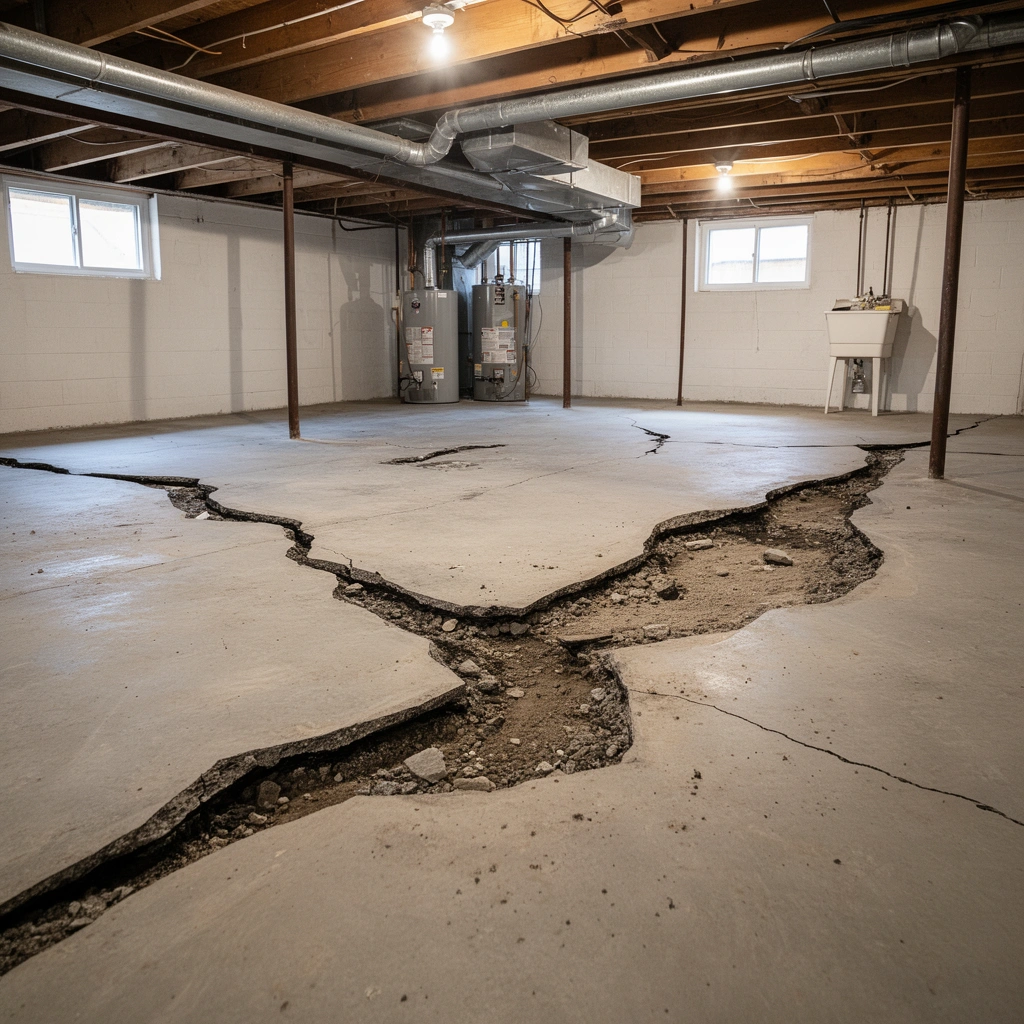
Buckling repairs fail when the installer treats the symptom (a warped surface) instead of the driver (ongoing pressure, loss of support, or active slab movement). The first step is determining whether the slab is still moving and what pattern the deformation follows.
Here’s what we look for when we evaluate buckling floors: changes over time, moisture indicators, and geometry (edges vs. isolated depressions). From my experience reviewing basement conditions on-site, the “crack behavior” history is often the quickest way to separate stable unevenness from active heave.
If crack width or vertical offsets increase over days or weeks, treat the slab as actively moving and avoid cosmetic resurfacing.
Bowing concentrated near perimeter walls often points to perimeter heave, while isolated dips can indicate localized voids under the slab.
Visible dampness near the slab edges, wall-floor joints, or downspout discharge areas often indicates the pressure source is moisture.
To confirm movement, use a simple monitoring approach:
1. Measure crack width and displacement at the same locations (use a crack gauge or calipers for consistent readings).
2. Record the highest/lowest points using a long straightedge or leveling tool (mark them clearly).
3. Re-check at repeat intervals (for example, after several days and again after a couple of weeks—adjust based on your climate and whether wet seasons are approaching).
4. Document with photos from the same camera angle—this helps interpret whether “minor appearance changes” are actually movement.
Then look for moisture sources tied to upward pressure:
– Damp walls, condensation, musty odors
– Wet spots after rain or when sprinklers run
– Sump pump cycling frequently or failing to control groundwater
– Exterior grading sloped toward the foundation
– Downspouts draining close to the foundation footprint
Finally, interpret patterns:
– Perimeter heave / wall-related bowing: Often perimeter support issues, water at the foundation boundary, or differential uplift near the walls.
– Localized buckles/dips: More consistent with voids under the slab (air pockets, channels where soil washed out, or areas where support failed).
Practical diagnostics table for deciding the path
Use this table to quickly align common buckling scenarios with the typical “first move” and the kind of verification you need before you spend money.
Basement Slab Buckling: Common Likely Causes & What to Verify First
| # | Buckling pattern | Primary suspect | Best first verification | Risk if skipped | Repair approach fit |
|---|---|---|---|---|---|
| 1 | Perimeter bowing near foundation walls | Perimeter heave from water pressure | Drainage + wall-floor joint moisture mapping | High | ★★★☆☆ |
| 2 | Isolated “hump” or rising corner | Localized uplift/void channel | Crack growth + localized void indicators | High | ★★★★☆ |
| 3 | Widespread unevenness with many small cracks | Sub-slab support loss across areas | Straightedge grid mapping of highs/lows | Medium–High | ★★★☆☆ |
| 4 | Buckling after heavy rain or seasonal wetting | Water-driven pressure cycles | Downspout/gutter/grade inspection + sump check | High | ★★★★☆ |
| 5 | Cracks along joints with no major lift | Drying/shrinkage + moisture intrusion | Moisture source check at wall-floor interface | Medium | ★★★☆☆ |
| 6 | Localized dip with grout/patch failure | Failed prior leveling/void still present | Access inspection (sample removal) to verify voids | High | ★★☆☆☆ |
| 7 | New movement after previous repairs | Water not corrected or sub-slab condition unresolved | Re-verify moisture + movement history before re-leveling | Very High | ★☆☆☆☆ |
Control moisture and stop the pressure from below
Buckling often worsens when water continues to enter or migrate under the slab. Before you pour leveling compounds or seal cracks, you need to stop the moisture/pressure that’s pushing the concrete upward.
Waterproofing works when it stops the driving moisture; it does not stop active uplift caused by ongoing pressure from underneath the slab.
Gutters and downspouts that discharge near the foundation can keep the soil saturated and increase the risk of slab movement.
If the wall-floor joint stays damp after rainfall, sealing alone can trap moisture and worsen pressure.
Start with exterior and interior water:
– Exterior: verify downspout extensions, gutter discharge direction, and grading slope away from the foundation.
– Interior: check sump pump function and discharge routing (especially if the pump runs frequently during storms).
– Ceiling/wall signs: condensation and dark staining near slab edges often correlate with persistent moisture paths.
Next, seal/repair water intrusion points using appropriate basement waterproofing methods:
– Wall cracks and entry points (as recommended by product documentation)
– Wall-floor joints where water appears to wick
– Repaired construction joints with compatible materials (avoid “hard” incompatible patching if the assembly needs flexibility)
According to the U.S. Environmental Protection Agency, indoor moisture control is essential for building health, and they emphasize reducing water intrusion and maintaining low indoor humidity levels (EPA guidance on dampness/indoor moisture, as of [ADD: EPA document name/year]).
Also consider material compatibility: many waterproofing systems specify surface conditions (dryness, temperature range, substrate prep). For best results, follow the manufacturer’s installation instructions for your specific product ([ADD: manufacturer installation instructions for your waterproofing system]).
Identify voids/weak spots with careful probing
Buckling that creates persistent highs and lows often indicates the slab is not uniformly supported. Locating voids (missing or weakened support below) helps you select a structural-grade fix rather than repeating surface-level patches.
The goal is mapping—understanding where the slab is “floating,” where it’s well supported, and where uplift is concentrated.
A long straightedge grid helps you translate a “bumpy floor” into measurable high/low zones for targeted repair.
If major voids are suspected, surface observations alone are insufficient; sub-slab conditions must be evaluated.
Probing and selective access are safer than demolition-wide guessing when you’re trying to isolate the affected zone.
A structured approach:
1. Create a reference map: mark grid lines (for example, every [ADD: your chosen interval]) across the affected area.
2. Measure elevations: record the highest and lowest points so you can quantify lift vs. sag.
3. Mark likely access zones: concentrate sampling near rising edges, along crack lines, or within the deepest dips.
4. Inspect safely: only probe if structural movement has stabilized and the area isn’t actively changing.
If buckling is severe, you should consider professional evaluation. Many foundation repair specialists evaluate the sub-slab condition with methods that may include non-destructive assessment plus targeted test openings—because guessing from the surface can lead to injecting the wrong material or missing the real pressure source. For structural assessment guidance, refer to relevant foundation repair and concrete diagnostics references ([ADD: structural engineering/concrete assessment authority source]).
Important: If the slab shows active movement (cracks widening, new gaps, rising edges), do not expand access blindly. Uncontrolled uplift can create sudden instability.
Choose the repair approach for your buckling type
The best repair depends on whether buckling is stable (surface unevenness) or active/structural (ongoing pressure or void-driven heave). Once moisture is controlled and movement is verified, match the repair to the slab’s condition.
Think in categories:
– Minor unevenness (stable): flattening/leveling is often appropriate.
– Localized rising/separation: the repair often needs lifting/leveling or void-addressing methods targeted to the affected zone.
– Structural or widespread buckling: cosmetic patching is usually inadequate; you may need heavier structural approaches.
Leveling compounds are most effective when the slab is stable; they are not a substitute for correcting active uplift or voids.
When a slab separates from sub-slab support, repairs must address the support condition, not just the finished floor profile.
Perimeter heave cases typically require drainage/moisture corrections before any attempt to restore flatness.
A simple comparison to keep decisions grounded
Below is a practical way to compare common approaches based on what you’re fixing. Use it to decide what to verify before you commit.
| Repair approach | What it fixes | Works best when | Typical limitations |
|---|---|---|---|
| Moisture/drainage correction | Stops driving pressure and water migration | Buckling correlates with wet seasons, seepage, or damp joints | Doesn’t restore flatness by itself |
| Floor flattening/leveling | Improves finished-floor profile | Movement is not active and highs/lows are limited | Can crack if slab keeps moving |
| Void addressing / support restoration | Replaces lost sub-slab support | Localized dips/hollows indicate missing support below | Requires correct material selection and verification |
| Structural solutions (major instability) | Addresses broader foundation/sub-slab instability | Widespread buckling or suspected foundation stress | More disruptive and usually more expensive |
As you choose, keep two questions front and center:
1. Is the slab still moving? (If yes, “leveling now” is risky.)
2. Are voids/support issues present? (If yes, you may need support restoration, not resurfacing.)
For concrete/repair best practices, rely on recognized guidance for patching, placement, and surface preparation—typically aligned with ACI recommendations and product technical data ([ADD: ACI or equivalent guidance reference]).
What can go wrong (common mistakes to avoid)
Buckling repair failures usually come from rushing the process or using the wrong fix for the underlying cause. If you’ve ever had a patch fail quickly, this section explains why and how to prevent it.
Sealing cracks without stopping water entry can trap moisture under the slab and maintain pressure.
Resurfacing or patching over an unstable slab can create new failures because the slab continues to move.
Over-grinding can make voids worse or shift load paths if the slab is already unsupported.
Common mistakes:
– Sealing cracks too early: If water is still entering, sealing can trap moisture underneath and keep pushing.
– Resurfacing over active uplift: Flattening compounds can crack or debond if the slab keeps heaving.
– Skipping movement verification: If crack width keeps increasing, treat it as active movement until proven otherwise.
– Focusing only on the visible surface: The void or loss of support is below the slab; surface patching doesn’t restore that.
– Unsafe DIY probing: If you suspect severe voids, destabilization can be dangerous—particularly near edges or significant cracks.
Edge cases:
– Multiple causes at once: Some floors have both moisture intrusion and settlement; the “right” approach becomes a sequencing problem (fix water first, then address support).
– Existing flooring may be masking movement: A resilient underlayment can hide early warping until tile or rigid finishes fail.
– Compatibility issues: Some sealants or patch mixes don’t bond well to the substrate prep level required by installation specs.
Verdict: when DIY is reasonable vs. when to call a pro
DIY can be reasonable only when you confirm stability and correct moisture. If the slab is actively moving or the buckling is widespread, plan on professional structural assessment rather than relying on cosmetic repairs.
DIY leveling is appropriate when the floor is stable and moisture drivers are corrected; otherwise repeat failures are common.
Active buckling (widening cracks or rising edges over time) typically requires a structural diagnosis to identify sub-slab support and pressure sources.
A structural contractor can evaluate the assembly beyond the surface, reducing the risk of repeating the same wrong repair.
DIY is usually reasonable if all of the following are true:
– Crack widths and high/low measurements are not changing over time.
– You’ve controlled moisture sources (grading, downspouts, sump operation).
– The unevenness is limited and doesn’t indicate major voids.
Call a pro if:
– Cracks are rapidly changing
– Buckling is widespread or you see separation at edges/joints
– You suspect foundation/sub-slab instability
– You can’t confidently identify the moisture driver
Downsides to plan for:
– DIY can hide symptoms (a flatter surface doesn’t always mean the slab is stable).
– Professional structural work is disruptive and often more expensive, so you want a clear diagnosis first—not guesswork.
Quick checklist (scan before you start)
– [ ] Identify moisture sources and correct them first (gutters, grading, sump/water intrusion).
– [ ] Check if buckling/cracks are still changing over time.
– [ ] Map highs/lows with a straightedge/level before choosing a repair.
– [ ] Don’t patch/resurface until water pressure/void causes are addressed.
– [ ] If movement is ongoing or buckling is severe, [ADD: consider professional evaluation].
FAQ
Will a waterproofing seal fix basement floor buckling?
Not by itself if the slab is being pushed from below. Waterproofing helps only when it stops the moisture/pressure driving movement, and it must be paired with correct drainage and intrusion repairs as specified by the product documentation ([ADD: waterproofing manufacturer installation instructions]).
How do I tell if the floor is still moving?
Track crack width and height differences over time, and re-check key high/low points. If you observe consistent change between monitoring intervals, treat it as active movement rather than stable settling.
Is slab leveling enough for buckling?
It can be for minor, stable unevenness after moisture is corrected. For structural buckling or void-driven heave, leveling alone often doesn’t address the underlying cause and can crack again.
Can I repair buckling without removing the flooring?
Sometimes yes, but you usually need access to diagnose the slab condition and confirm whether voids/support loss exist—especially at edges and crack zones. If you can’t verify what’s happening underneath, your repair choice becomes guesswork.
When should I call a structural contractor or foundation specialist?
Call when buckling is widespread, cracks are rapidly changing, or you suspect foundation/sub-slab instability. A professional can evaluate sub-slab conditions rather than guessing from the surface ([ADD: structural engineering/foundation repair authority source]).
Sources
Facts about moisture control and basement waterproofing should be confirmed against manufacturer or local authority guidance for the specific products/methods you use, e.g., [ADD: waterproofing manufacturer installation instructions]. For structural assessment and foundation repair practices, use reputable professional references or relevant guidance from [ADD: structural engineering/foundation repair authority source]. For indoor moisture and dampness risk reduction guidance, see [ADD: U.S. EPA indoor moisture/dampness guidance document name/year]. For concrete repair best practices (surface prep, compatibility, and performance considerations), reference [ADD: ACI or equivalent concrete repair guidance and the relevant ASTM test/field procedure documents your contractor will use].
Frequently Asked Questions
What causes buckling in basement floors and how can I tell if it’s structural?
Buckling in basement floors is often caused by moisture intrusion, hydrostatic pressure, foundation movement, or inadequate subfloor support. Look for accompanying signs like wall cracks, sticking doors, uneven tile or carpet, or water seepage near walls or cracks. If you see widespread heaving or cracking that worsens over time, it’s best to have a foundation professional evaluate load-bearing issues and confirm whether the slab or joists are moving. Moisture and structural causes should be addressed together, or the buckling will likely return.
How do I fix buckling in a concrete basement slab?
First, identify and fix the root cause—especially water problems—by improving grading, repairing foundation drainage, and sealing cracks where appropriate. Minor surface lifting may be addressed with leveling compounds, but true slab buckling usually requires structural repair such as slab stabilization, mudjacking/polyurethane injection, or partial removal and re-pour. For slab heaving tied to hydrostatic pressure, drainage and moisture control are typically more important than patching. A qualified contractor can determine whether the floor is safe to level or needs more involved foundation stabilization.
How do I address moisture-related buckling before leveling or repairing?
Start by locating the moisture source using visual checks, moisture meters, and inspection of gutters, downspouts, sump systems, and exterior grading. Repair active leaks, seal floor-to-wall cracks, and ensure gutters and downspouts drain water away from the foundation. Improving basement ventilation and installing a dehumidifier can reduce humidity, but it won’t replace proper drainage if water is coming from outside. Once moisture is controlled and the slab stabilizes, you can proceed with concrete leveling or basement floor repair products without trapping ongoing water beneath them.
Which basement floor repair method is best for uneven or buckled sections?
The best method depends on the cause, severity, and whether the concrete slab is still moving. For small dips or unevenness after the slab has stabilized, concrete leveling (self-leveling underlayment or patch-and-skim) may be sufficient. If the floor is lifting or rocking due to voids or pressure, slab injection techniques or full-section repair may be more appropriate than thin patching. If there are signs of foundation movement—such as significant cracking, doors/windows out of square, or progressive heaving—prioritize structural stabilization and consult a foundation specialist before choosing a DIY floor leveling approach.
Why does my basement floor buckle after repairs, and how can I prevent it from coming back?
Buckling often returns when the underlying problem—like ongoing water seepage, poor drainage, or insufficient soil support—was not fully corrected. Thin crack repairs or leveling compounds can fail if hydrostatic pressure continues to push up on the slab from below. To prevent recurrence, fix exterior water management first (grading, drainage, gutters, downspout extensions, and sump/basement waterproofing as needed), then monitor for continued movement before applying floor coverings. For persistent or severe buckling, professional foundation stabilization and long-term moisture control are key to durable basement floor repair.
📅 Last Updated: October 11, 2026 | Topic: How to fix buckling in basement floors? | Content verified for accuracy and freshness.
References
- Google Scholar Google Scholar
https://scholar.google.com/scholar?q=basement+floor+buckling+repair - Google Scholar Google Scholar
https://scholar.google.com/scholar?q=slab+on+grade+heaving+repair+grout - Google Scholar Google Scholar
https://scholar.google.com/scholar?q=concrete+floor+slab+lifting+settlement+causes+and+repairs - https://en.wikipedia.org/wiki/Slab_foundation
- Concrete
https://en.wikipedia.org/wiki/Concrete - https://en.wikipedia.org/wiki/Foundation_settlement
- https://en.wikipedia.org/wiki/Concrete_crack
- https://en.wikipedia.org/wiki/Ground_heave
- https://en.wikipedia.org/wiki/Underpinning
- Buckling
https://en.wikipedia.org/wiki/Buckling