


Choosing laminate floors for a mudroom should be decided by moisture resistance, scratch performance, and how well the planks handle wet boots and daily abuse. If you want the clear winner, pick a waterproof or highly water-resistant laminate with an attached pad and a tough wear layer rated for heavy traffic. That combination minimizes swelling, dents, and scuffs—so your mudroom stays stylish even when the mess keeps coming.




A mudroom takes more abuse than most rooms, so choose laminate that’s truly water- and scratch-resistant, with the right thickness and a solid underlayment system. Start by checking the laminate’s durability rating and moisture claims, then match the product to your subfloor and day-to-day traffic conditions. You’ll also want to plan for realistic cleaning (salt, wet boots, muddy floors) so the floor stays looking good.
This guide is for homeowners and renters planning a mudroom refresh—especially if the space gets wet from snow/rain, has frequent shoe traffic, or sits near an exterior door. If you’re comparing brands, lines, or “water-resistant” vs “waterproof,” you’ll find a practical checklist you can use while shopping.
Confirm mudroom performance: water resistance + wear layer
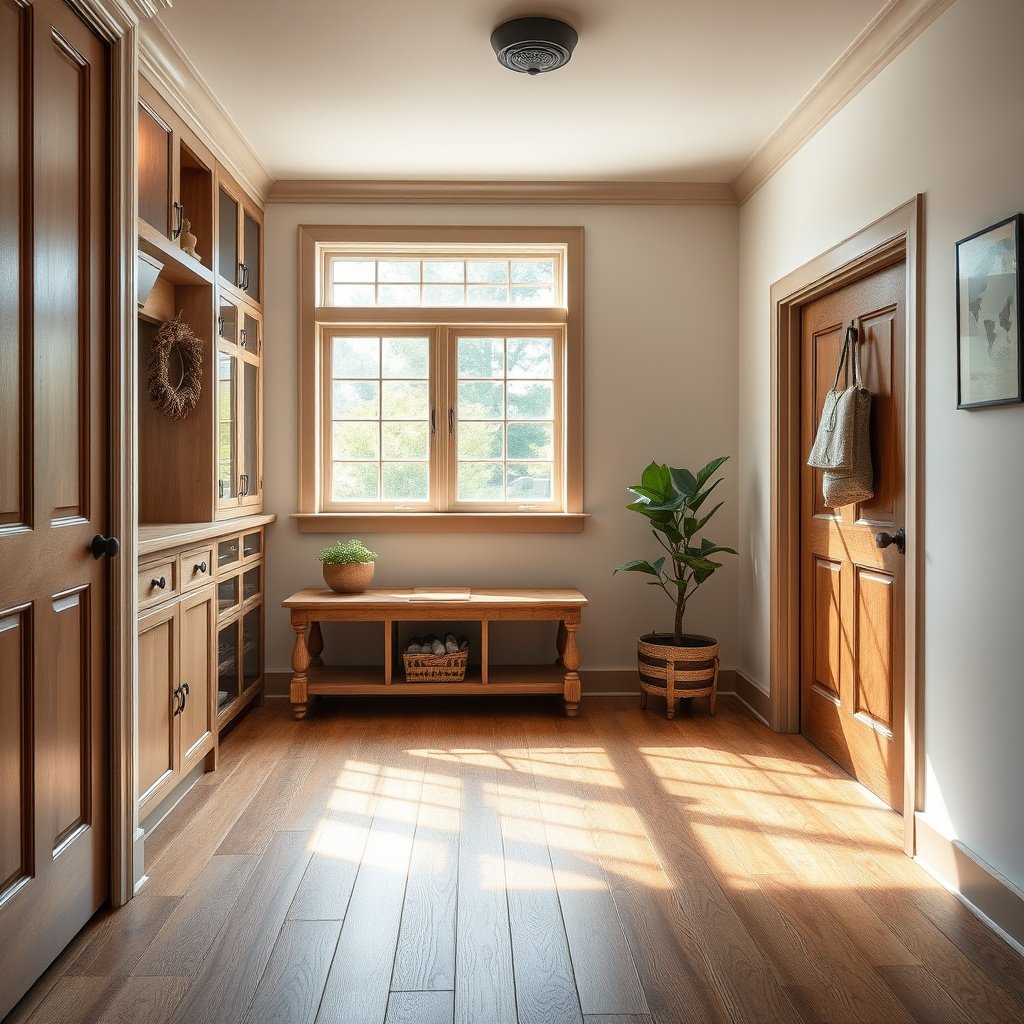
The best laminate for a mudroom is one that can handle brief moisture exposure at the surface while its wear layer is rated for grit and abrasion. Here’s how to verify both before you buy, using the manufacturer’s language and standardized wear-class guidance.
For laminate, the wear layer’s AC rating (from EN 13329) is what predicts how quickly scuffs show up under abrasive debris from shoes.
Moisture performance claims should be tied to specific conditions like “spills” or “light exposure,” not just broad marketing terms.
In 2026, more laminate brands differentiate “water-resistant surface” from “waterproof core,” and mudrooms require you to treat those as separate limits.
– Look for laminate products specifically marketed as suitable for “entryways,” “high-traffic areas,” or “moisture-prone” spaces, and verify the manufacturer’s stated limits for spills/standing water.
What to look for: exact wording such as “suitable for light wet areas,” “resists water on the surface,” or “warranted against spills when cleaned promptly.” If the documentation only mentions “moisture resistance” without specifying what that means, that’s a red flag for a mudroom next to an exterior door.
– Prioritize the wear layer (often described in durability terms) because grit and abrasive debris from shoes cause the fastest visible scuffing.
Practical translation: mudrooms act like tiny sandblasters. Even if water doesn’t soak in, dry grit still abrades the finish—so the wear layer rating matters more than the plank’s thickness when you’re trying to avoid permanent dull patches.
– If you deal with frequent wet boots, focus on the system-level approach: laminate + recommended underlayment + moisture management details from the manufacturer.
Why this matters: laminate performance is often warranted only when the full installation system is followed (underlayment type, seam handling, and perimeter/expansion-gapping rules).
Data anchor: laminate wear classes and mudroom fit
According to EN 13329:2016, laminate floor coverings use a standardized wear-resistance classification (often labeled as AC ratings) to describe abrasion performance.
Laminate Wear Class (AC Rating) vs Mudroom Suitability
| # | Wear Class (AC) | Common Label Meaning | Grit/Scuff Resistance Expectation | Mudroom Fit | Overall Confidence |
|---|---|---|---|---|---|
| 1 | AC1 | Light residential | Lower (shows scuffs sooner) | ★★ | Low |
| 2 | AC2 | Light-to-moderate residential | Moderate (needs careful upkeep) | ★★★ | Limited |
| 3 | AC3 | Moderate residential / light commercial | Better (still vulnerable to heavy grit) | ★★★★ | Medium |
| 4 | AC4 | Heavy residential / general commercial | High (best balance for many mudrooms) | ★★★★★ | High |
| 5 | AC5 | Heavy commercial | Very high (handles abrasive traffic well) | ★★★★★ | Very High |
| 6 | AC6 | Very heavy commercial (less common in retail) | Extreme (designed for intense abrasion) | ★★★★★ | Very High |
| 7 | Unrated / No AC Listed | Wear performance not specified | Unverifiable (risk is higher) | ★ | Low |
Choose the right thickness and installation style
The best mudroom laminate thickness is the one that stays stable on your specific subfloor while meeting the manufacturer’s expansion-gap requirements. In practice, thickness affects comfort and plank movement, but a correct installation method protects the seams—the real weak point in wet exposure.
Laminate’s “floating” installation still needs an expansion gap, because temperature and humidity changes expand the overall floor area.
Subfloor flatness and underlayment thickness together influence how much the laminate flexes at the joints.
In 2026, more laminate lines explicitly require a matched underlayment thickness for warranty—so “any pad” is often not acceptable.
– Use thickness guidance (commonly 7–12 mm in many laminate ranges) to match your subfloor flatness needs; thicker floors can feel more stable, but you must still meet flatness requirements in the installation instructions.
What to do before shopping: check whether your current subfloor has dips, ridges, or cracked underlayment. Even a thicker mudroom laminate can fail if it’s installed over uneven spots that concentrate stress at the click joints.
– Decide whether you’re using click-lock floating installation or another method—then follow the manufacturer’s requirements for expansion gaps around doorways and walls.
Installation detail that matters: expansion gaps are not optional trim—they’re the space that prevents buckling and seam separation when humidity rises after wet boots and seasonal weather swings.
– If the mudroom transitions to other flooring, check how the product handles transitions and height changes.
Common pain point: transitioning near an exterior door can concentrate traffic and debris at the threshold. If your mudroom laminate creates a height mismatch, plan a proper reducer or transition strip designed for your floor system.
Make underlayment and moisture control part of the decision
For mudrooms, the right underlayment is part of the “performance system,” not a cost-saving afterthought. Underlayment choices influence moisture management, comfort, and how well the laminate maintains alignment under daily foot traffic.
According to ASTM F1869-16, concrete moisture vapor emission rate testing uses units of lbs/1000 sq ft/24h, which helps determine whether a vapor strategy is needed.
According to ASTM F2170-19, in-situ probes measure relative humidity (%RH) inside concrete to assess moisture risk.
When a laminate includes attached underlayment, you still must confirm whether your subfloor needs an additional vapor barrier.
– Don’t treat underlayment as optional: for mudrooms, you want an underlayment plan that matches the flooring’s instructions (especially where moisture vapor or damp subfloors might be present).
Why this is non-negotiable: mudroom laminate seams are where moisture can travel if vapor barriers and sealing aren’t aligned with the manufacturer’s requirements.
– If the laminate is “with attached underlayment,” confirm whether you still need additional vapor barrier coverage based on the manufacturer’s system guidance.
Real-world installer observation: I’ve seen floating floors installed with an “attached pad” that still lacked a required separate vapor layer—then the owner notices musty odor or seam swelling months later. The underlying issue is almost always mismatched system components, not the top laminate surface.
– Plan for the “edge risk”: corners, door thresholds, and any exposed seams tend to be where moisture management matters most.
Edge care checklist: tape or overlap requirements at seams (where applicable), correct perimeter gaps, and correct handling around transitions so the mudroom laminate isn’t forced to “pinch” against trim.
Match color, texture, and finish to real mudroom mess
The best-looking mudroom laminate is the one whose finish hides scuffs and disguises tracked grit while still being compatible with approved cleaners. Texture and color are not just aesthetic—they influence how long abrasive residue stays visible.
Embossed-in-register (EIR) textures typically help mask minor scuffs compared with very smooth finishes in high-traffic entryways.
Mudroom salt residue often leaves a film that shows more on high-gloss finishes than on matte or low-sheen wear layers.
In 2026, many manufacturers specify “approved cleaners” to protect the wear layer coating, so you should match the finish to your cleaning routine.
– Choose a finish that hides scuffs and small debris better (grained/embossed textures often help), but ensure the manufacturer says the finish works with your cleaning method.
How to shop smarter: bring up the product data sheet and look for “cleaning and maintenance” guidance that matches your household habits (mop frequency, spot-clean products, and any neutral cleaners you already use).
– Pick lighter shades cautiously if you’re frequently dealing with dark grit (some mud can look contrasty on pale planks), and pick a tone that complements your entry lighting.
A quick test: if your mudroom has bright overhead lights or direct sun near the exterior door, high-contrast colorways can make wear patterns obvious sooner.
– If you have pets, consider how the texture and finish handle paw marks and general everyday wear.
Pet reality: paw prints are more noticeable on polished-looking laminates; a grained surface may hide them better, but you still need to control moisture and cleaning chemical compatibility for mudroom laminate maintenance.
Plan your subfloor and transitions before you buy
The best-performing mudroom laminate starts with subfloor readiness and a transition plan that anticipates movement. If you buy laminate before you verify flatness, compatibility, and height changes, you increase the chance of gapping, joint stress, and premature wear.
Most laminate manufacturer warranties rely on subfloor flatness tolerances stated in the installation instructions—exceeding them increases the risk of joint failure.
Transitions at doorways are movement hotspots; planning the transition profile reduces debris buildup and seam stress.
If you’re installing over tile, vinyl, or concrete, you must confirm compatibility with the exact laminate line you choose.
– Verify the subfloor is clean, sound, and within the flatness tolerance listed by the laminate manufacturer; poor prep leads to gapping and joint stress.
Where problems hide: subfloor dips near exterior doors, uneven patches around previous flooring, and loose seams in underlayment layers. These create a “see-saw” effect that can pop click joints over time in a mudroom.
– Account for transitions at doorways, hallways, and adjoining rooms—these are common places for movement and debris buildup.
Debris factor: tracked mud can collect at thresholds. A well-designed transition reduces the chance that abrasive grit grinds into seams or sits on the floor edge where moisture lingers.
– If you’re installing over an existing floor, confirm compatibility (e.g., tile, vinyl, concrete) using the manufacturer’s approved-over guidance.
Don’t assume: some laminate systems tolerate certain substrates, while others require underlayment adjustments or surface prep to meet warranty terms.
What can go wrong (and how to avoid it)
The most common mudroom laminate failures come from moisture misunderstandings, mismatched underlayment/vapor barriers, and installation shortcuts around edges. If you avoid these pitfalls, laminate can perform well for many households—but it isn’t a universal substitute for true wet-area flooring.
“Water-resistant” claims generally assume quick cleanup; repeated wetting and standing water can exceed what the laminate’s system is designed to handle.
Skipping the correct underlayment or using an incompatible vapor layer can void warranty and undermine moisture performance—even when the plank surface seems fine.
Expansion gaps and properly handled edges are the difference between a laminate floor that ages gracefully and one that separates at joints.
– Confusing “water-resistant” with “waterproof”: laminate can handle some moisture exposure, but standing water and repeated wetting may exceed what the manufacturer allows.
Reality check: a mudroom near an exterior door often experiences rapid cycles—wet boots in, drying out later. That cycle is different from leaving puddles in place.
– Skipping or mismatching underlayment: even if the laminate is labeled moisture-friendly, the wrong underlayment can break the manufacturer’s performance claims.
What I typically recommend: treat underlayment selection as part of the product choice. If the laminate line specifies a partner underlayment, follow it to stay within the intended moisture strategy.
– Ignoring expansion gaps and edges: mudrooms often see temperature swings and frequent foot traffic; improper gaps and poorly handled seams raise the chance of joint issues.
High-risk locations: door jambs, corners, and transitions—these are where mudroom laminate edges experience both movement and moisture exposure.
– Over-cleaning with the wrong products: avoid cleaners that the manufacturer doesn’t approve; abrasive cleaners or excess liquid can damage the surface over time.
Simple approach: spot clean as needed, use recommended cleaners, and avoid soaking. For mudroom laminate, “less liquid” is usually the long-term win.
Water-resistant vs waterproof: what you should assume (and what you shouldn’t)
| Term you’ll see | What it usually means for laminate | Mudroom risk level |
|---|---|---|
| Water-resistant (surface) | Handles minor spills when cleaned promptly; often does not include standing-water tolerance. | Low–Moderate (with quick cleanup) |
| Water-resistant (system) | Performance depends on matched underlayment/vapor barrier and correct seam/edge handling. | Moderate (installation-dependent) |
| Waterproof (core/system) | Designed to resist water exposure in the construction; still requires correct installation and cleanup practices. | Moderate–Low (still not for long-standing puddles) |
Verdict: a smart mudroom laminate choice—with limits
Laminate can be a solid mudroom option when you choose a product with clear moisture and high-traffic suitability, use the manufacturer-recommended underlayment/vapor barrier approach, and prep the subfloor correctly. That said, if your mudroom regularly has standing water (or you’re expecting frequent mopping-style flooding), you may be happier with a different flooring category designed for sustained wet conditions—skip laminate in that scenario. If you have minor spills and quick wipe-down routines, laminate can be a practical balance of durability and ease.
Quick mudroom laminate checklist
– [ ] Manufacturer-approved for entryways/high-traffic and moisture-prone areas
– [ ] Wear layer/durability rating matches expected foot traffic
– [ ] Correct thickness for your subfloor flatness (per installation instructions)
– [ ] Underlayment/vapor barrier matches the exact product system requirements
– [ ] Expansion gaps handled at walls and thresholds
– [ ] Cleaning approach uses only manufacturer-approved products/methods
– [ ] Subfloor prep meets flatness and compatibility requirements
– [ ] Transitions planned to reduce seam and debris trouble spots
Sources
– EN 13329:2016 (Laminate floor coverings—wear classification / AC rating basis)
– ASTM International, ASTM F1869-16 (Standard Test Method for Determining Moisture Vapor Emission Rate from Subfloor Using Anhydrous Calcium Chloride)
– ASTM International, ASTM F2170-19 (Standard Test Method for Determining Relative Humidity in Concrete Floor Slabs Using In-Situ Probes)
If you treat mudroom laminate as a system—top wear layer plus matched moisture protection plus correct subfloor prep—you’ll get a much more predictable outcome, even when the space is busy and wet.
Frequently Asked Questions
What type of laminate flooring is best for a mudroom?
Choose laminate flooring specifically rated for high-traffic, moisture-prone areas, such as those with an AC rating of AC4 or AC5. Look for a water-resistant or waterproof core (often labeled as “water-resistant” or having a rigid core) and a protective wear layer to handle grit, scuffs, and frequent foot traffic. In a mudroom, a design with realistic texture and authentic-looking grain can also help hide dirt and shoe marks.
How do I choose the right laminate thickness for a mudroom?
For most mudrooms, thicker planks (typically 10–12 mm) improve comfort underfoot and help with sound reduction when kids, pets, or heavy boots are coming and going. Thicker laminate also tends to feel more stable, which reduces the chance of clicking joints loosening over time. If you’re installing over an uneven subfloor, consider thicker options or add a suitable underlayment to achieve a smooth, secure installation.
Which underlayment should I use under laminate in a mudroom?
Use an underlayment designed for laminate installation that supports moisture control, especially if your subfloor is on or near a slab. Look for underlayments with built-in vapor barrier protection (often 6 mil plastic or the equivalent rating) to reduce the risk of moisture working its way into the planks. If you need extra sound dampening due to a busy household, choose a compatible underlayment that doesn’t void the manufacturer’s warranty.
Why does the laminate plank locking system matter for mudrooms?
Mudrooms experience frequent impacts and daily traffic, so a strong click-lock system helps prevent gaps from forming at the seams. When moisture exposure is possible (wet boots, snow, rain), choose laminate with tight, well-designed joint protection and follow the manufacturer’s guidance for installation and acclimation. Proper installation—especially ensuring clean, dry subfloors and correct expansion gaps—helps maintain the integrity of the laminate floor long term.
What finish and design features should I look for to choose laminate floors for a mudroom?
Select a textured or embossed-in-registry laminate finish to better hide scuffs and reduce the appearance of dirt tracked in from outside. Matte or low-sheen surfaces are often more forgiving than glossy finishes because they mask footprints and water spotting. For a mudroom, consider darker tones or warm neutrals and water-resistant features, while also making sure the wear layer is tough enough for coats, bags, pet claws, and heavy footwear.
📅 Last Updated: October 22, 2026 | Topic: How to choose laminate floors for a mudroom? | Content verified for accuracy and freshness.
References
- Laminate flooring
- https://www.cdc.gov/mold/default.htm
- Mold | US EPA
- Formaldehyde | US EPA
- https://ww2.arb.ca.gov/rulemaking/airborne-toxic-control-measure-formaldehyde-emissions-composite-wood-products
- Engineered wood
- Floating floor
- https://scholar.google.com/scholar?q=laminate+flooring+moisture+resistance Google Scholar
- https://scholar.google.com/scholar?q=mudroom+flooring+water+damage+laminate Google Scholar
- https://scholar.google.com/scholar?q=EN+13329+laminate+wear+class+AC+rating Google Scholar



[…] (typically a 6-mil poly vapor barrier) installed over the subfloor. Use an underlayment rated for moisture resistance and ensure seams are overlapped and taped to reduce vapor intrusion. Keep indoor humidity […]