Learn how to remove stains from commercial floors with a clear, step-by-step method that targets the common culprits—grease, rust, tire marks, and spills—without damaging finishes. You’ll get practical cleaning steps in the right order, the exact prep you need, and when to escalate to stronger spot treatments. Follow this approach and you’ll see measurable stain lift fast, with results that hold up in real traffic.



If you want to remove stains from commercial floors, start by identifying the stain type (oil/grease, rust, organic, dye, or general dirt) before choosing a cleaner. Use the gentlest method first—usually neutral detergent and the right scrubbing technique—then move to stronger chemistry only if the stain remains. This guide walks you through a quick, reliable process for safer results and fewer damage risks.
If your facility has heavy foot traffic, frequent spills, or floor finishes that need protection, you’ll benefit from a step-by-step approach. This is also for property managers, custodial leads, and maintenance teams who need cleaner outcomes without guesswork—or redoing the same area twice.
Identify the stain source (and protect the surface)
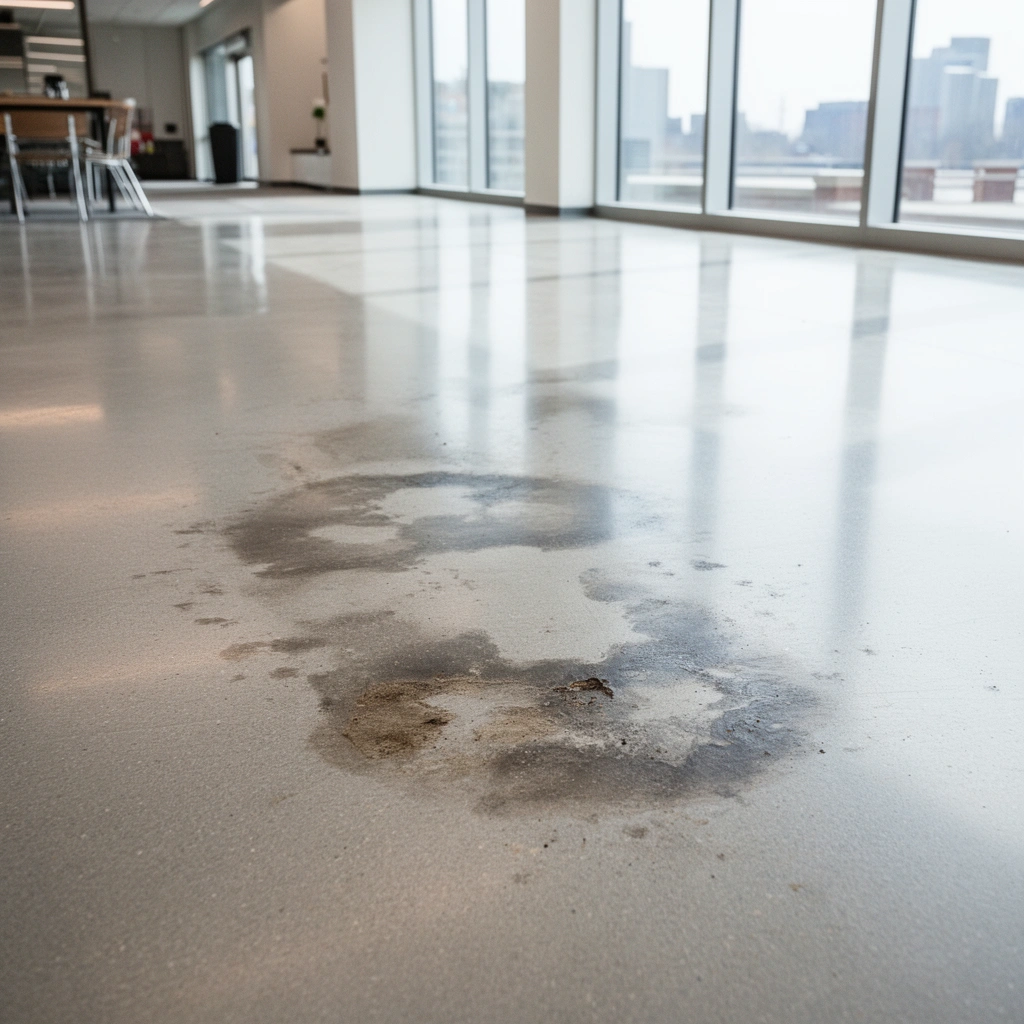
The fastest path to stain removal is matching the stain to its source, then protecting the floor finish before you apply any chemistry. When you treat a stain like “general dirt” but it’s actually rust, dye, or mineral buildup, you often spread the problem or create a new haze.
Start by observing the stain’s visual cues and the area context. Oil/grease stains commonly appear dark, rainbowing, or greasy to the touch near kitchens, loading bays, garages, or entry mats. Rust tends to show orange-brown spots or streaks and often appears where metal fixtures, carts, rails, or moisture contact the floor. Organic stains (food, urine, mud with biological material) may look darker over time, smell, or feel tacky in older spots. Mineral/hard-water staining usually presents as light gray-white rings, crusty edges, or “etched” looking patches—especially near HVAC condensate, mop water left to dry, or areas cleaned with inconsistent water quality. Dye/ink stains often look deep and saturated (sometimes bluish/black/purple) and can persist because dyes penetrate into the top finish layer.
Before you clean broadly, protect the surface and finish integrity. Test the cleaner in a hidden spot and check for changes like dulling, color shifting, softening, or surface film swelling. In my experience working with commercial floor-care crews, the most costly “oops” is not the chemistry—it’s skipping the small test patch when the flooring material or coating type isn’t fully confirmed.
“Match cleaning chemistry to stain chemistry—oil, rust, organic, and mineral deposits generally require different active ingredients.”
“Testing any cleaner on a small inconspicuous area helps prevent irreversible finish dulling or discoloration.”
“Rust staining often involves iron oxidation products that respond to targeted rust removers rather than routine detergents.”
What to look for (quick pairing of stain vs likely cause)
– Oil/grease: darkened, smears easily, may feel slippery; common near kitchens/parking.
– Rust: orange/brown, spotty or streaked; often near metal hardware and moisture.
– Organic: dark with odor potential; may return after partial cleaning.
– Mineral/hard-water: white-gray, crusty edges, “ring” patterns; worsens if left to dry.
– Dye/ink: deep color, uniform spread; resists detergent-only removal.
– General dirt: gray film, footprints, tracked soil from entrances.
Surface protection step (before chemistry)
– Identify the floor material/finish if possible (VCT, linoleum, polished concrete, epoxy, sealed tile/stone, rubber, etc.).
– Use PPE and ventilation as required by the product label.
– If you suspect an unknown coating, avoid acids/strong alkalis until you can confirm finish compatibility (or get manufacturer documentation).
Clear the area and start with the safest cleaning method
The safest starting point for commercial floors is to remove loose soil first and pre-clean with warm water and a neutral, pH-balanced detergent. This reduces contamination you’d otherwise “grind in,” and it helps you see whether the stain is truly removable at the surface level.
Begin with the basics: sweep or vacuum, then remove debris/dry soil. Particles act like abrasives, which can scratch finishes and push particulate soil into micro-textures. Next, pre-clean with warm water and a neutral detergent. Use a scrub pad/brush appropriate to the flooring type (for example, softer pads for finishes that scratch easily). Work in controlled sections so the detergent doesn’t dry on the floor.
According to the U.S. Environmental Protection Agency (EPA) guidance on safer cleaning practices, using appropriate cleaning methods and avoiding unnecessary stronger chemicals reduces both surface damage and environmental impact (EPA: Safer Choice / cleaning safety guidance). To keep the process repeatable, follow a consistent dwell time even during pre-cleaning—enough time to loosen soil, not enough to dry.
“Remove loose debris before wet cleaning to avoid grinding grit into the floor surface.”
“Neutral, pH-balanced detergents are generally less likely to strip or etch many common commercial floor finishes than strong acids or alkalies.”
“Consistent section-by-section cleaning improves results and reduces the likelihood of missed edges and re-soiling.”
Practical pre-clean workflow
1. Sweep/vacuum thoroughly—especially at edges, corners, and traffic lanes.
2. Pre-saturate lightly (warm water) to loosen surface film.
3. Use neutral detergent (per label dilution).
4. Scrub with the right tool:
– Soft/finish-safe pad for finished vinyl or sensitive coatings.
– Stiffer brush only where finish condition is known and abrasion is acceptable.
5. Remove residue (wipe/extract/rinse as required).
Why this step matters
If you skip debris removal, the “stain” can be a mix: topsoil plus chemistry residue plus finish sheen changes. The safest method first gives you a baseline and prevents you from escalating too early.
Use the right chemistry for the stain type
The best stain remover is the one designed for the chemistry you’re actually seeing—oil/grease, rust, organic, or mineral buildup. Once you identify the stain type, use targeted chemistry while staying within label dwell time and compatibility limits.
For oil/grease stains
Use a commercial degreaser formulated for floors, then follow with thorough rinsing. Keep dwell time short and avoid letting degreaser residue dry. Oil can trap detergent chemistry in the pores of the finish layer, leaving a sticky film that re-attracts soil. The goal is to break down oils, then remove them—not just “coat over” the area.
For rust stains
Rust removers are often acid-based and must be used carefully. Acidic chemistry can damage stone, certain grouts, and some coatings if compatibility is unknown. Only use rust remover if the flooring and finish can handle it, and strictly follow label directions. If rust appears repeatedly, you may also need to address the source (metal transfer, water intrusion, humidity).
For organic stains
Enzymatic cleaners can be effective because enzymes (biological catalysts) break down organic compounds. They’re commonly used for food, urine, and many biological spill residues. Apply as directed, allow appropriate dwell time, then rinse/dry based on label requirements. Not all enzymatic products require the same rinsing approach—check the manufacturer guidance.For mineral/hard-water stains
Mineral deposits respond to descaling chemistry compatible with your flooring. If you choose an incompatible product, you may etch finishes or change gloss. Descaling works best with controlled dwell time and complete rinsing.
“Oil/grease commonly requires surfactant-driven degreasing and thorough rinsing to prevent sticky residue that attracts new soil.”
“Rust removal typically uses chemistry that targets iron oxidation products; these products may be corrosive and require finish compatibility checks.”
“Enzymatic cleaners are designed to break down specific organic compounds, and their performance depends on correct dwell time and surface conditions.”
“Mineral deposits (hard-water scale) generally need descaling chemistry; leaving residue can worsen haze and re-staining.”
Chemistry at a glance (what you’re actually choosing)
Commercial Floor Stain Types: Chemistry Class and Finish Risk (Typical)
| # | Likely Stain Type | Typical Active Chemistry | General pH Range | Finish Compatibility Risk |
|---|---|---|---|---|
| 1 | General dirt / scuff film | Neutral detergent (surfactants + polymers) | ~6–8 |
★ |
| 2 | Oil / grease transfer | Degreaser (surfactants/emulsifiers) | ~9–13 |
★★ |
| 3 | Rust / metal transfer | Rust remover (often acid-based) | ~1–4 |
★★★★ |
| 4 | Organic spills (food/urine) | Enzymatic cleaner (protease/lipase) | ~5–9 |
★★ |
| 5 | Hard-water / mineral scale | Descaler (acid blends) | ~2–5 |
★★★★ |
| 6 | Dye/ink staining | Spot-chemistry (often oxidizers/solvents) | Product-specific |
★★★ |
| 7 | Unknown or mixed staining | Neutral-first escalation (test patches) | ~6–8 → as needed |
★★★ |
Note: pH ranges above are typical class-level ranges. Always confirm your specific product’s safety data sheet (SDS) and label directions for exact formulation and finish compatibility.
Scrub, rinse, and dry correctly to prevent re-staining
The difference between “it looks better” and “it stays clean” is scrubbing control, complete rinsing, and full drying. If you leave chemical residue or moisture behind, the floor can re-soil faster and stains can reappear in days.
Scrub with controlled pressure and consistent passes. Don’t chase the stain with maximum force—on finished floors, abrasion can remove or weaken the protective coating layer. Let the chemistry do the work within the product’s dwell time. If a degreaser or descaler needs time to react, applying less dwell than recommended can make the stain look stubborn; applying too long can change gloss or dull the finish.
Rinse thoroughly. Residue can attract soil and can also react with remaining contaminants to create “ghosting” (a faint shadow that wasn’t obvious during the wet stage). Dry the floor fully before reopening traffic. Drying is especially important in slip-risk environments—entrances, kitchens, and corridors—because residual moisture compounds risk.“Incomplete rinsing can leave surfactant or descaler residue that increases future soil loading and haze.”
“Controlled mechanical action plus correct dwell time is more reliable than excessive scrubbing for stain removal on finished floors.”
“Allowing floors to dry fully reduces slip risk and helps you evaluate the true cleaned appearance.”
A practical technique that reduces re-work
– Work in bands (e.g., 1–2 m sections) so dwell time is consistent.
– Use a timer for dwell time (based on the label).
– Rinse to clarity—no slickness, no strong odor, and no visible product film.
– Dry with extraction/wet-vac where available, or clean towels/mop heads that don’t spread moisture.
What can go wrong (common mistakes and limits)
Most cleaning failures come from mismatched chemistry, incorrect dwell time, or residue left behind. Once the finish layer is damaged—especially on VCT and other coated floors—stains often look “bigger” even when the chemistry removed the original source.
Common mistakes
– Using the wrong cleaner: Acidic products can etch stone or dull certain finishes; alkaline cleaners can leave haze on some coatings.
– Skipping dilution or dwell-time rules: Over-concentration or extended dwell can discolor and permanently dull the surface.
– Not rinsing: Residue can re-dissolve and migrate, creating ghosting or new “stain-like” shadows after drying.
– Scrubbing aggressively on softer floors: High abrasion may remove finish layers faster than the stain itself.
Important limits (when “cleaning” isn’t enough)
Some stains are deeper than the surface film—examples include corrosion beneath coatings, dye that penetrated multiple layers, or mineral scale embedded in porous substrates. In those cases, you may need resurfacing, re-sealing, or finish restoration rather than repeated spot cleaning.
From a maintenance and safety standpoint, slip prevention is a major driver of correct drying and rinse practices. For safety, follow your internal slip-prevention program and relevant facility procedures (ADD: source for facility slip-resistance/safety guidance used by your organization).
“If the floor finish is stripped or etched, the same stain can appear to return faster because the protective layer is gone.”
“Residue left after spot cleaning often shows up as haze or shadowing once the floor dries.”
Verdict: a dependable approach—with a few “skip it” cases
A reliable method is: identify the stain → neutral detergent first → escalate only when needed → rinse and dry thoroughly. This works for most routine commercial staining, but skip DIY escalation (and call a pro) if you suspect deep substrate staining, failed seals, extensive rust spread, or you don’t know the floor finish/material.
Here’s how to decide whether to proceed or stop:
– Proceed with the guide when the stain is superficial (surface film) and you can confirm floor type/finish or at least do careful spot testing.
– Call a floor-care specialist when you see signs of finish failure, repeated rust cycling, extensive dye penetration, or when acidic/descaling chemistry would be risky without verified compatibility.
“Start neutral and escalate based on results to reduce the risk of finish damage while still improving cleaning performance.”
“When the stain source is below the top film (deep corrosion/penetration), cleaning alone may not restore appearance without coating or restoration.”
Quick scan checklist (save this)
– [ ] Identify the stain type (oil/grease, rust, organic, mineral, dye/ink, or soil).
– [ ] Sweep/vacuum first; don’t grind debris in.
– [ ] Test cleaner in a hidden spot.
– [ ] Start with neutral detergent and the correct pad/brush.
– [ ] Use targeted chemistry only if needed; follow label dwell time.
– [ ] Scrub consistently (don’t over-apply pressure).
– [ ] Rinse thoroughly; remove all residue.
– [ ] Dry completely; keep traffic off until safe.
“A quick test patch reduces the risk of finish discoloration and helps you pick the right chemistry faster.”
“Dwell time and rinsing are key control points for predictable commercial floor results.”
FAQ
Can I use the same cleaner for every stain on commercial floors?
Usually no. Oil, rust, and mineral deposits respond to different chemistries, and the wrong product can worsen discoloration or damage finishes.
“Using a single cleaner for all stain types increases the likelihood of finish damage or ineffective removal.”
What’s the safest first product to try?
A neutral (pH-balanced) detergent and warm water is often the safest starting point, because it’s less likely to etch or strip finishes than aggressive acids/alkalis.
“Neutral pH detergents are commonly used as first-pass cleaners because they are generally less aggressive than acid or alkaline chemistry.”
Why does the stain come back after cleaning?
Common reasons include leftover residue, incomplete rinsing, or the stain being deeper than the surface film (so you clean the top but not the source).
“Residual cleaning chemicals can attract soil and make a previously removed stain appear to return.”
Do I need to rinse every time?
In most cases, yes. Thorough rinsing helps prevent chemical residue that can attract soil and cause lingering haze or re-staining.
“Rinsing after chemical cleaning reduces residue-related haze and soil re-deposition on traffic surfaces.”
When should I stop and call a professional?
Stop if you can’t identify the stain type, the floor material/finish is unknown, the stain looks deeply embedded, or repeated cleaning appears to damage the surface.
“If repeated cleaning visibly changes gloss or finish condition, further chemistry can accelerate finish failure.”
Sources
– [ADD: manufacturer/specification documentation for your specific floor type or floor finish—e.g., VCT, polished concrete, epoxy coating, sealed stone—on recommended cleaners and what to avoid]
– [ADD: official label instructions/source for the specific cleaner or degreaser you plan to use, including dilution and dwell time requirements]
– If you’re using enzymatic cleaners: [ADD: manufacturer guidance for application/dwell time and whether rinsing is required]
– [ADD: source for safety guidance related to slip risk and post-cleaning drying practices used in commercial facilities]
A dependable stain-removal process is built on one discipline: identify the stain type first, then choose the least aggressive method that’s compatible with your flooring. Start with neutral detergent and correct scrubbing, escalate only when the stain resists targeted steps, and always rinse and dry thoroughly to avoid re-staining. If the finish appears compromised or the stain is clearly embedded, treat that as a signal to stop DIY and move to floor-care expertise rather than repeating the same approach.
Frequently Asked Questions
What are the safest ways to remove stains from commercial floors without damaging the surface?
Start by identifying the floor type (vinyl, tile, polished concrete, sealed concrete, laminate, or epoxy) and the likely stain source (grease, rust, ink, or food). Use the least aggressive method first: blot or scrape away solids, then apply a pH-neutral commercial cleaner and rinse thoroughly. Avoid harsh acids or bleach on surfaces that aren’t guaranteed to be chemical-resistant, since this can dull finishes or strip coatings. Always test in an inconspicuous area before treating the full floor.
How can I remove grease and oil stains from a retail or warehouse floor?
For grease and oil, use a heavy-duty degreaser formulated for commercial floors and follow the dwell time on the label to break down the oils. Work from the outside of the stain toward the center to prevent spreading, then agitate with a stiff bristle brush or floor machine pad as appropriate for the surface. Rinse with clean water and repeat if needed, since oil stains often require multiple passes. For ongoing prevention, use proper matting and prompt spot cleaning to prevent grease from bonding to the finish.
How do I remove rust stains from concrete or tile in commercial facilities?
Rust removal usually requires an iron-targeting remover, so use a commercial rust remover designed for your specific floor material and finish. Apply the product, allow the recommended dwell time, and scrub gently with a non-abrasive pad to lift discoloration without damaging grout or sealants. Rinse well and check results before reapplying to avoid unnecessary exposure of the floor to chemicals. If the concrete is unsealed or the rust keeps returning, addressing moisture sources and considering re-sealing may be necessary.
Which cleaning method is best for removing ink, marker, or dye stains on commercial flooring?
Ink and marker stains typically respond best to an appropriate spot remover—often an alcohol-based or solvent-based cleaner labeled safe for your floor type. Blot the area first, then apply the cleaner to a cloth or directly to the stain (as directed) and gently blot, rather than scrubbing aggressively. For stained grout or porous surfaces, you may need a stronger treatment, followed by thorough rinsing to prevent residue buildup. Retest and use the mildest effective chemical to protect floor finish and indoor air quality.
Why do stains come back on commercial floors, and how can I prevent re-soiling after cleaning?
Stains often reappear because residue remains in pores, grout, or coating layers, or because the original contaminant source (water intrusion, grease tracking, or metal corrosion) isn’t corrected. Use the right cleaner for the stain chemistry, rinse well to remove chemical residue, and let floors dry completely before reopening areas. Consider using a compatible floor protector or sealant on polished or porous surfaces where appropriate to reduce future penetration. Consistent maintenance—quick spot removal, correct dilution, and routine deep cleaning—helps prevent stains from bonding to commercial flooring.
📅 Last Updated: October 12, 2026 | Topic: How to remove stains from commercial floors? | Content verified for accuracy and freshness.
References
- Google Scholar Google Scholar
https://scholar.google.com/scholar?q=commercial+floor+stain+removal+procedure+hard+floor+carpet - Google Scholar Google Scholar
https://scholar.google.com/scholar?q=blood+stain+removal+hard+surfaces+disinfection+guidance - Google Scholar Google Scholar
https://scholar.google.com/scholar?q=rust+stains+on+concrete+how+to+remove - https://www.cdc.gov/hai/ca_community/cleaning-disinfection.html
- https://www.cdc.gov/infectioncontrol/guidelines/environmental/cleaning.html
- https://www.who.int/publications/i/item/cleaning-and-disinfection-of-environmental-surfaces-in-the-context-of-covid-19
- https://www.osha.gov/bloodborne-pathogens/cleanup-procedures
- Mold Remediation in Schools and Commercial Buildings Guide: Chapter 1 | US EPA
https://www.epa.gov/mold/mold-remediation-schools-and-commercial-buildings - https://pubmed.ncbi.nlm.nih.gov/?term=cleaning+hard+surfaces+stain+removal+blood+organic+soil
- https://pubmed.ncbi.nlm.nih.gov/?term=effectiveness+of+cleaners+and+disinfectants+environmental+surfaces+floor