
Have you ever found yourself puzzled by the results of dividing two numbers in Python, only to be left with a seemingly endless string of digits? You’re not alone.
Python, a powerhouse in the programming world, offers a handy function that can simplify your calculations: the floor function. Imagine a tool that effortlessly rounds down numbers, providing you with a clear and precise integer. Sounds useful, right? Understanding how the floor function works can be a game-changer in your coding journey, making your calculations cleaner and your code more efficient.
By grasping the concept of Python’s floor function, you’ll gain a powerful tool to streamline your projects and enhance your programming skills. Dive into this article to discover how you can harness the power of Python’s floor function to elevate your coding experience.
Python Math Module
To use math features, import the math module first. Type import math at the top of your code. This line lets you access many math functions. Math functions help with calculations. They make tasks easier.
The math module has useful functions. Floor function rounds down numbers. Ceil function rounds up numbers. sqrt finds square roots. pow calculates powers. Use these functions for math problems.
| Function | Description |
|---|---|
floor(x) |
Rounds down x to nearest whole number. |
ceil(x) |
Rounds up x to nearest whole number. |
sqrt(x) |
Finds square root of x. |
pow(x, y) |
Calculates x to the power of y. |
Floor Function Basics
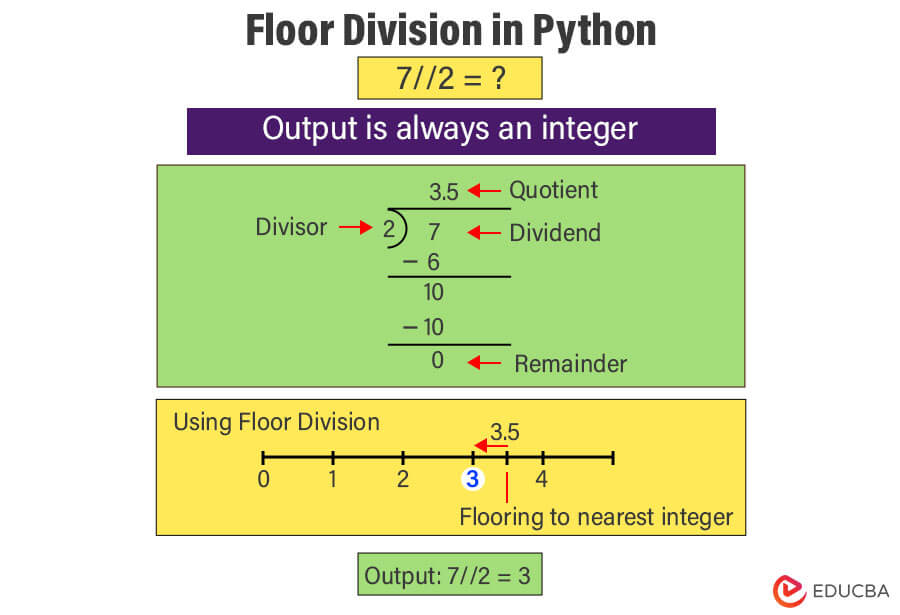
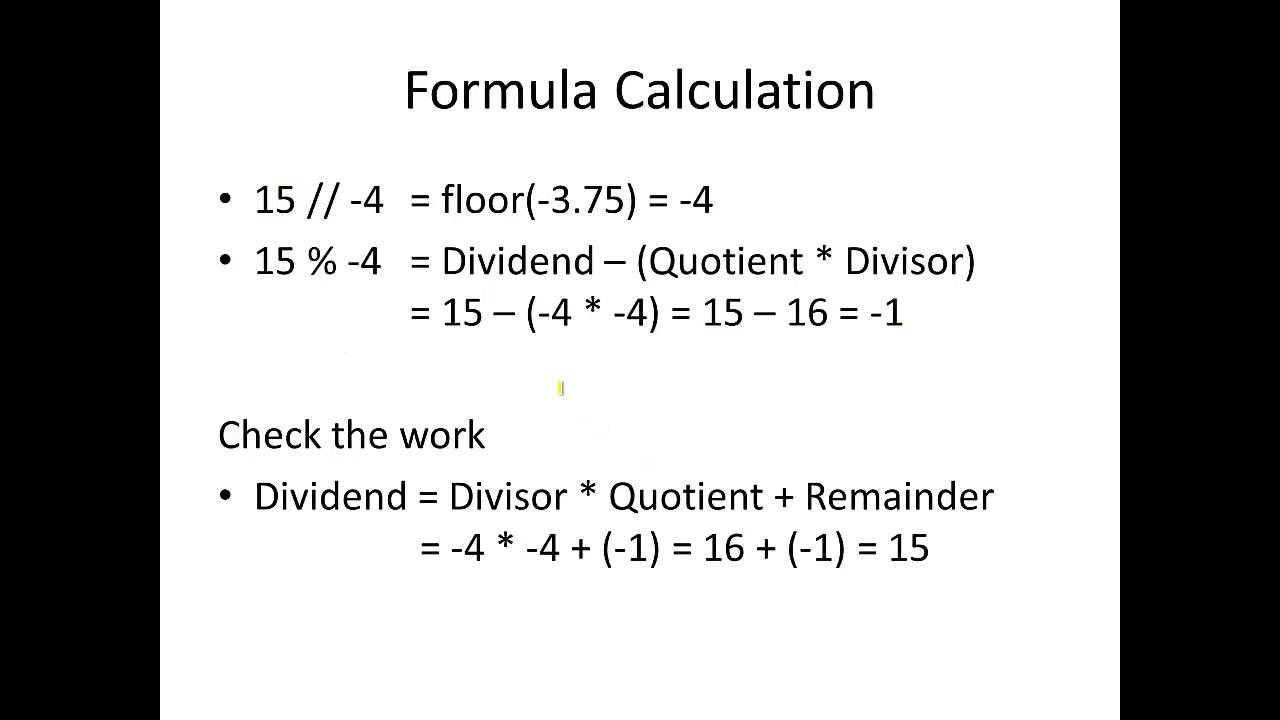
The floor function in Python is simple. It finds the largest whole number. This number is less than or equal to the input number. The floor function is in the math module. You need to import this module first. The function is written as math.floor(). If you have 3.7, the floor will be 3. For negative numbers, like -3.7, the floor is -4.
In math, the floor function is shown as ⌊x⌋. It means the greatest integer less than or equal to x. For example, ⌊5.9⌋ equals 5. The floor function rounds down to the nearest whole number. This is important for many calculations. It helps in managing numbers in programming.
Using Floor In Python
The floor function in Python is simple. It rounds down numbers. You use it with the math module. First, import the module. Then call the math.floor() method. It takes a number as input. This number can be a decimal or an integer. The function returns the largest integer less than or equal to the number. For example, math.floor(3.7) returns 3. This helps when you need whole numbers. It is often used in math calculations.
Here are some examples of the floor function:
- math.floor(5.8) returns 5.
- math.floor(2.3) returns 2.
- math.floor(-4.9) returns -5.
The floor function works with negative numbers too. It rounds them down to the next lower integer. This is useful in many coding tasks.
Applications Of Floor Function
Python’s floor function is used to round down numbers to the nearest whole number. It is helpful in various applications such as mathematical calculations, data analysis, and algorithm design. This function ensures precision by eliminating decimal points, making it essential for tasks requiring integer values.
Rounding Down In Calculations
The floor function in Python helps round numbers down. It finds the largest whole number below a decimal. This function is useful for dividing items evenly. If you have 17 candies and 3 friends, floor helps divide them fairly. Each friend gets 5 candies.
Use Cases In Programming
Programmers use floor for many tasks. It helps in financial calculations. Imagine pricing items in a sale. Floor makes sure prices aren’t too high. Floor also assists in computer graphics. It helps with pixel placement on screens. Floor keeps things neat and organized.
Floor Vs Other Rounding Functions
Floor and Ceil are like opposites in math. Floor brings numbers down. Ceil pushes numbers up. The floor of 5.7 is 5. The ceil of 5.7 is 6. Floor goes to the nearest smaller number. Ceil goes to the nearest bigger number. Both help in rounding numbers. They make calculations easier. Floor is often used in games. Ceil can be used for heights in rooms. Both have their own places in coding. Their differences are simple. Floor is down, ceil is up.
Round is not like floor or ceil. Round goes to the nearest whole number. It can go up or down. Round 5.7 becomes 6. But round 5.4 becomes 5. Floor always rounds down. Ceil always rounds up. Round is in the middle. It is good for everyday math. Floor and ceil have special uses. Round is more common. Round is easy for kids. Floor and ceil need more thinking. Round, floor, and ceil help in math. Each has its own job.
Common Mistakes
Python’s floor function only works with numbers. Always ensure your input is a number. Strings or other types will cause type errors. Use float() or int() to convert inputs. This way, you can avoid errors easily. Check your input types before using floor. This simple step helps a lot.
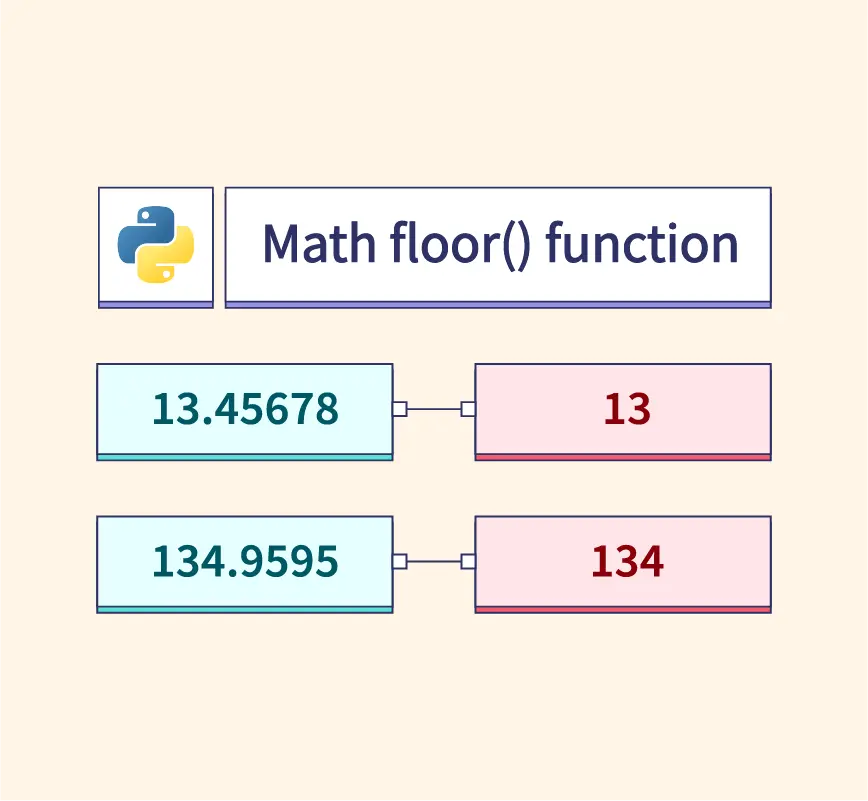
Using floor with negative numbers can be tricky. It rounds down to the next whole number. For example, floor(-2.3) becomes -3. This result might surprise some people. Always remember this behavior. Negative numbers need extra care. Understand how floor handles them. This keeps your code correct and reliable.
Advanced Floor Techniques
The floor function is handy with lists. It helps in rounding down numbers in a list. This is useful in many math problems. For example, if you have a list of numbers, you can use floor to get the lowest integer for each. Simply apply the floor function to each list element. The results will be a new list with rounded numbers. This makes calculations easier and more accurate.
Floor can work with other functions too. It pairs well with sum and min functions. First, use sum to add numbers. Then, apply floor to the result. This gives the lowest whole number. Similarly, use min to find the smallest number in a set. Then, floor makes it the nearest whole number. These combinations make Python coding more powerful and flexible.

Frequently Asked Questions
What Is The Floor Function In Python?
The floor function in Python rounds a number down to the nearest integer. It is part of the math module. This function is useful in scenarios where you need to discard the fractional part of a number. It always returns a float value, even if the result is an integer.
How Does Floor Differ From Ceil In Python?
Floor and ceil functions both round numbers, but differently. The floor function rounds down to the nearest integer. Conversely, the ceil function rounds up to the nearest integer. Both functions are part of Python’s math module. They are useful for handling numeric data in various applications.
Can Floor Handle Negative Numbers In Python?
Yes, the floor function can handle negative numbers in Python. It rounds the number down to the nearest integer. For negative numbers, this means moving towards a more negative value. For example, floor(-2. 7) would return -3, demonstrating how the function handles negative input.
Is Floor Function Available In Python’s Math Module?
Yes, the floor function is available in Python’s math module. You need to import the math module to use it. The function is called using math. floor(). It is widely used for rounding down operations in mathematical computations and data processing tasks.
Conclusion
Python’s floor function is simple but useful. It rounds numbers down. This helps in many situations where precise calculations are needed. Programmers often use floor to handle decimal numbers. It ensures consistent and predictable results. The floor function is part of Python’s math library.
Easy to access and use. Understanding this function can improve coding skills. It gives you control over numeric values. Practice using floor in different scenarios. This way, you can see its full potential. Python makes it easy to learn and apply.
Keep exploring its vast features.